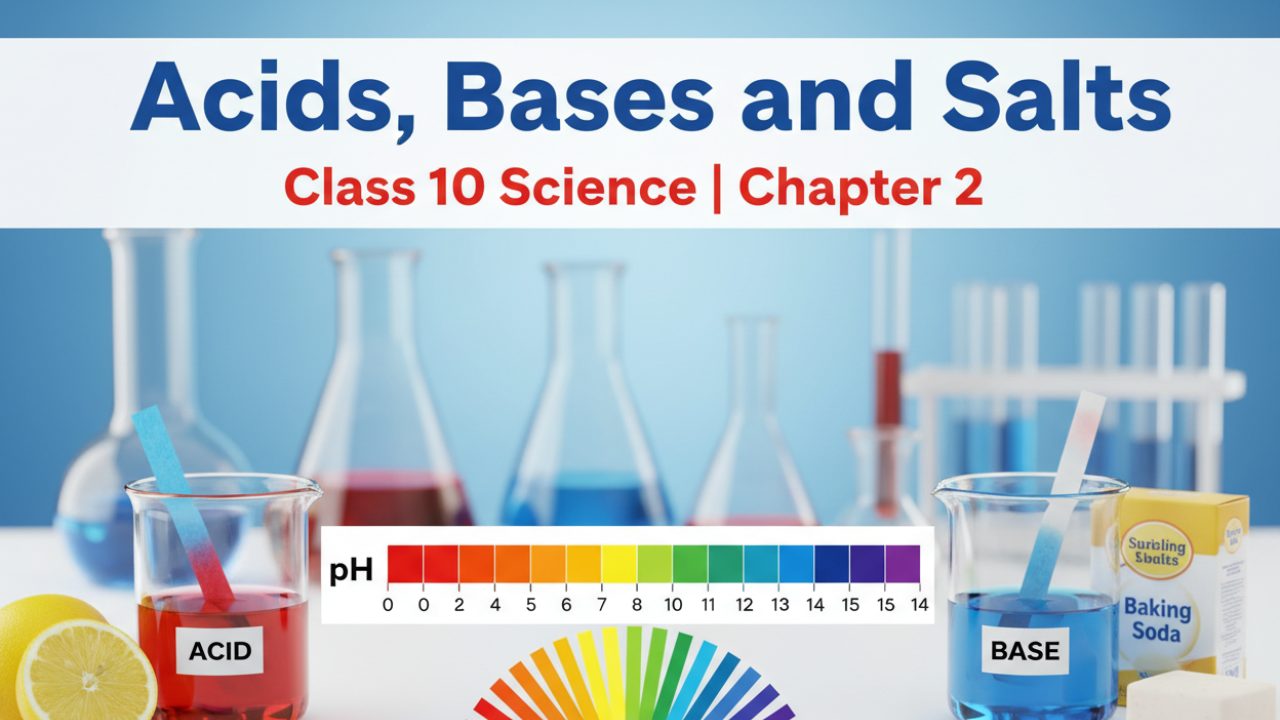
Class 10 NCERT Science — Chapter 2 | Study Notes
So, What Are Acids and Bases Anyway?
You’ve tasted lemon — that sharp, sour feeling? That’s an acid. You’ve touched soap — that slippery feel? That’s a base. But in science, we don’t identify them by taste. We use indicators.
Indicators — The Colour-Changing Detectives
Indicators are substances that change colour in the presence of an acid or a base.
| Indicator | In Acid | In Base |
|---|---|---|
| Litmus (Red) | Stays Red | Turns Blue |
| Litmus (Blue) | Turns Red | Stays Blue |
| Phenolphthalein | Colourless | Pink/Magenta |
| Methyl Orange | Red/Pink | Yellow |
Natural Indicators you already know:
- Turmeric — turns red in base
- Red Cabbage juice — red in acid, green/yellow in base
- Litmus itself — extracted from lichens (a natural source!)
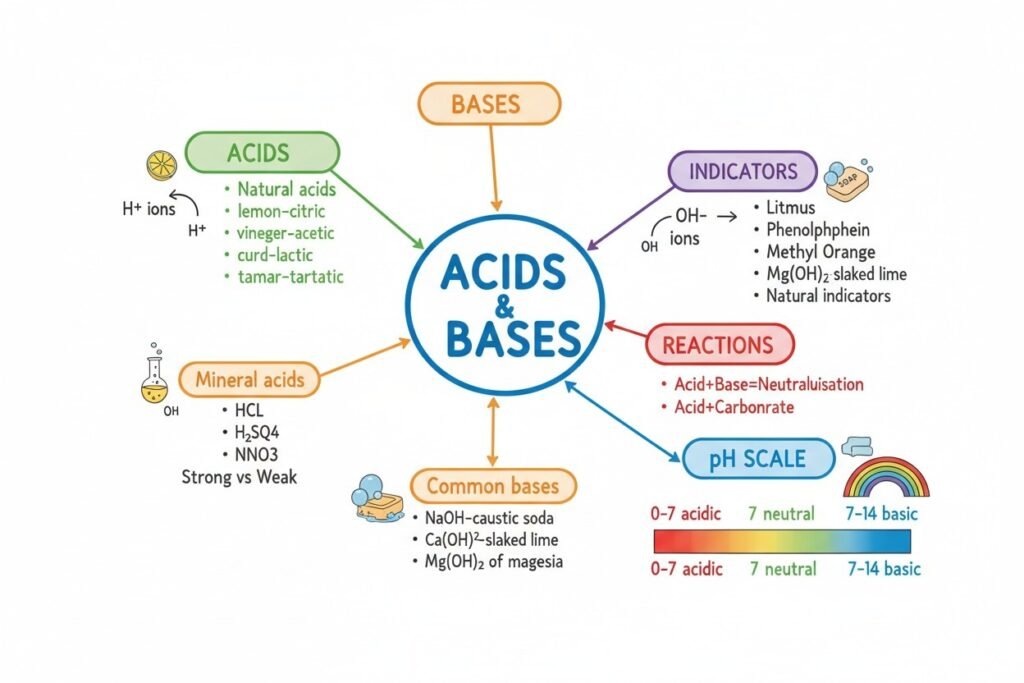
Acids — What Exactly Are They?
Definition: Substances that dissolve in water to produce H⁺ ions (Hydrogen ions).
HCl → H⁺ + Cl⁻
Natural (Organic) Acids Found in Daily Life:
| Acid | Found In |
|---|---|
| Acetic Acid | Vinegar |
| Citric Acid | Lemon, Orange |
| Tartaric Acid | Tamarind |
| Lactic Acid | Curd |
| Oxalic Acid | Tomato |
| Formic Acid | Ant sting |
Mineral (Inorganic) Acids:
- HCl — Hydrochloric Acid
- H₂SO₄ — Sulphuric Acid
- HNO₃ — Nitric Acid
Strong vs Weak Acids:
- Strong Acid — completely ionises in water → HCl, H₂SO₄, HNO₃
- Weak Acid — partially ionises → CH₃COOH (Acetic Acid)
Bases — The Other Side of the Story
Definition: Substances that dissolve in water to produce OH⁻ ions (Hydroxide ions).
NaOH → Na⁺ + OH⁻
Alkali = a base that is soluble in water (e.g., NaOH, KOH)
Common Bases:
| Base | Common Name |
|---|---|
| NaOH | Caustic Soda |
| Ca(OH)₂ | Slaked Lime |
| Mg(OH)₂ | Milk of Magnesia |
| NH₄OH | Ammonium Hydroxide |
What Happens When Acid Meets Base?
They cancel each other out. This is called Neutralisation.
Acid + Base → Salt + Water
NaOH + HCl → NaCl + H₂O
This reaction is exothermic — it releases heat.
Real life example? When your stomach produces too much HCl and you get acidity — you take an antacid containing Mg(OH)₂. It neutralises the acid. Relief! 😌
Acid + Metal → Hydrogen Gas
Acid + Metal → Salt + Hydrogen gas
Zn + H₂SO₄ → ZnSO₄ + H₂↑
Test for Hydrogen gas: Bring a burning splint near it — you hear a “pop” sound. ✅
Note: HNO₃ does not react this way — it is an oxidising acid.
Acid + Metal Carbonate / Bicarbonate → CO₂ Gas
Na₂CO₃ + 2HCl → 2NaCl + H₂O + CO₂↑
NaHCO₃ + HCl → NaCl + H₂O + CO₂↑
Test for CO₂: Pass it through lime water — it turns milky white.
Ca(OH)₂ + CO₂ → CaCO₃↓ + H₂O
Acid + Metal Oxide → Salt + Water
Metal oxides are basic in nature.
CuO + H₂SO₄ → CuSO₄ + H₂O
(You can observe the blue colour of CuSO₄ forming — easy to spot!)
Base + Metal → Hydrogen Gas
Not all metals react with bases — only specific ones like Zinc and Aluminium.
2NaOH + Zn → Na₂ZnO₂ + H₂↑
Why Does Water Matter So Much?
Here’s something interesting. Dry HCl gas does not change the colour of litmus paper. But the moment you add water — H⁺ ions are produced and litmus turns red.
The real character of an acid or base only shows up in the presence of water. Without water — no ionisation, no reaction.
The pH Scale — Measuring Acidity and Basicity
pH stands for “Potential of Hydrogen”
- pH 0 to 7 → Acidic (0 = strongest acid)
- pH 7 → Neutral (pure water)
- pH 7 to 14 → Basic/Alkaline (14 = strongest base)
pH in Real Life:
| Substance | pH |
|---|---|
| Gastric juice (stomach HCl) | 1.0–1.5 |
| Lemon juice | ~2.5 |
| Black coffee | ~5 |
| Pure water | 7 |
| Blood | 7.4 |
| Baking soda | ~8.3 |
| Milk of Magnesia | ~10 |
| NaOH solution | ~14 |
pH and Your Daily Life:
- Tooth decay — bacteria convert sugar into acid. When pH drops below 5.5, tooth enamel starts dissolving. That’s why toothpaste is basic!
- Soil pH — farmers add lime (CaO) when soil becomes too acidic
- Acid rain — pH below 5.6 — damages buildings, statues, and crops
- Aquatic life — fish need pH between 7–8.5. A big change kills them.
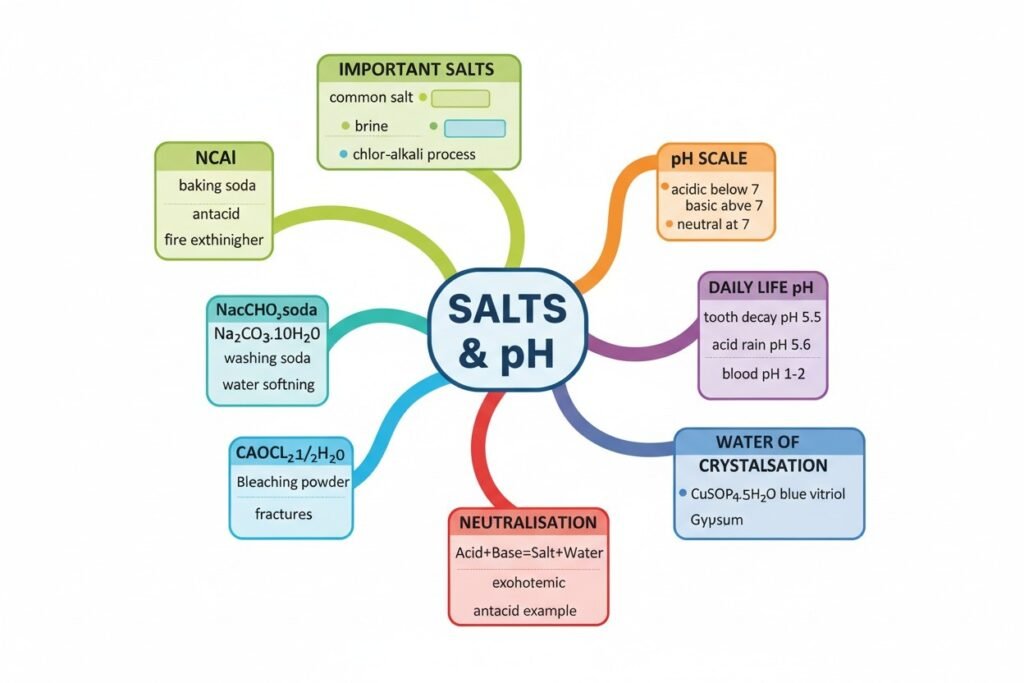
Salts — Born from Acid + Base
Salt = Anion from Acid + Cation from Base
Example:
- NaCl = Na⁺ (from NaOH) + Cl⁻ (from HCl)
pH of Salts:
- Strong acid + Strong base → Neutral salt (pH = 7) → NaCl
- Strong acid + Weak base → Acidic salt (pH < 7) → NH₄Cl
- Weak acid + Strong base → Basic salt (pH > 7) → Na₂CO₃
Important Salts You Must Know
1. Common Salt — NaCl (Sodium Chloride)
- Used in food
- Brine = concentrated NaCl solution
- Chlor-Alkali Process uses brine: > 2NaCl(aq) + 2H₂O(l) → 2NaOH(aq) + Cl₂(g) + H₂(g)
- Cl₂ → water purification, PVC, disinfectants
- H₂ → fuel, margarine production
- NaOH → soap, paper, dyes, bleach
2. Baking Soda — NaHCO₃ (Sodium Hydrogen Carbonate)
- Used in baking → releases CO₂ → makes bread/cake fluffy
- Works as an antacid
- Used in fire extinguishers
- On heating: NaHCO₃ → Na₂CO₃ + H₂O + CO₂↑
3. Washing Soda — Na₂CO₃·10H₂O (Sodium Carbonate)
- Used for washing clothes
- Used in glass, soap, and paper industries
- Softens hard water by removing Ca²⁺ and Mg²⁺ ions
- Made from baking soda: > 2NaHCO₃ → Na₂CO₃ + H₂O + CO₂ (on heating) > Na₂CO₃ + 10H₂O → Na₂CO₃·10H₂O (washing soda)
4. Bleaching Powder — CaOCl₂ (Calcium Oxychloride)
- Ca(OH)₂ + Cl₂ → CaOCl₂ + H₂O
- Uses: bleaching clothes, water purification, disinfectant, paper industry
5. Plaster of Paris — CaSO₄·½H₂O
- Made by heating Gypsum (CaSO₄·2H₂O): > CaSO₄·2H₂O → CaSO₄·½H₂O + 1½H₂O
- Add water → it sets hard again
- Uses: plaster for fractures, toys, chalk, building material
Quick Revision Table
| Reaction | Products |
|---|---|
| Acid + Metal | Salt + H₂↑ |
| Acid + Metal Oxide | Salt + Water |
| Acid + Metal Carbonate | Salt + Water + CO₂↑ |
| Acid + Base | Salt + Water |
| Base + Metal | Salt + H₂↑ |
Board Exam — Important Questions
Q1. What happens when an acid reacts with a metal? Give an equation.
Q2. How does dilution affect the concentration of H⁺ ions in an acid?
Q3. What is neutralisation? Give one example from daily life.
Q4. What is the pH scale? What is the pH of a neutral solution?
Q5. Why does tooth decay occur? How can it be prevented?
Q6. What is the Chlor-Alkali process? Write the equation and uses of its products.
Q7. Differentiate between baking soda and washing soda.
Q8. How is Plaster of Paris prepared? Write its uses.
Q9. What is a universal indicator? What does it show?
Q10. Why do farmers add lime to acidic soil?
📚 Based on NCERT Class 10 Science Chapter 2. Solve all NCERT exercises for complete board exam preparation!
Acids, Bases and Salts
Class 10 NCERT Science — Chapter 2 | Question & Answers
📘 NCERT Textbook Questions
Q1. A solution turns red litmus blue. Its pH is likely to be: (a) 1 (b) 4 (c) 5 (d) 10
Ans. (d) 10 A solution that turns red litmus blue is basic. Basic solutions have pH greater than 7. So pH = 10 is correct.
Q2. A solution reacts with crushed egg shells to give a gas that turns lime water milky. The solution contains: (a) NaCl (b) HCl (c) LiCl (d) KCl
Ans. (b) HCl Egg shells are made of CaCO₃. When an acid reacts with a carbonate, CO₂ gas is released — which turns lime water milky. So the solution must be an acid (HCl).
CaCO₃ + 2HCl → CaCl₂ + H₂O + CO₂↑
Q3. 10 mL of a solution of NaOH is found to be completely neutralised by 8 mL of a given solution of HCl. If we take 20 mL of the same solution of NaOH, the amount of HCl solution required to neutralise it will be: (a) 4 mL (b) 8 mL (c) 12 mL (d) 16 mL
Ans. (d) 16 mL If 10 mL NaOH needs 8 mL HCl, then 20 mL NaOH (double) will need 16 mL HCl (double). Simple proportionality!
Q4. Which one of the following types of medicines is used for treating indigestion? (a) Antibiotic (b) Analgesic (c) Antacid (d) Antiseptic
Ans. (c) Antacid Indigestion is caused by excess HCl in the stomach. Antacids are basic substances (like Mg(OH)₂) that neutralise this excess acid.
Q5. Write word equations and then balanced equations for the reaction taking place when:
(a) Dilute sulphuric acid reacts with zinc granules
Zinc + Sulphuric Acid → Zinc Sulphate + Hydrogen Zn + H₂SO₄ → ZnSO₄ + H₂↑
(b) Dilute hydrochloric acid reacts with magnesium ribbon
Magnesium + Hydrochloric Acid → Magnesium Chloride + Hydrogen Mg + 2HCl → MgCl₂ + H₂↑
(c) Dilute sulphuric acid reacts with aluminium powder
Aluminium + Sulphuric Acid → Aluminium Sulphate + Hydrogen 2Al + 3H₂SO₄ → Al₂(SO₄)₃ + 3H₂↑
(d) Dilute hydrochloric acid reacts with iron filings
Iron + Hydrochloric Acid → Ferrous Chloride + Hydrogen Fe + 2HCl → FeCl₂ + H₂↑
Q6. Compounds such as alcohols and glucose also contain hydrogen. Will they also turn blue litmus red? Give reason.
Ans. No, they will not turn blue litmus red. Alcohols and glucose do contain hydrogen, but they do not ionise in water to produce H⁺ ions. Acids are defined by their ability to release H⁺ ions in solution. Since glucose and alcohol don’t do this, they are not acids and won’t affect litmus.
Q7. Why does dry HCl gas not change the colour of dry litmus paper?
Ans. Dry HCl gas does not produce H⁺ ions on its own. It needs water to ionise:
HCl + H₂O → H₃O⁺ + Cl⁻
Without water, no H⁺ ions are formed. So dry HCl gas has no effect on dry litmus paper.
Q8. While diluting an acid, why is it recommended to add acid to water and not water to acid?
Ans. Diluting acid is a highly exothermic process — it releases a large amount of heat.
If water is added to acid, the small amount of water heats up instantly and can boil and splatter, causing acid burns.
If acid is added slowly to water, the large volume of water absorbs the heat safely.
So always remember: “Do as you oughta — add acid to water!” 🧪
Q9. How is the concentration of hydronium ions (H₃O⁺) affected when a solution of an acid is diluted?
Ans. When an acid is diluted, more water is added. This decreases the concentration of H₃O⁺ ions per unit volume. The solution becomes less acidic and its pH increases (moves closer to 7).
Q10. How is the concentration of hydroxide ions (OH⁻) affected when excess base is dissolved in a solution of sodium hydroxide?
Ans. When more base is dissolved, more OH⁻ ions are produced. The concentration of OH⁻ ions increases, making the solution more basic. The pH increases (moves closer to 14).
📗 Extra Important Questions
Q11. What is a universal indicator? What is its use?
Ans. A universal indicator is a mixture of several indicators that shows different colours at different pH values. It gives an approximate pH of a solution just by colour comparison.
- pH 1–3 → Red (strongly acidic)
- pH 4–6 → Orange/Yellow (weakly acidic)
- pH 7 → Green (neutral)
- pH 8–10 → Blue (weakly basic)
- pH 11–14 → Violet (strongly basic)
Q12. What is the Chlor-Alkali process? Write the equation and name the products with their uses.
Ans. When electricity is passed through brine (concentrated NaCl solution), it decomposes. This is called the Chlor-Alkali process.
2NaCl(aq) + 2H₂O(l) → 2NaOH(aq) + Cl₂(g) + H₂(g)
Products and Uses:
| Product | Uses |
|---|---|
| Chlorine (Cl₂) | Water purification, PVC, disinfectants, bleaching powder |
| Hydrogen (H₂) | Fuel, margarine production |
| Sodium Hydroxide (NaOH) | Soap, paper, dyes, degreasing metals |
Q13. Differentiate between baking soda and washing soda.
| Feature | Baking Soda | Washing Soda |
|---|---|---|
| Chemical Name | Sodium Hydrogen Carbonate | Sodium Carbonate |
| Formula | NaHCO₃ | Na₂CO₃·10H₂O |
| Nature | Mild base | Strong base |
| Uses | Baking, antacid, fire extinguisher | Washing, water softening, glass industry |
| Taste | Slightly salty | Cannot be consumed |
Q14. How is Plaster of Paris prepared? Write its chemical equation and uses.
Ans. Plaster of Paris is prepared by heating gypsum at 100°C:
CaSO₄·2H₂O → CaSO₄·½H₂O + 1½H₂O (Gypsum) → (Plaster of Paris) + Water
When water is added to Plaster of Paris, it sets into a hard solid (gypsum is reformed).
Uses:
- Setting fractured bones (plaster cast)
- Making toys and decorative items
- Making chalk and blackboard chalk
- Used in building and construction
Q15. What is water of crystallisation? Give one example.
Ans. Water of crystallisation is the fixed number of water molecules present in one formula unit of a salt crystal. These water molecules are part of the crystal structure.
Example: Copper Sulphate crystals — CuSO₄·5H₂O (Blue Vitriol)
- It has 5 water molecules per formula unit
- When heated, it loses water and turns white (anhydrous CuSO₄)
- Add water again → it turns blue again
Other examples:
- Washing Soda — Na₂CO₃·10H₂O
- Gypsum — CaSO₄·2H₂O
Q16. Why do acids not show acidic behaviour in the absence of water?
Ans. Acids produce H⁺ ions only when they dissolve in water. The ionisation process requires water as a medium. Without water, no H⁺ ions are released, and therefore no acidic properties are shown.
Q17. What happens when Plaster of Paris is mixed with water?
Ans. When water is added to Plaster of Paris, it reacts and sets into a hard solid — gypsum is reformed:
CaSO₄·½H₂O + 1½H₂O → CaSO₄·2H₂O (Plaster of Paris) + Water → (Gypsum — hard solid)
This property makes it useful for making casts and moulds.
🌟 One-Line Quick Revision
- Acid → produces H⁺ ions in water
- Base → produces OH⁻ ions in water
- Alkali → base soluble in water
- Neutralisation → Acid + Base → Salt + Water
- pH 7 → Neutral | < 7 → Acidic | > 7 → Basic
- Baking Soda → NaHCO₃ | Washing Soda → Na₂CO₃·10H₂O
- Plaster of Paris → CaSO₄·½H₂O
- Bleaching Powder → CaOCl₂
- Chlor-Alkali → electrolysis of brine → NaOH + Cl₂ + H₂
- Water of crystallisation → fixed H₂O molecules in salt crystals
📚 These Q&As cover all important questions from NCERT Class 10 Science Chapter 2 for Board Exams. Practice writing balanced equations regularly!