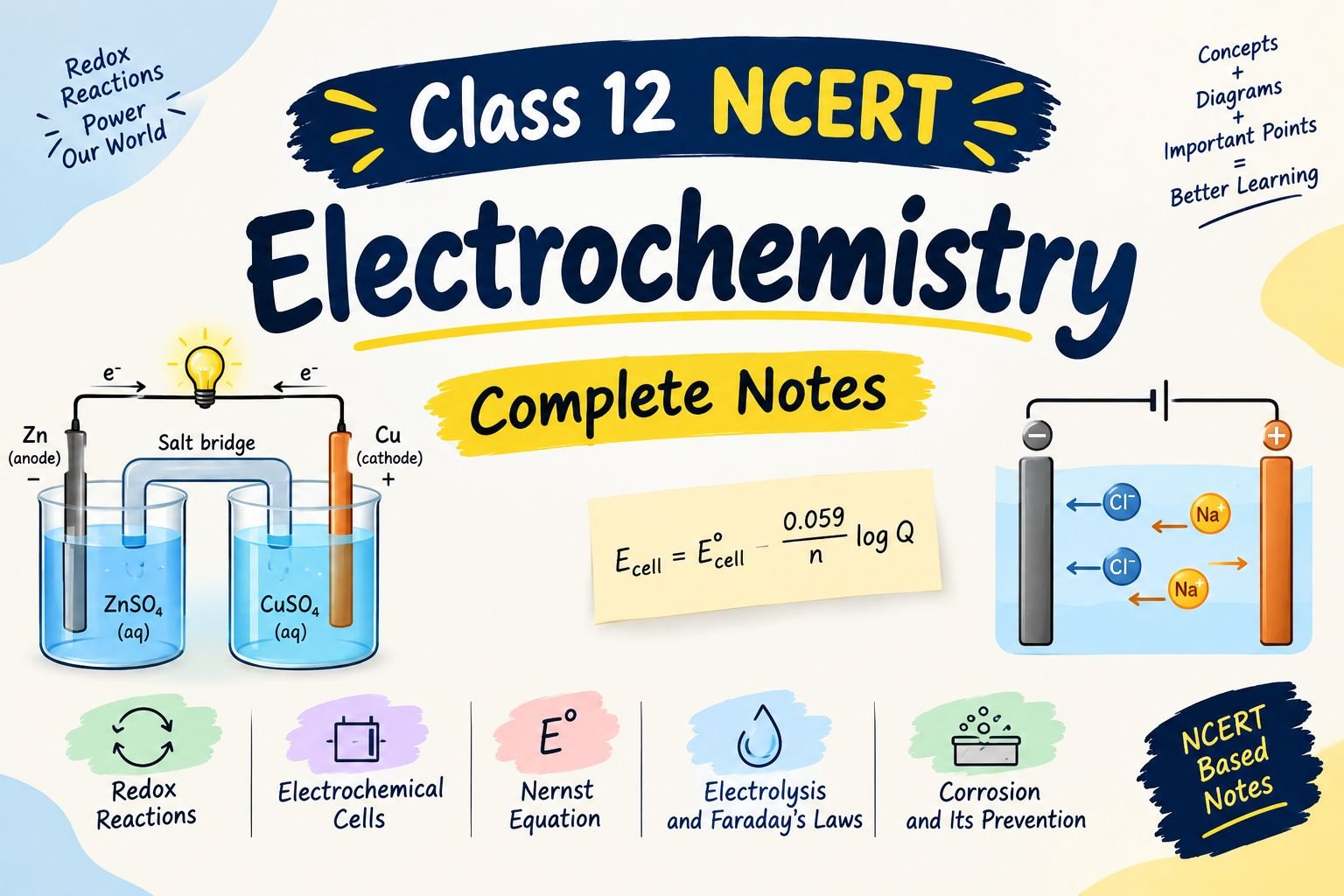
1. Electrochemical Cells — Kya Hota Hai?
Toh basically… jab bhi koi chemical reaction hoti hai jisme electrons transfer hote hain — woh electrochemistry ka kaam hai.(Electrochemistry Class 12 NCERT Complete Notes, Formulas & Mind Map)
Socho ek simple reaction — zinc ko copper sulphate solution mein daalo. Kya hoga? Zinc dissolve hoga, copper deposit hoga. Electrons transfer hue. Energy release hui. But yeh energy heat ke roop mein gayi — waste!
Ab agar hum yeh electrons ek wire se guzaren — toh wahi energy electrical energy ban jaati hai. Yahi kaam karta hai ek electrochemical cell.
Definition simply bolo toh:
Electrochemical cell ek aisa device hai jo chemical energy ko electrical energy mein convert karta hai (ya ulta bhi).
Do types hote hain:
- Galvanic Cell (Voltaic Cell) → Chemical → Electrical energy
- Electrolytic Cell → Electrical → Chemical energy
🔬 2. Galvanic Cells — Detail Mein
Yeh woh cell hai jo spontaneous redox reaction se electricity produce karta hai.
Sabse famous example — Daniell Cell:
Isme hota hai:
- Ek beaker mein ZnSO₄ solution
- Zinc rod (anode)
- Doosre beaker mein CuSO₄ solution
- Copper rod (cathode)
- Dono ko ek salt bridge connect karta hai
- Aur bahar se ek wire se electrons flow karte hain
Reactions:
Anode par (oxidation hoti hai):
Zn → Zn²⁺ + 2e⁻
Cathode par (reduction hoti hai):
Cu²⁺ + 2e⁻ → Cu
Overall reaction:
Zn + Cu²⁺ → Zn²⁺ + Cu
Electrons wire se anode → cathode ki taraf jaate hain. Current ulti direction mein flow karta hai (cathode → anode).
Salt Bridge ka kaam kya hai?
Yeh ek U-shaped tube hoti hai jisme KCl ya KNO₃ ka saturated solution hota hai. Yeh:
- Circuit complete karta hai
- Dono solutions mein electrical neutrality maintain karta hai
- Bina salt bridge ke — reaction ruk jaati hai!
Cell notation likhte hain aise:
Zn | Zn²⁺ (1M) || Cu²⁺ (1M) | Cu
- Single line
|= electrode-solution interface - Double line
||= salt bridge - Anode hamesha left, cathode right
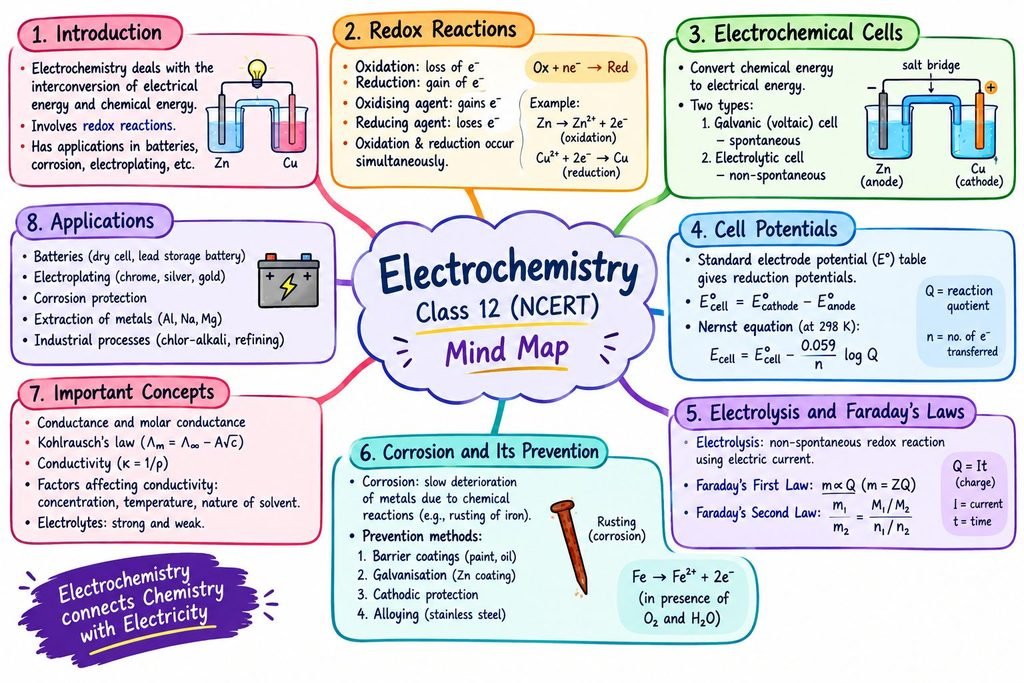
📏 3. Measurement of Electrode Potential
Yeh thoda confusing lagta hai pehle, but samjho dhyan se…
Har electrode ka apna ek potential hota hai — matlab woh kitni tendency rakhta hai electrons dene ya lene ki. Isko hum directly measure nahi kar sakte akele. Isliye ek reference electrode use karte hain.
Standard Hydrogen Electrode (SHE) — yahi reference hai.
Iska potential = 0.00 V (by definition)
SHE kaise bana hota hai?
- Platinum electrode
- H₂ gas 1 atm pressure par
- H⁺ ions 1M concentration par
- Temperature 298 K
Kisi bhi electrode ka potential SHE ke saath connect karke measure karte hain.
Standard Electrode Potential (E°): Jab saari conditions standard hon (1M concentration, 298K, 1 atm), tab jo potential milta hai woh standard electrode potential hai.
EMF of cell:
E°cell = E°cathode − E°anode
Example:
E°cell (Daniell) = E°Cu²⁺/Cu − E°Zn²⁺/Zn
                 = (+0.34) − (−0.76)
                 = +1.10 V
Positive EMF → reaction spontaneous hai ✅
📐 4. Nernst Equation
Standard conditions toh lab mein hoti hain… real life mein concentration alag hoti hai. Tab kya?
Tab aata hai Nernst Equation — jo actual conditions mein electrode potential calculate karta hai.
Formula:
E = E° − (RT/nF) × ln Q
Ya 298K par (simplified):
E = E° − (0.0592/n) × log Q
Jahan:
- E = actual cell potential
- E° = standard cell potential
- R = 8.314 J/mol·K
- T = temperature (Kelvin)
- n = electrons transferred
- F = Faraday constant = 96500 C/mol
- Q = reaction quotient
Example — Daniell Cell:
Reaction: Zn + Cu²⁺ → Zn²⁺ + Cu
Q = [Zn²⁺] / [Cu²⁺]
Agar [Zn²⁺] = 0.1M aur [Cu²⁺] = 0.1M, toh Q = 1, log Q = 0
E = 1.10 − (0.0592/2) × log(1)
E = 1.10 − 0 = 1.10 V
Ab agar [Zn²⁺] = 1M aur [Cu²⁺] = 0.1M:
Q = 1/0.1 = 10
E = 1.10 − (0.0592/2) × log(10)
E = 1.10 − (0.0296 × 1)
E = 1.10 − 0.0296
E = 1.0704 V
Concentration badha → EMF thoda kam hua. Makes sense!
⚖️ 5. Equilibrium Constant from Nernst Equation
Yeh ek beautiful connection hai electrochemistry aur chemical equilibrium ke beech…
Jab cell equilibrium par pahunch jaata hai — tab E = 0 aur Q = K (equilibrium constant).
Nernst equation mein daalo:
0 = E° − (0.0592/n) × log K
Toh:
log K = (n × E°) / 0.0592
Example:
Daniell cell ke liye: n = 2, E° = 1.10 V
log K = (2 × 1.10) / 0.0592
log K = 2.20 / 0.0592
log K = 37.16
K = 10^37.16 ≈ 1.45 × 10³⁷
Itna bada K matlab reaction almost completely forward direction mein jaati hai. Products dominate karte hain. ✅
🌀 6. Electrochemical Cell and Gibbs Energy
Yeh topic thermodynamics aur electrochemistry ko jodata hai.
Formula:
ΔG = −nFE
Standard conditions par:
ΔG° = −nFE°
Jahan:
- ΔG = Gibbs free energy change
- n = electrons transferred
- F = 96500 C/mol
- E = cell potential
Interpret karo:
- E > 0 → ΔG < 0 → Spontaneous reaction ✅
- E < 0 → ΔG > 0 → Non-spontaneous ❌
- E = 0 → ΔG = 0 → Equilibrium ⚖️
Example:
Daniell cell: n = 2, E° = 1.10 V
ΔG° = −2 × 96500 × 1.10
ΔG° = −212300 J/mol
ΔG° = −212.3 kJ/mol
Negative hai — toh reaction spontaneous hai. ✅
Connection with K:
ΔG° = −RT ln K
Toh:
−nFE° = −RT ln K
Yahi Nernst equation ka base hai!
🧪 7. Conductance of Electrolytic Solutions
Toh basically… jab hum kisi solution mein electricity pass karte hain, toh ions us current ko carry karte hain. Metals mein electrons current carry karte hain — but solutions mein ions karte hain. Yeh fundamental difference hai.
Resistance (R): Ohm’s law yaad hai? V = IR. Toh resistance woh property hai jo current flow ko oppose karta hai. Unit = Ohm (Ω)
Conductance (G): Resistance ka ulta hota hai conductance.
G = 1/R
Unit = Siemens (S) ya Ohm⁻¹ (mho)
Resistivity (ρ): Resistance depend karta hai wire/solution ki length aur area par:
R = ρ × (l/A)
- l = length (cm)
- A = cross-sectional area (cm²)
- ρ = resistivity (Ω·cm)
Conductivity (κ — kappa): Resistivity ka ulta:
κ = 1/ρ
Unit = S/cm ya S·cm⁻¹
Matlab — yeh batata hai ki solution kitni aasaani se current conduct kar sakta hai.
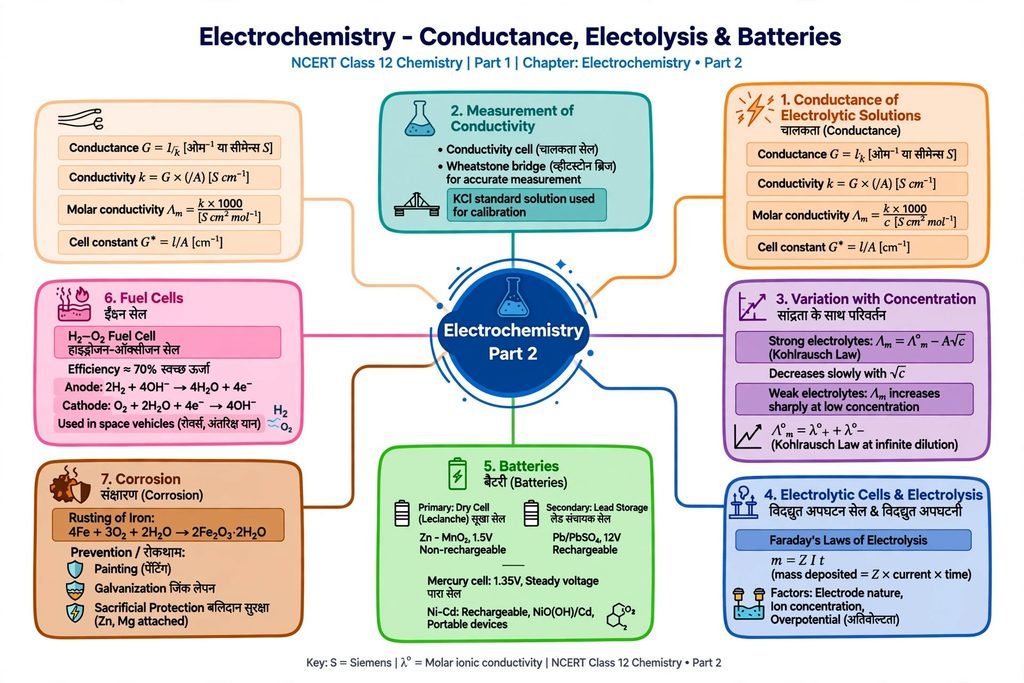
🔌 8. Measurement of Conductivity of Ionic Solutions
Yeh directly DC current se measure nahi karte — kyunki DC se electrolysis ho jaata hai aur readings galat aati hain.
Isliye AC current use karte hain — Wheatstone Bridge principle par based ek special setup.
Conductivity Cell:
- Do platinum electrodes hote hain
- Cell constant = l/A (fixed for a given cell)
- Pehle cell constant determine karte hain known conductivity solution se (jaise KCl)
- Phir unknown solution ka resistance measure karte hain
Formula:
κ = Cell Constant / R
Cell Constant:
Cell Constant = l/A (unit = cm⁻¹)
Agar R measure hua = 500 Ω aur cell constant = 1.5 cm⁻¹, toh:
κ = 1.5 / 500 = 0.003 S/cm
Simple hai yaar — bas cell constant aur resistance ka ratio.
📉 9. Variation of Conductivity and Molar Conductivity with Concentration
Yeh ek important topic hai — aur exam mein graphs bhi poochhe jaate hain.
Conductivity (κ) vs Concentration:
Jab concentration badhti hai:
- Ions ki number badhti hai → current carry karne wale zyada ho jaate hain
- Toh κ badhti hai
Simple! Zyada ions = zyada conductance.
Molar Conductivity (Λm):
Λm = (κ × 1000) / C
- C = concentration in mol/L (Molarity)
- κ = conductivity in S/cm
- Λm unit = S·cm²·mol⁻¹
Ab yahan interesting twist hai…
Jab concentration badhti hai → Λm GHATTI hai — kyun?
Kyunki ions ke beech interionic interactions badh jaate hain. Ions ek doosre ko slow karne lagte hain. Toh per mole efficiency kam ho jaati hai.
Strong Electrolytes (jaise KCl, NaCl, HCl):
Yeh fully ionize hote hain. Concentration ke saath Λm thodi kam hoti hai — linear relationship:
Λm = Λ°m − A√C
Yahi hai Debye-Hückel-Onsager equation.
Graph: Slight downward slope — almost flat.
Weak Electrolytes (jaise CH₃COOH, NH₄OH):
Yeh partially ionize hote hain. Dilution par ionization badhti hai toh Λm bahut tezi se badhti hai.
Infinite dilution par maximum hoti hai = Λ°m (limiting molar conductivity)
Graph: Sharply curved upward as C → 0.
📊 Kohlrausch’s Law — Bahut Important!
“At infinite dilution, molar conductivity of an electrolyte = sum of molar conductivities of its individual ions.”
Λ°m = ν₊λ°₊ + ν₋λ°₋
Jahan:
- ν₊, ν₋ = number of cations and anions
- λ°₊, λ°₋ = limiting molar conductivity of individual ions
Example — NaCl:
Λ°m(NaCl) = λ°(Na⁺) + λ°(Cl⁻)
           = 50.1 + 76.3
           = 126.4 S·cm²·mol⁻¹
Weak electrolyte ke liye use:
Acetic acid (CH₃COOH) ka Λ°m directly measure nahi hota — graph straight line nahi deta.
Toh Kohlrausch’s law se calculate karte hain:
Λ°m(CH₃COOH) = Λ°m(CH₃COONa) + Λ°m(HCl) − Λ°m(NaCl)
Degree of Dissociation (α):
α = Λm / Λ°m
Dissociation Constant (Ka):
Ka = Cα² / (1−α)
⚗️ 10. Electrolytic Cells and Electrolysis
Ab doosri taraf aate hain — jab hum electricity dete hain solution ko aur chemical change karwate hain.
Electrolytic Cell:
- External power supply (battery) dete hain
- Anode positive (+) hota hai → oxidation
- Cathode negative (−) hota hai → reduction
- Non-spontaneous reactions karwaata hai
Example — Molten NaCl ka electrolysis:
Cathode: Na⁺ + e⁻ → Na (reduction)
Anode:   Cl⁻ → ½Cl₂ + e⁻ (oxidation)
Sodium metal aur chlorine gas milti hai.
Faraday’s Laws of Electrolysis:
First Law:
Electrode par deposit/dissolve hua mass directly proportional hai passed charge ke.
W = Z × Q = Z × I × t
- W = mass deposited (grams)
- Z = electrochemical equivalent
- I = current (Amperes)
- t = time (seconds)
Second Law:
Same charge pass karne par alag alag substances ke equivalent masses deposit hote hain.
W₁/W₂ = E₁/E₂
(E = equivalent mass = molar mass / n-factor)
Example:
0.5A current 2 hours ke liye pass kiya. Copper kitna deposit hoga? (n = 2, Molar mass of Cu = 63.5 g/mol)
Q = I × t = 0.5 × 2 × 3600 = 3600 C
Equivalent mass of Cu = 63.5/2 = 31.75 g
W = (E/96500) × Q
W = (31.75/96500) × 3600
W = 1.184 g
🔀 11. Products of Electrolysis
Yeh question exam mein zaroor aata hai — “what is discharged at each electrode?”
Rules:
- Cathode par — jo ion zyada easily reduce ho (higher reduction potential), woh pehle discharge hoga
- Anode par — jo ion zyada easily oxidize ho (lower oxidation potential), woh pehle discharge hoga
- Concentration bhi matter karta hai
Example — Dilute H₂SO₄ ka electrolysis:
Cathode: H⁺ ions reduce hote hain → H₂ gas Anode: OH⁻ ions oxidize hote hain → O₂ gas
Overall:
2H₂O → 2H₂ + O₂
Example — Concentrated NaCl solution (brine) ka electrolysis:
Cathode: H⁺ discharge → H₂ gas Anode: Cl⁻ discharge (concentrated hai toh) → Cl₂ gas
Bacha: NaOH solution
Yahi Chlor-alkali process hai — industry mein use hota hai!
🔋 12. Batteries
Battery basically ek ya zyada electrochemical cells ka combination hoti hai jo electrical energy provide karti hai. Aur haan — har battery mein wahi Galvanic cell ka principle kaam karta hai.
Do main types hain:
🪫 13. Primary Batteries
Yeh one-time use hoti hain. Jab chemicals khatam — battery dead. Recharge nahi ho sakti.
A) Dry Cell (Leclanché Cell) — Sabse Common!
Yeh wahi AA/AAA batteries hain jo remote, torch mein use hoti hain.
Construction:
- Anode: Zinc container (khud anode hai)
- Cathode: Carbon (graphite) rod — MnO₂ se surrounded
- Electrolyte: NH₄Cl + ZnCl₂ ka paste (moist — isliye “dry” cell kehte hain, liquid nahi hota)
Reactions:
Anode:
Zn → Zn²⁺ + 2e⁻
Cathode (complex reaction):
MnO₂ + NH₄⁺ + e⁻ → MnO(OH) + NH₃
EMF ≈ 1.5 V
Limitation — time ke saath Zn container corrode ho jaata hai, NH₃ gas banti hai jo pressure create karta hai. Life limited hoti hai.
B) Mercury Cell
Hearing aids, cameras jaise small devices mein use hoti hai.
Construction:
- Anode: Zinc-mercury amalgam
- Cathode: HgO + Carbon
- Electrolyte: KOH + ZnO paste
Reactions:
Anode:
Zn(Hg) + 2OH⁻ → ZnO + H₂O + 2e⁻
Cathode:
HgO + H₂O + 2e⁻ → Hg + 2OH⁻
Overall:
Zn(Hg) + HgO → ZnO + Hg
EMF ≈ 1.35 V — constant throughout life!
Yeh advantage hai — voltage stable rehta hai. Isliye precision devices mein use hoti hai.
♻️ 14. Secondary Batteries
Yeh rechargeable hoti hain! Discharge hone par external current dekar wapas original state mein la sakte hain.
A) Lead Storage Battery — Car Battery!
Sabse zyada use hone wali secondary battery. Har car mein yahi hoti hai.
Construction:
- Anode: Lead (Pb) plates
- Cathode: Lead dioxide (PbO₂) plates
- Electrolyte: Dilute H₂SO₄ (38% solution)
During Discharge (current deta hai — battery use ho rahi hai):
Anode:
Pb + SO₄²⁻ → PbSO₄ + 2e⁻
Cathode:
PbO₂ + SO₄²⁻ + 4H⁺ + 2e⁻ → PbSO₄ + 2H₂O
Overall:
Pb + PbO₂ + 2H₂SO₄ → 2PbSO₄ + 2H₂O
Observe karo — H₂SO₄ consume hoti hai, PbSO₄ banta hai, paani banta hai. Toh discharge hone par acid weak ho jaata hai.
During Recharge (current dete hain — battery charge ho rahi hai):
Reaction reverse ho jaati hai:
2PbSO₄ + 2H₂O → Pb + PbO₂ + 2H₂SO₄
PbSO₄ wapas Pb aur PbO₂ mein convert hota hai, H₂SO₄ wapas banti hai.
EMF ≈ 2V per cell — usually 6 cells series mein = 12V car battery
B) Nickel-Cadmium Cell (Ni-Cd)
Modern rechargeable devices mein use hoti thi — ab Lithium-ion ne replace kar diya hai.
Anode: Cadmium (Cd) Cathode: NiO(OH) Electrolyte: KOH solution
Discharge reactions:
Anode:
Cd + 2OH⁻ → Cd(OH)₂ + 2e⁻
Cathode:
NiO(OH) + H₂O + e⁻ → Ni(OH)₂ + OH⁻
EMF ≈ 1.25 V
Advantage — longer life than dry cell, rechargeable. Disadvantage — Cadmium toxic hai, disposal problem.
⚗️ 15. Fuel Cells
Yeh concept bahut interesting hai. Honestly mujhe pehle samajh nahi aaya tha ki yeh battery se alag kaise hai…
Battery mein chemicals stored hote hain andar. Fuel cell mein chemicals bahar se continuously supply hoti hain — jab tak fuel milta rahega, electricity milti rahegi!
Hydrogen-Oxygen Fuel Cell — Most Important:
Construction:
- Porous carbon electrodes (with catalyst — Pt ya Pd)
- Electrolyte: KOH solution (alkaline)
- Hydrogen gas anode par supply
- Oxygen gas cathode par supply
Reactions:
Anode:
H₂ + 2OH⁻ → 2H₂O + 2e⁻
Cathode:
O₂ + 2H₂O + 4e⁻ → 4OH⁻
Overall:
2H₂ + O₂ → 2H₂O
Bas! Hydrogen aur oxygen mili — paani bana aur bijli aayi. Zero pollution! 🌱
Efficiency ≈ 70% — thermal power plants se kaafi zyada (jo sirf 40% efficient hain).
Applications:
- Space vehicles (NASA use karta hai)
- Future electric vehicles
- Portable power backup
Advantage over normal batteries:
- Continuous operation — sirf fuel chahiye
- No recharging needed
- Byproduct = water only (environment friendly)
🦠 16. Corrosion — Iron Kyun Rusts?
Yeh ek bahut practical topic hai. Dekho apne aas paas — iron gates, cars, bridges — sab par rust lagta hai. Yeh electrochemical process hai!
Definition:
Metals ka surface dhire dhire deteriorate hona due to chemical/electrochemical reactions with environment — isko corrosion kehte hain.
Iron par rust lagna sabse common example hai.
Corrosion ka Electrochemical Mechanism:
Iron ki surface par moisture (paani) aur oxygen dono hote hain. Toh yeh hota hai:
Anode regions (iron ka kuch hissa):
Fe → Fe²⁺ + 2e⁻ (oxidation)
Cathode regions (same iron — dusra hissa):
O₂ + 4H⁺ + 4e⁻ → 2H₂O (reduction)
Yeh electrons iron ke through hi flow karte hain — iron apna khud ka conductor hai!
Fe²⁺ ions aur OH⁻ react karte hain:
Fe²⁺ + 2OH⁻ → Fe(OH)₂
Aur phir:
4Fe(OH)₂ + O₂ → 2Fe₂O₃·H₂O + 2H₂O
Yahi rust hai — Fe₂O₃·H₂O (hydrated iron oxide).
Corrosion ko Accelerate karne wale factors:
- Moisture — paani electrolyte ka kaam karta hai
- Acids — CO₂, SO₂ se bana dilute acid corrosion badhaata hai
- Impurities — different metals = galvanic cell banta hai
- Salt — sea coast par zyada corrosion (NaCl electrolyte)
- Stress — bent metal zyada corrode hota hai
Corrosion Prevention ke Methods:
1. Barrier Protection: Paint, oil, grease lagao — oxygen aur moisture se surface ko alag karo.
2. Galvanization: Iron par zinc ki coating karte hain. Zinc zyada reactive hai — toh woh pehle corrode hota hai, iron protected rehta hai.
Zinc = sacrificial anode
GI pipes, buckets, roofing sheets — yahi use hota hai.
3. Tinning: Iron par tin ki coating. But agar coating toot gayi — tin iron se less reactive hai toh iron zyada tezi se corrode hoga. Isliye tin coating food cans tak limited hai.
4. Electroplating: Nickel, chromium jaise metals ki coating electrochemically deposit karte hain. Car bumpers, bathroom fittings — yahi hota hai.
5. Cathodic Protection (Sacrificial Anode Method): Iron structure ke saath zyada reactive metal (Mg ya Zn) attach karte hain. Woh metal corrode hota hai — iron safe rehta hai. Underground pipelines, ship hulls — yahi method use hota hai.
6. Alloying: Steel mein chromium milao → Stainless Steel → rust nahi lagta!
⚡ Electrochemistry — Class 12 NCERT
Complete Notes | Part 4 of 4 — Final! 🎯
📋 Quick Differences Table
Galvanic Cell vs Electrolytic Cell
| Point | Galvanic Cell | Electrolytic Cell |
|---|---|---|
| Energy | Chemical → Electrical | Electrical → Chemical |
| Reaction | Spontaneous | Non-spontaneous |
| Anode | Negative (−) | Positive (+) |
| Cathode | Positive (+) | Negative (−) |
| Example | Daniell Cell, Battery | Electroplating, Electrolysis |
| External power | Not needed | Required |
Primary vs Secondary Battery
| Point | Primary | Secondary |
|---|---|---|
| Recharge | ❌ No | ✅ Yes |
| Reaction | Irreversible | Reversible |
| Life | Short | Long |
| Cost | Cheap | Expensive |
| Example | Dry cell, Mercury cell | Lead storage, Ni-Cd |
📐 All Important Formulas — Ek Jagah!
EMF of Cell:
E°cell = E°cathode − E°anode
Nernst Equation:
E = E° − (0.0592/n) × log Q [at 298K]
Equilibrium Constant:
log K = (n × E°) / 0.0592
Gibbs Energy:
ΔG = −nFE
ΔG° = −nFE°
ΔG° = −RT ln K
Conductance:
G = 1/R
κ = 1/ρ
κ = Cell Constant / R
Molar Conductivity:
Λm = (κ × 1000) / C
Kohlrausch’s Law:
Λ°m = ν₊λ°₊ + ν₋λ°₋
Degree of Dissociation:
α = Λm / Λ°m
Faraday’s First Law:
W = Z × I × t
Z = M / (n × F)
Faraday’s Second Law:
W₁/W₂ = E₁/E₂
Constants to Remember:
F = 96500 C/mol
R = 8.314 J/mol·K
At 298K: RT/F = 0.02569 V
         (0.0592/n) factor
🔢 Important Numericals — Exam Ready!
Numerical 1 — Nernst Equation
Q: Calculate EMF of the cell: Mg | Mg²⁺ (0.001M) || Cu²⁺ (0.0001M) | Cu Given: E°(Mg²⁺/Mg) = −2.37V, E°(Cu²⁺/Cu) = +0.34V
Solution:
E°cell = 0.34 − (−2.37) = 2.71 V

Reaction: Mg + Cu²⁺ → Mg²⁺ + Cu
n = 2

Q = [Mg²⁺] / [Cu²⁺] = 0.001 / 0.0001 = 10

E = 2.71 − (0.0592/2) × log 10
E = 2.71 − (0.0296 × 1)
E = 2.71 − 0.0296
E = 2.6804 V ✅
Numerical 2 — Equilibrium Constant
Q: E°cell = 1.10V for Daniell cell, n = 2. Find K.
Solution:
log K = (n × E°) / 0.0592
log K = (2 × 1.10) / 0.0592
log K = 2.20 / 0.0592
log K = 37.16
K = 1.45 × 10³⁷ ✅
Numerical 3 — Gibbs Energy
Q: E°cell = 1.10V, n = 2. Calculate ΔG°.
Solution:
ΔG° = −nFE°
ΔG° = −2 × 96500 × 1.10
ΔG° = −212300 J/mol
ΔG° = −212.3 kJ/mol ✅

Negative → Spontaneous reaction ✅
Numerical 4 — Faraday’s Law
Q: 2A current 1.5 hours ke liye pass kiya silver solution mein. Kitna silver deposit hoga? (Molar mass of Ag = 108 g/mol, n = 1)
Solution:
Q = I × t = 2 × 1.5 × 3600 = 10800 C

E (equivalent mass) = 108/1 = 108 g

W = (E / F) × Q
W = (108 / 96500) × 10800
W = 12.07 g ✅
Numerical 5 — Molar Conductivity
Q: Conductivity of 0.01M acetic acid = 1.65 × 10⁻⁴ S/cm. Find Λm and α if Λ°m = 390.5 S·cm²·mol⁻¹
Solution:
Λm = (κ × 1000) / C
Λm = (1.65 × 10⁻⁴ × 1000) / 0.01
Λm = 0.165 / 0.01
Λm = 16.5 S·cm²·mol⁻¹

α = Λm / Λ°m
α = 16.5 / 390.5
α = 0.0423

Matlab 4.23% ionized hai acetic acid ✅
Numerical 6 — Kohlrausch’s Law
Q: Find Λ°m of CH₃COOH given:
- Λ°m(CH₃COONa) = 91.0
- Λ°m(HCl) = 426.2
- Λ°m(NaCl) = 126.4 (All in S·cm²·mol⁻¹)
Solution:
Λ°m(CH₃COOH) = Λ°m(CH₃COONa) + Λ°m(HCl) − Λ°m(NaCl)
              = 91.0 + 426.2 − 126.4
              = 390.8 S·cm²·mol⁻¹ ✅
⚡ Quick Revision Points — Last Minute!
Electrochemical Cells:
- Anode = oxidation hamesha
- Cathode = reduction hamesha
- Galvanic cell mein anode negative, electrolytic mein positive
- Salt bridge = neutrality maintain karta hai
Nernst Equation:
- Concentration badhne par Q badhta hai
- Q badhne par E ghatta hai
- Equilibrium par E = 0
Conductivity:
- Strong electrolyte: Λm slightly ghatta hai concentration badhne par
- Weak electrolyte: Λm bahut tezi se ghatta hai
- Kohlrausch’s law sirf infinite dilution par apply hota hai
Faraday:
- 1 Faraday = 96500 C = 1 mole electrons
- n = number of electrons in half reaction
Batteries:
- Dry cell EMF = 1.5V
- Lead battery = 2V per cell, 12V total (6 cells)
- Fuel cell byproduct = water only
Corrosion:
- Iron = anode (corrodes)
- Galvanization = Zinc coating (sacrificial anode)
- Stainless steel = chromium alloy = no rust
🎯 Most Expected Exam Questions:
- Daniell cell ka diagram aur working explain karo
- Nernst equation derive karo aur numerical solve karo
- Kohlrausch’s law — weak electrolyte ka Λ°m nikalo
- Lead storage battery — charge aur discharge reactions
- Hydrogen fuel cell ka working principle
- Corrosion ka electrochemical mechanism
- Faraday’s laws — numerical
- EMF se ΔG° aur K nikalna
Electrochemistry — NCERT Exercise Solutions
Class 12 | Q 2.1 to 2.18 | Complete Answers
✅ Q 2.1 — Metals Displacing Each Other
Reactivity series ke basis par arrange karte hain:
Higher the reactivity → more easily it displaces others from salt solution.
Order (most reactive → least reactive):
Mg > Al > Zn > Fe > Cu
Matlab:
- Mg sabko displace kar sakta hai
- Al → Zn, Fe, Cu ko displace karega
- Zn → Fe, Cu ko
- Fe → Cu ko
- Cu → kisi ko nahi (least reactive among these)
✅ Q 2.2 — Increasing Order of Reducing Power
Standard electrode potentials diye hain:
| Metal | E° (V) |
|---|---|
| K⁺/K | −2.93 |
| Mg²⁺/Mg | −2.37 |
| Cr³⁺/Cr | −0.74 |
| Hg²⁺/Hg | +0.79 |
| Ag⁺/Ag | +0.80 |
Rule: Jiska E° jitna kam (more negative) → uski reducing power utni zyada.
Increasing order of reducing power:
Ag < Hg < Cr < Mg < K
(Least reducing → Most reducing)
✅ Q 2.3 — Galvanic Cell for Zn + 2Ag⁺ → Zn²⁺ + 2Ag
Cell Notation:
Zn(s) | Zn²⁺(aq) || Ag⁺(aq) | Ag(s)
(i) Negatively charged electrode: Anode (Zinc electrode) negatively charged hota hai — kyunki yahan oxidation hoti hai aur electrons release hote hain jo wire mein jaate hain.
(ii) Current carriers:
- Solution mein: Ions (Zn²⁺, Ag⁺, aur salt bridge ions) current carry karte hain
- External wire mein: Electrons current carry karte hain (Zn → Ag direction)
(iii) Individual reactions:
Anode (Oxidation):
Zn(s) → Zn²⁺(aq) + 2e⁻
Cathode (Reduction):
2Ag⁺(aq) + 2e⁻ → 2Ag(s)
Overall:
Zn(s) + 2Ag⁺(aq) → Zn²⁺(aq) + 2Ag(s)
✅ Q 2.4 — Standard Cell Potential, ΔrG° and K
Given standard potentials (from table):
- E°(Cr³⁺/Cr) = −0.74 V
- E°(Cd²⁺/Cd) = −0.40 V
- E°(Fe³⁺/Fe²⁺) = +0.77 V
- E°(Ag⁺/Ag) = +0.80 V
(i) 2Cr(s) + 3Cd²⁺(aq) → 2Cr³⁺(aq) + 3Cd(s)
Cr = anode (oxidized), Cd = cathode (reduced)
E°cell = E°cathode − E°anode
E°cell = (−0.40) − (−0.74)
E°cell = +0.34 V
n = 6 (Cr → Cr³⁺, 3e⁻ each × 2 = 6)
ΔrG°:
ΔrG° = −nFE°
ΔrG° = −6 × 96500 × 0.34
ΔrG° = −196860 J/mol
ΔrG° = −196.86 kJ/mol
Equilibrium Constant K:
log K = (n × E°) / 0.0592
log K = (6 × 0.34) / 0.0592
log K = 2.04 / 0.0592
log K = 34.46
K = 2.88 × 10³⁴
(ii) Fe²⁺(aq) + Ag⁺(aq) → Fe³⁺(aq) + Ag(s)
Fe²⁺ → Fe³⁺ (oxidation = anode) Ag⁺ → Ag (reduction = cathode)
E°cell = E°(Ag⁺/Ag) − E°(Fe³⁺/Fe²⁺)
E°cell = 0.80 − 0.77
E°cell = +0.03 V
n = 1
ΔrG°:
ΔrG° = −1 × 96500 × 0.03
ΔrG° = −2895 J/mol
ΔrG° = −2.895 kJ/mol
Equilibrium Constant K:
log K = (1 × 0.03) / 0.0592
log K = 0.5068
K = 3.21
✅ Q 2.5 — Nernst Equation and EMF at 298K
Standard potentials:
- E°(Mg²⁺/Mg) = −2.37 V
- E°(Cu²⁺/Cu) = +0.34 V
- E°(Fe²⁺/Fe) = −0.44 V
- E°(H⁺/H₂) = 0.00 V
- E°(Sn²⁺/Sn) = −0.14 V
- E°(Br₂/Br⁻) = +1.09 V
(i) Mg(s) | Mg²⁺(0.001M) || Cu²⁺(0.0001M) | Cu(s)
E°cell = 0.34 − (−2.37) = 2.71 V
n = 2
Q = [Mg²⁺] / [Cu²⁺] = 0.001 / 0.0001 = 10

E = 2.71 − (0.0592/2) × log 10
E = 2.71 − 0.0296 × 1
E = 2.71 − 0.0296
E = 2.6804 V ✅
(ii) Fe(s) | Fe²⁺(0.001M) || H⁺(1M) | H₂(1bar) | Pt(s)
E°cell = 0.00 − (−0.44) = 0.44 V
n = 2

Reaction: Fe + 2H⁺ → Fe²⁺ + H₂
Q = [Fe²⁺] × P(H₂) / [H⁺]²
Q = (0.001 × 1) / (1)² = 0.001

E = 0.44 − (0.0592/2) × log(0.001)
E = 0.44 − 0.0296 × (−3)
E = 0.44 + 0.0888
E = 0.5288 V ✅
(iii) Sn(s) | Sn²⁺(0.050M) || H⁺(0.020M) | H₂(1bar) | Pt(s)
E°cell = 0.00 − (−0.14) = 0.14 V
n = 2

Reaction: Sn + 2H⁺ → Sn²⁺ + H₂
Q = [Sn²⁺] / [H⁺]²
Q = 0.050 / (0.020)²
Q = 0.050 / 0.0004 = 125

E = 0.14 − (0.0592/2) × log 125
E = 0.14 − 0.0296 × 2.097
E = 0.14 − 0.0621
E = 0.0779 V ✅
(iv) Pt(s) | Br⁻(0.010M) | Br₂(l) || H⁺(0.030M) | H₂(1bar) | Pt(s)
Anode: Br⁻ → Br₂ (oxidation) Cathode: H⁺ → H₂ (reduction)
E°cell = E°(H⁺/H₂) − E°(Br₂/Br⁻)
E°cell = 0.00 − 1.09 = −1.09 V
n = 2

Reaction: 2Br⁻ + 2H⁺ → Br₂ + H₂
Q = 1 / ([Br⁻]² × [H⁺]²)
Q = 1 / (0.010)² × (0.030)²
Q = 1 / (0.0001 × 0.0009)
Q = 1 / 9×10⁻⁸
Q = 1.11 × 10⁷

E = −1.09 − (0.0592/2) × log(1.11 × 10⁷)
E = −1.09 − 0.0296 × 7.045
E = −1.09 − 0.2085
E = −1.2985 V ✅
✅ Q 2.6 — Button Cell: ΔrG° and E°
Reaction:
Zn(s) + Ag₂O(s) + H₂O(l) → Zn²⁺(aq) + 2Ag(s) + 2OH⁻(aq)
Standard potentials:
- E°(Zn²⁺/Zn) = −0.76 V (anode)
- E°(Ag₂O/Ag) = +0.344 V (cathode)
E°cell = 0.344 − (−0.76) = 1.104 V
n = 2
ΔrG°:
ΔrG° = −nFE°
ΔrG° = −2 × 96500 × 1.104
ΔrG° = −213072 J/mol
ΔrG° = −213.07 kJ/mol ✅
✅ Q 2.7 — Conductivity and Molar Conductivity
Conductivity (κ): Kisi solution ki ability to conduct electricity. 1 cm³ solution ki conductance = conductivity.
κ = G × (l/A) = G × cell constant
Unit = S cm⁻¹
Concentration badhne par — ions badhte hain → κ badhti hai
Molar Conductivity (Λm): 1 mole electrolyte se bane solution ki conductance.
Λm = (κ × 1000) / C
Unit = S cm² mol⁻¹
Variation with concentration:
- Strong electrolytes: Fully ionized. Concentration badhne par interionic interactions badhte hain → Λm slightly ghatti hai. Graph: gentle slope.
Λm = Λ°m − A√C - Weak electrolytes: Partially ionized. Dilution par ionization badhti hai → Λm tezi se badhti hai. Graph: steep curve.
✅ Q 2.8 — Molar Conductivity of KCl
Given:
- C = 0.20 M
- κ = 0.0248 S cm⁻¹
Λm = (κ × 1000) / C
Λm = (0.0248 × 1000) / 0.20
Λm = 24.8 / 0.20
Λm = 124 S cm² mol⁻¹ ✅
✅ Q 2.9 — Cell Constant
Given:
- R = 1500 Ω
- κ = 0.146 × 10⁻³ S cm⁻¹
Cell Constant = κ × R
Cell Constant = 0.146 × 10⁻³ × 1500
Cell Constant = 0.219 cm⁻¹ ✅
✅ Q 2.10 — Λm for NaCl at Different Concentrations
Formula:
Λm = (κ × 1000) / C
Note: κ given as 10² × κ in S m⁻¹ → convert to S cm⁻¹: 1 S m⁻¹ = 0.01 S cm⁻¹
| C (M) | κ (S cm⁻¹) | Λm (S cm² mol⁻¹) | √C |
|---|---|---|---|
| 0.001 | 1.237×10⁻⁴ | 123.7 | 0.0316 |
| 0.010 | 11.85×10⁻⁴ | 118.5 | 0.1000 |
| 0.020 | 23.15×10⁻⁴ | 115.8 | 0.1414 |
| 0.050 | 55.53×10⁻⁴ | 111.1 | 0.2236 |
| 0.100 | 106.74×10⁻⁴ | 106.7 | 0.3162 |
Λ°m = Graph ko √C = 0 par extrapolate karo
Λ°m ≈ 126.4 S cm² mol⁻¹ ✅
✅ Q 2.11 — Acetic Acid Molar Conductivity & Ka
Given:
- C = 0.00241 M
- κ = 7.896 × 10⁻⁵ S cm⁻¹
- Λ°m = 390.5 S cm² mol⁻¹
Step 1 — Λm:
Λm = (κ × 1000) / C
Λm = (7.896 × 10⁻⁵ × 1000) / 0.00241
Λm = 0.07896 / 0.00241
Λm = 32.76 S cm² mol⁻¹
Step 2 — α (degree of dissociation):
α = Λm / Λ°m
α = 32.76 / 390.5
α = 0.08389
Step 3 — Ka:
Ka = Cα² / (1 − α)
Ka = (0.00241 × (0.08389)²) / (1 − 0.08389)
Ka = (0.00241 × 0.007038) / 0.9161
Ka = 1.696 × 10⁻⁵ / 0.9161
Ka = 1.85 × 10⁻⁵ ✅
✅ Q 2.12 — Charge Required for Reduction
F = 96500 C/mol
(i) Al³⁺ → Al (n = 3):
Charge = 3 × 96500 = 289500 C = 3F ✅
(ii) Cu²⁺ → Cu (n = 2):
Charge = 2 × 96500 = 193000 C = 2F ✅
(iii) MnO₄⁻ → Mn²⁺
MnO₄⁻ mein Mn = +7, Mn²⁺ mein Mn = +2 Change = 5 electrons
Charge = 5 × 96500 = 482500 C = 5F ✅
✅ Q 2.13 — Electricity in Faradays
(i) 20g of Ca from molten CaCl₂
Ca²⁺ + 2e⁻ → Ca (n = 2, Molar mass = 40 g/mol)
Moles of Ca = 20/40 = 0.5 mol
Faradays = 0.5 × 2 = 1F ✅
(ii) 40g of Al from molten Al₂O₃
Al³⁺ + 3e⁻ → Al (n = 3, Molar mass = 27 g/mol)
Moles of Al = 40/27 = 1.481 mol
Faradays = 1.481 × 3 = 4.44 F ✅
✅ Q 2.14 — Electricity for Oxidation
(i) 1 mol H₂O → O₂
2H₂O → O₂ + 4H⁺ + 4e⁻
1 mol H₂O → 2 electrons transferred
Charge = 2 × 96500 = 193000 C ✅
(ii) 1 mol FeO → Fe₂O₃
Fe²⁺ → Fe³⁺ (lose 1 electron each) 1 mol FeO = 1 mol Fe²⁺ → 1 electron
Charge = 1 × 96500 = 96500 C ✅
✅ Q 2.15 — Mass of Ni Deposited
Given:
- I = 5 A
- t = 20 min = 20 × 60 = 1200 s
- Ni²⁺ + 2e⁻ → Ni (n = 2, M = 58.7 g/mol)
Q = I × t = 5 × 1200 = 6000 C

W = (M × Q) / (n × F)
W = (58.7 × 6000) / (2 × 96500)
W = 352200 / 193000
W = 1.825 g ✅
✅ Q 2.16 — Series Cells: Time, Cu and Zn Mass
Given:
- I = 1.5 A
- Ag deposited = 1.45 g
- Ag: n = 1, M = 108 g/mol
Step 1 — Find time:
W = (M × I × t) / (n × F)
1.45 = (108 × 1.5 × t) / (1 × 96500)
1.45 × 96500 = 162 × t
139925 = 162t
t = 863.7 s ≈ 864 s ≈ 14.4 minutes ✅
Step 2 — Same charge Q for all cells (series):
Q = I × t = 1.5 × 864 = 1296 C
Copper deposited (Cu²⁺, n=2, M=63.5):
W = (63.5 × 1296) / (2 × 96500)
W = 82296 / 193000
W = 0.426 g ✅
Zinc deposited (Zn²⁺, n=2, M=65.4):
W = (65.4 × 1296) / (2 × 96500)
W = 84758 / 193000
W = 0.439 g ✅
✅ Q 2.17 — Feasibility of Reactions
Rule: Reaction feasible hai agar E°cell > 0
Standard potentials:
- E°(Fe³⁺/Fe²⁺) = +0.77V
- E°(I₂/I⁻) = +0.54V
- E°(Ag⁺/Ag) = +0.80V
- E°(Cu²⁺/Cu) = +0.34V
- E°(Br₂/Br⁻) = +1.09V
- E°(Fe²⁺/Fe) = −0.44V
(i) Fe³⁺ + I⁻ → Fe²⁺ + I₂
Fe³⁺ reduced (cathode), I⁻ oxidized (anode)
E°cell = 0.77 − 0.54 = +0.23V > 0
✅ Feasible
(ii) Ag⁺ + Cu → Cu²⁺ + Ag
Ag⁺ reduced, Cu oxidized
E°cell = 0.80 − 0.34 = +0.46V > 0
✅ Feasible
(iii) Fe³⁺ + Br⁻ → Fe²⁺ + Br₂
Fe³⁺ reduced, Br⁻ oxidized
E°cell = 0.77 − 1.09 = −0.32V < 0
❌ Not Feasible
(iv) Ag + Fe³⁺ → Ag⁺ + Fe²⁺
Fe³⁺ reduced, Ag oxidized
E°cell = 0.77 − 0.80 = −0.03V < 0
❌ Not Feasible
(v) Br₂ + Fe²⁺ → Br⁻ + Fe³⁺
Br₂ reduced, Fe²⁺ oxidized
E°cell = 1.09 − 0.77 = +0.32V > 0
✅ Feasible
✅ Q 2.18 — Products of Electrolysis
(i) AgNO₃ (aq) with Silver electrodes
Cathode: Ag⁺ + e⁻ → Ag (silver deposits) Anode: Ag → Ag⁺ + e⁻ (silver dissolves — active electrode)
Result: Silver transfers from anode to cathode. Solution concentration same rehti hai.
(ii) AgNO₃ (aq) with Platinum electrodes
Cathode: Ag⁺ + e⁻ → Ag (silver deposits) Anode: H₂O → ½O₂ + 2H⁺ + 2e⁻ (oxygen released — Pt inert)
Result: Silver deposits at cathode, O₂ gas at anode.
(iii) Dilute H₂SO₄ with Platinum electrodes
Cathode: 2H⁺ + 2e⁻ → H₂ ↑ (hydrogen gas) Anode: H₂O → ½O₂ + 2H⁺ + 2e⁻ (oxygen gas)
Overall:
2H₂O → 2H₂ + O₂
H₂ : O₂ = 2:1 volume ratio ✅
(iv) CuCl₂ (aq) with Platinum electrodes
Cathode: Cu²⁺ + 2e⁻ → Cu (copper deposits) Anode: 2Cl⁻ → Cl₂ + 2e⁻ (chlorine gas released)
Note: Cl⁻ preferentially discharged over OH⁻ at anode because Cl⁻ concentration zyada hai.