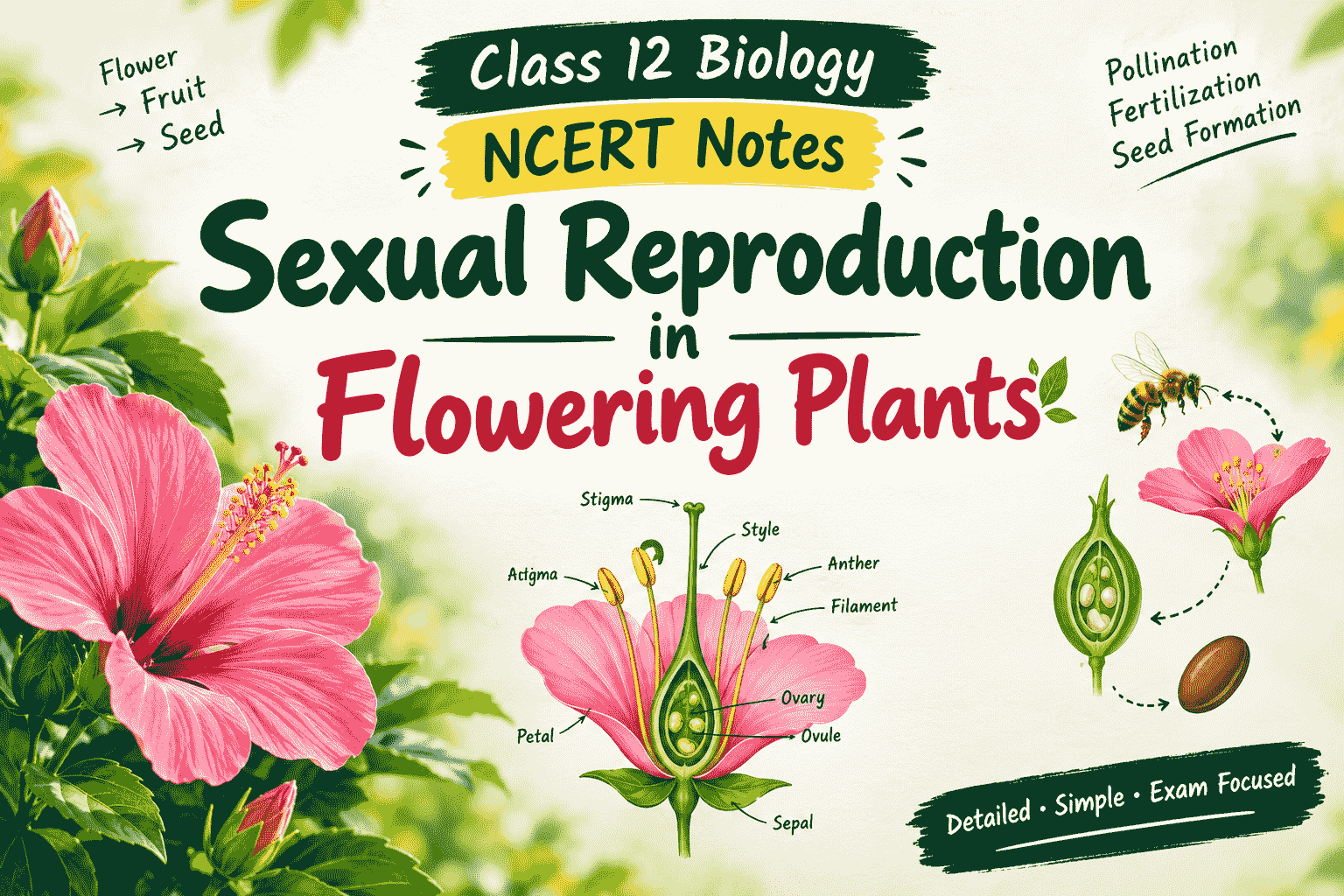
1.1 Flower – A Fascinating Organ of Angiosperms
Toh basically… flower sirf sundar dikhne ke liye nahi hota.(Sexual Reproduction in Flowering Plants – Class 12 Biology NCERT Notes)
Yeh actually angiosperms ka reproductive organ hai. Matlab — poori next generation isi se shuru hoti hai.
Flower ek modified shoot hai. Jab maine pehli baar padha toh laga, shoot aur flower mein kya connection? But sochte hain — shoot pe nodes hote hain, aur flower mein bhi parts ek axis pe lage hote hain. Toh connection toh hai.
Parts of a Flower:
Ek typical flower mein 4 whorls hote hain:
1. Calyx (Sepals)
- Sabse bahar wala whorl
- Green color ka hota hai generally
- Function: Bud ko protect karna
- Agar sepals aapas mein jude hon → Gamosepalous
- Agar alag alag hon → Polysepalous
2. Corolla (Petals)
- Rang-birangi petals
- Insects ko attract karna — pollination ke liye
- Jude hue → Gamopetalous
- Alag → Polypetalous
Calyx + Corolla ko milake Perianth kehte hain (jab dono similar dikhein)
3. Androecium (Male Part) 🌼
- Yeh hai stamens ka group
- Har stamen mein hota hai:
- Filament (danda)
- Anther (upar wala hissa jahan pollen banta hai)
- Anther mein pollen grains form hote hain — yeh male gametes hain
4. Gynoecium (Female Part) 🌺
- Flower ka center — sabse important part reproduction ke liye
- Pistil/Carpel se bana hota hai
- Har carpel mein:
- Stigma — pollen receive karta hai (upar)
- Style — beech ka hissa
- Ovary — neeche, jisme ovules hote hain
Flower Types:
| Type | Matlab |
|---|---|
| Bisexual | Androecium + Gynoecium dono ek hi flower mein |
| Unisexual | Sirf ek part hota hai |
| Complete | Chaaron whorl present |
| Incomplete | Koi ek whorl missing |
Honestly… yeh table yaad rakhna easy hai. Bas socho — bisexual = dono, unisexual = ek.
1.2 Pre-fertilisation: Structures and Events
Fertilisation se pehle kya hota hai? Bahut kuch!
Basically do cheezein prepare hoti hain:
- Male gamete (pollen)
- Female gamete (ovule ke andar)
🔶 Male Side: Microsporogenesis & Pollen Formation
Stamen ki structure:
Anther ek bilobed structure hota hai — matlab do hisse. Har lobe mein 2 thecae hote hain. Toh total = 4 microsporangia ek anther mein.
Microsporangium ki wall layers (bahar se andar):
- Epidermis
- Endothecium
- Middle layers
- Tapetum ← sabse important!
Tapetum — yeh layer developing pollen grains ko nutrition deti hai. Iske bina pollen nahi banega properly.
Microsporogenesis:
Microsporangium ke andar Microspore Mother Cell (MMC) hoti hai. Yeh Meiosis karta hai → 4 microspores bante hain → yeh ek saath Tetrad form karte hain → phir alag hote hain → har microspore develop hota hai pollen grain mein.
Simple line mein:
MMC → Meiosis → Tetrad → Microspores → Pollen Grains
Pollen Grain ki structure:
Do layers hoti hain:
- Exine — bahari, bahut hard, Sporopollenin se bani (fossilize bhi ho sakti hai!)
- Intine — andar, cellulose ki, soft
Pollen grain mein 2 cells hoti hain:
- Vegetative cell — badi, food store karta hai
- Generative cell — choti, divide hoke 2 male gametes banata hai
Pollen grains viable kitne time tak rahte hain? Kuch ghante… kuch mahine… depend karta hai species pe. Cryopreservation se inhe lamba time store kiya ja sakta hai — Pollen Banks mein.
🔷 Female Side: Megasporogenesis & Ovule
Ovule ki structure:
Ovule = future seed. Iske parts:
- Funicle — stalk jisse placenta se attached hota hai
- Hilum — junction point
- Integuments — 1 ya 2 protective layers
- Micropyle — chota opening (pollen tube yahan se enter karta hai)
- Chalaza — opposite end of micropyle
- Nucellus — tissue mass, andar hota hai
- Embryo sac — female gametophyte, sabse important
Megasporogenesis:
Nucellus mein ek cell hoti hai — Megaspore Mother Cell (MMC). Yeh Meiosis karta hai → 4 megaspores bante hain → inme se 3 degenerate ho jaate hain → sirf 1 functional megaspore bachti hai.
Yeh ek megaspore → develop hoti hai Female Gametophyte mein, yaani Embryo Sac mein.
Embryo Sac (7-celled, 8-nucleate):
Jab maine pehli baar “8 nuclei, 7 cells” padha toh confusing laga. But phir samajh aaya —
| Part | Cells/Nuclei | Position |
|---|---|---|
| Egg apparatus | 3 cells (1 egg + 2 synergids) | Micropyle end |
| Central cell | 1 cell (2 polar nuclei) | Center |
| Antipodal cells | 3 cells | Chalaza end |
Total = 7 cells, 8 nuclei (kyunki central cell mein 2 nuclei hain)
Synergids mein filiform apparatus hota hai — yeh pollen tube guide karta hai.
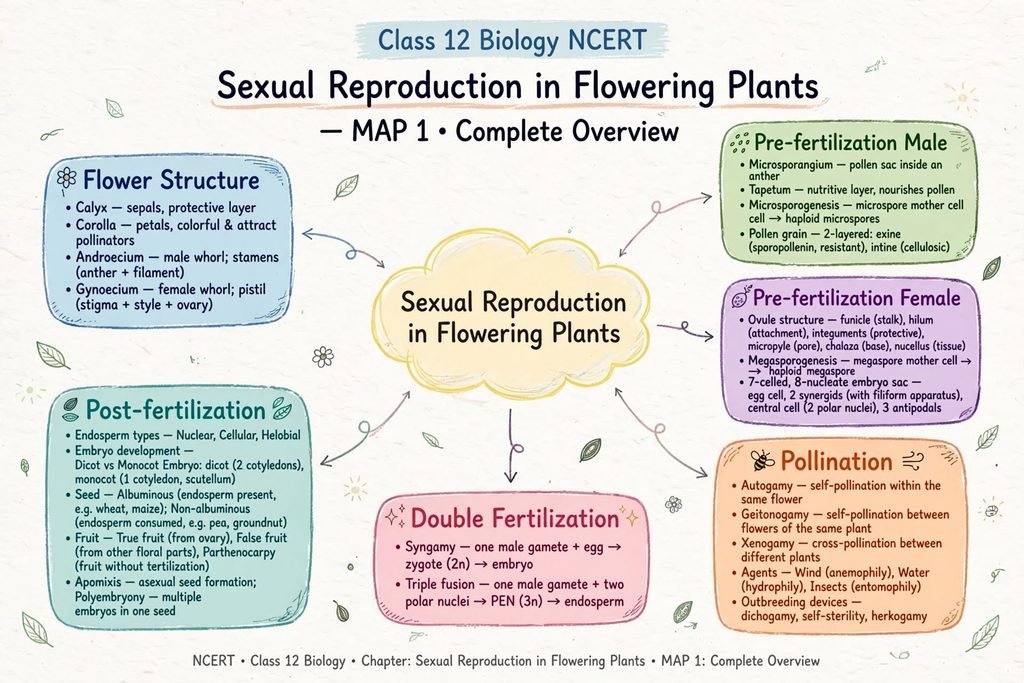
🌿 Pollination
Yeh process hai jisme pollen anther se stigma tak pohonchta hai.
Types of Pollination:
1. Autogamy (Self-pollination)
- Same flower ke andar
- Cleistogamous flowers mein guaranteed hota hai (jo kabhi khulete hi nahi — jaise Viola)
2. Geitonogamy
- Same plant ke alag flower pe
- Genetically self-pollination jaisa hi hai
- Pollinating agent chahiye
3. Xenogamy (Cross-pollination)
- Alag plant ke flower pe
- Genetic variation ke liye best!
Pollinating Agents:
- Wind (Anemophily): Pollen light, dry, smooth. Jaise — grasses, maize
- Water (Hydrophily): Jaise — Vallisneria, Zostera
- Insects (Entomophily): Flowers colorful, fragrant, nectar wale. Jaise — roses
- Birds (Ornithophily): Jaise — Bignonia
- Bats: Jaise — Kigelia
Outbreeding Devices (plants ensure karte hain cross-pollination):
- Anther aur stigma ki alag timing (Dichogamy)
- Anther aur stigma alag position pe (Herkogamy)
- Self-incompatibility — apna hi pollen reject kar deta hai plant
- Unisexuality
Pollen-Pistil Interaction:
Stigma decide karta hai — yeh pollen accept karna hai ya reject karna hai. Yeh ek recognition mechanism hai. Compatible pollen → accepted → Pollen tube germinate hota hai → style mein se travel karta hai → ovary mein jaata hai.
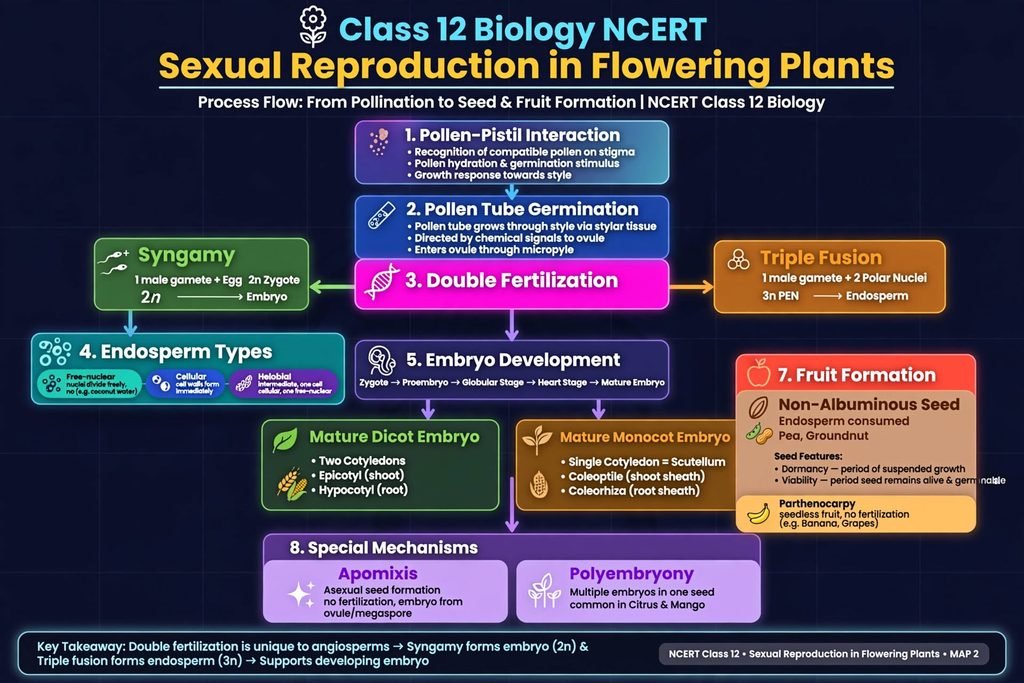
1.3 Double Fertilisation
Yeh angiosperms ki unique feature hai. Sirf flowering plants mein hota hai!
Process:
Pollen tube enter karta hai micropyle se → synergid mein burst hota hai → 2 male gametes release hote hain.
Phir kya hota hai:
1st Fertilisation — Syngamy:
1 male gamete + Egg cell → Zygote (2n)
2nd Fertilisation — Triple Fusion:
1 male gamete + 2 Polar nuclei → Primary Endosperm Nucleus (PEN) (3n)
Dono milake = Double Fertilisation ✅
Yeh 3n cell → Endosperm banega → jo seed ka food store hai.
Mujhe laga tha ek hi baar hoga fertilisation, but yahan do baar hota hai — ek baar egg se, ek baar polar nuclei se. Interesting hai!
1.4 Post-fertilisation: Structures and Events
Fertilisation ke baad kya banta hai?
Simple answer:
- Zygote → Embryo
- PEN → Endosperm
- Ovule → Seed
- Ovary → Fruit
🔸 Endosperm Development
Endosperm pehle develop hota hai, embryo baad mein. Kyunki endosperm = food, embryo ko chahiye nutrition.
Types:
- Nuclear type — pehle sirf nuclei divide hote hain, cell wall baad mein banti hai (most common — coconut water!)
- Cellular type — har division ke baad cell wall banti hai
- Helobial type — intermediate
Coconut water = liquid endosperm (nuclear type), aur coconut malai = solid endosperm (cellular)
🔸 Embryo Development (Embryogeny)
Zygote thoda rest karta hai, phir divide hota hai.
Dicot embryo development:
Zygote → Proembryo → Globular → Heart-shaped → Torpedo → Mature embryo
Mature Dicot Embryo ke parts:
- Embryonal axis — main axis
- Plumule — future shoot
- Radicle — future root
- 2 Cotyledons — food store (seed leaves)
Monocot Embryo (e.g., Maize):
- 1 Cotyledon = Scutellum
- Coleoptile — plumule ko cover karta hai
- Coleorhiza — radicle ko cover karta hai
🔸 Seed
Ovule → Seed ban jaata hai fertilisation ke baad.
Seed ke parts:
- Seed coat (Testa + Tegmen) — integuments se bana
- Cotyledon(s)
- Embryo axis (plumule + radicle)
- Endosperm (kuch seeds mein)
Albuminous seeds — endosperm bachta hai (wheat, maize, castor) Ex-albuminous seeds — endosperm cotyledons absorb kar lete hain (pea, bean)
Perisperm — kuch seeds mein nucellus ka kuch part bachta hai → perisperm kehte hain (e.g., Black pepper, beet)
Dormancy — seeds ek period tak rest karte hain. Germination ke liye sahi conditions chahiye.
🔸 Fruit
Ovary → Fruit
True fruit — sirf ovary se banta hai False fruit (Pseudocarp) — thalamus bhi involve hota hai (jaise apple, strawberry)
Parthenocarpy — bina fertilisation ke fruit banana (jaise banana). Seedless fruits!
1.5 Apomixis and Polyembryony
🔹 Apomixis
Matlab — bina fertilisation ke seed banana.
Yeh sexual reproduction jaisa dikhta hai, but actually asexual hai internally.
Kaise hota hai?
- Diploid egg cell bina fertilisation ke develop hoti hai
- Ya nucellus cells embryo banate hain
Importance:
- Hybrid seeds baar baar produce ho sakte hain without crossing
- Agriculture mein bahut useful — hybrid varieties maintain karne ke liye
Jaise — Asteraceae aur Grasses mein common hai.
🔹 Polyembryony
Ek seed mein ek se zyada embryo hona = Polyembryony.
Kaise hota hai?
- Zyada eggs fertilise ho jaayein
- Synergids ya antipodals develop ho jaayein
- Nucellus cells embryo banayein (Nucellar polyembryony)
Example: Citrus (orange, lemon) — isme nucellar embryos bahut common hain.
Importance:
- Nucellar embryos disease-free hote hain
- Horticulture mein use hota hai rootstock ke liye
📝 Quick Revision Table
| Term | Meaning |
|---|---|
| Microsporogenesis | Pollen grain formation |
| Megasporogenesis | Megaspore formation |
| Sporopollenin | Exine ka material, very resistant |
| Tapetum | Pollen ko nutrition dene wali layer |
| Syngamy | Egg + male gamete |
| Triple fusion | Polar nuclei + male gamete |
| Double fertilisation | Syngamy + Triple fusion |
| Parthenocarpy | Seedless fruit without fertilisation |
| Apomixis | Seed without fertilisation |
| Polyembryony | Multiple embryos in one seed |
⭐ Important Points for Exam
- Embryo sac = 7 celled, 8 nucleate
- Endosperm = 3n (triploid)
- Zygote = 2n (diploid)
- Sporopollenin = most resistant organic material known
- Double fertilisation = only in angiosperms
- Coconut water = liquid nuclear endosperm
- Banana = parthenocarpic fruit
- Citrus = best example of polyembryony
Chapter 1: Sexual Reproduction in Flowering Plants
NCERT Exercise — Detailed Question-Answers
Q1. Name the parts of an angiosperm flower in which development of male and female gametophyte take place.
Answer:
Male aur female gametophyte alag alag jagah develop hote hain flower mein —
Male Gametophyte develop hota hai → Anther mein
- Anther ke andar microsporangia hote hain
- Wahan microspore mother cells meiosis karke pollen grains banati hain
- Pollen grain hi male gametophyte hai
Female Gametophyte develop hoti hai → Ovule mein (jo Ovary ke andar hota hai)
- Ovule ke nucellus mein megaspore mother cell hoti hai
- Meiosis ke baad ek functional megaspore bachti hai
- Yahi develop hoti hai embryo sac (female gametophyte) mein
Simple yaad rakhne ke liye:
Male → Anther | Female → Ovule (inside Ovary)
Q2. Differentiate between microsporogenesis and megasporogenesis. Which type of cell division occurs during these events? Name the structures formed at the end of these two events.
Answer:
| Feature | Microsporogenesis | Megasporogenesis |
|---|---|---|
| Definition | Pollen grains (microspores) ka formation | Megaspores ka formation |
| Kahan hota hai | Anther ke microsporangia mein | Ovule ke nucellus mein |
| Kaun sa cell divide karta hai | Microspore Mother Cell (MMC) | Megaspore Mother Cell (MMC) |
| Cell division | Meiosis | Meiosis |
| Kitne products | 4 microspores (tetrad) | 4 megaspores (3 degenerate, 1 functional) |
| End structure | Pollen Grain (Male Gametophyte) | Embryo Sac (Female Gametophyte) |
Cell division: Dono events mein Meiosis (Meiotic division) hoti hai.
End structures:
- Microsporogenesis → Pollen Grains
- Megasporogenesis → Embryo Sac (functional megaspore se develop hota hai)
Q3. Arrange the following terms in the correct developmental sequence: Pollen grain, sporogenous tissue, microspore tetrad, pollen mother cell, male gametes.
Answer:
Sahi developmental sequence yeh hai:
Sporogenous tissue → Pollen Mother Cell → Microspore Tetrad → Pollen Grain → Male Gametes
Explanation:
- Sporogenous tissue — anther mein present cells ka group
- Pollen Mother Cell (PMC) — sporogenous tissue se banti hai
- Microspore Tetrad — PMC meiosis karke 4 microspores ka tetrad banata hai
- Pollen Grain — tetrad ke alag hone ke baad har microspore pollen grain banta hai
- Male Gametes — pollen grain ke andar generative cell divide hoke 2 male gametes banata hai
Q4. With a neat, labelled diagram, describe the parts of a typical angiosperm ovule.
Answer:
Ek typical angiosperm ovule ke yeh parts hote hain:
        Micropyle
           |
        Integuments (Inner + Outer)
           |
        Nucellus
           |
        Embryo Sac ← (Functional Megaspore se bana)
           |
        Chalaza (opposite end)
           |
        Funicle (stalk)
           |
        Hilum (placenta se junction)
Parts aur unka function:
1. Funicle:
- Stalk hota hai jisse ovule placenta se juda hota hai
- Nutrients transport karta hai
2. Hilum:
- Funicle aur ovule ka junction point
- Ek scar jaisa dikhta hai
3. Integuments:
- 1 ya 2 protective layers hoti hain ovule ke around
- Fertilisation ke baad seed coat (testa + tegmen) banti hain
4. Micropyle:
- Integuments mein ek choti si opening
- Pollen tube yahan se enter karta hai
- Water aur oxygen bhi yahan se enter hote hain
5. Chalaza:
- Micropyle ke opposite end
- Integuments aur nucellus yahan se attached hote hain
6. Nucellus:
- Tissue mass jo ovule ka bulk banta hai
- Developing embryo sac ko nutrition deta hai
- Kuch cases mein perisperm banta hai
7. Embryo Sac (Female Gametophyte):
- Nucellus ke andar hota hai
- 7-celled, 8-nucleate structure
- Egg cell yahan hoti hai
📝 Diagram (Text representation):
         Micropyle
            ↑
    [Outer Integument]
    [Inner Integument]
         |Nucellus|
      [Embryo Sac]
         |Nucellus|
            ↓
          Chalaza
            |
          Funicle
            |
          Hilum
(Exam mein neat labelled diagram zaroor draw karna!)
Q5. What is meant by monosporic development of female gametophyte?
Answer:
“Monosporic” ka matlab hai — ek (mono) megaspore se female gametophyte ka development.
Jab Megaspore Mother Cell (MMC) meiosis karta hai → 4 megaspores bante hain.
Inme se 3 megaspores degenerate ho jaate hain (nast ho jaate hain).
Sirf 1 functional megaspore bachti hai.
Yahi ek functional megaspore → mitotic divisions karke → Embryo Sac (Female Gametophyte) develop karti hai.
Kyunki sirf ek hi megaspore se poora female gametophyte bana → ise Monosporic Development kehte hain.
Yeh Polygonum type development hai — angiosperms mein sabse common type. 3 mitotic divisions hoti hain → 8 nuclei → 7 cells bante hain.
Q6. With a neat diagram explain the 7-celled, 8-nucleate nature of the female gametophyte.
Answer:
Female gametophyte yaani Embryo Sac — 7-celled aur 8-nucleate hota hai.
Pehle samjhte hain kaise banta hai:
Functional megaspore → 3 mitotic divisions → 8 nuclei bante hain → phir cell organization hoti hai → 7 cells bante hain.
Structure:
        MICROPYLE END
    ┌─────────────────┐
    │   Synergid (n)  │
    │   EGG CELL (n)  │  ← Egg Apparatus (3 cells)
    │   Synergid (n)  │
    ├─────────────────┤
    │  Central Cell   │  ← 2 Polar Nuclei (n+n)
    │  (2n effectively)│    (1 cell, 2 nuclei)
    ├─────────────────┤
    │  Antipodal (n)  │
    │  Antipodal (n)  │  ← Antipodal Cells (3 cells)
    │  Antipodal (n)  │
    └─────────────────┘
        CHALAZA END
7 Cells breakdown:
1. Egg Apparatus — 3 cells (Micropyle end pe)
- 1 Egg Cell — female gamete, fertilisation ke baad embryo banega
- 2 Synergids — egg cell ke sides mein, filiform apparatus hota hai inme jo pollen tube guide karta hai
2. Central Cell — 1 cell (center mein)
- Sabse badi cell
- Isme 2 Polar Nuclei hote hain
- Triple fusion mein participate karta hai → endosperm banta hai
3. Antipodal Cells — 3 cells (Chalaza end pe)
- Nutritive function
- Baad mein degenerate ho jaati hain
Count karo:
- 3 (egg apparatus) + 1 (central cell) + 3 (antipodal) = 7 cells ✅
- 3 nuclei + 2 polar nuclei + 3 nuclei = 8 nuclei ✅
(Central cell mein 2 nuclei hain isliye 7 cells hone ke baad bhi 8 nuclei hote hain!)
Q7. What are chasmogamous flowers? Can cross-pollination occur in cleistogamous flowers? Give reasons for your answer.
Answer:
Chasmogamous Flowers:
“Chasmo” = open. Toh chasmogamous flowers woh hote hain jo khulte hain — inke anther aur stigma exposed hote hain.
Inme both autogamy (self) aur xenogamy (cross) pollination ho sakti hai.
Examples: Sunflower, Rose, Hibiscus — basically zyaadatar common flowers.
Cleistogamous flowers mein cross-pollination?
Nahi, cross-pollination cleistogamous flowers mein nahi ho sakti.
Reason:
“Cleisto” = closed. Cleistogamous flowers kabhi nahi khulte. Yeh permanently closed rehte hain.
- Kyunki flower kabhi open hi nahi hota, bahar se koi pollinating agent andar nahi ja sakta
- Pollen bahar nahi ja sakta
- Sirf self-pollination (autogamy) hoti hai — andar hi andar
- Yeh guaranteed seed set ensure karta hai even without pollinators
Example: Viola (pansy), Oxalis, Commelina — inme dono type ke flowers hote hain — chasmogamous bhi aur cleistogamous bhi.
Interesting baat — ek hi plant pe dono type ke flowers ho sakte hain!
Q8. Mention two strategies evolved to prevent self-pollination in flowers.
Answer:
Plants ne self-pollination rokne ke liye bahut clever strategies evolve ki hain. Do main strategies:
Strategy 1: Dichogamy
Ek hi flower mein anther aur stigma alag alag time pe mature hote hain.
- Protandry — Anther pehle mature hota hai, stigma baad mein (e.g., Sunflower, Salvia)
- Protogyny — Stigma pehle mature hota hai, anther baad mein (e.g., Mirabilis)
Isse apna pollen khud ke stigma pe nahi pad sakta — timing match hi nahi karti!
Strategy 2: Self-incompatibility
Kuch plants apna hi pollen recognize karke reject kar dete hain.
Yeh ek genetic mechanism hai. Pollen aur pistil ke beech “recognition” hoti hai — agar same genetic type ka pollen aaya → germination nahi hogi.
Matlab — physically pollen pohonch bhi jaaye stigma pe, toh bhi fertilisation nahi hoga.
Bonus: Unisexuality (dioecious plants) bhi self-pollination rokti hai — male aur female flowers alag plants pe hote hain.
Q9. What is self-incompatibility? Why does self-pollination not lead to seed formation in self-incompatible species?
Answer:
Self-Incompatibility:
Yeh ek genetic mechanism hai jisme ek plant apne hi pollen ko recognize karke reject kar deta hai.
Matlab — even if self-pollination ho jaaye (apna pollen apne stigma pe gir jaaye) → seed nahi banega.
Yeh mechanism ensure karta hai cross-pollination aur genetic diversity.
Self-pollination seed formation kyun nahi karta self-incompatible species mein?
Reason:
Self-incompatibility mein S-gene (S-locus) involve hota hai.
Pollen grain aur pistil dono mein same S-alleles hote hain self-pollination mein.
Jab self-pollen stigma pe aaata hai:
- Stigma recognize kar leta hai ki yeh “apna” pollen hai
- Rejection response trigger hota hai
- Pollen tube germination ruk jaati hai ya pollen tube style mein grow nahi kar pata
- Pollen tube ovule tak pohonch hi nahi pata
- Fertilisation → nahi hoti
- Seed → nahi banta
Isliye self-incompatible species mein cross-pollination zaruri hai seed formation ke liye.
Q10. What is bagging technique? How is it useful in a plant breeding programme?
Answer:
Bagging Technique:
Yeh ek technique hai jisme flower ke bud ko ek bag se cover kar diya jaata hai — usually butter paper bag se — taaki unwanted pollen flower ke stigma pe na gire.
Process:
- Emasculation ke baad (stamens hataane ke baad) — pistillate flower ko bag se cover kiya jaata hai
- Jab stigma receptive ho jaata hai → bag temporarily hataya jaata hai
- Desired pollen manually lagaya jaata hai (hand pollination)
- Phir dobara bag lagaa diya jaata hai
- Fruit develop hone tak bag laga rehta hai
Plant Breeding mein importance:
Mujhe laga tha bagging sirf protection ke liye hogi — but actually yeh bahut zyada important hai breeding mein:
- Contamination rokta hai — bahar se koi unwanted pollen nahi aa sakta
- Controlled pollination possible hoti hai
- Desired crosses accurately produce ho sakte hain
- Hybrid seeds develop karne mein help karta hai
- Experiment ke results reliable aur repeatable bante hain
- Commercial scale pe pure hybrid varieties produce ki ja sakti hain
Bagging + Emasculation + Hand pollination = Complete controlled hybridization technique
Q11. What is triple fusion? Where and how does it take place? Name the nuclei involved in triple fusion.
Answer:
Triple Fusion kya hai?
Triple fusion woh process hai jisme ek male gamete + do polar nuclei aapas mein fuse karte hain → Primary Endosperm Nucleus (PEN) banta hai.
“Triple” isliye kyunki 3 nuclei fuse karte hain ek saath!
Kahan hota hai?
Triple fusion → Embryo Sac ke Central Cell mein hota hai.
Kaise hota hai?
- Pollen tube micropyle se enter karta hai
- Synergid mein burst hota hai → 2 male gametes release hote hain
- 1st male gamete → egg cell se fuse karta hai → Zygote (2n) — ise Syngamy kehte hain
- 2nd male gamete → central cell mein jaata hai → 2 polar nuclei se fuse karta hai
- Teen nuclei fuse hote hain → Primary Endosperm Nucleus (PEN) = 3n (triploid)
Yeh 2nd event hi Triple Fusion hai.
Nuclei involved in Triple Fusion:
- 1 Male Gamete nucleus (n)
- 2 Polar Nuclei (n + n)
- Result: PEN (3n)
Triple fusion + Syngamy milake = Double Fertilisation — angiosperms ki unique feature!
Q12. Why do you think the zygote is dormant for sometime in a fertilised ovule?
Answer:
Zygote thodi der ke liye dormant (inactive) rehta hai fertilised ovule mein.
Reason:
Zygote isliye dormant rehta hai kyunki pehle endosperm develop hona chahiye.
Sochte hain logically — embryo ko develop hone ke liye nutrition chahiye. Endosperm yahi nutrition provide karta hai. Agar zygote pehle divide karne lage aur endosperm baad mein bane, toh embryo ko food nahi milega aur wo properly develop nahi ho payega.
Toh sequence yeh hai:
- PEN (Primary Endosperm Nucleus) pehle divide hota hai → Endosperm banta hai
- Endosperm ready hone ke baad → Zygote divide hona shuru karta hai → Embryo develop hota hai
Basically zygote wait karta hai jab tak “tiffin ready” nahi ho jaata! 😄
Yeh nature ka ek intelligent mechanism hai — ensures ki embryo ko growth ke liye proper nutritional support mile.
Q13. Differentiate between:
(a) Hypocotyl and Epicotyl
| Feature | Hypocotyl | Epicotyl |
|---|---|---|
| Position | Radicle aur cotyledon ke beech | Cotyledon aur plumule ke beech |
| “Hypo” = | Neeche (below cotyledon) | Upar (above cotyledon) |
| Develops into | Lower stem + root junction | Upper stem (shoot) |
| Function | Root-shoot transition zone | Plumule ko support karta hai |
(b) Coleoptile and Coleorhiza
| Feature | Coleoptile | Coleorhiza |
|---|---|---|
| Kya cover karta hai | Plumule (future shoot) | Radicle (future root) |
| Kahan milta hai | Monocots mein (e.g., Maize) | Monocots mein (e.g., Maize) |
| Function | Plumule ko soil se bahar aate waqt protect karta hai | Radicle ko soil mein ghusne par protect karta hai |
(c) Integument and Testa
| Feature | Integument | Testa |
|---|---|---|
| Kab hota hai | Fertilisation se pehle | Fertilisation ke baad |
| Kya hai | Ovule ki protective layer | Seed coat ki outer layer |
| Origin | Ovule ka part | Integument se develop hota hai |
| Function | Ovule protect karna | Seed protect karna |
Simply: Integument → (after fertilisation) → Testa banta hai
(d) Perisperm and Pericarp
| Feature | Perisperm | Pericarp |
|---|---|---|
| Kya hai | Seed mein nucellus ka残留 (leftover tissue) | Fruit ki wall |
| Origin | Nucellus se | Ovary wall se |
| Kahan milta hai | Seed ke andar | Fruit ke bahar (wall) |
| Example | Black pepper, Beet | Mango ka chilka + pulp |
Q14. Why is apple called a false fruit? Which part(s) of the flower forms the fruit?
Answer:
Apple False Fruit kyun hai?
Normally fruit sirf ovary se banta hai — ise true fruit kehte hain.
Lekin apple mein fruit ka zyaadatar hissa — jo hum khaate hain, woh juicy fleshy part — ovary se nahi, balki thalamus (receptacle) se develop hota hai.
Ovary toh sirf apple ke center mein ek choti si core banta hai — jisme seeds hote hain.
Kyunki fruit ka major part ovary se nahi bana → apple ko False Fruit (Pseudocarp) kehte hain.
Apple mein fruit kaunse parts se banta hai?
- Thalamus (Receptacle) → juicy fleshy part jo hum khaate hain (majority)
- Ovary → core (beej wala hissa, center mein)
Aur examples of false fruits: Strawberry, Cashew (kaju mein jo fleshy part hota hai woh thalamus hai, actual fruit toh kaju ka seed hai!)
Q15. What is meant by emasculation? When and why does a plant breeder employ this technique?
Answer:
Emasculation kya hai?
Emasculation woh process hai jisme bisexual flower ke anthers (stamens) ko artificially remove kar diya jaata hai — bud stage mein hi, pollen release hone se pehle.
“Emascu” = male remove karna.
Kab employ karte hain?
- Jab controlled cross-pollination karni ho
- Bud stage mein — jab flower abhi khula nahi hota aur anthers immature hote hain
- Pollen shed hone se pehle
Kyun karte hain?
Plant breeder ek hybrid variety banana chahta hai — do alag plants ko cross karana chahta hai.
Lekin agar bisexual flower ka apna pollen already stigma pe gir jaaye → self-pollination ho jaayegi → desired cross nahi milega.
Isliye:
- Emasculation karo — apne anthers hata do
- Bagging karo — unwanted pollen se bachao
- Jab stigma receptive ho → desired pollen lagao (hand pollination)
- Dobara bag lagao
Is tarah specific cross produce hota hai jisme desired traits dono parents se milte hain.
Emasculation sirf bisexual flowers mein ki jaati hai. Unisexual (female) flowers mein yeh step nahi chahiye.
Q16. If one can induce parthenocarpy through the application of growth substances, which fruits would you select to induce parthenocarpy and why?
Answer:
Main in fruits mein parthenocarpy induce karna chahungi:
1. Watermelon (Tarbooz) 2. Grapes (Angoor) 3. Tomato 4. Cucumber
Kyun?
Parthenocarpy = bina fertilisation ke fruit development → seedless fruits bante hain.
Inka selection isliye kiya kyunki:
- Consumer preference: Logon ko seedless fruits zyada pasand hain — khaane mein easy, convenient
- Commercial value: Seedless varieties market mein zyada demand aur zyada price pe bikti hain
- Banana already naturally parthenocarpic hai — toh woh toh hai hi
- Grapes — seedless grapes ka market bahut bada hai globally
- Watermelon — seedless watermelon bahut popular hai, seeds nikaalna tedious hota hai
- Tomato — processing industry ke liye seedless tomato better hota hai
Growth substances jo use hote hain:
- Auxins (IAA, NAA)
- Gibberellins (GA)
Yeh growth hormones ovary ko signal dete hain fruit develop karne ka — bina fertilisation ke.
Q17. Explain the role of tapetum in the formation of pollen-grain wall.
Answer:
Tapetum — yeh microsporangium ki innermost wall layer hai jo directly developing pollen grains ke contact mein hoti hai.
Yeh ek nutritive layer hai — but sirf nutrition nahi, pollen wall formation mein bhi direct role hai.
Pollen wall mein Tapetum ka role:
Pollen grain ki wall 2 layers se bani hoti hai:
- Exine (bahari layer) — Sporopollenin se bani
- Intine (andar layer) — cellulose aur pectin se bani
Tapetum ka contribution:
1. Sporopollenin provide karna:
- Tapetum cells sporopollenin precursors secrete karti hain
- Yeh precursors exine ke formation mein use hote hain
- Sporopollenin nature ka sabse resistant organic compound hai — acid, alkali, enzymes kuch bhi dissolve nahi kar sakta
2. Pollenkitt provide karna:
- Tapetum pollenkitt (oily/sticky coating) provide karta hai
- Yeh pollen grains ko insects se stick karti hai (insect-pollinated flowers mein)
- Pollen grains ko colour aur UV patterns deta hai
3. Ubisch bodies (Orbicules):
- Tapetum cells Ubisch bodies produce karti hain
- Yeh small structures exine pattern formation mein help karte hain
4. Proteins for recognition:
- Tapetum pollen surface pe recognition proteins deposit karta hai
- Yeh proteins self-incompatibility aur pollen-pistil interaction mein role play karte hain
5. Nutrition:
- Developing microspores ko nutrients supply karta hai
- Tapetum degenerate ho jaata hai baad mein — apni contents release kar deta hai pollen ke liye
Basically tapetum ke bina — na proper exine banegi, na pollen viable hoga. Tapetum = pollen ka “life support system”!
Q18. What is apomixis and what is its importance?
Answer:
Apomixis kya hai?
Apomixis woh process hai jisme seeds bina fertilisation ke produce hote hain.
Yeh asexual reproduction ka ek type hai — lekin dikhta hai sexual jaisa (seed production hoti hai). Internally fertilisation nahi hota.
Kaise hota hai? Types:
1. Diplospory:
- MMC (Megaspore Mother Cell) meiosis nahi karta
- Directly diploid embryo sac bana deta hai
- Diploid egg → bina fertilisation → embryo
2. Apospory:
- Nucellus ya chalaza cells → embryo sac bana dete hain
- Meiosis involve nahi
3. Adventive Embryony:
- Nucellus ya integument cells seedas embryo develop kar dete hain
- Best example: Citrus (polyembryony ka reason)
Importance of Apomixis:
1. Agriculture mein hybrid seeds:
- Hybrid varieties bahut zyada yield deti hain — lekin har season inhe dobara cross karke produce karna costly aur time-consuming hota hai
- Agar hybrid mein apomixis introduce kar do → har season same hybrid seeds produce honge automatically
- Farmers ko baar baar expensive hybrid seeds nahi khareedne padenge
2. Genetic uniformity:
- Apomictic seeds genetically identical hote hain parent se
- Disease-resistant ya high-yield variety ek baar develop karo → apomixis se propagate karo
3. Nucellar embryos:
- Virus-free, disease-free plants milti hain (kyunki nucellar tissue mein virus nahi hota)
- Horticulture mein rootstock ke liye use hota hai
4. Breeding cost kam hoti hai:
- Baar baar crossing nahi karni padti
- Seed production economical hoti hai
5. Polyembryony ka source:
- Citrus mein nucellar polyembryony → multiple vigorous seedlings
Apomixis agricultural science ki next big revolution maan jaata hai — agar controlled tarike se use kiya jaaye toh food security improve ho sakti hai!
✅ Quick Summary Table
| Q No. | Topic | Key Point |
|---|---|---|
| Q1 | Gametophyte location | Male → Anther, Female → Ovule |
| Q2 | Micro vs Mega sporogenesis | Both = Meiosis; End: Pollen vs Embryo sac |
| Q3 | Developmental sequence | Sporogenous tissue → PMC → Tetrad → Pollen → Male gametes |
| Q4 | Ovule parts | Funicle, Hilum, Integuments, Micropyle, Nucellus, Embryo sac |
| Q5 | Monosporic | 1 functional megaspore → embryo sac |
| Q6 | 7-celled 8-nucleate | 3 egg apparatus + 1 central (2 nuclei) + 3 antipodal |
| Q7 | Cleistogamous | Never open, cross-pollination impossible |
| Q8 | Prevent self-pollination | Dichogamy, Self-incompatibility |
| Q9 | Self-incompatibility | Genetic rejection of own pollen |
| Q10 | Bagging | Controlled pollination in breeding |
| Q11 | Triple fusion | 1 male + 2 polar nuclei → PEN (3n) |
| Q12 | Zygote dormancy | Endosperm forms first for nutrition |
| Q13 | Differentiations | 4 pairs clearly explained |
| Q14 | False fruit | Thalamus → major part, not ovary |
| Q15 | Emasculation | Remove anthers before pollen shed |
| Q16 | Parthenocarpy | Seedless → Grapes, Watermelon, Tomato |
| Q17 | Tapetum role | Sporopollenin, Pollenkitt, proteins, nutrition |
| Q18 | Apomixis | Seed without fertilisation; agriculture mein important |
🧬 NEET PYQs Style MCQs
Chapter 1: Sexual Reproduction in Flowering Plants
Q1. Which one of the following represents the female gametophyte in angiosperms?
(a) Ovule (b) Embryo sac (c) Megaspore mother cell (d) Nucellus
✅ Answer: (b) Embryo sac
Explanation: Embryo sac hi female gametophyte hai. Yeh functional megaspore se develop hota hai. Ovule toh sporophytic structure hai jiske andar embryo sac hota hai.
Q2. The phenomenon of parthenocarpy was induced in tomato by:
(a) Removing petals (b) Application of auxins (c) Emasculation (d) Cross pollination
✅ Answer: (b) Application of auxins
Explanation: Parthenocarpy artificially auxins (IAA, NAA) ya gibberellins lagaake induce karte hain. Ovary bina fertilisation ke fruit mein develop ho jaati hai.
Q3. Perisperm differs from endosperm in:
(a) Being a product of double fertilisation (b) Being triploid (c) Being derived from nucellus (d) Having no reserve food
✅ Answer: (c) Being derived from nucellus
Explanation: Perisperm = nucellus ka leftover tissue (seed mein). Endosperm = triple fusion ka product (3n). Dono mein yahi main difference hai. Black pepper mein perisperm hota hai.
Q4. Which of the following statements is correct about double fertilisation?
(a) Two male gametes fuse with two egg cells (b) One male gamete fuses with egg cell and other with synergid (c) One male gamete fuses with egg cell and other with two polar nuclei (d) Two male gametes fuse with two polar nuclei
✅ Answer: (c) One male gamete fuses with egg cell and other with two polar nuclei
Explanation: Double fertilisation = Syngamy (male gamete + egg → 2n zygote) + Triple fusion (male gamete + 2 polar nuclei → 3n PEN). Yeh angiosperms ki unique feature hai.
Q5. Filiform apparatus is a characteristic feature of:
(a) Antipodal cells (b) Synergids (c) Central cell (d) Egg cell
✅ Answer: (b) Synergids
Explanation: Filiform apparatus synergids mein hota hai. Yeh finger-like projections pollen tube ko micropyle ki taraf guide karne mein help karte hain. Bahut important structure hai — NEET mein frequently aata hai!
Q6. Sporopollenin is present in:
(a) Intine of pollen grain (b) Exine of pollen grain (c) Tapetum (d) Middle layer of anther wall
✅ Answer: (b) Exine of pollen grain
Explanation: Sporopollenin pollen grain ki exine (bahari layer) mein hota hai. Yeh nature ka sabse resistant organic compound hai — high temperature, strong acid, alkali kuch bhi isse dissolve nahi kar sakta.
Q7. An anther has 1200 pollen grains. How many pollen mother cells (PMCs) must have been there to produce them?
(a) 300 (b) 600 (c) 1200 (d) 400
✅ Answer: (a) 300
Explanation: 1 PMC → Meiosis → 4 pollen grains (tetrad) Toh: 1200 ÷ 4 = 300 PMCs
Yeh calculation wala question NEET mein bahut common hai! Formula yaad rakho: PMC = Pollen grains ÷ 4
Q8. Which of the following is the correct sequence of events during microsporogenesis?
(a) Microspore tetrad → Pollen grain → Pollen mother cell → Sporogenous tissue (b) Sporogenous tissue → Pollen mother cell → Microspore tetrad → Pollen grain (c) Pollen mother cell → Sporogenous tissue → Pollen grain → Microspore tetrad (d) Pollen grain → Microspore tetrad → Pollen mother cell → Sporogenous tissue
✅ Answer: (b) Sporogenous tissue → Pollen mother cell → Microspore tetrad → Pollen grain
Explanation: Yeh Q3 wala sequence question hi hai MCQ form mein. Sporogenous tissue se shuru → PMC → Meiosis se tetrad → Pollen grain. Simple aur direct!
Q9. Which of the following is NOT a feature of wind pollinated flowers?
(a) Pollen grains are light and non-sticky (b) Flowers are brightly coloured (c) Stigma is large and feathery (d) Large quantity of pollen is produced
✅ Answer: (b) Flowers are brightly coloured
Explanation: Bright coloured flowers = insect pollination (entomophily) ke liye hote hain — insects ko attract karne ke liye. Wind pollinated (anemophilous) flowers small, dull, non-attractive hote hain. Inhe insects attract karne ki zarurat nahi — wind ka kaam hai!
Q10. In angiosperms, endosperm is formed by:
(a) Fertilisation of two polar nuclei (b) Fusion of one male gamete with two polar nuclei (triple fusion) (c) Fusion of two male gametes with egg nucleus (d) Division of zygote
✅ Answer: (b) Fusion of one male gamete with two polar nuclei (triple fusion)
Explanation: Triple fusion → Primary Endosperm Nucleus (PEN) → Endosperm develop hota hai. Endosperm 3n (triploid) hota hai. Yeh embryo ko nutrition deta hai. NEET mein yeh concept baar baar aata hai!
📊 Score Check Karo!
| Score | Result |
|---|---|
| 9-10 ✅ | Excellent! NEET ready ho! 🔥 |
| 7-8 ✅ | Bahut achha! Thoda revision aur karo |
| 5-6 ✅ | Average, notes dobara padhlo |
| Below 5 | Notes se shuru karo phir attempt karo |
⚡ NEET ke liye Most Important Points:
- Embryo sac = 7 celled, 8 nucleate — har saal aata hai
- Filiform apparatus = Synergids mein — frequently asked
- Sporopollenin = Exine mein, most resistant
- PMC calculation = Pollen ÷ 4
- Triple fusion = 3n endosperm
- Parthenocarpy = Auxins se induce hoti hai