Class 10 Geography Chapter 2 | NCERT Notes
Toh basically… yeh chapter ek tarah ka wake-up call hai.
Jab maine padha toh laga — hum kitna kuch kho chuke hain. Aur kitna kuch abhi bhi bacha sakte hain, agar sahi steps lein.
Chalo shuru karte hain. 🌿
🌿 Biodiversity / Biological Diversity
Pehle samjhte hain — biodiversity kya hoti hai.
Biodiversity matlab — ek area mein kitne alag alag types ke living organisms hain. Plants, animals, microorganisms — sab milake biodiversity banate hain.
India is maamle mein bahut rich hai. Sochte hain ek second —
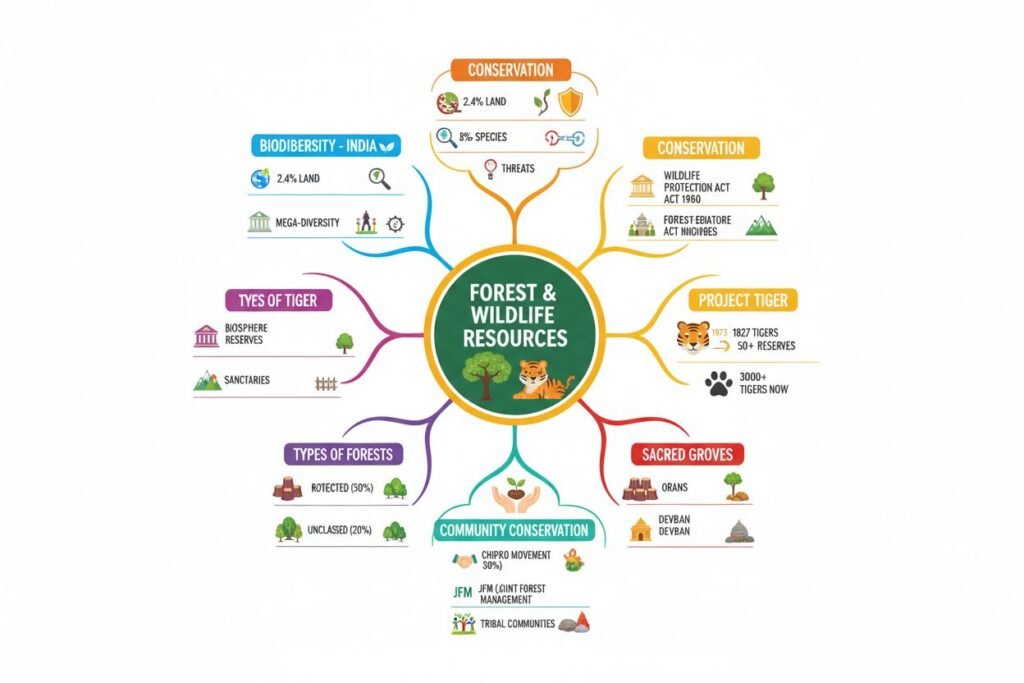
- India duniya ka sirf 2.4% land area cover karta hai
- But duniya ki 8% species yahan milti hain
- India 12 mega-diversity countries mein se ek hai
Yeh toh amazing hai na? But problem yeh hai ki yeh biodiversity khatam ho rahi hai — aur bahut tezi se.
Threats to Biodiversity:
- Habitat destruction — forests kaatna, wetlands drain karna
- Hunting aur poaching
- Environmental pollution
- Over-exploitation of resources
- Alien species ka invasion
India mein 1,300+ bird species, 350+ mammals, 30,000+ insect species hain. Yeh sab ek baar khatam hua toh dobara nahi aayega.
🛡️ Conservation of Forest and Wildlife in India
Mujhe laga conservation sirf “trees lagao” wali baat hai. But yeh bahut deeper hai.
Conservation kyun zaroori hai?
- Forests oxygen dete hain, carbon absorb karte hain
- Wildlife ecological balance maintain karta hai — ek species khatam hui toh poora food chain affect hota hai
- Forests water cycle regulate karte hain
- Tribal communities ka livelihood forests pe depend karta hai
- Medicinal plants — bahut saari medicines forests se aati hain
India mein conservation ke steps:
- 1972 — Wildlife Protection Act passed
- 1973 — Project Tiger launch
- 1980 — Forest Conservation Act
- 1988 — National Forest Policy revised
- Biosphere Reserves, National Parks, Wildlife Sanctuaries — protected areas banaye gaye
India mein abhi:
- 14 Biosphere Reserves
- 90+ National Parks
- 500+ Wildlife Sanctuaries
🐯 Project Tiger
Yeh ek milestone tha Indian conservation history mein.
Kab shuru hua: 1973
Kyun: 1970s mein tiger population drastically gir gayi thi. 1900 mein India mein ~1,00,000 tigers the. 1973 tak sirf 1,827 bache the. Shocking hai na?
Kaise kaam karta hai:
- Tiger reserves banaye gaye — jahan human interference minimum ho
- Poaching pe strict ban
- Habitat protection
- Regular monitoring
Result:
- Shuru mein 9 reserves the
- Ab 50+ tiger reserves hain India mein
- Tiger population badh ke 3,000+ ho gayi hai
Famous Tiger Reserves:
- Corbett (Uttarakhand) — India ka pehla
- Sundarbans (West Bengal)
- Bandhavgarh (MP)
- Ranthambore (Rajasthan)
- Periyar (Kerala)
- Sariska (Rajasthan)
Project Tiger ek success story hai — but abhi bhi poaching aur habitat loss badi problems hain.
🌳 Types and Distribution of Forest and Wildlife Resources
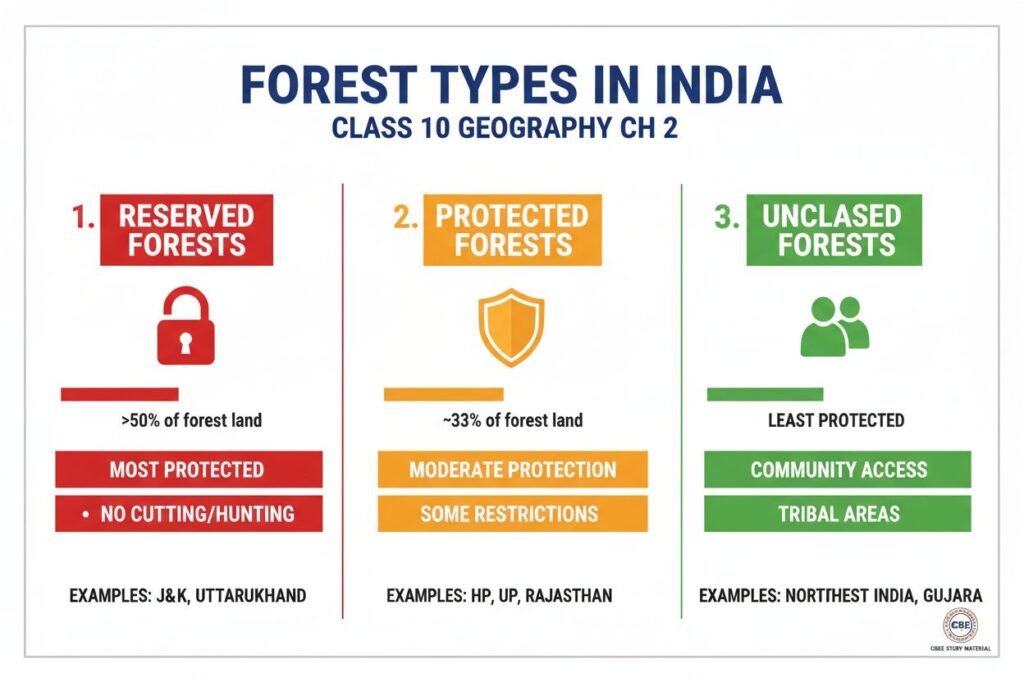
India mein forests ko teen categories mein divide kiya gaya hai — ownership aur protection level ke basis pe.
(i) Reserved Forests 🔴
- Sabse zyada protected category
- Total forest land ka more than half — yahan hai
- Government ka direct control
- Yahan timber cutting, grazing, hunting — sab banned ya strictly regulated
- Example: Most of Jammu & Kashmir, Uttarakhand, Himachal Pradesh ke forests
(ii) Protected Forests 🟡
- Reserved forests ke baad second most protected
- Total forest land ka one-third approximately
- Government control hai — but thoda less strict
- Yahan bhi cutting aur hunting pe restrictions hain
- Example: Himachal Pradesh, UP, Rajasthan ke kuch areas
(iii) Unclassed Forests 🟢
- Yeh woh forests hain jo Reserved ya Protected category mein nahi aate
- Government ya private — dono ke ho sakte hain
- Tribal communities aur local people yahan freely access kar sakte hain
- North-eastern states aur Gujarat mein zyada hain
- Least protected — isliye sabse zyada vulnerable bhi
State-wise Distribution — Important Points
- Madhya Pradesh — sabse zyada forest cover wala state
- North-eastern states — 60%+ area forests se covered
- Rajasthan, Gujarat, Haryana — bahut kam forest cover
- Andaman & Nicobar — dense tropical forests
🤝 Community and Conservation
Yeh section mujhe personally bahut interesting laga.
Hum sochte hain conservation sirf government ka kaam hai. But actually — local communities ne hamesha forests bachaye hain.
Kuch examples:
Chipko Movement (1970s):
- Uttarakhand mein
- Women ne literally trees ko hug kar liya — loggers ko rokne ke liye
- “Chipko” = chipakna
- Yeh ek grassroots movement tha — government ne nahi, logon ne shuru kiya
Beej Bachao Andolan:
- Tehri mein
- Traditional seeds bachane ki movement
- Chemical farming ke against
Joint Forest Management (JFM):
- 1988 ke baad government ne local communities ko forests manage karne mein involve kiya
- Village Forest Committees banaye gaye
- Community + government milke forests protect karte hain
Tribal communities aur forests:
- Odisha ke Dongria Kondh tribe — Niyamgiri hills ke forests protect karte hain
- Jharkhand ke Mundas aur Santhals — forests ko sacred maante hain
- Inke liye forest sirf resource nahi — identity hai
🌸 Sacred Groves — A Wealth of Diverse and Rare Species
Yeh concept bahut beautiful hai. Aur honestly — yeh India ki sabse purani conservation tradition hai.
Sacred Groves kya hain?
Yeh woh forest patches hain jo local communities ne religiously protect kiye hain. Inhe devta ka ghar maana jaata hai — isliye koi bhi yahan cutting, hunting, ya disturbance nahi karta.
Matlab yeh hai ki — bina kisi government law ke, bina kisi ranger ke — sirf faith aur tradition se yeh forests hazaron saalon se protected hain.
Kahan milte hain:
| State | Local Name |
|---|---|
| Rajasthan | Orans |
| Meghalaya | Mawphlang (sacred forests of Khasi tribe) |
| Himachal Pradesh | Devban |
| Uttarakhand | Deodar forests |
| Maharashtra/Karnataka | Devarakadu |
| Kerala | Kavu |
| Jharkhand | Jahera / Sarna |
Why are they important?
- Yeh patches mein rare aur endangered species milti hain — jo baaki jagah khatam ho chuki hain
- Biodiversity hotspots hain — ek chhoti si jagah mein itni variety
- Water sources protect karte hain — sacred groves aksar rivers/streams ke paas hote hain
- Traditional ecological knowledge preserve hoti hai
Meghalaya ke sacred groves toh itne dense hain ki scientists wahan naye species discover karte rehte hain.
Waise ek cheez aur — yeh sacred groves ab threat mein hain. Modernization, urbanization, aur younger generation ka traditional beliefs se disconnect — yeh sab sacred groves ko khatam kar raha hai.
📝 Quick Revision Points
- India = 2.4% land, 8% world species — mega-diversity country
- Wildlife Protection Act = 1972
- Project Tiger = 1973, started with 9 reserves, now 50+
- Tiger population 1973 mein = 1,827 → now 3,000+
- Reserved Forests = most protected, >50% of forest land
- Protected Forests = ~33% of forest land
- Unclassed Forests = least protected, NE states + Gujarat
- Chipko Movement = Uttarakhand, 1970s, women led
- Sacred Groves: Rajasthan = Orans, Meghalaya = Mawphlang
- JFM = Joint Forest Management, started after 1988
Forest and Wildlife Resources — NCERT Exercise
Class 10 Geography Chapter 2 | Solved Questions
1. Multiple Choice Question
(i) Which conservation strategy does NOT directly involve community participation?
✅ Answer: (d) Demarcation of Wildlife Sanctuaries
Kyun? Dekho aise samjho —
- JFM = government + community milke forests manage karte hain ✅
- Beej Bachao Andolan = local farmers ne shuru kiya ✅
- Chipko Movement = women aur villagers ne trees hugge ✅
- Wildlife Sanctuaries demarcate karna = yeh sirf government ka kaam hai — survey, legal notification, boundary marking. Community directly involve nahi hoti ❌
2. Match the Following
| Term | Correct Match |
|---|---|
| Reserved Forests | Forests are regarded as most valuable as far as the conservation of forest and wildlife resources. |
| Protected Forests | Forest lands are protected from any further depletion. |
| Unclassed Forests | Other forests and wastelands belonging to both government and private individuals and communities. |
Explanation yaad rakhne ke liye:
- Reserved = Most valuable + most protected → sabse strict
- Protected = Protected from further depletion → moderate protection
- Unclassed = Government + private + community → least strict, mixed ownership
3. Short Answer Questions (30 words)
(i) What is biodiversity? Why is biodiversity important for human lives?
Biodiversity matlab ek area mein paaye jaane wale saare living organisms ki variety — plants, animals, microorganisms sab milake.
Yeh important hai kyunki:
- Hamare food, medicine, aur clean air ka source hai
- Ecological balance maintain karta hai — ek species khatam hui toh poora food chain disturb hota hai
- Water cycle aur climate regulate karta hai
- Tribal aur rural communities ka livelihood isi pe depend karta hai
Simple baat — biodiversity khatam = human survival khatam. Hum nature se alag nahi hain.
(ii) How have human activities affected the depletion of flora and fauna?
Honestly yeh padhke thoda guilt feel hota hai — kyunki sab kuch humne hi kiya hai.
Flora (plants) pe impact:
- Deforestation — agriculture, timber, urbanization ke liye forests kaate gaye
- Mining — forest land destroy hoti hai
- Large dams — forests aur grasslands submerge ho jaate hain
- Monoculture farming — ek hi crop ugaane se biodiversity khatam
Fauna (animals) pe impact:
- Poaching aur hunting — tiger, elephant, rhino — sab target hue
- Habitat destruction — jab forests kaate, animals ka ghar gaya
- Pollution — water aur air pollution se species khatam ho rahi hain
- Alien species — bahar se laaye gaye species native species ko displace karte hain
India mein Cheetah already extinct ho chuka hai. Asiatic Lion sirf Gir mein bacha hai. One-horned Rhinoceros sirf Kaziranga mein.
Yeh sab human activities ka result hai.
4. Long Answer Questions (120 words)
(i) Describe how communities have conserved and protected forests and wildlife in India.
Jab maine padha toh realize hua — conservation sirf government ka kaam nahi hai. Asli heroes toh local communities hain.
Chipko Movement (1970s): Uttarakhand mein hua. Women ne literally trees ko hug kar liya — loggers ko rokne ke liye. “Chipko” matlab chipakna. Yeh ek powerful grassroots movement tha — kisi ne order nahi diya, logon ne khud decide kiya ki apne forests bachayenge.
Beej Bachao Andolan: Tehri, Uttarakhand mein. Local farmers ne traditional seeds bachaye — chemical farming aur hybrid seeds ke against. Biodiversity preserve ki bina kisi government help ke.
Joint Forest Management (JFM): 1988 ke baad government ne realize kiya ki akele conservation possible nahi. Toh Village Forest Committees banaye gaye — community + government milke forests manage karte hain. Odisha pehla state tha jisne 1988 mein JFM formally shuru kiya.
Tribal Communities:
- Odisha ke Dongria Kondh — Niyamgiri hills ke forests ko apni identity maante hain, protect karte hain
- Rajasthan ke Bishnoi community — wildlife aur trees ki protection unke religion mein hai. 1730 mein Amrita Devi Bishnoi ne 363 logon ke saath trees bachane ke liye apni jaan di
- Meghalaya ke Khasi tribe — sacred groves (Mawphlang) hazaron saalon se protect kar rahe hain
Sacred Groves: Rajasthan mein Orans, Kerala mein Kavu, Karnataka mein Devarakadu — yeh sab community ki faith se protected hain. Koi law nahi, koi ranger nahi — sirf tradition aur respect.
Matlab yeh hai ki — jab community apna maane, toh conservation automatic hoti hai.
(ii) Write a note on good practices towards conserving forest and wildlife.
India mein conservation ke liye kai achhe practices hain — government level pe bhi, community level pe bhi.
Government Initiatives:
- Wildlife Protection Act, 1972 — hunting aur poaching pe strict ban. Endangered species ki list banai gayi.
- Project Tiger, 1973 — 9 reserves se shuru, ab 50+ reserves. Tiger population 1,827 se 3,000+ ho gayi.
- Forest Conservation Act, 1980 — forest land ko non-forest use ke liye divert karna restricted kiya
- Biosphere Reserves — 14 reserves jahan ecosystem poora protect hota hai — plants, animals, aur humans sab
- National Parks aur Wildlife Sanctuaries — 90+ national parks, 500+ sanctuaries
Community Practices:
- Sacred Groves — traditional faith-based conservation. Rare species yahan survive karti hain jo baaki jagah khatam ho chuki hain
- Chipko Movement — people-led forest protection
- JFM — community ko forest management mein partner banaya
- Bishnoi community — wildlife ko religiously protect karte hain. Blackbuck aur chinkara unke area mein safe hain
Individual Level:
- Paper waste kam karo — ek ton paper = 17 trees
- Wood furniture ki jagah alternatives use karo
- Eco-tourism support karo — local communities ko income milti hai forests bachane se
Waise ek cheez aur — sabse important practice yeh hai ki forests ko economic value dena. Jab local communities ko forests se sustainable income milegi — tab woh khud forests bachayenge. Yahi long-term solution hai.
⚡ Quick Revision — Exam Ready
- MCQ answer = (d) Demarcation of Wildlife Sanctuaries — no community involvement
- Reserved = most valuable | Protected = protected from depletion | Unclassed = mixed ownership
- Chipko = Uttarakhand, 1970s, women led
- Beej Bachao = Tehri, traditional seeds
- JFM = 1988, Odisha first state
- Bishnoi community = 1730, Amrita Devi, 363 lives for trees 🌳
- Project Tiger = 1973, 1827 → 3000+ tigers
- Sacred Groves: Rajasthan = Orans, Meghalaya = Mawphlang, Kerala = Kavu
Extra Practice Questions — Forest and Wildlife Resources
Class 10 Geography Chapter 2 | Self-Made MCQs + Q&A
🔵 Multiple Choice Questions (MCQs)
Q1. India is one of the world’s mega-diversity countries. What percentage of world’s species are found in India? (a) 2.4% (b) 5% (c) 8% (d) 12%
✅ Answer: (c) 8% India ka land area sirf 2.4% hai duniya ka — but species 8% hain. Yeh ratio amazing hai.
Q2. Project Tiger was launched in which year? (a) 1970 (b) 1972 (c) 1973 (d) 1980
✅ Answer: (c) 1973 1973 mein shuru hua — sirf 9 reserves se. Ab 50+ reserves hain aur tigers 3,000+ ho gaye hain.
Q3. Which of the following is India’s first tiger reserve? (a) Ranthambore (b) Sundarbans (c) Corbett (d) Periyar
✅ Answer: (c) Corbett Jim Corbett National Park, Uttarakhand — India ka pehla tiger reserve. 1973 mein Project Tiger ke saath designated hua.
Q4. Sacred groves in Rajasthan are locally known as: (a) Mawphlang (b) Kavu (c) Devarakadu (d) Orans
✅ Answer: (d) Orans Rajasthan = Orans, Meghalaya = Mawphlang, Kerala = Kavu, Karnataka = Devarakadu. Yeh yaad rakho!
Q5. Which state was the first to implement Joint Forest Management (JFM)? (a) Uttarakhand (b) Odisha (c) Madhya Pradesh (d) Kerala
✅ Answer: (b) Odisha 1988 mein Odisha ne pehli baar formally JFM implement kiya. Phir baaki states ne follow kiya.
Q6. Amrita Devi Bishnoi is associated with which conservation effort? (a) Chipko Movement (b) Beej Bachao Andolan (c) Protection of Khejri trees in Rajasthan (d) Project Tiger
✅ Answer: (c) Protection of Khejri trees in Rajasthan 1730 mein Amrita Devi Bishnoi ne 363 logon ke saath Khejri trees bachane ke liye apni jaan di. Bishnoi community ke liye trees aur wildlife sacred hain.
Q7. Which of the following animals is found ONLY in the Gir forests of India? (a) Bengal Tiger (b) One-horned Rhinoceros (c) Asiatic Lion (d) Snow Leopard
✅ Answer: (c) Asiatic Lion Asiatic Lion sirf Gujarat ke Gir National Park mein bacha hai. Yeh critically endangered hai.
Q8. What percentage of India’s total forest land is under Reserved Forests? (a) One-third (b) One-fourth (c) More than half (d) Two-thirds
✅ Answer: (c) More than half Reserved Forests = India ke total forest land ka more than 50%. Sabse zyada protected category.
Q9. The Chipko Movement was primarily started to protest against: (a) Mining in forests (b) Commercial logging / felling of trees (c) Construction of dams (d) Poaching of wildlife
✅ Answer: (b) Commercial logging / felling of trees Uttarakhand mein contractors trees kaatne aaye — women ne trees ko hug kar liya. “Chipko” = chipakna.
Q10. Which of the following is NOT a threat to biodiversity? (a) Habitat destruction (b) Afforestation (c) Poaching (d) Alien species invasion
✅ Answer: (b) Afforestation Afforestation = trees lagana — yeh toh conservation hai, threat nahi. Baaki teeno biodiversity ke liye harmful hain.
📝 Extra Q&A Practice
Q1. What are sacred groves? Why are they important for conservation?
Sacred groves woh forest patches hain jo local communities ne religiously protect kiye hain — inhe devta ka ghar maana jaata hai.
Koi law nahi, koi ranger nahi — sirf faith aur tradition se hazaron saalon se protected hain.
Importance:
- Yahan rare aur endangered species milti hain jo baaki jagah khatam ho chuki hain
- Biodiversity hotspots hain — chhoti jagah mein amazing variety
- Water sources protect karte hain — aksar rivers ke paas hote hain
- Traditional ecological knowledge preserve hoti hai
- Scientists yahan naye species discover karte rehte hain — especially Meghalaya mein
Honestly yeh India ki sabse purani aur sabse effective conservation tradition hai.
Q2. Distinguish between Reserved Forests, Protected Forests, and Unclassed Forests.
| Feature | Reserved Forests | Protected Forests | Unclassed Forests |
|---|---|---|---|
| Protection level | Highest | Moderate | Lowest |
| % of forest land | >50% | ~33% | Remaining |
| Ownership | Government | Government | Govt + Private + Community |
| Activities allowed | Strictly banned | Restricted | Relatively open |
| Examples | J&K, Uttarakhand | HP, UP, Rajasthan | Northeast India, Gujarat |
Yaad rakhne ka trick — R-P-U = Most to Least protected. Reserved > Protected > Unclassed.
Q3. What is the significance of the Wildlife Protection Act, 1972?
1972 se pehle India mein wildlife ke liye koi strong law nahi tha. Hunting aur poaching openly hoti thi.
Wildlife Protection Act, 1972 ne kya kiya:
- Hunting aur poaching pe strict ban lagaya
- Endangered species ki schedule banai — inhe special protection
- National Parks aur Sanctuaries establish karne ka legal framework diya
- Trade of wildlife products — ivory, skin, feathers — ban kiya
- Wildlife Crime Control Bureau — enforcement ke liye
Yeh act ek turning point tha. Iske baad hi Project Tiger (1973) possible hua.
Q4. How does the loss of one species affect the entire ecosystem?
Yeh concept bahut important hai — food chain aur food web.
Ek example se samjhte hain:
Maan lo ek jungle mein tigers khatam ho gaye.
- Tigers deer/sambhar khate the → ab deer ki population uncontrolled badhegi
- Zyada deer = zyada grass/plants consume hogi
- Grass khatam → soil erosion badhegi
- Soil erosion → water sources affect honge
- Water sources affect → baaki animals bhi suffer karenge
Ek species ka khatam hona domino effect create karta hai. Isliye har species — chahe woh chhoti si bee ho ya bada tiger — ecosystem ke liye zaroori hai.
Bees khatam ho jaayein toh? Pollination nahi hogi → crops nahi ugenge → food crisis. Simple.
Q5. Why is the northeastern region of India considered a biodiversity hotspot?
Northeastern India — Assam, Meghalaya, Arunachal Pradesh, Manipur, Mizoram, Nagaland, Tripura, Sikkim — yeh sab ek unique zone hai.
Kyun itna special hai?
- 60%+ area forests se covered — India mein sabse zyada
- Eastern Himalayas + Indo-Burma biodiversity hotspot — globally recognized
- Unique species — Red Panda, Clouded Leopard, Hoolock Gibbon (India ka only ape), Golden Langur
- Tribal communities — 200+ tribes jo forests ke saath sustainable relationship mein rehte hain
- Sacred groves — Meghalaya ke Khasi tribe ke Mawphlang forests — rare species ka ghar
- Rainfall — Cherrapunji (highest rainfall) → dense vegetation → amazing biodiversity
Aur haan — yeh region abhi bhi threat mein hai — deforestation, jhum cultivation (slash and burn), aur development projects se.
Q6. “Forests are a resource for local communities, not just for the government.” Explain.
Yeh statement 100% sahi hai.
Government ke liye forests = timber, revenue, carbon credits.
But local aur tribal communities ke liye forests = poori zindagi.
- Food — fruits, roots, mushrooms, honey — sab forests se
- Medicine — traditional herbal medicines — aaj bhi lakhs of people forests pe depend karte hain
- Livelihood — tendu leaves (bidi banane ke liye), bamboo, lac — income sources
- Water — forests water cycle regulate karte hain — inke bina rivers sukh jaayengi
- Culture aur identity — Dongria Kondh ke liye Niyamgiri hills sirf jungle nahi — woh unke devta ka ghar hai
- Shelter — kuch tribes abhi bhi forests mein rehti hain
Isliye jab forests kaate jaate hain — government ko sirf revenue loss hota hai. But communities apna sab kuch kho deti hain.
Yahi reason hai ki community-based conservation government-only conservation se zyada effective hoti hai.
Forest and Wildlife Resources Class 10
Resource and Development Class 10 Geography Chapter 1
[…] Nelson Mandela: Long Walk to Freedom – Summary & Question Answers | Class 10 First Flight Chapter 2Forest and Wildlife Resources Class 10 Geography Chapter 2 Notes | NCERT CBSE […]
[…] Forest and Wildlife Resources Class 10 Geography Chapter 2 […]