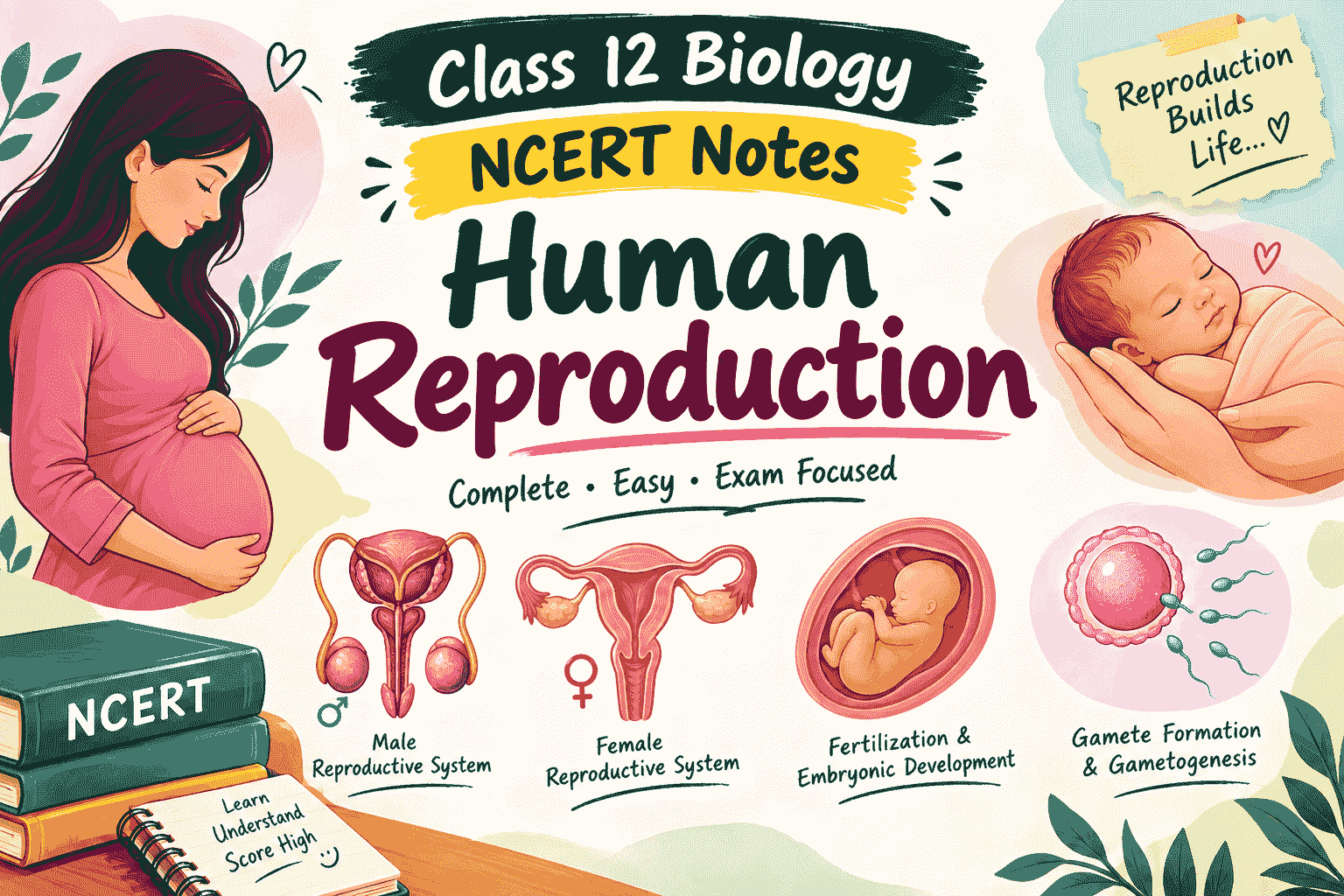
2.1 The Male Reproductive System
Toh basically… male reproductive system ka kaam hai sperm produce karna aur usse female reproductive tract tak pohonchaana.(Human Reproduction Class 12 Biology)
Main Parts:
1. Testes (Sing. Testis)
- Do testes hote hain — scrotum mein located
- Scrotum body ke bahar kyun? Kyunki sperm production ke liye temperature 2-2.5°C kam chahiye body temperature se
- Testis ke andar seminiferous tubules hote hain — yahan sperm banta hai
- Seminiferous tubules mein 2 types of cells:
- Sertoli cells — sperm ko nutrition deti hain
- Spermatogonia — sperm mother cells
- Testis ke beech mein Leydig cells (Interstitial cells) hote hain → Testosterone produce karte hain
2. Epididymis
- Testis ke upar ek coiled tube
- Sperm yahan mature hota hai aur temporarily store hota hai
3. Vas Deferens (Sperm duct)
- Epididymis se sperm ko upar le jaata hai
- Urinary bladder ke upar se guzarta hai
4. Seminal Vesicle
- Fructose-rich fluid secrete karta hai
- Yeh fluid sperm ko energy deta hai
5. Prostate Gland
- Milky fluid secrete karta hai
- Semen ko alkaline banata hai (vagina ki acidity se sperm ko bachata hai)
6. Bulbourethral Glands (Cowper’s Glands)
- Lubricating fluid secrete karta hai
- Urethra ko clean karta hai semen pass hone se pehle
7. Urethra
- Common passage for urine aur semen (ek waqt mein sirf ek)
8. Penis
- Male copulatory organ
- Urethra yahan se bahar nikalti hai
Semen kya hota hai?
Semen = Sperm + Seminal fluid (seminal vesicle + prostate + bulbourethral glands ka secretion) Ek ejaculation mein ~200-300 million sperms hote hain!
2.2 The Female Reproductive System
Female system ka kaam — egg produce karna, fertilisation allow karna, aur baby ko develop karna.
Main Parts:
1. Ovaries
- Do ovaries hoti hain — abdominal cavity mein, uterus ke dono taraf
- Eggs (oocytes) produce karti hain
- Estrogen aur Progesterone hormones produce karti hain
- Ovary mein follicles hote hain — har follicle mein ek developing egg hoti hai
2. Fallopian Tubes (Oviducts)
- Do tubes — ovary se uterus tak
- Har tube ke 3 parts:
- Infundibulum — funnel shaped, ovary ke paas, fimbriae hote hain (finger-like) jo egg pakadti hain
- Ampulla — wider part — fertilisation yahan hota hai!
- Isthmus — narrow part, uterus se juda
3. Uterus (Womb)
- Pear-shaped muscular organ
- Baby yahan develop hota hai
- 3 layers:
- Perimetrium — bahari layer
- Myometrium — middle muscular layer (delivery mein contract karti hai)
- Endometrium — inner layer — menstrual cycle mein shed hoti hai, embryo yahan implant hota hai
4. Cervix
- Uterus ka lower narrow part
- Vagina se connect karta hai
5. Vagina
- Female copulatory organ
- Birth canal bhi yahi hai
External Genitalia (Vulva):
- Mons pubis — fatty tissue
- Labia majora — outer folds
- Labia minora — inner folds
- Hymen — vaginal opening pe membrane
- Clitoris — sensitive erectile tissue
Mammary Glands (Breasts):
- Lactation ke liye — baby ko milk provide karna
- Glandular tissue + fat
- Alveoli → milk produce → mammary ducts → mammary duct → lactiferous duct → nipple
2.3 Gametogenesis
Gametogenesis = gametes banana.
Do types:
- Spermatogenesis — sperm formation (male)
- Oogenesis — egg formation (female)
🔵 Spermatogenesis
Kahan hota hai → Seminiferous tubules mein
Steps:
Step 1: Spermatogonia (2n)
- Diploid cells, seminiferous tubule ki wall mein
- Mitosis karte hain → multiply hote hain
Step 2: Primary Spermatocyte (2n)
- Spermatogonia grow karte hain → primary spermatocyte bante hain
Step 3: Meiosis I → Secondary Spermatocytes (n)
- Primary spermatocyte → Meiosis I → 2 Secondary Spermatocytes (haploid)
Step 4: Meiosis II → Spermatids (n)
- 2 Secondary spermatocytes → Meiosis II → 4 Spermatids
Step 5: Spermiogenesis
- Spermatids → Mature spermatozoa (sperm) mein transform hote hain
- Yeh process = Spermiogenesis
- Sertoli cells help karti hain
Step 6: Spermiation
- Mature sperm seminiferous tubule se release hona = Spermiation
Summary:
1 Spermatogonium → 4 sperms (all functional)
🔴 Structure of Sperm:
HEAD → NECK → MIDDLE PIECE → TAIL
Head:
- Nucleus — haploid, genetic material
- Acrosome — cap-like structure, enzymes contain karta hai (hyaluronidase etc.) — egg membrane ko penetrate karne ke liye
Neck:
- Centrioles hote hain
- Head aur middle piece ko join karta hai
Middle Piece:
- Mitochondria — energy (ATP) produce karta hai sperm movement ke liye
- Isliye middle piece = “powerhouse of sperm“
Tail (Flagellum):
- Movement ke liye
- Sperm ko swim karne mein help karta hai
🔴 Oogenesis
Kahan hota hai → Ovaries mein
Interesting fact: Female mein eggs birth se pehle hi partially develop ho jaate hain — Primary oocytes ovaries mein prophase I mein arrested rehte hain janam se!
Steps:
Step 1: Oogonia (2n)
- Foetal life mein ovaries mein oogonia hote hain
- Mitosis karte hain → multiply hote hain
Step 2: Primary Oocyte (2n)
- Oogonia → Primary oocyte banta hai
- Meiosis I shuru karta hai lekin Prophase I mein ROOK JAATA HAI
- Birth tak aur puberty tak yahi ruka rehta hai!
Step 3: Meiosis I complete hona (puberty ke baad)
- Asymmetric division hoti hai:
- 1 large Secondary Oocyte (zyada cytoplasm)
- 1 small First Polar Body (almost no cytoplasm)
Step 4: Secondary Oocyte → Meiosis II shuru karta hai
- Lekin phir Metaphase II mein ruk jaata hai
- Is stage pe ovulation hoti hai!
Step 5: Fertilisation ke baad
- Sperm enter karta hai → Meiosis II complete hoti hai
- 1 Ovum (egg) + 1 Second Polar Body banta hai
Summary:
1 Oogonium → 1 functional egg + 3 polar bodies (jo degenerate ho jaate hain)
Oogenesis vs Spermatogenesis comparison:
| Feature | Spermatogenesis | Oogenesis |
|---|---|---|
| Products | 4 functional sperms | 1 egg + 3 polar bodies |
| Where | Seminiferous tubules | Ovaries |
| When starts | Puberty | Foetal life |
| Cell division | Equal | Unequal (asymmetric) |
| Arrested stage | No arrest | Prophase I (birth tak), Metaphase II (fertilisation tak) |
2.4 Menstrual Cycle
Menstrual cycle = ek reproductive cycle jo fertile females mein approximately 28 days mein complete hota hai.
Pehli menstruation = Menarche (puberty pe) Last menstruation = Menopause (~45-50 years pe)
Phases of Menstrual Cycle:
Phase 1: Menstrual Phase (Day 1-5)
- Endometrium shed hoti hai → bleeding hoti hai
- Unfertilised egg + endometrial lining bahar aati hai
- Progesterone aur estrogen levels low hote hain
- Day 1 = first day of bleeding = Day 1 of cycle
Phase 2: Follicular Phase (Day 1-13)
- Ovary mein follicle develop hona shuru hota hai
- FSH (Follicle Stimulating Hormone) pituitary se release hota hai
- Follicle grow karta hai → Estrogen produce karta hai
- Estrogen → endometrium rebuild karti hai (proliferation)
- Estrogen levels badhte hain → positive feedback → LH surge trigger hota hai
Phase 3: Ovulation (Day 14)
- LH surge → Graafian follicle burst karta hai → Secondary oocyte release hoti hai
- Yeh oocyte fallopian tube mein jaati hai
- Agar fertilisation nahi hua 12-24 hours mein → egg degenerate ho jaati hai
Phase 4: Luteal Phase (Day 15-28)
- Burst follicle → Corpus Luteum banta hai
- Corpus luteum → Progesterone produce karta hai
- Progesterone → endometrium maintain karti hai (agar pregnancy ho toh)
- Agar fertilisation nahi hua → Corpus luteum degenerate hota hai → Corpus albicans banta hai
- Progesterone fall → endometrium shed → next cycle shuru!
Hormones summary:
| Hormone | Source | Function |
|---|---|---|
| FSH | Anterior pituitary | Follicle development |
| LH | Anterior pituitary | Ovulation trigger, corpus luteum |
| Estrogen | Follicle/Ovary | Endometrium proliferation |
| Progesterone | Corpus luteum | Endometrium maintenance |
Pregnancy mein: HCG (Human Chorionic Gonadotropin) → corpus luteum maintain karta hai → progesterone continue → periods nahi aate!
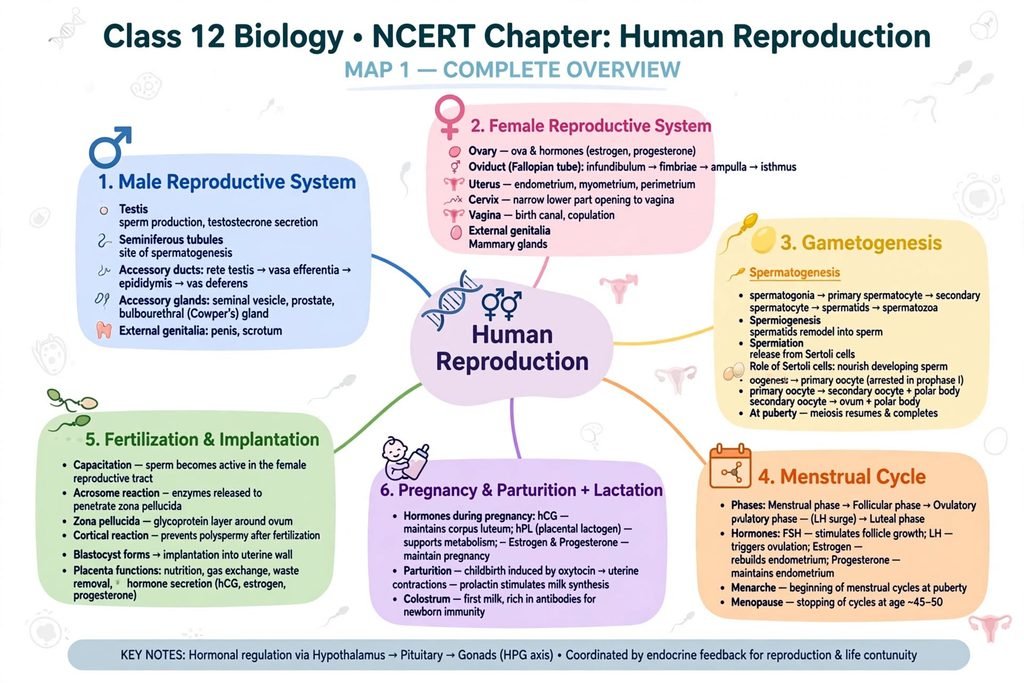
2.5 Fertilisation and Implantation
Fertilisation:
Kahan hota hai? → Fallopian tube ke Ampulla mein
Process:
- Ovulation ke baad secondary oocyte fallopian tube mein aati hai
- Sperm vagina → cervix → uterus → fallopian tube mein travel karta hai
- Sperm ka acrosome enzymes release karta hai (Acrosomal reaction) → egg ke zona pellucida ko dissolve karta hai
- Sperm egg mein enter karta hai → Cortical reaction — zona pellucida harden ho jaati hai → doosra sperm enter nahi kar sakta (Polyspermy blocked)
- Sperm enter karte hi → Secondary oocyte Meiosis II complete karta hai → Ovum + 2nd Polar Body
- Male pronucleus + Female pronucleus fuse karte hain → Zygote (2n)
Fertilisation = Syngamy between sperm and egg
Cleavage aur Blastocyst formation:
Zygote divide hona shuru karta hai — yeh divisions = Cleavage
Cleavage → 2 cells (blastomeres) → 4 → 8 → 16… → Morula → Blastocyst
- Morula = 16-32 cells ka solid ball
- Blastocyst = hollow ball structure
- Trophoblast — bahari layer (placenta banega)
- Inner Cell Mass (ICM/Embryoblast) — andar ki cells (embryo banega)
Implantation:
Kahan hota hai? → Uterus ke endometrium mein
Kab hota hai? → Fertilisation ke 6-7 days baad
Process:
- Blastocyst fallopian tube se uterus mein aata hai
- Trophoblast endometrium se attach karta hai
- Endometrium mein embed ho jaata hai = Implantation
- Implantation ke baad → HCG hormone produce hota hai → corpus luteum maintain hota hai → pregnancy continue hoti hai
Pregnancy test HCG ko hi detect karta hai urine mein!
2.6 Pregnancy and Embryonic Development
Placenta:
Implantation ke baad Placenta develop hota hai.
Placenta kya hai?
- Mother aur embryo ke beech ek special structure
- Trophoblast + Uterine tissue se bana
Functions of Placenta:
- Nutrition — glucose, amino acids, oxygen mother se embryo ko
- Excretion — CO2, urea embryo se mother ko
- Hormones — HCG, Progesterone, Estrogen, hPL produce karta hai
- Protection — harmful substances rokta hai (kuch)
- Umbilical cord se embryo se connected
Embryonic Development:
First Trimester (Month 1-3):
Month 1:
- Heart form hota hai, heartbeat shuru
- Limb buds appear hote hain
- Embryo ≈ 1 cm
Month 2:
- Fingers, toes form hote hain
- Eyes, ears develop hone lagte hain
- Embryo → Foetus (2 months ke baad)
- Major organs form ho jaate hain
Month 3:
- Limbs fully formed
- External genitalia visible
- Foetus movements shuru (mother ko feel nahi hoti abhi)
Second Trimester (Month 4-6):
- Foetus rapidly grow karta hai
- Month 5 → First foetal movements feel hone lagte hain (Quickening)
- Hair, eyebrows, eyelashes appear
- Eyelids form hoti hain
Third Trimester (Month 7-9):
- Rapid growth aur weight gain
- Organs mature hote hain
- Foetus uterus mein head-down position le leta hai (normal delivery ke liye)
- Month 9 → Baby fully developed, delivery ready
Gestation period:
Human mein gestation period = 9 months (266-280 days)
2.7 Parturition and Lactation
Parturition (Delivery/Childbirth):
Parturition = baby ka bahar aana = Labour
Kaise hota hai?
Yeh ek neuroendocrine mechanism hai.
Hormones involved:
- Fully developed foetus → signals send karta hai
- Oxytocin (pituitary se) → uterine contractions trigger karta hai
- Uterine contractions → placenta press hota hai → aur oxytocin release → aur contractions (Positive feedback loop)
- Contractions badh jaati hain → cervix dilate hoti hai → baby bahar aata hai
- Placenta baad mein bahar aata hai (afterbirth)
Types of delivery:
- Normal/Vaginal delivery — natural way
- Caesarean (C-section) — surgical, jab complications hon
Lactation:
Lactation = milk production aur secretion
Hormone involved: Prolactin (anterior pituitary se)
Colostrum:
- Delivery ke baad pehle kuch din jo milk hota hai → Colostrum
- Yellowish, thick
- Immunoglobulins (IgA) se bharpoor → baby ko passive immunity deta hai
- Bahut important! Isliye doctors kehte hain pehla milk zaroor pilao
Milk ejection:
- Baby suckling → nipple stimulation → Oxytocin release → alveoli contract → milk ejection = Let-down reflex
Breast milk benefits:
- Complete nutrition for baby
- Antibodies provide karta hai
- Mother-baby bonding
- Mother ka weight loss bhi
- Ovulation temporarily suppress karta hai (natural contraception — but reliable nahi)
Lactational Amenorrhea:
- Breastfeeding ke during periods nahi aate — yeh temporary natural contraception hai
- But yeh 100% reliable nahi — pregnancy ho sakti hai
📝 Important Terms — Quick Recall
| Term | Meaning |
|---|---|
| Spermatogenesis | Sperm formation |
| Oogenesis | Egg formation |
| Spermiogenesis | Spermatid → mature sperm |
| Spermiation | Sperm release from seminiferous tubule |
| Menarche | First menstruation |
| Menopause | Last menstruation |
| Ovulation | Egg release from ovary |
| Corpus luteum | Post-ovulation structure, progesterone produce karta hai |
| Acrosomal reaction | Sperm enzymes release during fertilisation |
| Cleavage | Zygote ki early divisions |
| Morula | 16-32 cell stage |
| Blastocyst | Hollow ball, implantation karta hai |
| Implantation | Blastocyst uterus mein embed hona |
| Placenta | Mother-embryo exchange organ |
| Quickening | First foetal movements felt |
| Parturition | Childbirth |
| Colostrum | First milk, antibodies wala |
| Prolactin | Milk production hormone |
| Oxytocin | Uterine contraction + milk ejection |
| HCG | Pregnancy hormone, test mein detect hota hai |
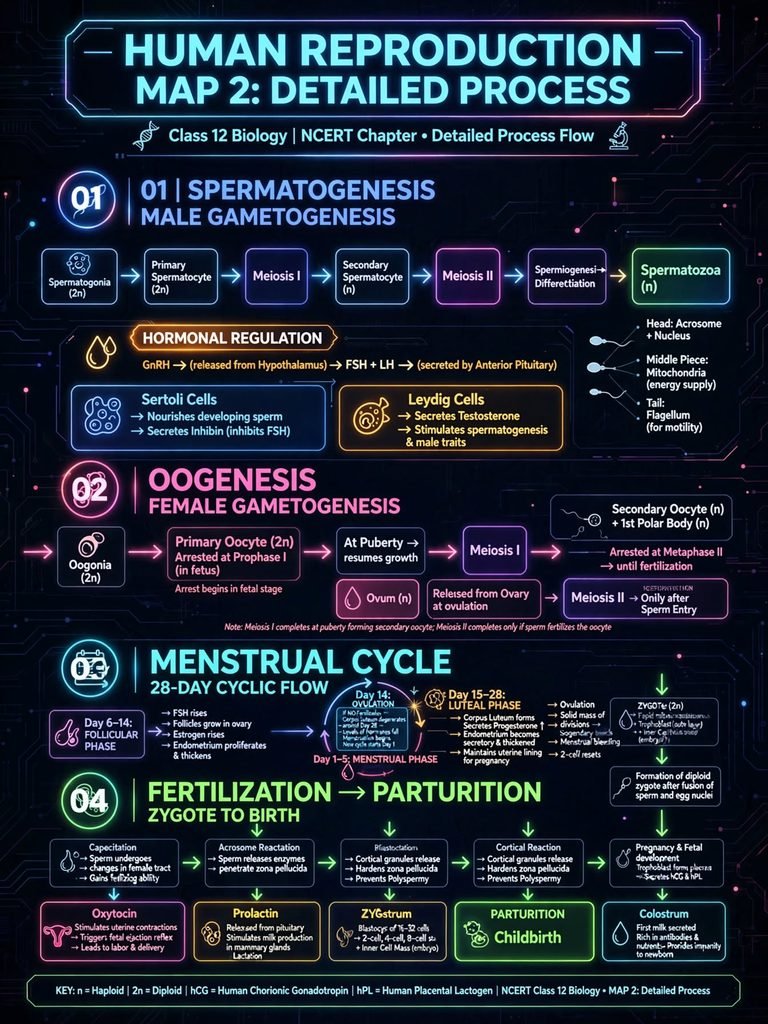
⭐ NEET ke liye Must Remember:
- Fertilisation → Ampulla of fallopian tube mein
- Implantation → Endometrium mein, 6-7 days baad
- Corpus luteum → Progesterone produce karta hai
- HCG → pregnancy test detect karta hai
- Gestation period → 9 months
- Colostrum → IgA antibodies, passive immunity
- Acrosomal reaction → fertilisation mein
- Secondary oocyte arrested → Metaphase II mein
- Primary oocyte arrested → Prophase I mein
- 1 spermatogonium → 4 sperms
- 1 oogonium → 1 egg + 3 polar bodies
- Oxytocin → parturition + milk ejection dono
- Prolactin → milk production
Chapter 2: Human Reproduction
Fill in the Blanks — Complete Answers
(a) Humans reproduce _ (asexually/sexually)
✅ sexually
Explanation: Humans mein reproduction sexual hoti hai — male aur female gametes (sperm aur egg) ki fusion se new life banta hai.
(b) Humans are _ (oviparous, viviparous, ovoviviparous)
✅ viviparous
Explanation:
- Oviparous = eggs dete hain (birds, reptiles)
- Viviparous = baby directly janam dete hain (humans, mammals)
- Ovoviviparous = eggs andar hatch hote hain (kuch sharks)
Humans mein baby mother ke uterus mein develop hota hai aur directly janam leta hai → Viviparous
(c) Fertilisation is _ in humans (external/internal)
✅ internal
Explanation: Humans mein fertilisation female body ke andar — fallopian tube ke ampulla mein hoti hai. External fertilisation water mein hoti hai (jaise frogs, fish mein).
(d) Male and female gametes are _ (diploid/haploid)
✅ haploid
Explanation: Sperm (male gamete) aur egg (female gamete) dono haploid (n) hote hain — inme 23 chromosomes hote hain. Meiosis ke baad bante hain isliye haploid.
(e) Zygote is _ (diploid/haploid)
✅ diploid
Explanation: Sperm (n) + Egg (n) → Zygote (2n = diploid). Fertilisation ke baad dono haploid gametes fuse karte hain → diploid zygote banta hai jisme 46 chromosomes hote hain.
(f) The process of release of ovum from a mature follicle is called _
✅ Ovulation
Explanation: Mature Graafian follicle burst karta hai → secondary oocyte (ovum) release hoti hai → yeh process Ovulation hai. Menstrual cycle ke approximately Day 14 pe hota hai.
(g) Ovulation is induced by a hormone called _
✅ Luteinising Hormone (LH)
Explanation: Pituitary gland se LH surge aata hai → Graafian follicle burst karta hai → ovulation hoti hai. Yeh LH surge estrogen ke high levels ke baad positive feedback se trigger hota hai.
(h) The fusion of male and female gametes is called _
✅ Fertilisation (Syngamy)
Explanation: Sperm aur egg ka fusion = Fertilisation ya Syngamy. Is process se zygote banta hai. Fallopian tube ke ampulla mein hoti hai humans mein.
(i) Fertilisation takes place in _
✅ Fallopian tube (Ampulla of fallopian tube)
Explanation: Fertilisation fallopian tube ke ampulla mein hoti hai — yeh ovary ke paas wala wider portion hota hai. NEET mein yeh exact location yaad rakhna zaroori hai!
(j) Zygote divides to form _ which is implanted in uterus.
✅ Blastocyst
Explanation: Zygote → Cleavage → Morula → Blastocyst banta hai → jo uterus ke endometrium mein implant hota hai (fertilisation ke 6-7 days baad).
(k) The structure which provides vascular connection between foetus and uterus is called _
✅ Placenta
Explanation: Placenta mother aur foetus ke beech connection provide karta hai — oxygen, nutrients foetus ko milte hain, aur CO2, waste products wapas mother ko. Umbilical cord placenta ko foetus se connect karti hai.
✅ Quick Answer List:
| # | Answer |
|---|---|
| (a) | Sexually |
| (b) | Viviparous |
| (c) | Internal |
| (d) | Haploid |
| (e) | Diploid |
| (f) | Ovulation |
| (g) | LH (Luteinising Hormone) |
| (h) | Fertilisation (Syngamy) |
| (i) | Fallopian tube (Ampulla) |
| (j) | Blastocyst |
| (k) | Placenta |
🧬 Chapter 2: Human Reproduction
NCERT Exercise Q2 to Q21 — Complete Answers
Q2. Draw a labelled diagram of male reproductive system.
Answer:
        Urinary Bladder
              |
        Seminal Vesicle ──┐
              |            |
        Vas Deferens      |
              |            ├── Ejaculatory Duct
        Prostate Gland ───┘
              |
        Bulbourethral Gland (Cowper's)
              |
           Urethra
              |
            Penis
              |
          Glans Penis

    [Side structures:]
    Epididymis ← sits on top of → Testis
    (inside Scrotum)
Labelled Parts:
- Testis — sperm + testosterone production
- Epididymis — sperm maturation + storage
- Vas Deferens — sperm transport
- Seminal Vesicle — fructose-rich fluid
- Prostate Gland — alkaline fluid
- Bulbourethral Gland — lubricating fluid
- Urethra — common passage
- Penis — copulatory organ
- Scrotum — testis ko house karta hai
(Exam mein neat diagram draw karna with all labels!)
Q3. Draw a labelled diagram of female reproductive system.
Answer:
        Ovary (left)          Ovary (right)
            \                    /
         Fallopian Tube      Fallopian Tube
          (Oviduct)           (Oviduct)
              \                  /
          Infundibulum+Fimbriae
                    \
                  Ampulla
                    \
                  Isthmus
                      \
                    UTERUS
                   /      \
            Fundus        Body
                      |
                   Cervix
                      |
                   Vagina
Labelled Parts:
- Ovary — egg + hormones produce karta hai
- Infundibulum — funnel shaped, fimbriae hote hain
- Ampulla — fertilisation yahan hoti hai
- Isthmus — narrow part, uterus se juda
- Uterus — baby develop hota hai
- Endometrium — inner lining
- Myometrium — muscular layer
- Cervix — lower narrow part
- Vagina — copulatory organ + birth canal
(Exam mein neat diagram draw karna!)
Q4. Write two major functions each of testis and ovary.
Answer:
Testis ke functions:
1. Spermatogenesis:
- Seminiferous tubules mein sperm (spermatozoa) produce karna
- Male gametes yahan bante hain
2. Androgen secretion:
- Leydig cells → Testosterone produce karta hai
- Secondary sexual characters develop karta hai (beard, deep voice, muscle growth etc.)
Ovary ke functions:
1. Oogenesis:
- Eggs (ova) produce karna
- Female gametes yahan develop hote hain
2. Hormone secretion:
- Estrogen → secondary sexual characters, endometrium proliferation
- Progesterone → pregnancy maintain karna, endometrium maintain karna
Q5. Describe the structure of a seminiferous tubule.
Answer:
Seminiferous tubules testis ke andar highly coiled tubules hain — yahan sperm banta hai.
Structure:
Outer wall — Germinal Epithelium:
Tubule ki wall mein do types of cells hoti hain:
1. Spermatogonia (Germ cells):
- Tubule ki wall mein lined hoti hain
- Ye cells divide karke sperm produce karti hain
- Different stages mein dikhengi — spermatogonia → primary spermatocyte → secondary spermatocyte → spermatids → sperm
2. Sertoli cells (Nurse cells):
- Large cells jo germ cells ke beech mein hoti hain
- Functions:
- Developing sperm ko nutrition provide karti hain
- Blood-testis barrier banati hain
- Inhibin hormone secrete karti hain (FSH ko regulate karta hai)
- Spermiogenesis mein help karti hain
Interstitial space (tubules ke beech):
- Leydig cells (Interstitial cells) hote hain
- Testosterone produce karte hain
Lumen:
- Tubule ke center mein fluid hota hai
- Mature sperm yahan release hote hain → epididymis ki taraf
Overall:
Seminiferous tubule = sperm factory. Wall pe mother cells hain, nurse cells hain, aur beech mein Leydig cells testosterone banate hain.
Q6. What is spermatogenesis? Briefly describe the process of spermatogenesis.
Answer:
Spermatogenesis kya hai?
Yeh woh process hai jisme male gonads (testes) ke seminiferous tubules mein spermatozoa (sperm) produce hote hain.
Yeh puberty ke baad shuru hota hai aur lifelong chalta rehta hai.
Process of Spermatogenesis:
Step 1: Spermatogonia (2n)
- Seminiferous tubule ki wall mein diploid cells
- Mitosis se multiply karte hain — kuch stem cells ki tarah rehte hain, kuch differentiate hote hain
Step 2: Primary Spermatocyte (2n)
- Kuch spermatogonia → grow karke primary spermatocytes bante hain
- DNA replication hoti hai
Step 3: Meiosis I → Secondary Spermatocytes (n)
- Primary spermatocyte → Meiosis I → 2 Secondary Spermatocytes
- Ab haploid (n) hain
- 23 chromosomes each mein
Step 4: Meiosis II → Spermatids (n)
- 2 Secondary spermatocytes → Meiosis II → 4 Spermatids
- Still haploid
- Round shaped cells — abhi tail nahi hoti
Step 5: Spermiogenesis
- Spermatids → Mature spermatozoa mein transform hona
- Acrosome develop hota hai
- Flagellum (tail) develop hota hai
- Nucleus compact hota hai
- Extra cytoplasm shed hota hai
- Sertoli cells yahan help karti hain
Step 6: Spermiation
- Mature sperm seminiferous tubule ke lumen mein release hote hain
- Phir epididymis mein jaate hain maturation ke liye
Summary:
Spermatogonia (2n) → Primary spermatocyte (2n) → Secondary spermatocyte (n) → Spermatid (n) → Spermatozoa (n) 1 Spermatogonium → 4 Sperms
Q7. Name the hormones involved in regulation of spermatogenesis.
Answer:
Spermatogenesis regulate karne wale hormones:
1. GnRH (Gonadotropin Releasing Hormone)
- Source: Hypothalamus
- Function: Pituitary ko FSH aur LH release karne ka signal deta hai
2. FSH (Follicle Stimulating Hormone)
- Source: Anterior Pituitary
- Function: Sertoli cells ko stimulate karta hai → jo spermatogenesis support karte hain
- Inhibin ke through negative feedback
3. LH (Luteinising Hormone)
- Source: Anterior Pituitary
- Function: Leydig cells ko stimulate karta hai → Testosterone produce karte hain
4. Testosterone (Androgens)
- Source: Leydig cells (Testis)
- Function: Spermatogenesis ke liye essential — sperm development directly influence karta hai
- Secondary sexual characters bhi develop karta hai
5. Inhibin
- Source: Sertoli cells
- Function: FSH ko negative feedback deta hai — zyada sperm hone par FSH kam hoti hai (regulation)
Axis:
Hypothalamus → GnRH → Pituitary → FSH + LH → Testis → Testosterone + Sperm
Q8. Define spermiogenesis and spermiation.
Answer:
Spermiogenesis:
Spermatids ka mature spermatozoa (sperm) mein transformation = Spermiogenesis
Changes jo hote hain:
- Acrosome develop hota hai (Golgi body se)
- Flagellum (tail) develop hota hai
- Nucleus elongate aur compact hota hai
- Extra cytoplasm shed hota hai
- Mitochondria middle piece mein arrange hote hain
Basically spermatid ek round cell hoti hai → spermiogenesis ke baad tadpole-shaped sperm banta hai.
Spermiation:
Mature spermatozoa (sperm) ka Sertoli cells se detach hokar seminiferous tubule ke lumen mein release hona = Spermiation
Iske baad sperm epididymis mein jaata hai final maturation ke liye.
Simple yaad karo:
- Spermiogenesis = spermatid banta hai sperm
- Spermiation = sperm release hota hai tubule mein
Q9. Draw a labelled diagram of sperm.
Answer:
    ┌─────────────┐
    │  ACROSOME   │  ← Enzymes (Hyaluronidase etc.)
    ├─────────────┤
    │   NUCLEUS   │  ← Haploid genetic material
    └──────┬──────┘
           │  HEAD
    ═══════╪═══════
           │  NECK
    ═══════╪═══════  ← Centrioles
           │
    ┌──────┴──────┐
    │ MITOCHONDRIA│  ← Energy (ATP) production
    │  (Spiral)   │
    └──────┬──────┘
           │  MIDDLE PIECE
    ═══════╪═══════
           │
           │  TAIL (Flagellum)
           │
           ▼  (Movement)
Parts aur functions:
| Part | Content | Function |
|---|---|---|
| Acrosome | Enzymes | Egg membrane penetrate karna |
| Nucleus | DNA (23 chromosomes) | Genetic material carry karna |
| Neck | Centrioles | Tail formation |
| Middle piece | Mitochondria | ATP energy for movement |
| Tail | Axoneme (microtubules) | Swimming/movement |
Q10. What are the major components of seminal plasma?
Answer:
Seminal plasma = semen ka fluid part (sperm ke alawa)
Yeh in glands ka secretion hai:
1. Seminal Vesicle secretion:
- Fructose — sperm ko energy source
- Prostaglandins
- Proteins
- Ascorbic acid
2. Prostate Gland secretion:
- Alkaline fluid — vagina ki acidity neutralize karta hai (sperm protect karta hai)
- Citric acid
- Calcium
- Enzymes (PSA — Prostate Specific Antigen)
3. Bulbourethral Gland (Cowper’s) secretion:
- Lubricating fluid
- Urethra ko clean karta hai
- Pre-ejaculatory fluid
Overall seminal plasma mein hota hai:
- Fructose (energy)
- Proteins
- Enzymes
- Hormones
- Alkaline substances
- Water
Seminal plasma sperm ko protect, nourish, aur transport karne mein help karta hai.
Q11. What are the major functions of male accessory ducts and glands?
Answer:
Male Accessory Ducts:
1. Epididymis:
- Sperm ka maturation — sperm motility aur fertilising ability develop hoti hai
- Sperm storage — temporarily store karta hai
2. Vas Deferens:
- Sperm ko epididymis se ejaculatory duct tak transport karta hai
- Peristaltic movements se
3. Ejaculatory Duct:
- Vas deferens aur seminal vesicle duct mein join karta hai
- Semen ko urethra mein deliver karta hai
4. Urethra:
- Common passage for urine aur semen
- Semen ko body se bahar nikalta hai (ejaculation)
Male Accessory Glands:
1. Seminal Vesicles:
- Fructose provide — sperm ko energy
- Fluid semen volume ka ~60% hota hai
2. Prostate Gland:
- Alkaline fluid — vaginal acidity neutralize karta hai
- Sperm ko acidic environment se bachata hai
3. Bulbourethral Glands:
- Lubrication provide karta hai
- Urethra mein koi urine residue ho toh saaf karta hai
- Sperm movement smooth banata hai
Ek line mein: Accessory ducts = transport, Accessory glands = nourish + protect + lubricate sperm
Q12. What is oogenesis? Give a brief account of oogenesis.
Answer:
Oogenesis kya hai?
Female gonads (ovaries) mein eggs (ova/oocytes) ka formation = Oogenesis
Yeh foetal life mein shuru hota hai aur fertilisation tak complete nahi hota!
Process:
Step 1: Oogonia (2n) — Foetal life mein
- Embryo ke ovaries mein oogonia form hote hain
- Mitosis se multiply karte hain
- Millions of oogonia bante hain
Step 2: Primary Oocyte (2n) — Birth se pehle
- Oogonia → Primary oocyte bante hain
- Meiosis I shuru karte hain lekin Prophase I mein ROOK JAATE HAIN
- Birth tak aur puberty tak yahi stage pe ruke rehte hain
- Primary follicle se surrounded rehte hain
Step 3: Puberty ke baad — Meiosis I complete
- Har menstrual cycle mein ek follicle mature hota hai
- Primary oocyte → Meiosis I complete karta hai
- Asymmetric division:
- 1 Large Secondary Oocyte (zyada cytoplasm)
- 1 Small First Polar Body (bahut kam cytoplasm)
Step 4: Secondary Oocyte → Meiosis II shuru
- Secondary oocyte → Meiosis II shuru karta hai
- Lekin Metaphase II mein ruk jaata hai
- Is stage pe OVULATION hoti hai — secondary oocyte fallopian tube mein jaati hai
Step 5: Fertilisation ke baad — Meiosis II complete
- Sperm enter karta hai → trigger hota hai
- Meiosis II complete hoti hai:
- 1 Mature Ovum (egg)
- 1 Second Polar Body
Summary:
1 Oogonium → 1 Mature Ovum + 3 Polar bodies (degenerate ho jaate hain)
Key arrests:
– Prophase I →
birth tak ruka
- Metaphase II → fertilisation tak ruka
Q13. Draw a labelled diagram of a section through ovary.
Answer:
         OVARY — Cross Section
    ┌─────────────────────────────┐
    │      Germinal Epithelium    │ ← outermost layer
    │  ┌──────────────────────┐   │
    │  │    Cortex            │   │
    │  │                      │   │
    │  │ [Primordial Follicle]│   │
    │  │                      │   │
    │  │ [Primary Follicle]   │   │
    │  │                      │   │
    │  │ [Secondary Follicle] │   │
    │  │        ↓             │   │
    │  │ [Graafian Follicle]  │   │
    │  │  (mature, with antrum│   │
    │  │   and oocyte)        │   │
    │  │        ↓             │   │
    │  │ [Corpus Luteum]      │   │
    │  │   (post ovulation)   │   │
    │  │        ↓             │   │
    │  │ [Corpus Albicans]    │   │
    │  │   (degenerated CL)   │   │
    │  │                      │   │
    │  │      Medulla         │   │
    │  │  (Blood vessels,     │   │
    │  │   nerves, lymphatics)│   │
    │  └──────────────────────┘   │
    └─────────────────────────────┘
Labels:
- Germinal epithelium
- Primordial follicle
- Primary follicle
- Secondary follicle
- Graafian follicle (antrum visible)
- Corpus luteum
- Corpus albicans
- Medulla (blood vessels)
(Exam mein neat diagram zaroor draw karna!)
Q14. Draw a labelled diagram of a Graafian follicle.
Answer:
         GRAAFIAN FOLLICLE
    ┌──────────────────────────┐
    │   Theca Externa          │ ← outermost layer
    │  ┌────────────────────┐  │
    │  │  Theca Interna     │  │ ← estrogen produce
    │  │ ┌──────────────┐   │  │
    │  │ │ Granulosa    │   │  │ ← FSH responsive cells
    │  │ │ cells        │   │  │
    │  │ │   ┌───────┐  │   │  │
    │  │ │   │ANTRUM │  │   │  │ ← fluid filled space
    │  │ │   │(fluid)│  │   │  │
    │  │ │   └───────┘  │   │  │
    │  │ │              │   │  │
    │  │ │  [Cumulus    │   │  │
    │  │ │   Oophorus]  │   │  │ ← granulosa cells around egg
    │  │ │    ↓         │   │  │
    │  │ │  [OOCYTE]    │   │  │ ← Secondary oocyte
    │  │ │  +Zona       │   │  │ ← Zona pellucida
    │  │ │  Pellucida   │   │  │
    │  │ └──────────────┘   │  │
    │  └────────────────────┘  │
    └──────────────────────────┘
Labels:
- Theca externa
- Theca interna
- Granulosa cells
- Antrum (follicular fluid)
- Cumulus oophorus
- Secondary oocyte
- Zona pellucida
- Corona radiata
Q15. Name the functions of the following:
(a) Corpus Luteum:
- Ovulation ke baad burst follicle se banta hai
- Progesterone hormone secrete karta hai
- Endometrium maintain karta hai pregnancy ke liye
- Agar pregnancy ho → HCG se maintain rehta hai
- Agar pregnancy nahi → degenerate hota hai → corpus albicans banta hai → menstruation shuru
(b) Endometrium:
- Uterus ki inner lining
- Implantation ke liye site provide karta hai
- Embryo ko nourish karta hai implantation ke baad
- Menstrual cycle mein shed hota hai (agar pregnancy nahi hui)
- Estrogen se proliferate karta hai, progesterone se maintain hota hai
(c) Acrosome:
- Sperm ke head pe cap-like structure
- Enzymes contain karta hai — Hyaluronidase, Acrosin etc.
- Acrosomal reaction — fertilisation ke time enzymes release karta hai
- Egg ki Zona pellucida ko dissolve karta hai
- Sperm ko egg mein penetrate karne mein help karta hai
(d) Sperm Tail:
- Sperm ka flagellum = tail
- Motility provide karta hai — sperm ko swim karne mein help karta hai
- Female reproductive tract mein egg tak pohonchne ke liye movement
- Axoneme (microtubule arrangement) se bana hota hai — 9+2 pattern
(e) Fimbriae:
- Fallopian tube ke infundibulum pe finger-like projections
- Ovulation ke baad egg ko pakadti hain
- Egg ko infundibulum mein guide karti hain
- Cilia ki movements se egg fallopian tube mein move karti hai
Q16. Identify True/False statements. Correct each false statement.
(a) Androgens are produced by Sertoli cells.
❌ FALSE
Correction: Androgens (Testosterone) Leydig cells (Interstitial cells) dwara produce hote hain, Sertoli cells dwara nahi. Sertoli cells sperm ko nutrition deti hain aur Inhibin secrete karti hain.
(b) Spermatozoa get nutrition from Sertoli cells.
✅ TRUE
Explanation: Sertoli cells developing spermatozoa ko nutrients provide karti hain. Isliye inhe “Nurse cells” bhi kehte hain.
(c) Leydig cells are found in ovary.
❌ FALSE
Correction: Leydig cells testis mein (seminiferous tubules ke beech interstitial space mein) paaye jaate hain, ovary mein nahi.
(d) Leydig cells synthesise androgens.
✅ TRUE
Explanation: Leydig cells (Interstitial cells of Leydig) → Testosterone (androgen) synthesise karte hain. LH inhe stimulate karta hai.
(e) Oogenesis takes place in corpus luteum.
❌ FALSE
Correction: Oogenesis ovary mein hoti hai (specifically ovarian follicles mein). Corpus luteum toh ovulation ke baad banta hai aur progesterone secrete karta hai — oogenesis yahan nahi hoti.
(f) Menstrual cycle ceases during pregnancy.
✅ TRUE
Explanation: Pregnancy mein HCG → corpus luteum maintain karta hai → progesterone high rehta hai → endometrium shed nahi hoti → menstruation nahi hoti. Delivery ke baad normal cycle resume hoti hai.
(g) Presence or absence of hymen is not a reliable indicator of virginity or sexual experience.
✅ TRUE
Explanation: Hymen physically activities (exercise, sports, cycling) se bhi alter ho sakti hai. Isiliye iska presence ya absence virginity ka indicator nahi hai. Yeh scientifically aur medically confirmed fact hai.
Q17. What is menstrual cycle? Which hormones regulate menstrual cycle?
Answer:
Menstrual Cycle:
Fertile human females mein approximately 28 days mein complete hone wala reproductive cycle = Menstrual cycle
Pehla cycle = Menarche (puberty pe ~12-13 years) Last cycle = Menopause (~45-50 years)
4 phases:
- Menstrual phase (Day 1-5) — bleeding
- Follicular phase (Day 1-13) — follicle develop, endometrium rebuild
- Ovulation (Day 14) — egg release
- Luteal phase (Day 15-28) — corpus luteum, progesterone
Regulating Hormones:
| Hormone | Source | Role in cycle |
|---|---|---|
| GnRH | Hypothalamus | FSH/LH release stimulate karta hai |
| FSH | Anterior Pituitary | Follicle develop karta hai |
| LH | Anterior Pituitary | Ovulation trigger karta hai (LH surge) |
| Estrogen | Ovarian follicle | Endometrium proliferate karta hai |
| Progesterone | Corpus luteum | Endometrium maintain karta hai |
Q18. What is parturition? Which hormones are involved in induction of parturition?
Answer:
Parturition:
Gestation period (9 months) ke baad baby ka uterus se bahar aana = Parturition (Childbirth/Labour)
Process:
- Fully developed foetus aur placenta → signals produce karte hain
- Mild uterine contractions shuru hoti hain
- Positive feedback se contractions strong hoti jaati hain
- Cervix dilate hoti hai → baby bahar aata hai
- Baad mein placenta bahar aata hai (afterbirth)
Hormones involved:
1. Oxytocin (most important):
- Source: Posterior Pituitary
- Strong uterine contractions induce karta hai
- Positive feedback loop — baby ka pressure → aur oxytocin → aur contractions
- Medically bhi labor induce karne ke liye use hota hai
2. Relaxin:
- Source: Corpus luteum + Placenta
- Pubic symphysis aur cervix ko relax aur dilate karta hai
- Baby ke passage ko easy banata hai
3. Estrogen:
- Parturition ke near estrogen badh jaata hai
- Oxytocin receptors uterus mein increase karta hai
- Uterus ko contractions ke liye prepare karta hai
4. Prostaglandins:
- Uterine contractions mein contribute karte hain
- Cervical ripening mein help karte hain
Q19. In our society the women are often blamed for giving birth to daughters. Can you explain why this is not correct?
Answer:
Yeh bilkul galat aur unscientific soch hai. Biology clearly explain karti hai kyun:
Sex determination kaise hota hai?
Humans mein sex chromosomes hote hain:
- Female: XX (do X chromosomes)
- Male: XY (ek X, ek Y chromosome)
Eggs (female gametes):
- Female sirf X chromosome wali eggs produce kar sakti hai
- Kyunki female XX hai → meiosis ke baad sirf X
Sperms (male gametes):
- Male XY hai → meiosis ke baad:
- 50% sperms = X chromosome wale
- 50% sperms = Y chromosome wale
Fertilisation:
- X sperm + X egg = XX = Girl 👧
- Y sperm + X egg = XY = Boy 👦
Conclusion:
Baby ka sex father ke sperm pe depend karta hai — X wala aaya ya Y wala.
Mother ke paas sirf X chromosome hota hai egg mein — toh woh toh sirf X de sakti hai!
Isliye baby girl ya boy hona 100% father ke sperm pe depend karta hai, mother pe nahi.
Women ko blame karna scientifically completely wrong hai — unka isme koi control nahi. Society ko yeh samajhna chahiye!
Q20. How many eggs are released by a human ovary in a month? How many eggs would have been released if the mother gave birth to identical twins? Would your answer change if the twins born were fraternal?
Answer:
Normal case:
- Human ovary ek month mein 1 egg release karta hai (ovulation)
Identical Twins (Monozygotic twins):
- Still 1 egg release hota hai
- 1 egg + 1 sperm → 1 zygote → early division mein 2 separate embryos ban jaate hain
- Dono genetically identical hote hain (same DNA)
- Answer nahi badlega — sirf 1 egg
Fraternal Twins (Dizygotic twins):
- 2 eggs release hote hain (ek cycle mein dono ovaries se ya ek hi se)
- 2 alag eggs + 2 alag sperms → 2 alag zygotes
- Dono genetically alag hote hain (siblings ki tarah)
- Haan, answer badlega — 2 eggs
Summary:
| Type | Eggs released | Zygotes | Genetically |
|---|---|---|---|
| Single baby | 1 | 1 | — |
| Identical twins | 1 | 1 (splits) | Identical |
| Fraternal twins | 2 | 2 | Different |
Q21. How many eggs do you think were released by the ovary of a female dog which gave birth to 6 puppies?
Answer:
6 eggs released hue honge.
Explanation:
Dogs polytocous animals hain — ek baar mein multiple offspring dete hain.
Dogs mein multiple ovulation hoti hai — ek cycle mein multiple eggs release hote hain.
Har puppy = ek alag egg + ek alag sperm = ek alag zygote
Toh 6 puppies = 6 alag zygotes = 6 alag eggs fertilised
Isliye female dog ki ovary ne us cycle mein 6 eggs release kiye.
(Agar identical twins ki tarah split hota kisi ek mein, toh kam eggs se bhi ho sakta tha — lekin generally 6 puppies = 6 eggs assume karte hain)
✅ Quick Reference Table
| Q | Key Answer |
|---|---|
| Q4 | Testis: sperm + testosterone; Ovary: egg + estrogen/progesterone |
| Q7 | GnRH, FSH, LH, Testosterone, Inhibin |
| Q8 | Spermiogenesis = spermatid→sperm; Spermiation = sperm release |
| Q10 | Fructose, alkaline fluid, lubricants, proteins |
| Q15 | CL=progesterone; Endometrium=implantation; Acrosome=enzymes |
| Q16 | False: a, c, e; True: b, d, f, g |
| Q17 | FSH, LH, Estrogen, Progesterone, GnRH |
| Q18 | Oxytocin, Relaxin, Estrogen, Prostaglandins |
| Q19 | Father’s sperm determines sex — Y=boy, X=girl |
| Q20 | Identical=1 egg; Fraternal=2 eggs |
| Q21 | 6 eggs |