NCERT Class 12 Chemistry Chapter 1 Solutions complete Notes
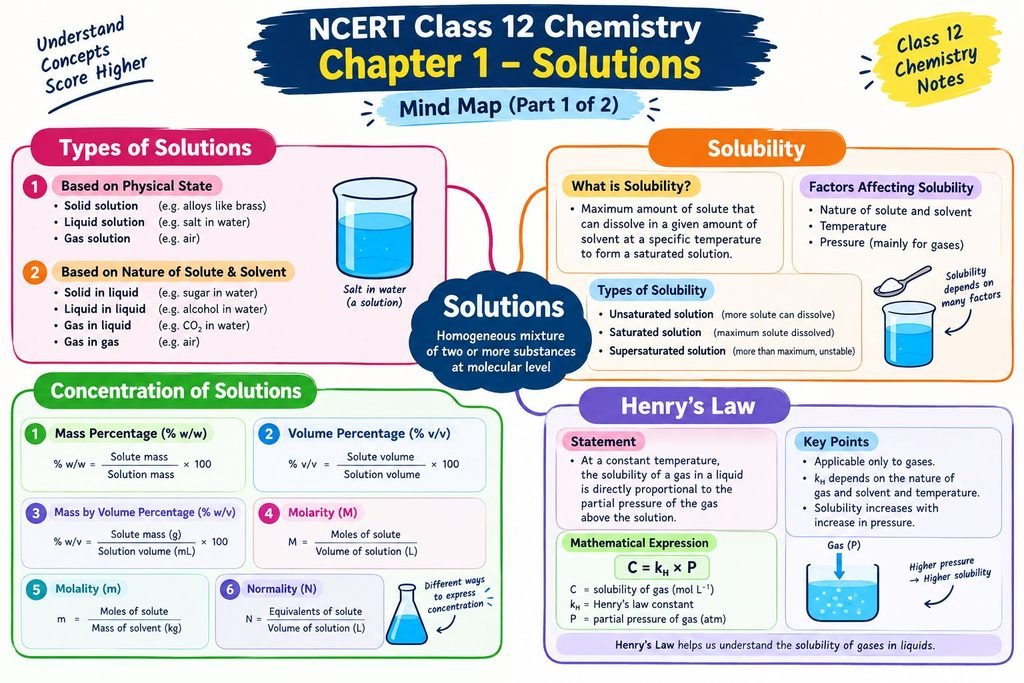
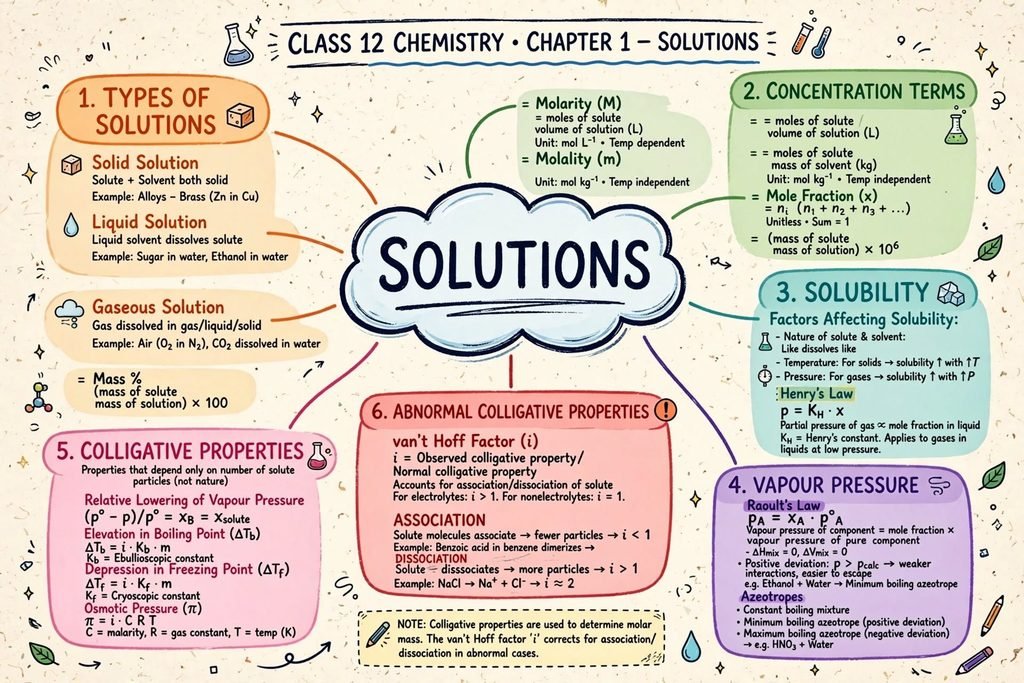
1. Types of Solutions
Toh basically… solution ek homogeneous mixture hota hai — matlab dono substances itne ache se mix ho jaate hain ki alag-alag nahi dikh te.
Solute = jo dissolve hota hai (kam matra mein) Solvent = jisme dissolve hota hai (zyada matra mein)
Teen states hain — solid, liquid, gas. Inhe combine karo toh 9 types of solutions bante hain:
| Solute | Solvent | Example |
|---|---|---|
| Gas | Gas | Air (O₂ in N₂) |
| Gas | Liquid | Soda water (CO₂ in H₂O) |
| Gas | Solid | H₂ in Palladium |
| Liquid | Gas | Humidity (water vapour in air) |
| Liquid | Liquid | Alcohol in water |
| Liquid | Solid | Mercury in zinc (amalgam) |
| Solid | Gas | Camphor in N₂ |
| Solid | Liquid | Salt in water |
| Solid | Solid | Alloys (brass = Cu + Zn) |
Sabse common type jo hum padhte hain — solid in liquid aur liquid in liquid.
2. Expressing Concentration of Solutions
Yeh thoda confusing lagta hai pehle, but ek baar samajh gaye toh sab easy hai.
(a) Mass percentage (w/w)
$$\text{Mass%} = \frac{\text{Mass of solute}}{\text{Mass of solution}} \times 100$$
Example: 10g NaCl in 90g water → Mass% = 10/100 × 100 = 10%
(b) Volume percentage (v/v)
$$\text{Volume%} = \frac{\text{Volume of solute}}{\text{Volume of solution}} \times 100$$
Example: 50 mL alcohol in 200 mL solution = 25% v/v
(c) Mass by Volume percentage (w/v)
$$\text{w/v%} = \frac{\text{Mass of solute (g)}}{\text{Volume of solution (mL)}} \times 100$$
(d) Parts per million (ppm)
Jab concentration bahut bahut kam ho — jaise pollutants in water. $$\text{ppm} = \frac{\text{Mass of component}}{\text{Total mass of solution}} \times 10^6$$
Example: 0.002g Cl⁻ in 1kg water = 2 ppm
(e) Mole Fraction (x)
$$x_A = \frac{n_A}{n_A + n_B}$$
Example: 2 mol A + 3 mol B → x_A = 2/5 = 0.4, x_B = 3/5 = 0.6
Note: x_A + x_B = 1 hamesha!
(f) Molarity (M)
$$M = \frac{\text{Moles of solute}}{\text{Volume of solution in Litres}}$$
Example: 4g NaOH (MW=40) in 500mL → Moles = 4/40 = 0.1 mol → M = 0.1/0.5 = 0.2 M
Temperature ke saath change hota hai — kyunki volume change hota hai.
(g) Molality (m)
$$m = \frac{\text{Moles of solute}}{\text{Mass of solvent in kg}}$$
Example: 0.1 mol glucose in 200g water → m = 0.1/0.2 = 0.5 m
Temperature se independent hota hai — isliye colligative properties mein use hota hai!
(h) Normality (N)
$$N = \frac{\text{Equivalents of solute}}{\text{Volume of solution in L}}$$
3. Solubility
Solubility of a Solid in a Liquid
Solubility = maximum amount of substance jo ek given temperature par ek solvent mein dissolve ho sake.
“Like dissolves like” — polar solute polar solvent mein, nonpolar nonpolar mein.
Effect of Temperature:
- Agar dissolving process endothermic hai → temperature badhao → solubility badhti hai (e.g., KNO₃)
- Agar dissolving process exothermic hai → temperature badhao → solubility kam hoti hai (e.g., Na₂SO₄·10H₂O above 32.4°C)
Saturated solution = jisme aur solute dissolve na ho sake at that temp. Unsaturated = aur dissolve ho sakta hai. Supersaturated = limit se zyada dissolved hai (unstable state).
Solubility of a Gas in a Liquid
Gases liquids mein dissolve hoti hain — jaise CO₂ soda mein.
Henry’s Law: $$p = K_H \cdot x$$
Jahan:
- p = partial pressure of gas
- K_H = Henry’s constant (specific for each gas)
- x = mole fraction of gas in solution
Example: Agar CO₂ ka K_H = 1.67 × 10⁸ Pa aur pressure = 5 × 10⁴ Pa hai toh: x = p/K_H = 5×10⁴ / 1.67×10⁸ = 2.99 × 10⁻⁴
Applications of Henry’s Law:
- Scuba divers ko bends (N₂ bubble in blood) isliye hota hai — depth par pressure high hoti hai
- Soft drinks mein CO₂ high pressure par fill hota hai
- At high altitude, O₂ partial pressure kam → blood mein kam O₂ → weakness
Temperature effect: Temperature badhao → gas solubility kam hoti hai (gases liquid se bahar nikal jaati hain — isliye garam water mein bubbles dikh te hain)
4. Vapour Pressure of Liquid Solutions
Vapour Pressure kya hota hai?
Jab liquid evaporate hota hai, uske molecules vapour phase mein jaate hain aur ek pressure exert karte hain — yahi vapour pressure hai.
Ek closed container mein — liquid aur vapour equilibrium mein hote hain.
Raoult’s Law (Liquid-Liquid Solutions)
For a solution of two volatile liquids:
$$p_A = p_A^\circ \cdot x_A$$ $$p_B = p_B^\circ \cdot x_B$$
Total pressure: P_total = p_A + p_B = p_A°·x_A + p_B°·x_B
Example: Benzene (p° = 12.8 kPa, x = 0.4) + Toluene (p° = 3.85 kPa, x = 0.6)
- p_benzene = 12.8 × 0.4 = 5.12 kPa
- p_toluene = 3.85 × 0.6 = 2.31 kPa
- P_total = 7.43 kPa
Raoult’s Law as Special Case of Henry’s Law
Dono laws same form mein hain: p = constant × x
- Raoult’s Law: constant = p° (vapour pressure of pure component)
- Henry’s Law: constant = K_H
Jab solute aur solvent similar hote hain (toh K_H ≈ p°) — Raoult’s Law Henry’s Law ka special case ban jaata hai.
Vapour Pressure of Solutions of Solids in Liquids
Jab non-volatile solid dissolve hota hai liquid mein — vapour pressure kam ho jaata hai.
Kyunki? Solid molecules surface par occupy karte hain → liquid molecules ka evaporation kam hota hai.
Raoult’s Law here: $$p_{solution} = p_A^\circ \cdot x_A$$
Since x_A < 1 (kyunki solute bhi hai) → p_solution < p_A°
Relative lowering of vapour pressure: $$\frac{p^\circ – p}{p^\circ} = x_B \text{ (mole fraction of solute)}$$
5. Ideal and Non-Ideal Solutions
Ideal Solutions
Woh solutions jo Raoult’s Law follow karte hain at all concentrations.
Conditions:
- A-B interactions ≈ A-A aur B-B interactions
- ΔH_mix = 0 (mixing mein heat change nahi)
- ΔV_mix = 0 (volume change nahi)
Examples: Benzene + Toluene, n-Hexane + n-Heptane, Ethyl bromide + Ethyl iodide
Non-Ideal Solutions
Positive Deviation:
- A-B interactions < A-A, B-B interactions
- Molecules zyada aasani se escape karte hain → p_actual > p_Raoult
- ΔH_mix = positive (endothermic)
- ΔV_mix = positive
- Example: Ethanol + Acetone, Acetone + CS₂
- Minimum boiling azeotrope banta hai (e.g., Ethanol 95.5% + Water 4.5% boils at 78.13°C)
Negative Deviation:
- A-B interactions > A-A, B-B interactions
- Molecules mushkil se escape karte hain → p_actual < p_Raoult
- ΔH_mix = negative (exothermic)
- ΔV_mix = negative
- Example: Acetone + Chloroform, HCl + H₂O
- Maximum boiling azeotrope banta hai (e.g., HNO₃ 68% + Water boils at 393.5K)
6. Colligative Properties
Colligative properties depend on number of solute particles, not their nature.
Aur haan — yeh sirf dilute solutions ke liye valid hain.
(a) Relative Lowering of Vapour Pressure
$$\frac{p^\circ – p_s}{p^\circ} = \frac{n_B}{n_A + n_B} = x_B$$
For dilute solutions: $$\frac{p^\circ – p_s}{p^\circ} \approx \frac{n_B}{n_A} = \frac{w_B \cdot M_A}{M_B \cdot w_A}$$
Example: 25g glucose (M=180) in 450g water (M=18):
- n_glucose = 25/180 = 0.139 mol
- n_water = 450/18 = 25 mol
- x_glucose = 0.139/(25+0.139) = 0.00553
- Relative lowering = 0.00553
(b) Elevation of Boiling Point (ΔTb)
Jab non-volatile solute dissolve hota hai → vapour pressure kam → higher temperature chahiye boil karne ke liye.
$$\Delta T_b = K_b \cdot m$$
Jahan:
- K_b = ebullioscopic constant (solvent ka property)
- m = molality
K_b of Water = 0.52 K·kg/mol
Example: 18g glucose (M=180) in 1kg water:
- m = (18/180)/1 = 0.1 mol/kg
- ΔTb = 0.52 × 0.1 = 0.052°C
- New boiling point = 100 + 0.052 = 100.052°C
(c) Depression of Freezing Point (ΔTf)
Solution ka freezing point pure solvent se kam hota hai.
$$\Delta T_f = K_f \cdot m$$
K_f of Water = 1.86 K·kg/mol
Example: 30g urea (M=60) in 1kg water:
- m = 30/60 = 0.5 mol/kg
- ΔTf = 1.86 × 0.5 = 0.93°C
- New freezing point = 0 – 0.93 = -0.93°C
Real life: Roads par salt daala jaata hai winter mein — freezing point depress hota hai → ice nahi jamti!
(d) Osmosis and Osmotic Pressure
Osmosis = solvent ka movement semi-permeable membrane se low concentration → high concentration ki taraf.
Mujhe laga yeh ek simple concept hai, but honestly yeh bahut important hai!
Osmotic Pressure (π): $$\pi = CRT = \frac{n_B}{V}RT$$
Jahan:
- C = molarity
- R = 0.0821 L·atm/mol·K
- T = temperature in Kelvin
Example: 0.1 mol glucose in 1L solution at 300K:
- π = 0.1 × 0.0821 × 300 = 2.46 atm
Isotonic solutions = same osmotic pressure (e.g., 0.9% NaCl = normal saline = blood plasma ke barabar)
Hypotonic = less concentrated → cell phool jaati hai (plasmolysis reverse) Hypertonic = more concentrated → cell sikunti hai (plasmolysis)
Reverse Osmosis and Water Purification
Agar osmotic pressure se zyada external pressure lagao → solvent reverse direction mein flow karta hai (pure solvent ki taraf).
Use: Sea water purification / Desalination plants.
Sea water π ≈ 30 atm — toh 30 atm se zyada pressure lagaate hain → pure water milta hai.
7. Abnormal Molar Masses
Kabhi kabhi measured molar mass aur actual molar mass alag hoti hai — yeh tab hota hai jab:
Association (molecules aapas mein jud jaate hain)
- Measured molar mass zyada hoti hai
- Example: Acetic acid in benzene — 2 molecules H-bond se associate hote hain (dimer banta hai) → M_observed = 2 × 60 = 120
Dissociation (molecules toot jaate hain)
- Measured molar mass kam hoti hai
- Example: NaCl → Na⁺ + Cl⁻ → 2 particles bante hain → apparent molar mass = 58.5/2 ≈ 29.25
Van’t Hoff Factor (i)
$$i = \frac{\text{Observed colligative property}}{\text{Calculated colligative property}} = \frac{\text{Normal molar mass}}{\text{Observed molar mass}}$$
Modified formulas:
- ΔTb = i·Kb·m
- ΔTf = i·Kf·m
- π = i·CRT
For NaCl (dissociates into 2 ions) → i = 2 For K₂SO₄ (3 ions) → i = 3 For acetic acid dimer → i = 0.5
Example: 0.5m NaCl solution:
- ΔTf = i × Kf × m = 2 × 1.86 × 0.5 = 1.86°C
- Freezing point = -1.86°C
Quick Revision Table
| Property | Formula | Key Point |
|---|---|---|
| Molarity | M = n/V(L) | Temp dependent |
| Molality | m = n/kg(solvent) | Temp independent |
| Henry’s Law | p = KH·x | Gas solubility |
| Raoult’s Law | p = p°·x | VP lowering |
| Boiling point elevation | ΔTb = Kb·m | Non-volatile solute |
| Freezing point depression | ΔTf = Kf·m | Anti-freeze |
| Osmotic pressure | π = CRT | Semi-permeable membrane |
| Van’t Hoff factor | i = observed/calculated | Dissociation/Association |
NCERT Chemistry Class 12 — Chapter 1: Solutions
Exercise Questions — Complete Answers
Q 1.1 — Define Solution & Types
Solution: A solution is a homogeneous mixture of two or more substances whose composition can be varied within certain limits.
- Solute = component present in smaller amount
- Solvent = component present in larger amount
9 Types of Solutions:
| Type | Solute | Solvent | Example |
|---|---|---|---|
| 1 | Gas | Gas | Air (O₂ + N₂) |
| 2 | Gas | Liquid | CO₂ in water (soda) |
| 3 | Gas | Solid | H₂ gas in Palladium |
| 4 | Liquid | Gas | Water vapour in air |
| 5 | Liquid | Liquid | Ethanol in water |
| 6 | Liquid | Solid | Mercury in zinc (amalgam) |
| 7 | Solid | Gas | Camphor vapours in N₂ |
| 8 | Solid | Liquid | Salt in water |
| 9 | Solid | Solid | Brass (Cu + Zn) |
Q 1.2 — Solid Solution Where Solute is a Gas
Example: Hydrogen gas (H₂) dissolved in Palladium (Pd) metal.
Here H₂ = solute (gas), Palladium = solvent (solid).
Q 1.3 — Define Terms
(i) Mole Fraction (x): $$x_A = \frac{n_A}{n_A + n_B}$$ Ratio of moles of one component to total moles of all components. Sum of all mole fractions = 1. Dimensionless.
(ii) Molality (m): $$m = \frac{\text{Moles of solute}}{\text{Mass of solvent in kg}}$$ Unit: mol/kg. Temperature independent — used in colligative properties.
(iii) Molarity (M): $$M = \frac{\text{Moles of solute}}{\text{Volume of solution in L}}$$ Unit: mol/L or M. Temperature dependent.
(iv) Mass Percentage (w/w): $$\text{Mass%} = \frac{\text{Mass of solute}}{\text{Mass of solution}} \times 100$$ Example: 10g NaCl in 90g water → 10% w/w solution.
Q 1.4 — Molarity of 68% HNO₃
Given:
- Mass% = 68%
- Density = 1.504 g/mL
- Molar mass of HNO₃ = 1 + 14 + 48 = 63 g/mol
Step 1: 100g solution mein HNO₃ = 68g
Step 2: Moles of HNO₃ = 68/63 = 1.079 mol
Step 3: Volume of 100g solution: $$V = \frac{\text{Mass}}{\text{Density}} = \frac{100}{1.504} = 66.49 \text{ mL} = 0.06649 \text{ L}$$
Step 4: $$M = \frac{1.079}{0.06649} = \boxed{16.23 \text{ M}}$$
Q 1.5 — 10% w/w Glucose Solution
Given:
- 10% w/w glucose → 10g glucose in 100g solution → 90g water
- Density = 1.2 g/mL
- M(glucose) = 180 g/mol, M(water) = 18 g/mol
Molality: $$n_{glucose} = \frac{10}{180} = 0.0556 \text{ mol}$$ $$\text{Mass of water} = 90g = 0.09 \text{ kg}$$ $$m = \frac{0.0556}{0.09} = \boxed{0.617 \text{ mol/kg}}$$
Mole Fraction: $$n{water} = \frac{90}{18} = 5 \text{ mol}$$ $$x{glucose} = \frac{0.0556}{0.0556 + 5} = \frac{0.0556}{5.0556} = \boxed{0.0110}$$ $$x_{water} = 1 – 0.0110 = \boxed{0.989}$$
Molarity: $$V = \frac{100\text{g}}{1.2\text{ g/mL}} = 83.33 \text{ mL} = 0.08333 \text{ L}$$ $$M = \frac{0.0556}{0.08333} = \boxed{0.667 \text{ M}}$$
Q 1.6 — mL of 0.1M HCl for 1g Mixture
Given: 1g equimolar mixture of Na₂CO₃ and NaHCO₃
Let moles of each = x
$$\text{Molar mass of Na}_2\text{CO}_3 = 106 \text{ g/mol}$$ $$\text{Molar mass of NaHCO}_3 = 84 \text{ g/mol}$$
Since equimolar: $$106x + 84x = 1$$ $$190x = 1$$ $$x = \frac{1}{190} = 0.00526 \text{ mol each}$$
Reactions: $$\text{Na}_2\text{CO}_3 + 2\text{HCl} \rightarrow 2\text{NaCl} + \text{H}_2\text{O} + \text{CO}_2$$ $$\text{NaHCO}_3 + \text{HCl} \rightarrow \text{NaCl} + \text{H}_2\text{O} + \text{CO}_2$$
Moles of HCl needed:
- For Na₂CO₃: 2 × 0.00526 = 0.01052 mol
- For NaHCO₃: 1 × 0.00526 = 0.00526 mol
- Total = 0.01578 mol
Volume of 0.1M HCl: $$V = \frac{0.01578}{0.1} = 0.1578 \text{ L} = \boxed{157.8 \text{ mL}}$$
Q 1.7 — Mass% of Mixed Solutions
Given:
- Solution 1: 300g of 25% solution → solute = 300 × 0.25 = 75g
- Solution 2: 400g of 40% solution → solute = 400 × 0.40 = 160g
Total solute = 75 + 160 = 235g Total solution = 300 + 400 = 700g
$$\text{Mass%} = \frac{235}{700} \times 100 = \boxed{33.57%}$$
Q 1.8 — Molality and Molarity of Antifreeze Solution
Given:
- Ethylene glycol (C₂H₆O₂) = 222.6g → M = 62 g/mol
- Water = 200g
- Density of solution = 1.072 g/mL
Molality: $$n_{glycol} = \frac{222.6}{62} = 3.59 \text{ mol}$$ $$\text{Mass of water} = 200g = 0.2 \text{ kg}$$ $$m = \frac{3.59}{0.2} = \boxed{17.95 \text{ mol/kg}}$$
Molarity: $$\text{Total mass} = 222.6 + 200 = 422.6 \text{ g}$$ $$V = \frac{422.6}{1.072} = 394.22 \text{ mL} = 0.39422 \text{ L}$$ $$M = \frac{3.59}{0.39422} = \boxed{9.11 \text{ M}}$$
Q 1.9 — Chloroform Contamination (15 ppm)
Given: 15 ppm CHCl₃ by mass, M(CHCl₃) = 119.5 g/mol
(i) % by mass: $$\text{ppm} = \frac{\text{mass of solute}}{\text{mass of solution}} \times 10^6$$ $$15 \text{ ppm} = \frac{15}{10^6} \times 100 = \boxed{1.5 \times 10^{-3}%}$$
(ii) Molality: In 10⁶ g solution → 15g CHCl₃ → solvent (water) ≈ 10⁶ g (approx)
$$n_{CHCl_3} = \frac{15}{119.5} = 0.1255 \text{ mol}$$ $$\text{Mass of water} = 10^6 \text{ g} = 1000 \text{ kg}$$ $$m = \frac{0.1255}{1000} = \boxed{1.255 \times 10^{-4} \text{ mol/kg}}$$
Q 1.10 — Molecular Interaction in Alcohol + Water
Alcohol (C₂H₅OH) aur water dono mein –OH groups hote hain.
- Pure alcohol mein: alcohol-alcohol H-bonds
- Pure water mein: water-water H-bonds
- Mixture mein: alcohol-water H-bonds bante hain
But alcohol-water H-bonds, pure alcohol-alcohol aur water-water bonds se weaker hote hain.
Isliye yeh solution positive deviation from Raoult’s law dikhata hai:
- Vapour pressure slightly higher
- ΔH_mix = slightly positive
- Volume slightly increases on mixing
Q 1.11 — Why Gases Less Soluble at Higher Temperature?
Gas dissolving in liquid is an exothermic process: $$\text{Gas} + \text{Solvent} \rightarrow \text{Solution} + \text{Heat}$$
Le Chatelier’s Principle: Agar temperature badhao → equilibrium endothermic direction mein shift hoga → gas vapour phase mein wapas aayegi → solubility decreases.
Also, at higher temperature, gas molecules ke paas zyada kinetic energy hoti hai → liquid se escape kar jaate hain.
Q 1.12 — Henry’s Law & Applications
Henry’s Law: “At constant temperature, the solubility of a gas in a liquid is directly proportional to the partial pressure of the gas above the solution.”
$$p = K_H \cdot x$$
where p = partial pressure, K_H = Henry’s constant, x = mole fraction of gas.
Important Applications:
- Soft drinks & soda: CO₂ is sealed at high pressure → dissolves more → when opened, pressure drops → CO₂ fizzes out.
- Scuba diving (Bends): Deep sea mein high pressure → N₂ blood mein zyada dissolve hoti hai. Agar diver jaldi surface par aaye → pressure drop → N₂ bubbles form in blood → painful condition called “bends”. Isliye divers He + O₂ mixture use karte hain.
- Altitude sickness: High altitude par O₂ ka partial pressure kam → less O₂ dissolves in blood → weakness, nausea. Athletes isliye altitude pe train karte hain.
Q 1.13 — Partial Pressure of Ethane
Given:
- 6.56 × 10⁻³ g ethane → pressure = 1 bar
- New mass = 5.00 × 10⁻² g ethane → pressure = ?
Henry’s Law: p ∝ mole fraction ∝ mass (at dilute solutions, approximately)
$$\frac{p_2}{p_1} = \frac{m_2}{m_1}$$
$$p_2 = 1 \times \frac{5.00 \times 10^{-2}}{6.56 \times 10^{-3}} = \frac{0.05}{0.00656} = \boxed{7.62 \text{ bar}}$$
Q 1.14 — Positive & Negative Deviations from Raoult’s Law
Positive Deviation:
- Observed VP > Raoult’s Law VP
- A-B interactions weaker than A-A and B-B
- Molecules escape more easily
- ΔmixH = positive (endothermic)
- Example: Ethanol + Acetone
Negative Deviation:
- Observed VP < Raoult’s Law VP
- A-B interactions stronger than A-A and B-B
- Molecules escape less easily
- ΔmixH = negative (exothermic)
- Example: Acetone + Chloroform (H-bond between C=O and H-CCl₃)
Summary:
| Positive | Negative | |
|---|---|---|
| VP | > calculated | < calculated |
| A-B interaction | Weak | Strong |
| ΔmixH | +ve | −ve |
| ΔmixV | +ve | −ve |
Q 1.15 — Molar Mass of Non-Volatile Solute
Given:
- 2% non-volatile solute (w/w)
- Pressure of solution = 1.004 bar
- Normal BP of water → p° of water = 1.013 bar (standard)
Formula: Relative lowering of VP $$\frac{p^\circ – p_s}{p^\circ} = x_B = \frac{n_B}{n_A + n_B}$$
$$\frac{1.013 – 1.004}{1.013} = \frac{0.009}{1.013} = 0.00888$$
In 100g solution: solute = 2g, water = 98g
$$n_{water} = \frac{98}{18} = 5.444 \text{ mol}$$
$$0.00888 = \frac{n_B}{5.444 + n_B}$$
$$0.00888(5.444 + n_B) = n_B$$
$$0.04834 = n_B(1 – 0.00888) = 0.9911 \cdot n_B$$
$$n_B = \frac{0.04834}{0.9911} = 0.04877 \text{ mol}$$
$$M_B = \frac{2}{0.04877} = \boxed{41.01 \text{ g/mol} \approx 41 \text{ g/mol}}$$
Q 1.16 — VP of Heptane + Octane Mixture
Given:
- p°(heptane) = 105.2 kPa, M = 100 g/mol → 26g → n = 0.26 mol
- p°(octane) = 46.8 kPa, M = 114 g/mol → 35g → n = 0.307 mol
Mole fractions: $$x{heptane} = \frac{0.26}{0.26 + 0.307} = \frac{0.26}{0.567} = 0.459$$ $$x{octane} = 1 – 0.459 = 0.541$$
Partial pressures (Raoult’s Law): $$p{heptane} = 105.2 \times 0.459 = 48.29 \text{ kPa}$$ $$p{octane} = 46.8 \times 0.541 = 25.32 \text{ kPa}$$
$$P_{total} = 48.29 + 25.32 = \boxed{73.61 \text{ kPa}}$$
Q 1.17 — VP of 1 Molal Solution
Given:
- p°(water) = 12.3 kPa at 300K
- 1 molal solution → 1 mol solute in 1000g water
$$n_{water} = \frac{1000}{18} = 55.56 \text{ mol}$$
$$x_{solute} = \frac{1}{1 + 55.56} = \frac{1}{56.56} = 0.01768$$
$$\frac{p^\circ – ps}{p^\circ} = x{solute}$$
$$p^\circ – p_s = 12.3 \times 0.01768 = 0.2174$$
$$p_s = 12.3 – 0.2174 = \boxed{12.08 \text{ kPa}}$$
Q 1.18 — Mass of Non-Volatile Solute to Reduce VP to 80%
Given:
- Octane = 114g (M = 114 g/mol) → n_octane = 1 mol
- VP reduced to 80% → p_s = 0.80 × p° → (p° – p_s)/p° = 0.20
- M(solute) = 40 g/mol
$$\frac{p^\circ – ps}{p^\circ} = x{solute} = 0.20$$
$$x_{solute} = \frac{n_B}{n_B + 1} = 0.20$$
$$n_B = 0.20(n_B + 1)$$ $$n_B = 0.20 \cdot n_B + 0.20$$ $$0.80 \cdot n_B = 0.20$$ $$n_B = 0.25 \text{ mol}$$
$$\text{Mass} = 0.25 \times 40 = \boxed{10 \text{ g}}$$
Q 1.19 — Molar Mass and VP of Water
Given:
- 30g solute in 90g water → p₁ = 2.8 kPa
- After adding 18g water → total water = 108g → p₂ = 2.9 kPa
Let p° = VP of pure water, M_B = molar mass of solute
Case 1: $$\frac{p^\circ – 2.8}{p^\circ} = \frac{30/M_B}{30/M_B + 90/18} = \frac{30/M_B}{30/M_B + 5} \quad …(1)$$
Case 2: $$\frac{p^\circ – 2.9}{p^\circ} = \frac{30/M_B}{30/M_B + 108/18} = \frac{30/M_B}{30/M_B + 6} \quad …(2)$$
Let n = 30/M_B
From (1): p° – 2.8 = p° × n/(n+5) → 2.8 = p°×5/(n+5) From (2): p° – 2.9 = p° × n/(n+6) → 2.9 = p°×6/(n+6)
Dividing: $$\frac{2.8}{2.9} = \frac{5(n+6)}{6(n+5)}$$
$$2.8 \times 6(n+5) = 2.9 \times 5(n+6)$$ $$16.8n + 84 = 14.5n + 87$$ $$2.3n = 3$$ $$n = 1.304$$
$$M_B = \frac{30}{1.304} = \boxed{23.01 \approx 23 \text{ g/mol}}$$
Finding p°: $$2.8 = p° \times \frac{5}{1.304 + 5} = p° \times \frac{5}{6.304}$$ $$p° = \frac{2.8 \times 6.304}{5} = \boxed{3.53 \text{ kPa}}$$
Q 1.20 — Freezing Point of 5% Glucose Solution
Given:
- 5% cane sugar → FP = 271K → ΔTf(sugar) = 273.15 – 271 = 2.15K
- M(sugar, C₁₂H₂₂O₁₁) = 342 g/mol
- M(glucose, C₆H₁₂O₆) = 180 g/mol
Finding Kf using sugar data:
In 100g solution: 5g sugar, 95g water
$$m_{sugar} = \frac{5/342}{0.095} = \frac{0.01462}{0.095} = 0.1539 \text{ mol/kg}$$
$$K_f = \frac{\Delta T_f}{m} = \frac{2.15}{0.1539} = 13.97 \text{ K·kg/mol}$$
For 5% glucose:
5g glucose in 95g water: $$m_{glucose} = \frac{5/180}{0.095} = \frac{0.02778}{0.095} = 0.2924 \text{ mol/kg}$$
$$\Delta T_f = K_f \times m = 13.97 \times 0.2924 = 4.085 \text{ K}$$
$$\text{FP of glucose solution} = 273.15 – 4.085 = \boxed{269.06 \text{ K}}$$
Q 1.21 — Atomic Masses of A and B
Given:
- 1g AB₂ in 20g benzene → ΔTf = 2.3K
- 1g AB₄ in 20g benzene → ΔTf = 1.3K
- Kf(benzene) = 5.1 K·kg/mol
For AB₂: $$\Delta Tf = K_f \times m$$ $$2.3 = 5.1 \times \frac{1/M{AB2}}{0.020}$$ $$2.3 = \frac{5.1}{0.020 \times M{AB2}}$$ $$M{AB_2} = \frac{5.1}{0.020 \times 2.3} = \frac{5.1}{0.046} = 110.87 \approx \boxed{110.9 \text{ g/mol}}$$
For AB₄: $$1.3 = \frac{5.1}{0.020 \times M{AB_4}}$$ $$M{AB_4} = \frac{5.1}{0.020 \times 1.3} = \frac{5.1}{0.026} = 196.15 \approx \boxed{196.2 \text{ g/mol}}$$
Finding atomic masses:
Let A = a, B = b
$$M{AB_2} = a + 2b = 110.9 \quad …(1)$$ $$M{AB_4} = a + 4b = 196.2 \quad …(2)$$
Subtract (1) from (2): $$2b = 85.3$$ $$\boxed{b = 42.65 \approx 42.7 \text{ g/mol}}$$
From (1): $$a = 110.9 – 2(42.65) = 110.9 – 85.3 = \boxed{25.6 \text{ g/mol}}$$
∴ Atomic mass of A = 25.6 u, Atomic mass of B = 42.7 u
NCERT Chemistry Class 12 — Chapter 1: Solutions
Exercise Q 1.22 to 1.36 — Complete Answers
Q 1.22 — Concentration from Osmotic Pressure
Given:
- 36g glucose in 1L → π₁ = 4.98 bar at 300K
- New π₂ = 1.52 bar at 300K → C₂ = ?
Using: π = CRT
Since temperature same hai: $$\frac{\pi_1}{\pi_2} = \frac{C_1}{C_2}$$
First find C₁: $$C_1 = \frac{36/180}{1} = 0.2 \text{ mol/L}$$
$$C_2 = C_1 \times \frac{\pi_2}{\pi_1} = 0.2 \times \frac{1.52}{4.98} = 0.2 \times 0.3253$$
$$\boxed{C_2 = 0.061 \text{ mol/L}}$$
Q 1.23 — Intermolecular Attractive Interactions
(i) n-hexane and n-octane Dono non-polar hydrocarbons hain. → London dispersion forces (Van der Waals forces)
(ii) I₂ and CCl₄ Dono non-polar molecules hain. → London dispersion forces (Van der Waals forces)
(iii) NaClO₄ and water NaClO₄ ionic compound hai, water polar. → Ion-dipole interactions (Na⁺ aur ClO₄⁻ water molecules ke saath)
(iv) Methanol and Acetone Methanol mein –OH group hai, acetone mein C=O group. → Hydrogen bonding (O–H···O=C)
(v) Acetonitrile (CH₃CN) and Acetone (C₃H₆O) Dono polar molecules hain — C≡N aur C=O dipoles. → Dipole-dipole interactions
Q 1.24 — Solubility in n-Octane (Increasing Order)
n-Octane ek non-polar solvent hai. “Like dissolves like” rule apply hoga.
Analysis of each:
- KCl → Ionic compound, highly polar → almost insoluble in non-polar octane
- CH₃OH (Methanol) → Polar, H-bonding → poor solubility in octane
- CH₃CN (Acetonitrile) → Polar but weaker interactions than methanol → slightly better than methanol but still low
- Cyclohexane → Non-polar, like octane → completely miscible
Increasing order of solubility in n-octane:
$$\boxed{KCl < CH_3OH < CH_3CN < \text{Cyclohexane}}$$
Explanation: Non-polar cyclohexane n-octane ke saath best interact karta hai. KCl ionic hai isliye sabse kam dissolve hota hai. Polar molecules partially dissolve hote hain.
Q 1.25 — Solubility in Water
Water ek polar solvent hai → polar/ionic substances dissolve honge.
(i) Phenol (C₆H₅OH) → –OH group hai (polar) + benzene ring (non-polar) → Partially soluble in water
(ii) Toluene (C₆H₅CH₃) → Completely non-polar hydrocarbon → Insoluble in water
(iii) Formic acid (HCOOH) → Polar, H-bonding with water → Highly soluble in water
(iv) Ethylene glycol (C₂H₆O₂) → Two –OH groups, strong H-bonding → Highly soluble in water
(v) Chloroform (CHCl₃) → Slightly polar but mostly non-polar → Partially soluble in water
(vi) Pentanol (C₅H₁₁OH) → –OH group but long non-polar carbon chain dominates → Partially soluble in water
Q 1.26 — Molarity of Na⁺ Ions in Lake Water
Given:
- Density of lake water = 1.25 g/mL
- 92g Na⁺ per kg of water
- M(Na⁺) = 23 g/mol
Moles of Na⁺: $$n_{Na^+} = \frac{92}{23} = 4 \text{ mol}$$
Mass of solution: = mass of water + mass of Na⁺ = 1000 + 92 = 1092 g
Volume of solution: $$V = \frac{1092}{1.25} = 873.6 \text{ mL} = 0.8736 \text{ L}$$
Molarity: $$M = \frac{4}{0.8736} = \boxed{4.58 \text{ mol/L}}$$
Q 1.27 — Maximum Molarity of CuS
Given: Ksp(CuS) = 6 × 10⁻¹⁶
Dissociation: $$\text{CuS} \rightleftharpoons \text{Cu}^{2+} + \text{S}^{2-}$$
If solubility = s mol/L: $$K_{sp} = [Cu^{2+}][S^{2-}] = s \times s = s^2$$
$$s^2 = 6 \times 10^{-16}$$
$$s = \sqrt{6 \times 10^{-16}} = \sqrt{6} \times 10^{-8} = 2.449 \times 10^{-8}$$
$$\boxed{s \approx 2.45 \times 10^{-8} \text{ mol/L}}$$
Q 1.28 — Mass% of Aspirin in Acetonitrile
Given:
- Aspirin (C₉H₈O₄) = 6.5g
- Acetonitrile (CH₃CN) = 450g
Total mass of solution = 6.5 + 450 = 456.5g
$$\text{Mass%} = \frac{6.5}{456.5} \times 100 = \boxed{1.424%}$$
Q 1.29 — Mass of Nalorphene Solution Required
Given:
- Dose = 1.5 mg = 1.5 × 10⁻³ g nalorphene
- Solution concentration = 1.5 × 10⁻³ m (molal)
- M(nalorphene, C₁₉H₂₁NO₃) = 19×12 + 21×1 + 14 + 3×16 = 228 + 21 + 14 + 48 = 311 g/mol
Molality means: 1.5 × 10⁻³ mol nalorphene in 1kg water
Mass of nalorphene in 1kg water: $$= 1.5 \times 10^{-3} \times 311 = 0.4665 \text{ g}$$
Total mass of solution = 1000 + 0.4665 ≈ 1000.4665g
For dose of 1.5 × 10⁻³ g: $$\text{Mass of solution required} = \frac{1.5 \times 10^{-3}}{0.4665} \times 1000.4665$$
$$= \frac{1.5 \times 10^{-3} \times 1000.4665}{0.4665}$$
$$= \frac{1.5007}{0.4665} = \boxed{3.216 \text{ g}}$$
Q 1.30 — Mass of Benzoic Acid for 250 mL of 0.15M Solution
Given:
- Volume = 250 mL = 0.25 L
- Molarity = 0.15 M
- M(C₆H₅COOH) = 7×12 + 6×1 + 2×16 = 84 + 6 + 32 = 122 g/mol
Moles needed: $$n = M \times V = 0.15 \times 0.25 = 0.0375 \text{ mol}$$
Mass: $$\text{Mass} = 0.0375 \times 122 = \boxed{4.575 \text{ g}}$$
Q 1.31 — Depression in FP: Acetic < Trichloroacetic < Trifluoroacetic
ΔTf depends on number of ions/particles in solution.
More dissociation → more particles → greater ΔTf
Dissociation of these acids: $$\text{HA} \rightleftharpoons \text{H}^+ + \text{A}^-$$
- Acetic acid (CH₃COOH): Weakly acidic, least dissociation → fewest particles → least ΔTf
- Trichloroacetic acid (CCl₃COOH): Cl atoms electron-withdrawing → weakens O-H bond → more dissociation than acetic acid
- Trifluoroacetic acid (CF₃COOH): F is more electronegative than Cl → strongest electron withdrawal → maximum dissociation → most particles → greatest ΔTf
Order of ΔTf: $$\text{Acetic acid} < \text{Trichloroacetic acid} < \text{Trifluoroacetic acid}$$
Q 1.32 — Depression in FP of CH₃CH₂CHClCOOH
Given:
- Solute = CH₃CH₂CHClCOOH (2-chlorobutanoic acid)
- M = 12+3 + 12+2 + 12+1+35 + 12+2×16+1 = let’s calculate:
- C₄H₇ClO₂: 4×12 + 7×1 + 35 + 2×16 = 48 + 7 + 35 + 32 = 122.5 g/mol
- Mass = 10g in 250g water
- Ka = 1.4 × 10⁻³, Kf = 1.86 K·kg/mol
Molality (before dissociation): $$m = \frac{10/122.5}{0.250} = \frac{0.08163}{0.250} = 0.3265 \text{ mol/kg}$$
Degree of dissociation (α):
For weak acid: Ka = mα²/(1-α) ≈ mα² (if α << 1)
$$\alpha = \sqrt{\frac{K_a}{m}} = \sqrt{\frac{1.4 \times 10^{-3}}{0.3265}} = \sqrt{0.004289} = 0.06549$$
Van’t Hoff factor: $$i = 1 + \alpha = 1 + 0.0655 = 1.0655$$
Depression in FP: $$\Delta T_f = i \times K_f \times m = 1.0655 \times 1.86 \times 0.3265$$
$$= 1.0655 \times 0.6073 = \boxed{0.647 \text{ K}}$$
Q 1.33 — Van’t Hoff Factor & Dissociation Constant of CH₂FCOOH
Given:
- CH₂FCOOH (fluoroacetic acid) = 19.5g in 500g water
- ΔTf = 1.00°C
- Kf = 1.86 K·kg/mol
- M(CH₂FCOOH) = 12+2+19+12+2×16+1 = 14+19+12+32+1 = 78 g/mol
Molality: $$m = \frac{19.5/78}{0.500} = \frac{0.25}{0.500} = 0.5 \text{ mol/kg}$$
Calculated ΔTf (if no dissociation): $$\Delta T_f^{calc} = K_f \times m = 1.86 \times 0.5 = 0.93°C$$
Van’t Hoff factor: $$i = \frac{\Delta T_f^{obs}}{\Delta T_f^{calc}} = \frac{1.00}{0.93} = \boxed{1.0753}$$
Degree of dissociation (α):
For HA ⇌ H⁺ + A⁻ → i = 1 + α
$$\alpha = i – 1 = 1.0753 – 1 = 0.0753$$
Dissociation constant Ka: $$C = 0.5 \text{ mol/L (approx)}$$
$$K_a = \frac{C\alpha^2}{1 – \alpha} = \frac{0.5 \times (0.0753)^2}{1 – 0.0753}$$
$$= \frac{0.5 \times 0.005670}{0.9247} = \frac{0.002835}{0.9247}$$
$$\boxed{K_a = 3.07 \times 10^{-3}}$$
Q 1.34 — Vapour Pressure of Water with Glucose
Given:
- p°(water) = 17.535 mm Hg at 293K
- 25g glucose (M = 180) in 450g water (M = 18)
Moles: $$n{glucose} = \frac{25}{180} = 0.1389 \text{ mol}$$ $$n{water} = \frac{450}{18} = 25 \text{ mol}$$
Mole fraction of glucose: $$x_{glucose} = \frac{0.1389}{0.1389 + 25} = \frac{0.1389}{25.1389} = 0.005526$$
Raoult’s Law: $$\frac{p^\circ – ps}{p^\circ} = x{glucose}$$
$$p^\circ – p_s = 17.535 \times 0.005526 = 0.09693$$
$$p_s = 17.535 – 0.09693 = \boxed{17.44 \text{ mm Hg}}$$
Q 1.35 — Solubility of Methane in Benzene
Given:
- KH(methane in benzene) = 4.27 × 10⁵ mm Hg at 298K
- Pressure of methane = 760 mm Hg
Henry’s Law: $$p = K_H \cdot x$$
$$x_{methane} = \frac{p}{K_H} = \frac{760}{4.27 \times 10^5}$$
$$x_{methane} = \frac{760}{427000} = \boxed{1.78 \times 10^{-3}}$$
This is the mole fraction = solubility of methane in benzene at 298K under 760 mm Hg.
Q 1.36 — VP of Pure Liquid A and Its VP in Solution
Given:
- Liquid A: 100g, M = 140 g/mol
- Liquid B: 1000g, M = 180 g/mol
- p°(B) = 500 torr
- P_total = 475 torr
Moles: $$n_A = \frac{100}{140} = 0.714 \text{ mol}$$ $$n_B = \frac{1000}{180} = 5.556 \text{ mol}$$
Mole fractions: $$x_A = \frac{0.714}{0.714 + 5.556} = \frac{0.714}{6.270} = 0.1139$$ $$x_B = 1 – 0.1139 = 0.8861$$
Partial VP of B in solution: $$p_B = p^\circ_B \times x_B = 500 \times 0.8861 = 443.05 \text{ torr}$$
Partial VP of A in solution: $$pA = P{total} – p_B = 475 – 443.05 = 31.95 \text{ torr}$$
$$\boxed{p_A \text{ (in solution)} = 31.95 \text{ torr}}$$
Vapour Pressure of Pure A: $$p_A = p^\circ_A \times x_A$$ $$31.95 = p^\circ_A \times 0.1139$$ $$p^\circ_A = \frac{31.95}{0.1139} = \boxed{280.5 \text{ torr}}$$
Q 1.37 — Acetone + Chloroform: Ideal vs Experimental
Ideal Solution Calculations
p°(acetone) = 741.8 mm Hg, p°(chloroform) = 632.8 mm Hg
| x_acetone | p_acetone (ideal) | p_chloroform (ideal) | P_total (ideal) |
|---|---|---|---|
| 0 | 0 | 632.8 | 632.8 |
| 0.118 | 87.5 | 557.9 | 645.4 |
| 0.234 | 173.6 | 484.8 | 658.4 |
| 0.360 | 267.0 | 404.9 | 671.9 |
| 0.508 | 376.8 | 311.3 | 688.1 |
| 0.582 | 431.7 | 264.9 | 696.6 |
| 0.645 | 478.5 | 223.5 | 702.0 |
| 0.721 | 534.9 | 178.2 | 713.1 |
Formula used: $$p{acetone}^{ideal} = 741.8 \times x{acetone}$$ $$p{chloroform}^{ideal} = 632.8 \times (1 – x{acetone})$$
Experimental Data (Given):
| x_acetone | p_acetone (exp) | p_chloroform (exp) | P_total (exp) |
|---|---|---|---|
| 0 | 0 | 632.8 | 632.8 |
| 0.118 | 54.9 | 548.1 | 603.0 |
| 0.234 | 110.1 | 469.4 | 579.5 |
| 0.360 | 202.4 | 359.7 | 562.1 |
| 0.508 | 322.7 | 257.7 | 580.4 |
| 0.582 | 405.9 | 193.6 | 599.5 |
| 0.645 | 454.1 | 161.2 | 615.3 |
| 0.721 | 521.1 | 120.7 | 641.8 |
Graph Description (Plot):
X-axis: x_acetone (0 to 1) Y-axis: Pressure in mm Hg (0 to ~750)
Plot 6 lines:
- Ideal p_acetone → straight line from 0 to 741.8 (dashed)
- Ideal p_chloroform → straight line from 632.8 to 0 (dashed)
- Ideal P_total → straight line from 632.8 to 741.8 (dashed)
- Exp p_acetone → curve below ideal line (solid)
- Exp p_chloroform → curve below ideal line (solid)
- Exp P_total → curve below ideal P_total (solid)
Conclusion:
Experimental P_total < Ideal P_total at all compositions.
$$\boxed{\text{Negative Deviation from Raoult’s Law}}$$
Reason: Acetone aur Chloroform ke beech H-bond banta hai:
$$\underset{acetone}{C=O} \cdots \underset{chloroform}{H-CCl_3}$$
Yeh interaction A-A aur B-B interactions se stronger hai → molecules escape karna mushkil ho jaata hai → vapour pressure kam → negative deviation.
Q 1.38 — Mole Fraction of Benzene in Vapour Phase
Given:
- p°(benzene) = 50.71 mm Hg, M = 78 g/mol → 80g
- p°(toluene) = 32.06 mm Hg, M = 92 g/mol → 100g
Moles: $$n{benzene} = \frac{80}{78} = 1.026 \text{ mol}$$ $$n{toluene} = \frac{100}{92} = 1.087 \text{ mol}$$
Mole fractions in liquid phase: $$x{benzene} = \frac{1.026}{1.026 + 1.087} = \frac{1.026}{2.113} = 0.4855$$ $$x{toluene} = 1 – 0.4855 = 0.5145$$
Partial pressures: $$p{benzene} = 50.71 \times 0.4855 = 24.62 \text{ mm Hg}$$ $$p{toluene} = 32.06 \times 0.5145 = 16.50 \text{ mm Hg}$$
Total pressure: $$P_{total} = 24.62 + 16.50 = 41.12 \text{ mm Hg}$$
Mole fraction of benzene in vapour phase: $$y{benzene} = \frac{p{benzene}}{P_{total}} = \frac{24.62}{41.12}$$
$$\boxed{y_{benzene} = 0.5988 \approx 0.599}$$
Q 1.39 — Composition of O₂ and N₂ in Water
Given:
- Total pressure = 10 atm = 10 × 760 = 7600 mm Hg
- O₂ = 20% by volume → partial pressure = 0.20 × 7600 = 1520 mm Hg
- N₂ = 79% by volume → partial pressure = 0.79 × 7600 = 6004 mm Hg
- K_H(O₂) = 3.30 × 10⁷ mm Hg
- K_H(N₂) = 6.51 × 10⁷ mm Hg
Henry’s Law: p = K_H × x
Mole fraction of O₂ in water: $$x{O_2} = \frac{p{O_2}}{K_H(O_2)} = \frac{1520}{3.30 \times 10^7}$$
$$\boxed{x_{O_2} = 4.61 \times 10^{-5}}$$
Mole fraction of N₂ in water: $$x{N_2} = \frac{p{N_2}}{K_H(N_2)} = \frac{6004}{6.51 \times 10^7}$$
$$\boxed{x_{N_2} = 9.22 \times 10^{-5}}$$
Q 1.40 — Amount of CaCl₂ to Dissolve for Given Osmotic Pressure
Given:
- i (Van’t Hoff factor) = 2.47
- V = 2.5 L
- π = 0.75 atm
- T = 27°C = 300 K
- R = 0.0821 L·atm/mol·K
- M(CaCl₂) = 40 + 2×35.5 = 111 g/mol
Formula: π = iCRT = i × (n/V) × RT
$$n = \frac{\pi \times V}{i \times R \times T} = \frac{0.75 \times 2.5}{2.47 \times 0.0821 \times 300}$$
$$n = \frac{1.875}{60.87} = 0.03081 \text{ mol}$$
Mass of CaCl₂: $$\text{Mass} = 0.03081 \times 111 = \boxed{3.42 \text{ g}}$$
Q 1.41 — Osmotic Pressure of K₂SO₄ Solution
Given:
- Mass of K₂SO₄ = 25 mg = 0.025 g
- Volume = 2 L
- T = 25°C = 298 K
- R = 0.0821 L·atm/mol·K
- Complete dissociation assumed
- M(K₂SO₄) = 2×39 + 32 + 4×16 = 78 + 32 + 64 = 174 g/mol
Dissociation: $$K_2SO_4 \rightarrow 2K^+ + SO_4^{2-}$$
→ i = 3 (3 ions per formula unit)
Moles of K₂SO₄: $$n = \frac{0.025}{174} = 1.437 \times 10^{-4} \text{ mol}$$
Molarity: $$C = \frac{1.437 \times 10^{-4}}{2} = 7.184 \times 10^{-5} \text{ mol/L}$$
Osmotic Pressure: $$\pi = iCRT = 3 \times 7.184 \times 10^{-5} \times 0.0821 \times 298$$
$$= 3 \times 7.184 \times 10^{-5} \times 24.47$$
$$= 3 \times 1.758 \times 10^{-3}$$
$$\boxed{\pi = 5.27 \times 10^{-3} \text{ atm}}$$