Class 10 Geography | Chapter 1 | NCERT Notes
🌍 What is a Resource?
Toh basically… resource kya hota hai?
Koi bhi cheez jo hamare kaam aaye — physically, technically, aur economically — use hum resource kehte hain. Matlab sirf woh cheez nahi jo dikhti hai, balki jo useful bhi ho.
Aur haan — resources akele nature nahi banata. Insaan bhi unhe banata hai. Jab technology, institution, aur culture milte hain — tab koi cheez resource banti hai.
📦 Types of Resources
On the basis of Origin:
- Biotic — living things se milte hain. Jaise fish, forests, animals.
- Abiotic — non-living. Jaise rocks, metals, minerals.
On the basis of Exhaustibility:
- Renewable — jo dobara ban sakein. Solar energy, wind, water.
- Non-renewable — jo ek baar khatam ho gaye toh gaye. Coal, petroleum.
On the basis of Ownership:
- Individual — kisi ek insaan ki property. Jaise khet, ghar.
- Community — sabke liye. Jaise village pond, public parks.
- National — government ki. Roads, railways, forests.
- International — kisi ek desh ka nahi. Jaise oceans beyond 200 nautical miles.
On the basis of Status of Development:
- Potential — jo abhi use nahi hue. Jaise Rajasthan mein solar/wind energy — hai bahut, use kam.
- Developed — jo survey ho chuke hain aur use ho rahe hain.
- Stock — hai toh, par technology nahi hai use karne ki. Jaise hydrogen as fuel.
- Reserves — stock ka woh part jo abhi use ho sakta hai, par ho nahi raha.
🌱 Development of Resources
Pehle insaan resources ko blindly use karta raha. Sochta nahi tha ki khatam bhi ho sakte hain.
Iska result? Yeh problems aayi:
- Resources kuch logon ke haath mein concentrate ho gaye
- Global ecological crisis — jaise global warming, ozone depletion, land degradation, pollution
Toh samajh aaya — development zaroori hai, but responsible development.
♻️ Sustainable Development
Yeh concept thoda important hai — exam mein definitely aata hai.
Definition: “Development that meets the needs of the present without compromising the ability of future generations to meet their own needs.”
Simple baat — aaj itna use karo ki kal ke liye bhi bacha rahe.
Matlab yeh nahi ki use hi mat karo. Matlab yeh hai ki wisely use karo.
🌐 Rio de Janeiro Earth Summit, 1992
Jab maine padha toh laga — yeh toh ek turning point tha.
- Kab: June 1992
- Kahan: Rio de Janeiro, Brazil
- Kyun: 100+ deshon ke leaders mile — environment aur development ke baare mein baat karne.
- Kya hua: Sustainable development ko globally accept kiya gaya. Agenda 21 adopt hua.
📋 Agenda 21
Rio Summit ka sabse bada output.
Yeh ek international agreement tha — jisme decide hua ki har desh apne level pe sustainable development achieve karega.
- Global se local tak — har level pe action.
- Har sheher, har village apna local Agenda 21 banayega.
- Goal: 21st century mein sustainable development.
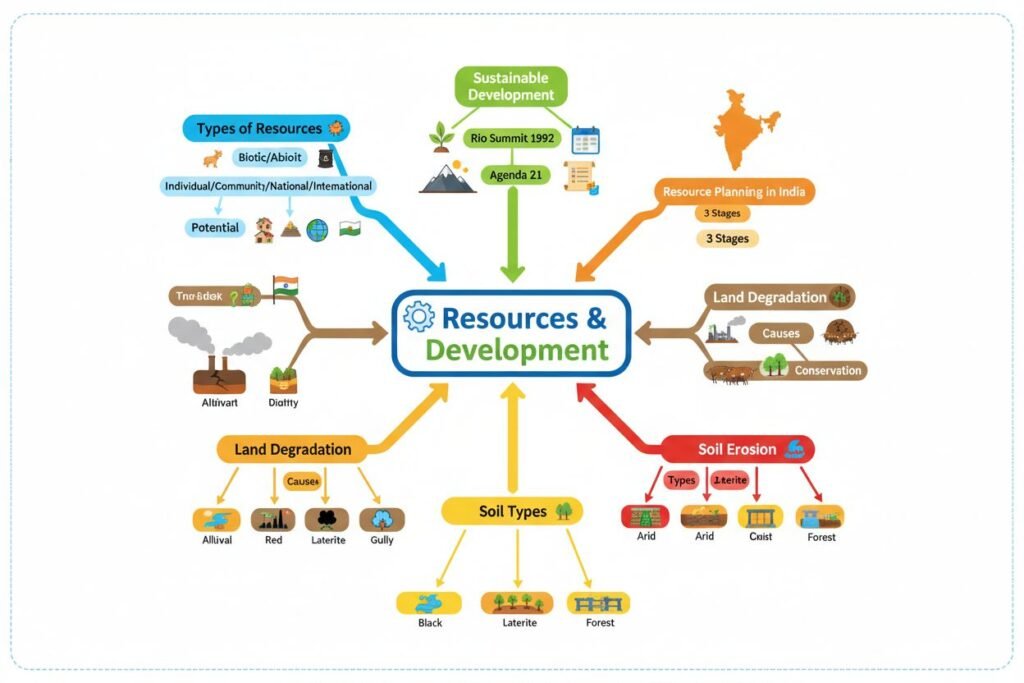
🗺️ Resource Planning
Sirf resources hona kaafi nahi. Unka sahi planning se use karna zaroori hai.
Resource planning matlab — resources ko identify karo, map karo, aur phir systematically use karo.
Yeh isliye zaroori hai kyunki:
- Resources unequally distributed hain
- Kuch regions mein bahut hai, kuch mein bilkul nahi
- Bina planning ke wastage hoti hai
🇮🇳 Resource Planning in India
India mein resource planning teen stages mein hoti hai:
- Identification and inventory — survey, mapping, qualitative aur quantitative estimation
- Planning structure — technology, skills, aur institutions develop karna
- Matching resources with national development plans — resources ko actual development se jodna
Aur haan — sirf resources hona kaafi nahi. Jaise Jharkhand mein minerals bahut hain, par woh state abhi bhi develop ho raha hai. Aur agar sirf technology ho par resources nahi — toh bhi kaam nahi chalega. Dono chahiye.
🌾 Land Utilisation
India mein land use kaise hoti hai? Yeh categories hain:
| Category | Matlab |
|---|---|
| Forests | Forest cover |
| Land not available for cultivation | Barren land, non-agricultural use |
| Other uncultivated land | Fallow lands, pastures, etc. |
| Fallow lands | Jo temporarily khali hain |
| Net sown area | Jahan actually crops ugti hain |
Total cropped area = Net sown area + land where more than one crop is grown.
India mein land use data land revenue records se aata hai — par yeh data complete nahi hota, especially northeastern states mein.
⚠️ Land Degradation and Conservation Measures
Yeh ek serious problem hai. Honestly mujhe pehle samajh nahi aaya tha ki itna bada issue hai.
Causes of Land Degradation:
- Mining — mining sites pe vegetation destroy hoti hai, craters bante hain
- Over-irrigation — waterlogging aur salinity badhti hai (especially Punjab, Haryana, UP mein)
- Overgrazing — Rajasthan, Gujarat, MP mein badi problem
- Deforestation — soil exposed ho jaati hai
- Industrial effluents — water aur soil dono contaminate hote hain
Conservation Measures:
- Afforestation — trees lagao
- Proper management of grazing
- Shelter belts — wind erosion rokne ke liye (Rajasthan mein use hota hai)
- Control on mining activities
- Proper discharge of industrial waste
🪨 Soil as a Resource
Soil — yeh sirf “mitti” nahi hai yaar. Yeh ek living system hai.
Soil banने mein lakhs of years lagte hain. Relief, parent rock, climate, vegetation, time — sab milke soil banate hain.
Soil ek renewable resource hai — but bahut slowly renewable. Isliye conservation zaroori hai.
🗂️ Classification of Soils
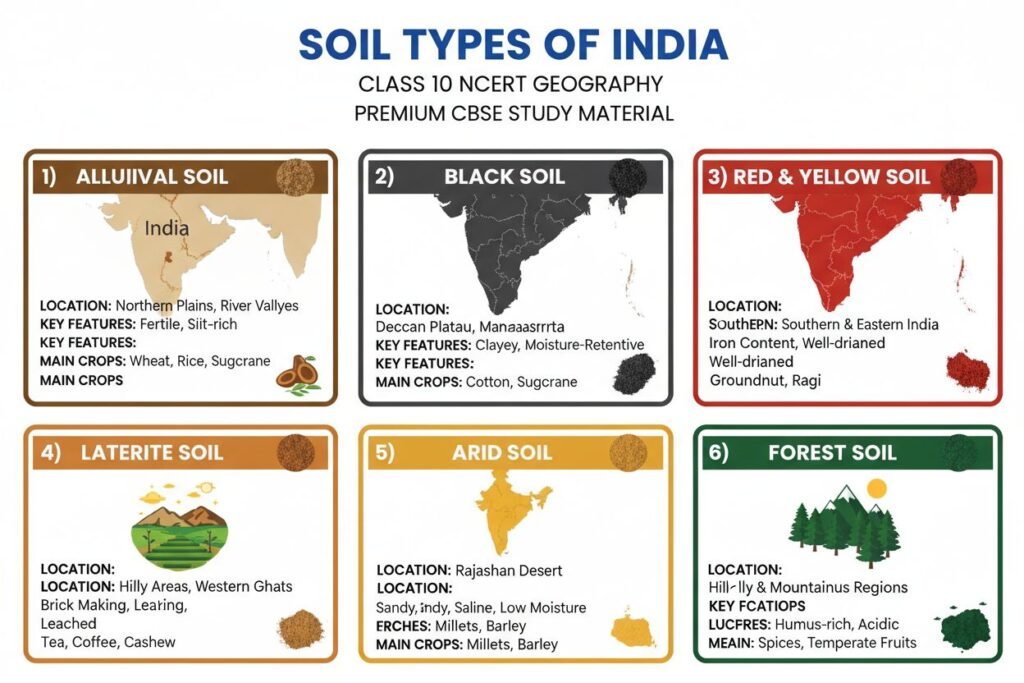
India mein mainly 6 types of soils hain. Ek ek karke samjhte hain.
1. 🟤 Alluvial Soils
Sabse important aur widespread soil of India.
- Kahan: Northern plains — Punjab, Haryana, UP, Bihar, West Bengal, coastal plains
- Kaise bani: Rivers (Indus, Ganga, Brahmaputra) ke sediments se
- Types:
- Khadar — new alluvial, lighter, more fertile
- Bhangar — old alluvial, darker, kankar (calcium carbonate) hota hai
- Properties: Potash, phosphoric acid, lime — adequate. Nitrogen aur humus — deficient.
- Crops: Wheat, rice, sugarcane, pulses — almost everything!
2. ⚫ Black Soil
Isko Regur soil bhi kehte hain. Cotton ke liye famous.
- Kahan: Deccan Plateau — Maharashtra, MP, Gujarat, AP, Tamil Nadu
- Kaise bani: Volcanic lava se
- Properties:
- Moisture retain karne ki amazing capacity
- Self-ploughing — crack karta hai aur khud mix hota hai
- Rich in calcium, potassium, magnesium — but nitrogen, phosphorus, organic matter mein poor
- Crops: Cotton (isliye “black cotton soil” bhi kehte hain), wheat, jowar, linseed, tobacco
3. 🔴 Red and Yellow Soils
- Kahan: Odisha, Chhattisgarh, MP ka kuch hissa, southern states
- Kaise bana rang: Iron diffusion se — oxidation hone pe red, hydrated hone pe yellow
- Properties: Low fertility, porous, nitrogen/phosphorus/humus mein deficient
- Crops: Wheat, rice, cotton, sugarcane, pulses — but irrigation chahiye
4. 🟠 Laterite Soil
Naam Latin word “later” se — matlab brick.
- Kahan: Karnataka, Kerala, Tamil Nadu, MP, Odisha hills
- Kaise bani: High temperature + heavy rainfall = intense leaching. Silica wash out ho jaata hai, iron aur aluminium bachta hai.
- Properties: Humus bahut kam — kyunki bacteria high temperature mein humus destroy kar dete hain. Acidic nature.
- Crops: Akele fertile nahi — but manure/fertilizer se tea, coffee, cashew ugta hai
- Extra use: Brick banane ke kaam aata hai — Tamil Nadu, Kerala mein
5. 🏜️ Arid Soils
Desert wali soil.
- Kahan: Rajasthan, Gujarat (western parts)
- Properties:
- Sandy texture, low moisture
- Salt content high — evaporation zyada hoti hai toh salt surface pe aa jaata hai
- Nitrogen aur humus — bahut kam
- Phosphate — relatively high (interesting!)
- Crops: Irrigation se possible — but water availability limited hai
6. 🌲 Forest Soils
- Kahan: Hilly aur mountainous areas — Himalayas, northeastern states
- Properties: Vary karte hain location ke hisaab se
- Valley sides — fertile
- Upper slopes — coarse, less fertile
- Snow-covered areas — acidic, low humus
- Crops: Tea, coffee (suitable areas mein)
🌊 Soil Erosion and Soil Conservation
Soil Erosion
Soil ka apni jagah se hat jaana — yeh erosion hai.
Types:
- Sheet erosion — pani ki sheet ki tarah soil utha le jaata hai
- Rill erosion — choti choti naaliyan ban jaati hain
- Gully erosion — deep cuts — “bad land” ya “ravines” bante hain. Chambal valley famous example.
- Wind erosion — Rajasthan mein common
Causes:
- Deforestation
- Overgrazing
- Construction activities
- Mining
Soil Conservation
Toh basically… soil bachani hai toh yeh karna padega:
- Strip cropping — crops ki strips mein kheti — wind/water erosion rokti hai
- Contour ploughing — slope ke across jotna — runoff rokta hai
- Terrace farming — hills pe seedhi seedhi terraces — Uttarakhand, Himachal mein common
- Shelter belts — trees ki rows — wind erosion rokne ke liye (Rajasthan)
- Afforestation — trees lagao, roots soil pakad ke rakhti hain
- Controlled grazing
- Proper crop rotation
📝 Quick Revision Points
- Resource = useful + technologically accessible + economically feasible
- Sustainable development = present needs + future generations ka dhyan
- Rio Summit 1992 → Agenda 21
- India ki most important soil = Alluvial
- Black soil = best for cotton, self-ploughing
- Laterite = leaching se bani, brick ke liye use
- Gully erosion → bad lands/ravines (Chambal)
- Soil conservation: contour ploughing, strip cropping, terrace farming
NCERT Exercise Questions | Class 10 Geography
1. Multiple Choice Questions
(i) Main cause of land degradation in Punjab? ✅ Answer: (c) Over irrigation
Punjab mein over-irrigation se waterlogging aur soil salinity badhti hai — yahi main problem hai wahan.
(ii) Terrace cultivation kahan hoti hai? ✅ Answer: (d) Uttarakhand
Hilly areas mein slopes pe terrace bana ke kheti karte hain — runoff rokne ke liye. Uttarakhand classic example hai.
(iii) Black soil predominantly kahan milti hai? ✅ Answer: (b) Maharashtra
Deccan Plateau — Maharashtra, MP, Gujarat — yahan black/regur soil milti hai. Maharashtra sabse zyada.
2. Short Answer Questions (30 words)
(i) Name three states having black soil and the crop mainly grown in it.
Black soil mainly Maharashtra, Madhya Pradesh, aur Gujarat mein milti hai.
Isme mainly cotton ugayi jaati hai — isliye ise “black cotton soil” bhi kehte hain. Wheat aur jowar bhi ugta hai.
(ii) What type of soil is found in river deltas of the eastern coast? Three main features?
Eastern coast ke river deltas mein Alluvial Soil milti hai.
Teen main features:
- Bahut fertile — potash, phosphoric acid, lime adequate hota hai
- Fine texture — silt aur clay ka mix, moisture retain karta hai
- Crops ke liye best — rice, wheat, sugarcane sab kuch ugta hai yahan
(iii) Steps to control soil erosion in hilly areas?
Hilly areas mein soil erosion rokne ke liye:
- Terrace farming — slopes pe seedhi terraces banao, runoff ruke
- Contour ploughing — slope ke across jotna, soil neeche nahi jaati
- Afforestation — trees lagao, roots soil ko pakad ke rakhti hain
3. Long Answer Questions (120 words)
(i) Explain land use pattern in India. Why has land under forest not increased much since 1960-61?
Toh basically… India mein land use kaafi diverse hai.
Land ko in categories mein divide karte hain — forests, barren/wasteland, land under non-agricultural use (buildings, roads), permanent pastures, miscellaneous tree crops, culturable wasteland, fallow lands, aur net sown area.
India ki total geographical area 3.28 million sq km hai — but complete land use data sirf 93% ke liye available hai. Northeastern states ka data properly recorded nahi hota.
Net sown area aur forest cover dono important hain. Aur yahan ek interesting baat hai —
Forest cover 1960-61 ke baad zyada kyun nahi badha?
Honestly yeh thoda disappointing hai. Kuch reasons:
- Agricultural expansion — population badhi, toh forests kaatke kheti ki jagah banayi gayi
- Development projects — dams, roads, industries ke liye forest land liya gaya
- Encroachment — log forests mein ghus ke settle ho gaye
- Target vs reality gap — National Forest Policy kehti hai 33% land forest honi chahiye, par abhi sirf around 23% hai
Matlab sochte hain ek second — agar development ke liye forests kaatenge, toh soil erosion, floods, climate change sab badhega. Yeh ek cycle hai jo todna zaroori hai.
(ii) How have technical and economic development led to more consumption of resources?
Jab maine padha toh laga — yeh toh seedha common sense hai, but itna deep bhi hai.
Pehle ke zamane mein insaan sirf utna use karta tha jitna zaroorat thi. Technology limited thi, toh resources ka use bhi limited tha.
Phir industrial revolution aaya. Technology badhi. Aur saath mein —
Resources ka consumption bhi exponentially badha.
Kaise? Dekho aise samjho:
- Technology ne access diya — pehle jo resources reach se bahar the (deep sea minerals, underground oil), ab unhe nikalna possible ho gaya
- Economic development ne demand badhayi — jaise jaise log ameer hue, lifestyle badli — cars, gadgets, processed food — sab resources consume karte hain
- Industrialization — factories mein raw materials ka use massive scale pe hone laga
- Colonialism ka role — developed countries ne developing countries ke resources exploit kiye apni growth ke liye
Result? Resources kuch logon ke haath mein concentrate ho gaye. Aur ecological crisis shuru hui — global warming, pollution, land degradation.
Isliye sustainable development ka concept aaya — development karo, but future ke liye bhi socho.
📝 Exam Tips
- MCQ (i) — Over irrigation yaad rakho Punjab ke liye, overgrazing Rajasthan ke liye
- Delta soil = always Alluvial
- Black soil = Maharashtra
- Cotton
- Long answers mein examples zaroor likho — examiner ko pasand aata hai
- “33% forest target” — yeh figure long answer mein gold hai ✨
Extra Practice Questions — Resources and Development
Class 10 Geography Chapter 1 | Self-Made MCQs + Q&A
🔵 Multiple Choice Questions (MCQs)
Q1. Which of the following is NOT a renewable resource? (a) Solar energy (b) Wind energy (c) Coal (d) Water
✅ Answer: (c) Coal Coal ek non-renewable resource hai — ek baar khatam hua toh dobara nahi banega millions of years tak.
Q2. “Khadar” and “Bhangar” are two types of which soil? (a) Black soil (b) Laterite soil (c) Alluvial soil (d) Red soil
✅ Answer: (c) Alluvial soil Khadar = new alluvial (zyada fertile), Bhangar = old alluvial (kankar hota hai).
Q3. Which soil is known for its self-ploughing nature? (a) Alluvial soil (b) Red soil (c) Laterite soil (d) Black soil
✅ Answer: (d) Black soil Black soil mein cracks bante hain aur woh khud mix hoti hai — isliye self-ploughing kehte hain.
Q4. Agenda 21 was adopted in which year? (a) 1990 (b) 1992 (c) 1995 (d) 2000
✅ Answer: (b) 1992 Rio de Janeiro Earth Summit, 1992 mein Agenda 21 adopt hua.
Q5. Gully erosion leads to the formation of: (a) Shelter belts (b) Terraces (c) Bad lands / Ravines (d) Strip crops
✅ Answer: (c) Bad lands / Ravines Chambal Valley — classic example. Deep gullies banti hain jo land ko “bad land” bana deti hain.
Q6. Which of the following states is most associated with laterite soil? (a) Punjab (b) Rajasthan (c) Karnataka (d) Uttar Pradesh
✅ Answer: (c) Karnataka Karnataka, Kerala, Tamil Nadu — yahan laterite soil milti hai. High temp + heavy rain = leaching.
Q7. According to National Forest Policy, what percentage of land should be under forests? (a) 25% (b) 30% (c) 33% (d) 40%
✅ Answer: (c) 33% Target 33% hai — par abhi sirf ~23% hai. Yeh gap bahut bada problem hai.
Q8. Which type of resource is hydrogen when used as fuel? (a) Developed resource (b) Potential resource (c) Stock (d) Reserve
✅ Answer: (c) Stock Technology abhi available nahi hai hydrogen ko fuel ki tarah use karne ki — isliye yeh “stock” hai.
Q9. Shelter belts are mainly used to prevent: (a) Gully erosion (b) Sheet erosion (c) Wind erosion (d) Rill erosion
✅ Answer: (c) Wind erosion Rajasthan mein trees ki rows lagayi jaati hain — wind erosion rokne ke liye.
Q10. Which of the following is an example of a community-owned resource? (a) A farmer’s field (b) A village pond (c) National highway (d) Ocean beyond 200 nautical miles
✅ Answer: (b) A village pond Community resource = sabke liye, kisi ek ka nahi. Village pond, grazing grounds — yeh sab community resources hain.
📝 Extra Q&A Practice
Q1. What is the difference between “stock” and “reserve” resources? Give an example of each.
Yeh thoda confusing lagta hai pehle, but…
- Stock — resources jo available hain, par technology nahi hai unhe use karne ki. Example: hydrogen as fuel — hydrogen atmosphere mein hai, par abhi hum efficiently use nahi kar sakte.
- Reserve — stock ka woh part jo abhi use ho sakta hai, par ho nahi raha. Example: river water for hydroelectricity — technology hai, resources hain, par abhi poora use nahi ho raha.
Simple baat: Reserve ⊂ Stock. Reserve stock ka subset hai.
Q2. Why is soil considered a “living resource”?
Soil mein sirf mitti nahi hoti — usme bacteria, fungi, earthworms, organic matter sab hote hain.
Yeh sab milke soil ko fertile banate hain. Bacteria humus decompose karte hain. Earthworms soil ko aerate karte hain.
Isliye soil ek living system hai — aur agar yeh living components destroy ho jaayein (jaise over-use of chemicals se), toh soil barren ho jaati hai.
Aur haan — soil banने mein lakhs of years lagte hain. Isliye ek baar destroy hui toh dobara banana practically impossible hai human timescale pe.
Q3. “Resources are not given by nature, they are created by humans.” Do you agree? Explain.
Haan, main agree karta/karti hoon — partially.
Nature raw materials deta hai. But woh resource tab banta hai jab insaan usse useful banata hai.
Example — coal zameen mein tha lakhs of saal se. But jab tak insaan ne use karne ki technology develop nahi ki, woh sirf ek black rock tha. Technology aai, use aaya — tab woh resource bana.
Isi tarah — solar energy hamesha thi. But photovoltaic cells develop hone ke baad woh ek proper resource bana.
Toh basically — nature potential deta hai, insaan use resource mein convert karta hai.
Q4. What is the difference between “biotic” and “abiotic” resources? Give two examples of each.
- Biotic resources — living organisms se milte hain. Examples: Fish, forests, animals, crops
- Abiotic resources — non-living things se milte hain. Examples: Rocks, metals, minerals, solar energy, wind
Ek interesting baat — coal technically biotic origin ka hai (ancient plants se bana), but abiotic category mein count hota hai kyunki ab woh non-living hai.
Q5. How does over-irrigation lead to land degradation? Which states are most affected?
Over-irrigation se do main problems hoti hain:
1. Waterlogging — zyada paani dene se zameen mein paani ruk jaata hai. Roots ko oxygen nahi milti — crops mar jaati hain.
2. Soil salinity — jab paani evaporate hota hai, toh salt surface pe aa jaata hai. Yeh salt crops ke liye toxic hota hai.
Dheere dheere zameen barren ho jaati hai — na crops ugti hain, na kuch aur.
Most affected states: Punjab, Haryana, aur western Uttar Pradesh — yahan Green Revolution ke baad intensive irrigation hui, aur ab yeh problem serious ho gayi hai.
Q6. Explain the concept of “sustainable development” with a real-life example.
Sustainable development = aaj ki zaroorat poori karo, kal ke liye bhi bacha ke rakho.
Real-life example — Fishing:
Agar ek fisherman roz itni fish pakde ki ocean mein fish reproduce hi na kar sake — toh kuch saalon mein fish khatam ho jaayegi. Na uske liye, na uske bachon ke liye.
But agar woh sustainable fishing kare — limited quantity, breeding season mein fishing band, small fish wapas daalo — toh fish population bani rahegi. Aaj bhi income, kal bhi income.
Yahi sustainable development hai — use karo, but destroy mat karo.
Forest and Wildlife Resources Class 10 Geography Chapter 2 Notes
Nelson Mandela: Long Walk to Freedom – Summary & Question Answers
[…] Resource and Development Class 10 Geography Chapter 1 Notes | NCERT CBSE […]