The Living World
Toh basically… yeh chapter ek simple sawaal se shuru hota hai.
Kya hai “living”? Kaise pata chalega koi cheez zinda hai ya nahi?
Pehle lagta hai — obvious hai na. Ped zinda hai, patthar nahi. But jab science wala angle aata hai, toh realize hota hai ki yeh itna simple nahi.
Ek virus — zinda hai ya nahi? Bahar environment mein — bilkul dead. Host cell ke andar — reproduce karta hai, evolve karta hai. Toh?
Yahi confusion is chapter ko interesting banata hai.
Diversity in the Living World
Aur haan, ek aur cheez jo immediately strike karti hai — duniya mein kitne organisms hain.
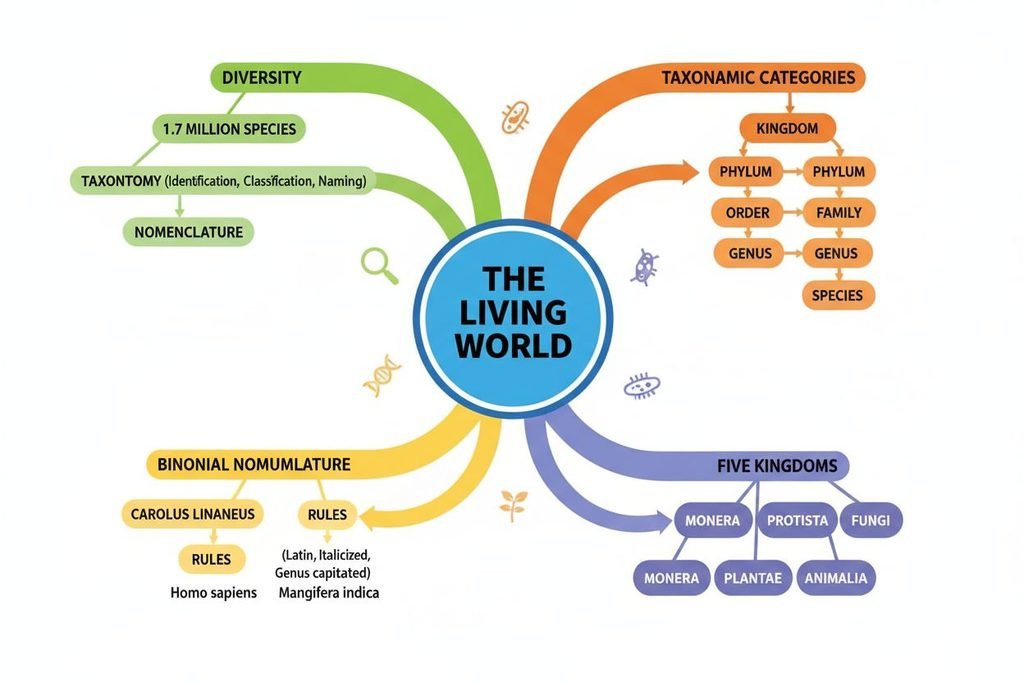
Abhi tak scientists ne approximately 1.7 to 1.8 million species describe ki hain. Aur estimate hai ki actual number 5 million se zyada ho sakta hai. Matlab abhi bhi bahut kuch discover hona baaki hai.
Sochte hain ek second — ek chhoti si ant aur ek blue whale — dono “living” hain. Ek microscopic bacteria aur ek 100-foot tall sequoia tree — dono zinda hain. Yeh diversity… honestly overwhelming hai.
Toh is diversity ko manage karne ke liye, scientists ne ek system banaya — Taxonomy.
Taxonomy = organisms ko identify karna, name dena, aur classify karna.
Aur taxonomy ke saath aata hai — Nomenclature (naming rules) aur Classification (grouping rules).
Taxonomic Categories
Yeh thoda confusing lagta hai pehle — itne saare levels kyun?
But dekho aise samjho — jaise address hota hai. Ghar → Mohalla → Shahar → State → Desh. Har level pe zyada broad hota jaata hai.
Waise hi organisms ke liye ek hierarchical system hai. Isko Taxonomic Hierarchy kehte hain.
Levels hain — neeche se upar:
Species → Genus → Family → Order → Class → Phylum → Kingdom
Ek trick yaad rakhne ke liye:
Sir Gordon Found Our Class Pretty Kind (Species, Genus, Family, Order, Class, Phylum, Kingdom)
Ab har level detail mein samjhte hain.
Species
Species — yeh sabse basic unit hai classification ki.
Definition: Organisms ka ek group jo interbreed kar sakein aur fertile offspring produce kar sakein — woh ek species hain.
Example — sab humans ek species hain. Homo sapiens. Hum sab aapas mein reproduce kar sakte hain, fertile bachche hote hain.
Lekin ek lion aur tiger? Dono alag species. Haan, inke beech ligers/tigons ban sakte hain — but woh fertile nahi hote. Isliye alag species.
Jab maine yeh padha toh socha — toh species ka matlab sirf “dikhne mein alag” nahi hai. Yeh reproductive isolation ke baare mein hai. Interesting.
Genus
Genus — ek level upar.
Ek genus mein woh species hoti hain jo closely related hoon aur common characteristics share karti hoon.
Example:
- Panthera leo — Lion
- Panthera tigris — Tiger
- Panthera pardus — Leopard
Teeno alag species hain. But teeno ek hi genus mein hain — Panthera. Kyunki inke beech bahut saari similarities hain — body structure, hunting style, etc.
Matlab genus ek “family group” jaisa hai species ke liye.
Family
Family — aur broad.
Related genera (plural of genus) ek family mein aate hain.
Example:
- Cats ki family — Felidae. Isme lions, tigers, leopards, cheetahs, domestic cats — sab aate hain.
- Dogs ki family — Canidae. Wolves, foxes, domestic dogs — sab.
Yeh thoda real life family jaisa hi hai — sab related hain, but sab same nahi hain.
Order
Order — aur upar.
Related families ek order mein group hoti hain.
Example:
- Felidae (cats) aur Canidae (dogs) — dono Carnivora order mein hain. Kyunki dono meat khate hain, similar digestive systems hain.
Jab maine socha ki cats aur dogs ek hi order mein hain — thoda weird laga. But scientifically sense banta hai.
Class
Class — aur broad hota jaata hai.
Related orders ek class mein aate hain.
Example:
- Carnivora (cats, dogs) aur Primates (humans, monkeys) — dono Mammalia class mein hain.
- Kyunki dono mammals hain — warm-blooded, mammary glands, hair/fur.
Mammalia class mein bahut diversity hai — whale bhi, bat bhi, human bhi, lion bhi. But sab share karte hain woh basic mammalian features.
Phylum
Phylum — aur upar.
Related classes ek phylum mein aate hain.
Example:
- Mammalia, Aves (birds), Reptilia, Amphibia, Pisces (fish) — sab Chordata phylum mein hain.
- Common feature — notochord (ya backbone at some stage of life).
Plants mein phylum ki jagah Division use hoti hai. Yeh yaad rakhna — exam mein kaam aata hai.
Kingdom
Kingdom — sabse broad category.
Sabse top level. Sab organisms kisi na kisi kingdom mein aate hain.
Aaj kal Five Kingdom Classification use hoti hai (R.H. Whittaker, 1969):
| Kingdom | Examples |
|---|---|
| Monera | Bacteria |
| Protista | Amoeba, Paramecium |
| Fungi | Mushrooms, Yeast |
| Plantae | All plants |
| Animalia | All animals |
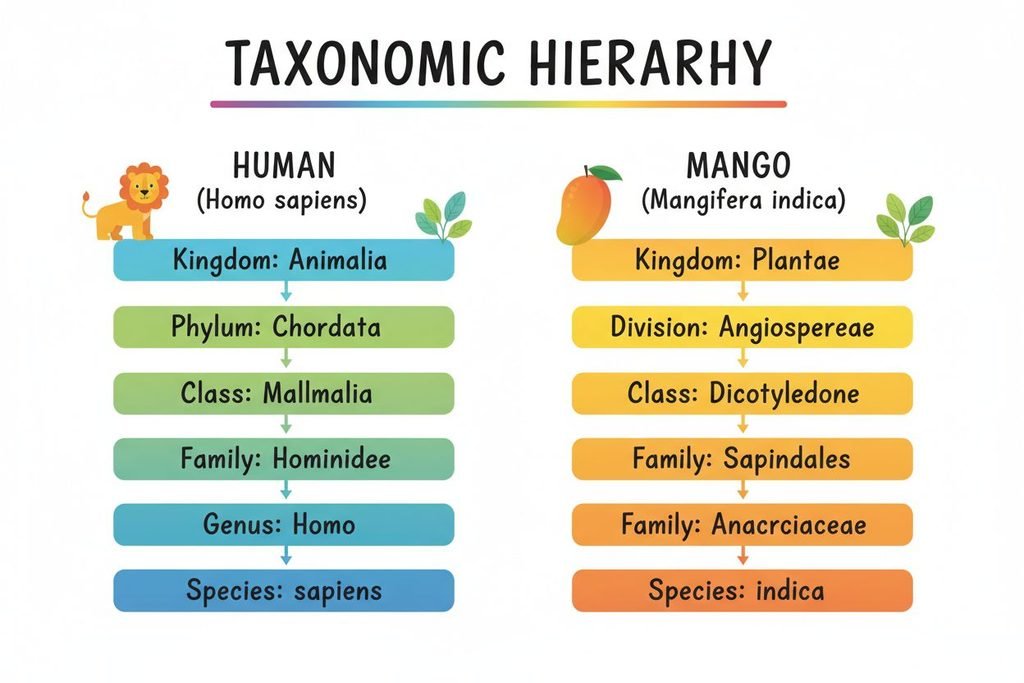
Humans? Animalia kingdom → Chordata phylum → Mammalia class → Primates order → Hominidae family → Homo genus → sapiens species.
Poora address: Homo sapiens 😄
Nomenclature — Naam Dene Ka System
Ek important concept jo is chapter mein aata hai — Binomial Nomenclature.
Yeh system Carolus Linnaeus ne diya. Har organism ka ek scientific name hota hai — do parts mein:
- Genus name — capital letter se shuru
- Species name — small letter se shuru
Dono italics mein likhte hain (ya underline karte hain handwriting mein).
Examples:
- Humans — Homo sapiens
- Mango — Mangifera indica
- Housefly — Musca domestica
- Dog — Canis lupus familiaris
Kyun yeh system? Kyunki ek hi organism ke alag alag jagah alag alag local names hote hain. Scientific name worldwide same rehta hai. Confusion khatam.
Summary
Honestly, is chapter ka core idea simple hai:
Duniya mein bahut zyada diversity hai living organisms mein. Is diversity ko samajhne ke liye, scientists ne ek systematic classification banai — Taxonomy.
Classification ka hierarchy hai:
Kingdom → Phylum → Class → Order → Family → Genus → Species (Broad se Narrow)
Aur har organism ka ek unique scientific name hota hai — Binomial Nomenclature ke through.
Yeh chapter basically baaki poori biology ka foundation hai. Agar yeh samajh aaya — aage sab zyada easy lagega.
Quick Revision Box
- Taxonomy = identification + nomenclature + classification
- Taxonomic hierarchy: King Philip Came Over For Good Soup (Kingdom, Phylum, Class, Order, Family, Genus, Species)
- Binomial Nomenclature — Linnaeus ne diya, Genus + species
- Species = interbreeding + fertile offspring
- Five Kingdoms: Monera, Protista, Fungi, Plantae, Animalia
- Plants mein Phylum की jagah Division use hoti hai
NCERT Exercise Questions & Answers
Q1. Why are living organisms classified?
Sochte hain — duniya mein 1.7 million se zyada known species hain. Aur actually kitni hain — koi nahi jaanta.
Itni diversity mein bina classification ke kaam karna… impossible hoga.
Classification isliye zaroori hai:
- Study easy hoti hai — related organisms ek saath study kar sakte hain
- Identification easy hoti hai — naya organism mile toh pata chalega kahan fit hoga
- Relationships samajh aate hain — evolutionary connections dikhte hain
- Communication easy hoti hai — worldwide scientists ek hi system use karte hain
- Knowledge organize hoti hai — systematic way mein store aur retrieve kar sakte hain
Matlab classification basically ek library cataloguing system hai — bina iske sab books ek heap mein hoti.
Q2. Why are the classification systems changing every now and then?
Yeh ek bahut valid sawaal hai.
Pehle sirf morphology (bahari structure) dekh ke classify karte the. Phir anatomy add hua. Phir physiology. Phir evolutionary relationships.
Aur ab? Molecular biology aur DNA sequencing ne sab badal diya.
Jab DNA analysis hota hai — toh kabhi kabhi pata chalta hai ki do organisms jo dikhne mein bilkul alag hain, genetically bahut close hain. Ya jo similar lagte the — woh actually alag evolutionary line se hain.
Isliye classification change hoti rehti hai kyunki:
- Naye scientific tools aate hain — better analysis possible hoti hai
- Naye organisms discover hote hain
- Purani information revise hoti hai new evidence se
- Science static nahi hai — yeh evolve karta rehta hai
Honestly yeh science ki strength hai, weakness nahi.
Q3. What different criteria would you choose to classify people that you meet often?
Yeh question interesting hai — real life application.
Hum logon ko kai tarah classify kar sakte hain:
- Age — children, teenagers, adults, elderly
- Gender — male, female
- Profession — student, teacher, doctor, shopkeeper
- Language — Hindi speaking, English speaking, regional languages
- Habitat/Location — urban, rural, which city/state
- Physical traits — height, skin color (though scientifically these are minor variations)
- Relationship — family, friends, colleagues, acquaintances
- Interests/Hobbies — sports lovers, readers, artists
Important point — criteria depend karta hai purpose pe. Doctor logon ko blood group se classify karega. Teacher students ko performance se. Sociologist income se.
Waise hi biology mein — classification ka criteria depend karta hai kya jaanna chahte hain us organism ke baare mein.
Q4. What do we learn from identification of individuals and populations?
Identification se hum jaante hain:
- Organism kaun hai — species, genus, family — poora taxonomic address
- Uski characteristics kya hain — behavior, habitat, diet, lifespan
- Evolutionary history — kab aur kaise evolve hua
- Ecological role — ecosystem mein kya kaam karta hai
- Population health — kitne hain, badh rahe hain ya ghatt rahe hain
- Conservation status — endangered hai ya nahi
Population level pe jaanne se — biodiversity assess kar sakte hain, conservation strategies bana sakte hain, aur ecosystem changes track kar sakte hain.
Matlab identification sirf naam jaanna nahi — yeh ek organism ki poori story jaanna hai.
Q5. Given below is the scientific name of Mango. Identify the correctly written name. Mangifera Indica vs Mangifera indica
Answer: Mangifera indica ✅
Kyun?
Binomial Nomenclature ke rules:
- Genus name — pehla word, Capital letter se shuru — Mangifera ✅
- Species name — doosra word, small letter se shuru — indica ✅
- Dono italics mein (ya handwriting mein underline)
Mangifera Indica — galat hai kyunki “Indica” capital I se shuru ho raha hai. Species name kabhi capital se nahi likhte.
Simple rule — Genus = Capital, species = small.
Q6. Define a taxon. Give some examples of taxa at different hierarchical levels.
Taxon (plural: Taxa) — classification ki koi bhi unit ya category ko taxon kehte hain.
Matlab — Species ek taxon hai. Genus ek taxon hai. Family ek taxon hai. Har level ek taxon hai.
Examples at different levels:
| Taxonomic Level | Taxon Example (Animal) | Taxon Example (Plant) |
|---|---|---|
| Kingdom | Animalia | Plantae |
| Phylum/Division | Chordata | Angiospermae |
| Class | Mammalia | Dicotyledonae |
| Order | Primates | Rosales |
| Family | Hominidae | Rosaceae |
| Genus | Homo | Rosa |
| Species | sapiens | indica |
Jab maine pehli baar “taxon” suna toh laga koi naya concept hai. But basically yeh sirf ek umbrella term hai — kisi bhi classification level ke liye.
Q7. Can you identify the correct sequence of taxonomical categories?
Options:
- (a) Species → Order → Phylum → Kingdom
- (b) Genus → Species → Order → Kingdom
- (c) Species → Genus → Order → Phylum ✅
Answer: (c) Species Genus Order Phylum
Kyun?
Correct hierarchy (narrow to broad): Species → Genus → Family → Order → Class → Phylum → Kingdom
Option (c) mein — Species, Genus, Order, Phylum — yeh sab correct sequence mein hain (Family aur Class skip hain, but jo hain woh sahi order mein hain).
Option (a) — Species ke baad Order aaya, Genus skip — galat order. Option (b) — Genus ke baad Species aaya — ulta hai, galat.
Q8. Meanings of ‘Species’ — Higher Plants/Animals vs Bacteria
Generally accepted meanings of ‘Species’:
- Biological Species Concept (most common) — organisms ka group jo interbreed kar sakein aur fertile offspring produce karein, aur doosre groups se reproductively isolated hoon
- Morphological Species Concept — organisms jo physically/structurally similar hoon
- Phylogenetic Species Concept — organisms jo common ancestor share karein
- Ecological Species Concept — organisms jo same ecological niche occupy karein
Higher Plants aur Animals mein: Biological species concept well-defined hai. Sexual reproduction hoti hai, reproductive isolation clearly define kar sakti hai species boundaries. Homo sapiens — clear species.
Bacteria mein — yahan problem hai:
Bacteria asexually reproduce karte hain — binary fission se. Toh “interbreeding” ka concept apply nahi hota.
Bacteria mein horizontal gene transfer hoti hai — ek species doosri species ko genes de sakti hai. Toh boundaries blur hoti hain.
Isliye bacteria mein species define karna mushkil hai. Abhi 16S rRNA gene sequencing use karte hain bacterial species identify karne ke liye — agar 97% similarity hai toh same species maante hain. But yeh bhi debated hai.
Honestly bacteria ke liye “species” concept abhi bhi scientists mein debated hai. Koi universal agreement nahi.
Q9. Define the following terms:
(i) Phylum Related classes ka group. Animals mein use hota hai. Common body plan ya structural features share karte hain. Example — Chordata phylum mein Mammalia, Aves, Reptilia, Amphibia, Pisces sab aate hain — kyunki sab mein notochord/backbone hoti hai. (Plants mein Phylum ki jagah Division use hoti hai)
(ii) Class Related orders ka group. Example — Mammalia class mein Carnivora (cats, dogs), Primates (humans, monkeys), Cetacea (whales) — sab aate hain. Common feature — mammary glands, warm-blooded, hair.
(iii) Family Related genera (plural of genus) ka group. Example — Felidae family mein lions (Panthera leo), tigers (Panthera tigris), domestic cats (Felis catus) — sab aate hain.
(iv) Order Related families ka group. Example — Carnivora order mein Felidae (cats) aur Canidae (dogs) dono aate hain — kyunki dono carnivorous hain, similar digestive system hai.
(v) Genus Related species ka group jo common characteristics share karti hain. Example — Panthera genus mein lion, tiger, leopard, jaguar — sab aate hain. Genus name scientific name ka pehla part hota hai.
Q10. Taxonomical Hierarchy — Plant aur Animal Example
Animal Example — Housecat (Felis catus)
| Category | Classification |
|---|---|
| Kingdom | Animalia |
| Phylum | Chordata |
| Class | Mammalia |
| Order | Carnivora |
| Family | Felidae |
| Genus | Felis |
| Species | catus |
Plant Example — Wheat (Triticum aestivum)
| Category | Classification |
|---|---|
| Kingdom | Plantae |
| Division | Angiospermae |
| Class | Monocotyledonae |
| Order | Poales |
| Family | Poaceae |
| Genus | Triticum |
| Species | aestivum |
Note — Plants mein Phylum ki jagah Division use hoti hai. Yeh ek common exam mistake hai — dhyan rakhna! ⚠️
🔵 MCQs — Practice Set
Q1. The science of classification of organisms is called: (a) Ecology (b) Taxonomy (c) Morphology (d) Physiology
✅ Answer: (b) Taxonomy Taxonomy = identification + nomenclature + classification. Yeh teen kaam karta hai.
Q2. Binomial Nomenclature was given by: (a) R.H. Whittaker (b) Ernst Mayr (c) Carolus Linnaeus (d) Charles Darwin
✅ Answer: (c) Carolus Linnaeus Linnaeus ne Systema Naturae mein yeh system diya. Isliye unhe “Father of Taxonomy” bhi kehte hain.
Q3. Which of the following is the correct scientific name of Mango? (a) mangifera Indica (b) Mangifera Indica (c) Mangifera indica (d) mangifera indica
✅ Answer: (c) Mangifera indica Genus = Capital, species = small. Dono italics mein. Simple rule.
Q4. Which is the basic unit of classification? (a) Genus (b) Family (c) Species (d) Order
✅ Answer: (c) Species Species sabse fundamental unit hai. Baaki sab uske upar build hote hain.
Q5. In plants, the term used instead of Phylum is: (a) Class (b) Division (c) Order (d) Kingdom
✅ Answer: (b) Division Yeh ek common exam trap hai. Animals = Phylum, Plants = Division. Dhyan rakhna! ⚠️
Q6. Which of the following is the correct sequence from lowest to highest taxonomic category? (a) Species → Family → Genus → Order (b) Species → Genus → Family → Order (c) Genus → Species → Family → Order (d) Family → Genus → Species → Order
✅ Answer: (b) Species → Genus → Family → Order Narrow se broad — Species, Genus, Family, Order. Trick: Sir Gordon Found Our…
Q7. How many species are known and described so far? (a) 1.5 million (b) 1.7–1.8 million (c) 5 million (d) 10 million
✅ Answer: (b) 1.7–1.8 million Known aur described = 1.7–1.8 million. Estimated actual = 5–50 million. Dono alag hain.
Q8. Five Kingdom Classification was proposed by: (a) Carolus Linnaeus (b) Ernst Mayr (c) R.H. Whittaker (d) Carl Woese
✅ Answer: (c) R.H. Whittaker 1969 mein Whittaker ne Five Kingdom system diya — Monera, Protista, Fungi, Plantae, Animalia.
Q9. Panthera leo, Panthera tigris, Panthera pardus — these belong to the same: (a) Species (b) Family (c) Genus (d) Order
✅ Answer: (c) Genus Teeno ka genus same hai — Panthera. Species alag hain — leo, tigris, pardus.
Q10. A group of organisms that can interbreed freely and produce fertile offspring is called: (a) Genus (b) Family (c) Species (d) Population
✅ Answer: (c) Species Yeh biological species concept hai — Ernst Mayr ne diya.
Q11. ICBN stands for: (a) International Code of Botanical Nomenclature (b) Indian Code of Biological Nomenclature (c) International Code of Biological Nomenclature (d) Indian Code of Botanical Nomenclature
✅ Answer: (a) International Code of Botanical Nomenclature Plants ke liye ICBN. Animals ke liye ICZN (International Code of Zoological Nomenclature).
Q12. Which of the following is NOT a characteristic of living organisms? (a) Growth (b) Reproduction (c) Consciousness (d) Crystallization
✅ Answer: (d) Crystallization Crystallization non-living cheezein bhi karti hain — jaise salt crystals. Yeh living characteristic nahi hai.
🔴 NEET PYQs — The Living World
Q1. [NEET 2022] Which of the following is an incorrect statement? (a) Genus comprises a group of related species (b) Taxonomic categories are part of overall taxonomic arrangement (c) Both ICBN and ICZN are universal codes of nomenclature (d) Family is a higher category than Order
✅ Answer: (d) Family is a higher category than Order Galat statement yahi hai. Actually Order is higher than Family. Hierarchy: …Order → Family → Genus → Species. Family, Order se neeche hoti hai.
Q2. [NEET 2021] Couplets in taxonomic keys refer to: (a) Two contrasting characters (b) Two similar characters (c) Two genera (d) Two species
✅ Answer: (a) Two contrasting characters Taxonomic key mein har step pe do contrasting (opposite) characters diye jaate hain — ek choose karo aur aage badho. Isse dichotomous key kehte hain.
Q3. [NEET 2019] Which of the following is not a correct statement? (a) Herbarium is a store house of collected plant specimens (b) Botanical gardens have collection of living plants for reference (c) Key is a taxonomic aid used for identification of specimens (d) Museum has collection of photographs of plants and animals
✅ Answer: (d) Museum has collection of photographs of plants and animals Museum mein actual preserved specimens hote hain — photographs nahi. Preserved animals, skeletons, dried insects, etc.
Q4. [NEET 2018] Which of the following is not a characteristic of living organisms? (a) Isolated metabolic reactions in vitro are living (b) Cellular organization is the defining feature (c) Reproduction is not an all-inclusive defining characteristic (d) Growth is a universal characteristic
✅ Answer: (a) Isolated metabolic reactions in vitro are living In vitro (test tube mein) isolated reactions living nahi hoti. Living = organized, self-regulating system. Sirf ek reaction = living nahi.
Q5. [NEET 2017] Taxonomic hierarchy refers to: (a) Step-wise arrangement of all categories for classification (b) A group of related families (c) Identification of plants and animals (d) Numerical taxonomy
✅ Answer: (a) Step-wise arrangement of all categories for classification Taxonomic hierarchy = Kingdom se Species tak ka stepwise arrangement. Yeh classification ka backbone hai.
Q6. [NEET 2016] Which of the following is correctly matched? (a) Systema Naturae — Ernst Mayr (b) Genera Plantarum — Linnaeus (c) Species Plantarum — Bentham & Hooker (d) Natural System of Classification — Linnaeus
✅ Answer: (b) Genera Plantarum — Linnaeus
- Systema Naturae → Linnaeus ✅
- Genera Plantarum → Bentham & Hooker
- Species Plantarum → Linnaeus
- Natural System → Bentham & Hooker
Wait — actually (b) is incorrect too. Correct match:
- Systema Naturae → Linnaeus ✅
NEET 2016 mein yeh question tricky tha — options mein sab galat the except ek. Apne teacher se verify karna ek baar. 📌
Q7. [NEET 2015] The term ‘New Systematics’ was introduced by: (a) Linnaeus (b) Julian Huxley (c) A.P. de Candolle (d) Bentham & Hooker
✅ Answer: (b) Julian Huxley Julian Huxley ne 1940 mein “New Systematics” term introduce kiya — jisme evolutionary relationships ko classification mein include kiya gaya.
⚡ Quick Revision — Exam ke liye
Important names yaad rakho:
- Taxonomy ka Father → Linnaeus
- Binomial Nomenclature → Linnaeus
- Five Kingdom → R.H. Whittaker (1969)
- New Systematics → Julian Huxley
- Biological Species Concept → Ernst Mayr
Common traps:
- Plants = Division (Phylum nahi) ⚠️
- Family Order se neeche hoti hai ⚠️
- Scientific name mein species = small letter ⚠️
- Museum = preserved specimens (photographs nahi) ⚠️
Motion in a Straight Line Class 11 Physics Notes, Complete Chapter 2 Summary
Units and Measurements Class 11 Physics Notes, SI Units
[…] The Living World Class 11 Biology Notes | NCERT Chapter 1 […]