Development of Chemistry
Sochte hain ek second… Chemistry aaj ek proper science hai, lekin yeh aise hi nahi bani.
Pehle ke zamane mein log alchemy karte the — matlab sone banana, ya aisa potion dhundhna jo insaan ko immortal bana de. Yeh science nahi tha, yeh zyada magic jaisa tha. Lekin is koshish mein hi kai discoveries hui.
Dheere dheere, experiments hone lage. Observations likhne lage. Aur phir aaya scientific method — aur tab jaake Chemistry ek real science bani.
Kuch important names:
- Antoine Lavoisier — “Father of Modern Chemistry” — usne bataya ki mass conserve hoti hai
- John Dalton — Atomic theory di
- Avogadro — Molecules ka concept diya
Basically yeh ek slow journey thi — alchemy se atoms tak. Aur yeh journey aaj bhi jaari hai.
🌍 Importance of Chemistry
Yaar honestly — Chemistry har jagah hai. Literally.
- Jo medicine tum lete ho bukhar mein — Chemistry
- Jo fertilizer khet mein dalta hai kisaan — Chemistry
- Jo plastic ki bottle mein paani peete ho — Chemistry
- Jo sunscreen lagaate ho — Chemistry
- Jo khana pakta hai gas pe — Chemical reaction
Industries jaise textile, pharma, agriculture, petroleum, cosmetics — sab mein Chemistry ki direct role hai. Bina Chemistry ke modern life possible hi nahi thi.
🧱 Nature of Matter
Matter kya hai? Simple answer — jo kuch bhi jagah gherta hai aur jisme mass ho, woh matter hai.
Tum, main, paani, hawa, pathhar — sab matter hain.
📦 States of Matter
Matter teen basic states mein hota hai:
1. Solid (Thos)
- Particles bahut paas paas hote hain
- Shape aur volume dono fixed hote hain
- Example: ice, stone, wood
2. Liquid (Drav)
- Particles thoda door hote hain
- Volume fixed hota hai, shape nahi
- Example: water, milk, oil
3. Gas (Gas)
- Particles bahut door hote hain
- Na shape fixed, na volume
- Example: oxygen, carbon dioxide
Ek aur state bhi hoti hai — Plasma — but woh Class 11 mein utni detail mein nahi padhate.
🗂️ Classification of Matter
Matter ko basically do taraf se classify karte hain:
Matter
├── Pure Substances
│   ├── Elements (e.g., Gold, Oxygen)
│   └── Compounds (e.g., Water H₂O, Salt NaCl)
└── Mixtures
    ├── Homogeneous (e.g., saltwater, air)
    └── Heterogeneous (e.g., sand+water, salad)
Element — sirf ek type ke atoms. Todh nahi sakte chemical reactions se.
Compound — do ya zyada elements chemically combine. Properties bilkul alag hoti hain elements se. Jaise H₂O mein Hydrogen aur Oxygen dono hain, lekin paani na hydrogen jaisa hai na oxygen jaisa.
Mixture — cheezein physically mile hain, chemically nahi. Alag kiya ja sakta hai.
📏 Properties of Matter and Their Measurement
Physical vs Chemical Properties
Physical Properties — woh properties jo matter ki identity nahi badlatin:
- Colour, odour, melting point, boiling point, density, hardness
Chemical Properties — woh properties jo matter kisi reaction mein kaisi behave karta hai:
- Iron rusts (Fe + O₂ → Fe₂O₃)
- Wood burns
- Milk turns sour
🌐 The International System of Units (SI)
Poori duniya mein ek hi system use ho — isliye SI System banaya gaya.
| Quantity | SI Unit | Symbol |
|---|---|---|
| Length | Metre | m |
| Mass | Kilogram | kg |
| Time | Second | s |
| Temperature | Kelvin | K |
| Amount of substance | Mole | mol |
| Electric current | Ampere | A |
| Luminous intensity | Candela | cd |
Prefixes in SI System
| Prefix | Symbol | Value |
|---|---|---|
| Mega | M | 10⁶ |
| Kilo | k | 10³ |
| Deci | d | 10⁻¹ |
| Centi | c | 10⁻² |
| Milli | m | 10⁻³ |
| Micro | μ | 10⁻⁶ |
| Nano | n | 10⁻⁹ |
| Pico | p | 10⁻¹² |
⚖️ Mass and Weight
Yeh confusing lagta hai pehle, but simple hai:
- Mass — kitna matter hai — constant rahti hai har jagah
- Weight — gravity ka effect mass par — change hoti hai (moon par weight kam hogi, mass same rahegi)
SI unit of mass = kilogram (kg)
🧪 Volume
Volume matlab — kitni jagah koi cheez gherta hai.
- SI unit = m³ (cubic metre)
- Chemistry mein zyada use hota hai litre (L) ya mL
- 1 L = 1 dm³ = 1000 mL
🏋️ Density
Density = Mass / Volume
d = m/V
SI unit = kg/m³
Practically chemistry mein g/cm³ ya g/mL bhi use hota hai.
Simple samjho — density batati hai ki kitna “packed” hai ek substance. Lead ki density zyada hai water se, isliye doob jaata hai.
🌡️ Temperature
Teen scales hain:
| Scale | Freezing Point of Water | Boiling Point |
|---|---|---|
| Celsius (°C) | 0°C | 100°C |
| Fahrenheit (°F) | 32°F | 212°F |
| Kelvin (K) | 273 K | 373 K |
Conversion formulas:
- K = °C + 273.15
- °F = (9/5 × °C) + 32
Science mein Kelvin use karte hain kyunki yeh absolute scale hai — 0 K matlab absolute zero — aur neeche nahi ja sakte.
📐 Uncertainty in Measurement
Jab bhi hum measure karte hain — thodi uncertainty hoti hi hai. Koi bhi instrument perfect nahi hota.
Isliye hum significant figures aur scientific notation use karte hain.
🔢 Scientific Notation
Bahut bade ya bahut chhote numbers ko likhne ka tarika:
N × 10ⁿ
Jahan N = 1 se 10 ke beech ka number, n = integer
Examples:
- 0.000345 = 3.45 × 10⁻⁴
- 6,02,00,000 = 6.02 × 10⁷
Multiplication: Powers add hote hain
(3 × 10⁴) × (2 × 10³) = 6 × 10⁷
Division: Powers subtract hote hain
(6 × 10⁵) ÷ (2 × 10³) = 3 × 10²
Addition/Subtraction: Pehle same power mein convert karo, phir add/subtract karo
✏️ Significant Figures
Significant figures matlab — measurement mein kitne digits reliable hain.
Rules:
- Zero nahi hote significant agar number ke shuru mein ho — 0.005 mein sirf 1 sig fig
- Zeros beech mein hote hain — 1005 mein 4 sig figs
- Zeros end mein decimal ke baad — 1.500 mein 4 sig figs
- Baaki sab digits significant hote hain
Addition/Subtraction mein: Answer mein decimal places utne hi honge jitne least wale number mein
Multiplication/Division mein: Answer mein sig figs utne hi honge jitne least wale number mein
📏 Dimensional Analysis
Yeh ek technique hai units convert karne ki.
Jo unit chahiye / Jo unit hai × given value
Example: 5 km ko metres mein convert karo
5 km × (1000 m / 1 km) = 5000 m
Yeh method bahut useful hai problems mein jab units confuse ho jaayein.
⚗️ Laws of Chemical Combinations
1. Law of Conservation of Mass
— Antoine Lavoisier
“Matter na create hoti hai, na destroy — sirf form change hoti hai.”
Reactants ki total mass = Products ki total mass
Example:
2H₂ + O₂ → 2H₂O Mass of H₂ + O₂ = Mass of H₂O
2. Law of Definite Proportions
— Joseph Proust
“Ek compound mein elements hamesha same mass ratio mein hote hain — chahe sample kahan se bhi aaya ho.”
Jaise H₂O mein hamesha:
- Hydrogen : Oxygen = 1:8 (by mass)
Chahe paani India ka ho ya America ka — ratio same rahega.
3. Law of Multiple Proportions
— John Dalton
“Jab do elements milkar different compounds banate hain, toh ek element ki fixed mass ke liye doosre element ki masses simple whole number ratio mein hoti hain.”
Example — Carbon aur Oxygen:
- CO mein O = 16 g (per 12 g C)
- CO₂ mein O = 32 g (per 12 g C)
- Ratio = 16:32 = 1:2 ✅ Simple whole number ratio!
4. Gay Lussac’s Law of Gaseous Volumes
— Gay Lussac
“Jab gases react karti hain, toh unke volumes simple whole number ratio mein hote hain — same temperature aur pressure par.”
Example:
H₂ + Cl₂ → 2HCl 1 vol + 1 vol → 2 vol Ratio = 1:1:2 ✅
5. Avogadro’s Law
— Amedeo Avogadro
“Equal volumes of all gases at same temperature and pressure contain equal number of molecules.”
Yahi se mole concept ka idea aaya!
⚛️ Dalton’s Atomic Theory
John Dalton ne 1808 mein yeh theory di:
- Matter atoms se bana hai — atoms indivisible hain
- Ek element ke sab atoms same hote hain (mass aur properties mein)
- Different elements ke atoms different hote hain
- Atoms combine karke compounds banate hain — simple whole number ratio mein
- Chemical reactions mein atoms na create hote hain na destroy — sirf rearrange hote hain
Limitations:
- Atoms actually divisible hote hain (proton, neutron, electron)
- Same element ke atoms different masses ke ho sakte hain (isotopes)
- Lekin phir bhi yeh theory chemistry ka base bani — respect toh banti hai! 😄
⚖️ Atomic and Molecular Masses
Atomic Mass
Atom itna chhota hai ki grams mein measure karna impractical hai. Isliye hum use karte hain atomic mass unit (amu or u).
1 amu = 1/12th mass of C-12 atom = 1.66 × 10⁻²⁴ g
| Element | Atomic Mass |
|---|---|
| H | 1 u |
| C | 12 u |
| O | 16 u |
| N | 14 u |
| Na | 23 u |
| Fe | 56 u |
Average Atomic Mass
Elements ke isotopes hote hain — same element, alag mass. Toh hum weighted average lete hain.
Example — Chlorine:
- Cl-35 (75% abundance) aur Cl-37 (25% abundance)
- Average = (35 × 0.75) + (37 × 0.25) = 26.25 + 9.25 = 35.5 u ✅
Molecular Mass
Molecule mein jo atoms hain, unke atomic masses ka sum.
H₂O = 2(1) + 16 = 18 u CO₂ = 12 + 2(16) = 44 u H₂SO₄ = 2(1) + 32 + 4(16) = 98 u
Formula Mass
Ionic compounds ke liye (like NaCl) — unke molecules nahi hote, toh hum formula mass kehte hain:
NaCl = 23 + 35.5 = 58.5 u
🔵 Mole Concept and Molar Masses
Yeh topic bahut important hai. Thoda dhyan se samjho.
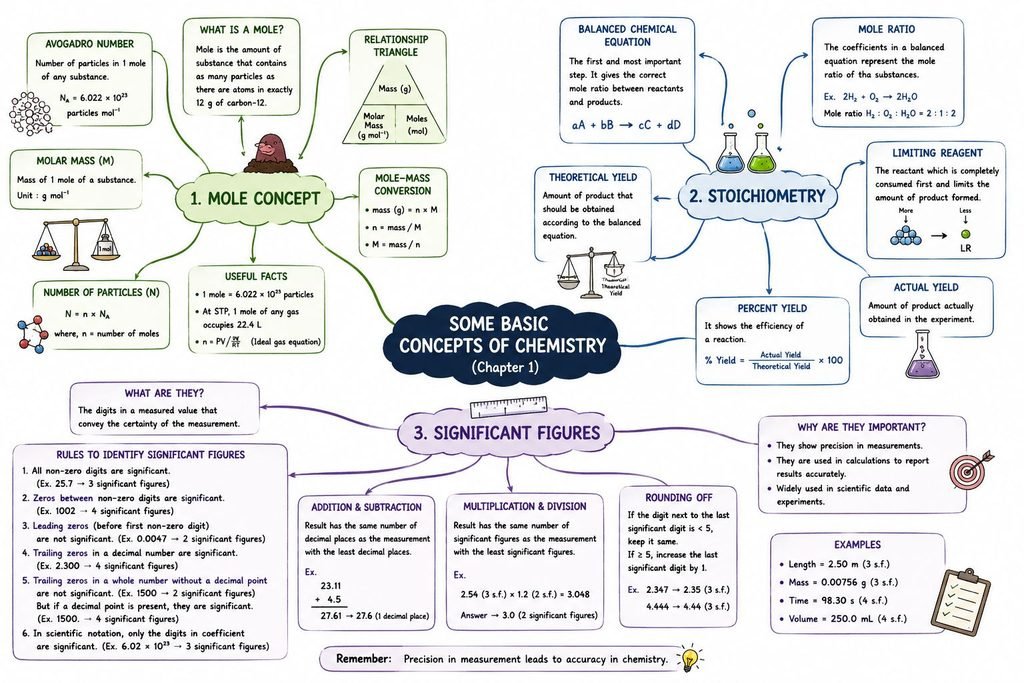
Ek mole matlab — 6.022 × 10²³ particles (atoms/molecules/ions)
Yeh number hai Avogadro’s Number (Nₐ)
Nₐ = 6.022 × 10²³ mol⁻¹
Molar mass = mass of 1 mole of substance = atomic/molecular mass in grams
1 mole of C = 12 g 1 mole of H₂O = 18 g 1 mole of CO₂ = 44 g
Important formula:
n (moles) = Given mass / Molar mass
📊 Percentage Composition
Compound mein each element ka percentage by mass:
% of element = (Mass of element in 1 mole / Molar mass of compound) × 100
Example — H₂O:
- % H = (2/18) × 100 = 11.11%
- % O = (16/18) × 100 = 88.89%
🔬 Empirical Formula and Molecular Formula
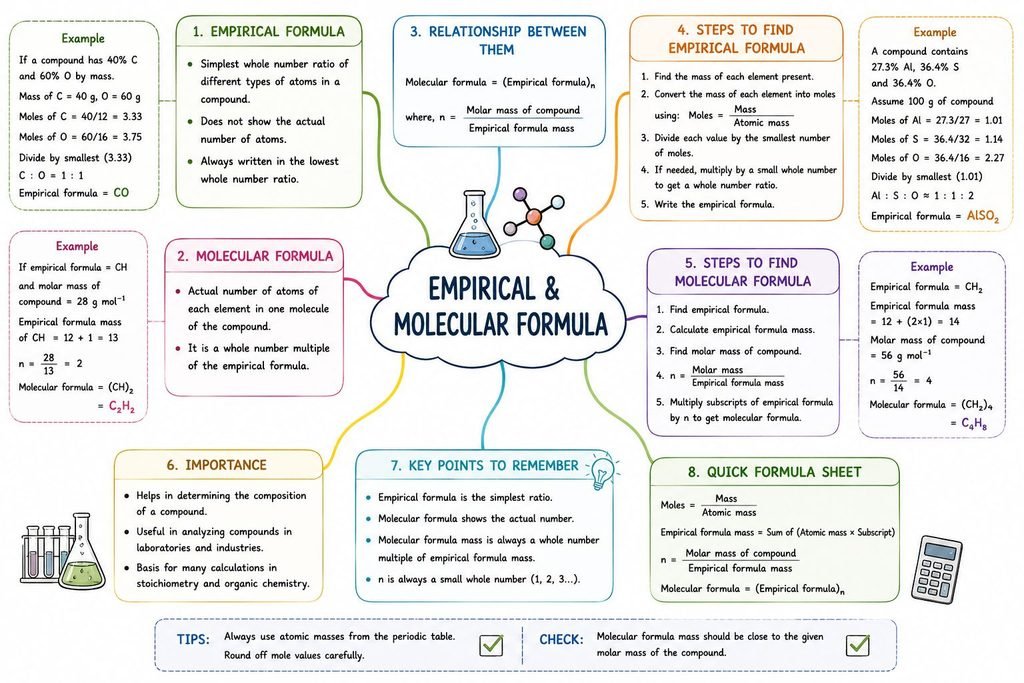
Empirical Formula — simplest whole number ratio of atoms
Molecular Formula — actual number of atoms in molecule
Molecular Formula = n × Empirical Formula
Jahan n = Molecular mass / Empirical formula mass
Example:
- Glucose ka Molecular Formula = C₆H₁₂O₆
- Empirical Formula = CH₂O
- n = 180/30 = 6 ✅
⚗️ Stoichiometry and Stoichiometric Calculations
Stoichiometry = chemical equations se quantitative calculations
Basically — kitna reactant lena hai, kitna product milega.
Example:
2H₂ + O₂ → 2H₂O
Iska matlab:
- 2 moles H₂ + 1 mole O₂ → 2 moles H₂O
- 4 g H₂ + 32 g O₂ → 36 g H₂O
⛽ Limiting Reagent
Jab do reactants hain, woh dono equal proportion mein nahi hote. Jo pehle khatam ho jaaye, woh limiting reagent hai — aur product ki quantity ussi se decide hoti hai.
Simple example:
- Roti banana hai. 1 roti ke liye — 1 aata ball + 1 tawa spot
- Agar 10 aata balls hain lekin tawa par sirf 5 spots — toh sirf 5 rotiyaan banegi
- Tawa = limiting reagent! 😄
💧 Reactions in Solutions
Mass per cent (w/w)
Mass % = (Mass of solute / Mass of solution) × 100
Mole Fraction (x)
xₐ = nₐ / (nₐ + n_b)
Jahan nₐ = moles of A, n_b = moles of B
Note: Sum of all mole fractions = 1
Molarity (M) — Most Important! ⭐
M = Moles of solute / Volume of solution in litres
Unit = mol/L or M
Example: 4 g NaOH (mol mass 40) in 500 mL solution
Moles = 4/40 = 0.1 mol M = 0.1 / 0.5 = 0.2 M
Molality (m)
m = Moles of solute / Mass of solvent in kg
Unit = mol/kg
Molarity vs Molality:
- Molarity — volume of solution
- Molality — mass of solvent
- Molality temperature se affect nahi hota — isliye accurate hota hai
📝 Summary
| Concept | Key Point |
|---|---|
| Matter | Solid, Liquid, Gas |
| SI Units | 7 base units — kg, m, s, K, mol, A, cd |
| Sig Figs | Reliable digits in measurement |
| Conservation of Mass | Mass never created or destroyed |
| Definite Proportions | Fixed ratio in compounds |
| Avogadro’s Number | 6.022 × 10²³ |
| Mole | Amount of substance |
| Molarity | Moles per litre of solution |
| Limiting Reagent | First reactant to finish |
| Empirical Formula | Simplest ratio |
💡 Exam Tip: Mole concept, Molarity, aur Stoichiometry se numericals zaroor aate hain — formulas yaad rakhna aur practice karna!
NCERT Chemistry Chapter 1 — Solved Numericals
Class 11 | Exercise Questions 1.1 to 1.10
✅ Q1.1 Calculate the molar mass of:
(i) H₂O
H = 1 × 2 = 2 O = 16 × 1 = 16 Molar mass of H₂O = 18 g/mol ✅
(ii) CO₂
C = 12 × 1 = 12 O = 16 × 2 = 32 Molar mass of CO₂ = 44 g/mol ✅
(iii) CH₄
C = 12 × 1 = 12 H = 1 × 4 = 4 Molar mass of CH₄ = 16 g/mol ✅
✅ Q1.2 Mass per cent of elements in Na₂SO₄
Molar mass of Na₂SO₄:
Na = 23 × 2 = 46 S = 32 × 1 = 32 O = 16 × 4 = 64 Total = 142 g/mol
% of each element:
% Na = (46/142) × 100 = 32.39%
% S = (32/142) × 100 = 22.54%
% O = (64/142) × 100 = 45.07%
Verification: 32.39 + 22.54 + 45.07 = 100% ✅
✅ Q1.3 Empirical Formula of Iron Oxide (69.9% Fe, 30.1% O)
Step 1 — Assume 100g sample:
- Fe = 69.9 g
- O = 30.1 g
Step 2 — Convert to moles:
Moles of Fe = 69.9 / 55.85 = 1.25 mol Moles of O = 30.1 / 16 = 1.88 mol
Step 3 — Divide by smallest (1.25):
Fe = 1.25/1.25 = 1 O = 1.88/1.25 = 1.504 ≈ 1.5
Step 4 — Multiply by 2 to get whole numbers:
Fe = 1 × 2 = 2 O = 1.5 × 2 = 3
🔴 Empirical Formula = Fe₂O₃ ✅
✅ Q1.4 CO₂ produced when Carbon is burnt
Reaction:
C + O₂ → CO₂ 1 mole C + 1 mole O₂ → 1 mole CO₂ 12 g C + 32 g O₂ → 44 g CO₂
(i) 1 mole of C burnt in air (excess O₂)
O₂ is excess in air — C is limiting reagent 1 mole C → 1 mole CO₂ = 44 g CO₂ ✅
(ii) 1 mole of C burnt in 16 g of O₂
Moles of O₂ = 16/32 = 0.5 mol
Check limiting reagent:
- 1 mole C needs 1 mole O₂
- But only 0.5 mole O₂ available
- ∴ O₂ is limiting reagent
0.5 mole O₂ × 1 mole CO₂/1 mole O₂ = 0.5 mole CO₂ Mass = 0.5 × 44 = 22 g CO₂ ✅
(iii) 2 moles of C burnt in 16 g of O₂
Moles of O₂ = 16/32 = 0.5 mol
Check limiting reagent:
- 2 mole C needs 2 mole O₂
- But only 0.5 mole O₂ available
- ∴ O₂ is limiting reagent
0.5 mole O₂ → 0.5 mole CO₂ Mass = 0.5 × 44 = 22 g CO₂ ✅
✅ Q1.5 Mass of Sodium Acetate for 0.375 M solution (500 mL)
Given:
- Volume = 500 mL = 0.5 L
- Molarity = 0.375 M
- Molar mass of CH₃COONa = 82.0245 g/mol
Formula:
Moles = Molarity × Volume (in L) Moles = 0.375 × 0.5 = 0.1875 mol
Mass:
Mass = Moles × Molar mass Mass = 0.1875 × 82.0245 Mass = 15.38 g ✅
✅ Q1.6 Concentration of Nitric Acid in mol/L
Given:
- Density = 1.41 g/mL
- Mass % of HNO₃ = 69%
- Molar mass of HNO₃ = 1 + 14 + 48 = 63 g/mol
Step 1 — Mass of HNO₃ in 1L solution:
Mass of 1L solution = 1000 × 1.41 = 1410 g Mass of HNO₃ = (69/100) × 1410 = 972.9 g
Step 2 — Moles of HNO₃:
Moles = 972.9 / 63 = 15.44 mol
Step 3 — Molarity:
M = 15.44 mol / 1 L Molarity = 15.44 mol/L ✅
✅ Q1.7 Copper from 100 g of CuSO₄
Molar mass of CuSO₄:
Cu = 63.5 S = 32 O = 16 × 4 = 64 Total = 159.5 g/mol
% of Cu in CuSO₄:
% Cu = (63.5/159.5) × 100 = 39.81%
Mass of Cu in 100 g CuSO₄:
Mass of Cu = (63.5/159.5) × 100 Mass of Cu = 39.81 g ✅
✅ Q1.8 Molecular Formula of Iron Oxide (Fe = 69.9%, O = 30.1%)
Step 1 — From Q1.3, Empirical Formula = Fe₂O₃
Step 2 — Empirical formula mass:
Fe₂O₃ = 2(55.85) + 3(16) = 111.7 + 48 = 159.7 g/mol
Step 3 — Find n:
Molecular mass of iron oxide = 159.7 g/mol (same as empirical) n = 159.7/159.7 = 1
Step 4:
Molecular Formula = 1 × Fe₂O₃ Molecular Formula = Fe₂O₃ ✅
✅ Q1.9 Average Atomic Mass of Chlorine
Given:
| Isotope | % Abundance | Molar Mass |
|---|---|---|
| ³⁵Cl | 75.77 | 34.9689 |
| ³⁷Cl | 24.23 | 36.9659 |
Formula:
Average atomic mass = Σ (fractional abundance × molar mass)
Calculation:
= (75.77/100 × 34.9689) + (24.23/100 × 36.9659) = (0.7577 × 34.9689) + (0.2423 × 36.9659) = 26.4959 + 8.9568 = 35.4527 u ✅
✅ Q1.10 Three moles of Ethane (C₂H₆)
Molecular formula of Ethane = C₂H₆
- Each molecule has 2 C atoms and 6 H atoms
(i) Moles of Carbon atoms
1 mole C₂H₆ → 2 moles C atoms 3 moles C₂H₆ → 3 × 2 = 6 moles of Carbon atoms ✅
(ii) Moles of Hydrogen atoms
1 mole C₂H₆ → 6 moles H atoms 3 moles C₂H₆ → 3 × 6 = 18 moles of Hydrogen atoms ✅
(iii) Number of molecules of Ethane
Molecules = moles × Avogadro’s number = 3 × 6.022 × 10²³ = 18.066 × 10²³ = 1.8066 × 10²⁴ molecules ✅
✅ Q1.11 Concentration of Sugar (C₁₂H₂₂O₁₁)
Given:
- Mass = 20 g
- Volume = 2 L
- Molar mass of C₁₂H₂₂O₁₁ = 12(12) + 22(1) + 11(16) = 144 + 22 + 176 = 342 g/mol
Moles of sugar:
n = 20/342 = 0.0585 mol
Molarity:
M = 0.0585/2 = 0.0293 mol/L ✅
✅ Q1.12 Volume of Methanol needed
Given:
- Density of methanol = 0.793 kg/L = 793 g/L
- Final volume = 2.5 L
- Molarity = 0.25 M
- Molar mass of CH₃OH = 12 + 4 + 16 = 32 g/mol
Step 1 — Moles needed:
Moles = M × V = 0.25 × 2.5 = 0.625 mol
Step 2 — Mass of methanol:
Mass = 0.625 × 32 = 20 g
Step 3 — Volume:
Volume = Mass/Density = 20/793 = 0.02522 L = 25.22 mL ✅
✅ Q1.13 Pressure of Air in Pascal
Given:
- Mass of air = 1034 g/cm²
- 1 Pa = 1 N/m²
- g = 9.8 m/s²
Step 1 — Convert mass to kg/m²:
1034 g/cm² = 1034 × 10⁻³ kg / 10⁻⁴ m² = 1034 × 10⁻³ / 10⁻⁴ = 10340 kg/m²
Step 2 — Pressure = Force/Area = mg/A:
P = 10340 × 9.8 P = 101332 Pa ≈ 1.013 × 10⁵ Pa ✅
✅ Q1.14 SI Unit of Mass
SI unit of mass = Kilogram (kg)
Definition:
Kilogram is defined as the mass of a platinum-iridium (Pt-Ir) cylinder kept at the International Bureau of Weights and Measures in Sèvres, France.
Since 2019, it is redefined in terms of Planck’s constant (h):
h = 6.62607015 × 10⁻³⁴ J·s
✅ Q1.15 Match the Prefixes
| Prefix | Correct Multiple |
|---|---|
| (i) micro | 10⁻⁶ |
| (ii) deca | 10 |
| (iii) mega | 10⁶ |
| (iv) giga | 10⁹ |
| (v) femto | 10⁻¹⁵ |
✅
✅ Q1.16 What are Significant Figures?
Significant figures are the meaningful digits in a measured or calculated quantity that are known with certainty plus one estimated digit.
Rules:
- All non-zero digits are significant — e.g., 345 → 3 sig figs
- Zeros between non-zero digits are significant — e.g., 1005 → 4 sig figs
- Leading zeros are NOT significant — e.g., 0.0025 → 2 sig figs
- Trailing zeros after decimal ARE significant — e.g., 1.500 → 4 sig figs
- Trailing zeros without decimal — may or may not be significant — e.g., 1000 → ambiguous
✅ Q1.17 Chloroform Contamination at 15 ppm
ppm = parts per million = mg per kg = mg per litre (for water)
(i) Express in per cent by mass:
15 ppm = 15 g in 10⁶ g % = (15/10⁶) × 100 = 1.5 × 10⁻³ % ✅
(ii) Molality of CHCl₃ in water:
Molar mass of CHCl₃:
= 12 + 1 + 3(35.5) = 12 + 1 + 106.5 = 119.5 g/mol
In 10⁶ g water sample:
- Mass of CHCl₃ = 15 g
- Mass of water (solvent) = 10⁶ – 15 ≈ 10⁶ g = 1000 kg
Moles of CHCl₃:
n = 15/119.5 = 0.1255 mol
Molality:
m = 0.1255/1000 = 1.255 × 10⁻⁴ mol/kg ✅
✅ Q1.18 Scientific Notation
| Number | Scientific Notation |
|---|---|
| (i) 0.0048 | 4.8 × 10⁻³ |
| (ii) 234,000 | 2.34 × 10⁵ |
| (iii) 8008 | 8.008 × 10³ |
| (iv) 500.0 | 5.000 × 10² |
| (v) 6.0012 | 6.0012 × 10⁰ |
✅
✅ Q1.19 Count Significant Figures
| Number | Sig Figs | Reason |
|---|---|---|
| (i) 0.0025 | 2 | Leading zeros not significant |
| (ii) 208 | 3 | Middle zero is significant |
| (iii) 5005 | 4 | Middle zeros significant |
| (iv) 126,000 | 3 | Trailing zeros without decimal — not significant |
| (v) 500.0 | 4 | Trailing zeros after decimal — significant |
| (vi) 2.0034 | 5 | All digits significant |
✅
✅ Q1.20 Round to Three Significant Figures
| Number | Rounded |
|---|---|
| (i) 34.216 | 34.2 |
| (ii) 10.4107 | 10.4 |
| (iii) 0.04597 | 0.0460 |
| (iv) 2808 | 2810 |
✅
✅ Q1.21
(a) Which Law is Obeyed?
Data analysis:
| Experiment | N₂ (g) | O₂ (g) | O₂ ratio |
|---|---|---|---|
| (i) | 14 | 16 | 1 |
| (ii) | 14 | 32 | 2 |
| (iii) | 28 | 32 | 2 |
| (iv) | 28 | 80 | 5 |
For fixed mass of N₂ (14g), O₂ masses are 16, 32 → ratio = 1:2 For fixed mass of N₂ (28g), O₂ masses are 32, 80 → ratio = 2:5
These are simple whole number ratios ✅
Law obeyed = Law of Multiple Proportions
“When two elements combine to form two or more compounds, the masses of one element that combine with a fixed mass of the other are in simple whole number ratios.”
(b) Fill in the Blanks — Unit Conversions
(i) 1 km = _ mm = _ pm
1 km = 1000 m = 1000 × 1000 mm = 10⁶ mm 1 km = 1000 m = 1000 × 10¹² pm = 10¹⁵ pm ✅
(ii) 1 mg = _ kg = _ ng
1 mg = 10⁻³ g = 10⁻⁶ kg 1 mg = 10⁻³ g = 10⁻³ × 10⁹ ng = 10⁶ ng ✅
(iii) 1 mL = _ L = _ dm³
1 mL = 10⁻³ L 1 mL = 10⁻³ dm³ ✅
✅ Q1.22 Distance covered by light in 2.00 ns
Given:
- Speed of light = 3.0 × 10⁸ m/s
- Time = 2.00 ns = 2.00 × 10⁻⁹ s
Formula: Distance = Speed × Time
d = 3.0 × 10⁸ × 2.00 × 10⁻⁹ d = 6.0 × 10⁻¹ m d = 0.60 m = 6.0 × 10⁻¹ m ✅
✅ Q1.23 Limiting Reagent — A + B₂ → AB₂
(1 atom A reacts with 1 molecule B₂)
(i) 300 atoms A + 200 molecules B₂
A needs 300 molecules B₂, but only 200 available Limiting reagent = B₂ ✅
(ii) 2 mol A + 3 mol B₂
Ratio needed = 1:1 A needs 2 mol B₂, but 3 mol B₂ available Limiting reagent = A ✅
(iii) 100 atoms A + 100 molecules B₂
Ratio = 1:1 — exact! No limiting reagent — both fully consumed ✅
(iv) 5 mol A + 2.5 mol B₂
A needs 5 mol B₂, only 2.5 available Limiting reagent = B₂ ✅
(v) 2.5 mol A + 5 mol B₂
A needs 2.5 mol B₂, 5 mol available Limiting reagent = A ✅
✅ Q1.24 N₂ + 3H₂ → 2NH₃
Given:
- Mass of N₂ = 2.00 × 10³ g
- Mass of H₂ = 1.00 × 10³ g
Moles:
Moles of N₂ = 2000/28 = 71.43 mol Moles of H₂ = 1000/2 = 500 mol
Check Limiting Reagent:
1 mole N₂ needs 3 moles H₂ 71.43 mol N₂ needs = 71.43 × 3 = 214.29 mol H₂ Available H₂ = 500 mol > 214.29 mol ∴ N₂ is the Limiting Reagent ✅
(i) Mass of NH₃ produced:
1 mole N₂ → 2 moles NH₃ 71.43 mol N₂ → 71.43 × 2 = 142.86 mol NH₃ Mass = 142.86 × 17 = 2428.57 g ≈ 2.43 × 10³ g NH₃ ✅
(ii) Will any reactant remain unreacted?
Yes — H₂ will remain unreacted ✅
(iii) Mass of unreacted H₂:
H₂ used = 71.43 × 3 = 214.29 mol H₂ remaining = 500 – 214.29 = 285.71 mol Mass = 285.71 × 2 = 571.43 g ≈ 571 g H₂ ✅
✅ Q1.25 Difference between 0.50 mol Na₂CO₃ and 0.50 M Na₂CO₃
| 0.50 mol Na₂CO₃ | 0.50 M Na₂CO₃ | |
|---|---|---|
| Meaning | 0.50 moles of Na₂CO₃ | 0.50 moles Na₂CO₃ dissolved per litre of solution |
| Mass | 0.50 × 106 = 53 g | 53 g per litre of solution |
| Volume | Not specified | 1 litre of solution |
| Type | Amount of substance | Concentration |
Key difference: 0.50 mol is just an amount, while 0.50 M is a concentration — it tells us how much is dissolved in a specific volume (1L) of solution. ✅
⚗️ NCERT Chemistry Chapter 1 — Solved Numericals
Exercise Questions 1.26 to 1.36
✅ Q1.26 Volumes of Water Vapour Produced
Reaction:
2H₂ + O₂ → 2H₂O
Given: 10 volumes H₂ + 5 volumes O₂
Check ratio:
2 vol H₂ : 1 vol O₂ : 2 vol H₂O 10 vol H₂ needs = 5 vol O₂ ✅ (exact ratio — no limiting reagent)
Water produced:
10 vol H₂ → 10 volumes of water vapour ✅
✅ Q1.27 Convert into Basic SI Units
(i) 28.7 pm → metres
1 pm = 10⁻¹² m 28.7 pm = 28.7 × 10⁻¹² m = 2.87 × 10⁻¹¹ m ✅
(ii) 15.15 pm → metres
15.15 pm = 15.15 × 10⁻¹² m = 1.515 × 10⁻¹¹ m ✅
(iii) 25365 mg → kg
1 mg = 10⁻⁶ kg 25365 mg = 25365 × 10⁻⁶ kg = 2.5365 × 10⁻² kg ✅
✅ Q1.28 Which has Largest Number of Atoms?
Formula: Number of atoms = (Given mass / Atomic mass) × Nₐ
| Substance | Mass | Atomic/Molecular Mass | Moles | Atoms |
|---|---|---|---|---|
| (i) Au | 1 g | 197 g/mol | 1/197 = 0.00508 | 0.00508 Nₐ |
| (ii) Na | 1 g | 23 g/mol | 1/23 = 0.0435 | 0.0435 Nₐ |
| (iii) Li | 1 g | 6.941 g/mol | 1/6.941 = 0.1441 | 0.1441 Nₐ |
| (iv) Cl₂ | 1 g | 71 g/mol | 1/71 = 0.0141 | 0.0282 Nₐ* |
*Cl₂ has 2 atoms per molecule, so atoms = 2 × 0.0141 Nₐ = 0.0282 Nₐ
🔴 Answer: (iii) 1 g of Li has the largest number of atoms ✅ Because Li has the smallest atomic mass (6.941), so 1g gives maximum moles.
✅ Q1.29 Molarity of Ethanol Solution
Given:
- Mole fraction of ethanol (C₂H₅OH) = 0.040
- Density of water = 1 g/mL
- Molar mass of ethanol = 46 g/mol
- Molar mass of water = 18 g/mol
Step 1 — Mole fraction of water:
x(water) = 1 – 0.040 = 0.960
Step 2 — Assume 1 mole total:
Moles of ethanol = 0.040 mol Moles of water = 0.960 mol
Step 3 — Mass of water (solvent):
Mass = 0.960 × 18 = 17.28 g = 17.28 mL = 0.01728 L
Step 4 — Molarity:
M = moles of ethanol / volume of solution in L M = 0.040 / 0.01728 M = 2.314 mol/L ≈ 2.31 M ✅
✅ Q1.30 Mass of One ¹²C Atom in grams
Molar mass of ¹²C = 12 g/mol
Mass of 1 atom = Molar mass / Nₐ = 12 / (6.022 × 10²³) = 1.993 × 10⁻²³ g ✅
✅ Q1.31 Significant Figures in Calculations
(i) (0.02856 × 298.15 × 0.112) / 0.5785
Identify sig figs in each number:
- 0.02856 → 4 sig figs
- 298.15 → 5 sig figs
- 0.112 → 3 sig figs ← least
- 0.5785 → 4 sig figs
Answer should have 3 significant figures ✅
(ii) 5 × 5.364
– 5 →
1 sig fig (exact integer — treated as infinite sig figs here)
- 5.364 → 4 sig figs
Answer should have 4 significant figures ✅
(iii) 0.0125 + 0.7864 + 0.0215
For addition — count decimal places:
- 0.0125 → 4 decimal places
- 0.7864 → 4 decimal places
- 0.0215 → 4 decimal places
Answer should have 4 decimal places ✅ = 0.0125 + 0.7864 + 0.0215 = 0.8204
✅ Q1.32 Molar Mass of Naturally Occurring Argon
Formula:
Average molar mass = Σ (fractional abundance × isotopic molar mass)
Calculation:
³⁶Ar = (0.337/100) × 35.96755 = 0.003370 × 35.96755 = 0.12121 g/mol
³⁸Ar = (0.063/100) × 37.96272 = 0.000630 × 37.96272 = 0.02392 g/mol
⁴⁰Ar = (99.600/100) × 39.9624 = 0.99600 × 39.9624 = 39.7825 g/mol
Total:
= 0.12121 + 0.02392 + 39.7825 = 39.948 g/mol ✅
✅ Q1.33 Number of Atoms
(i) 52 moles of Ar
Atoms = 52 × 6.022 × 10²³ = 3.131 × 10²⁵ atoms ✅
(ii) 52 u of He
Atomic mass of He = 4 u Number of atoms = 52/4 = 13 atoms ✅
(u is atomic mass unit — 52 u means 52 atomic mass units worth of He)
(iii) 52 g of He
Molar mass of He = 4 g/mol Moles = 52/4 = 13 mol Atoms = 13 × 6.022 × 10²³ = 7.829 × 10²⁴ atoms ✅
✅ Q1.34 Welding Gas — Empirical & Molecular Formula
Given:
- CO₂ produced = 3.38 g
- H₂O produced = 0.690 g
- Volume at STP = 10.0 L, Mass = 11.6 g
Step 1 — Find mass of C and H:
Moles of CO₂ = 3.38/44 = 0.0768 mol Mass of C = 0.0768 × 12 = 0.9216 g
Moles of H₂O = 0.690/18 = 0.0383 mol Mass of H = 0.0383 × 2 = 0.0766 g
Check — only C and H:
Total = 0.9216 + 0.0766 = 0.9982 g ≈ 1 g ✅
Step 2 — Moles ratio:
Moles of C = 0.9216/12 = 0.0768 Moles of H = 0.0766/1 = 0.0766
Ratio C:H:
= 0.0768 : 0.0766 ≈ 1 : 1
🔴 (i) Empirical Formula = CH ✅
Step 3 — Molar mass from density at STP:
At STP, 1 mole of gas = 22.4 L 10.0 L weighs 11.6 g 22.4 L weighs = (11.6/10.0) × 22.4 = 25.984 g/mol ≈ 26 g/mol
🔴 (ii) Molar mass = 26 g/mol ✅
Step 4 — Molecular Formula:
Empirical formula mass of CH = 12 + 1 = 13 n = 26/13 = 2 Molecular Formula = 2 × CH
🔴 (iii) Molecular Formula = C₂H₂ (Acetylene) ✅
✅ Q1.35 Mass of CaCO₃ for reaction with HCl
Reaction:
CaCO₃ + 2HCl → CaCl₂ + CO₂ + H₂O
Given:
- Volume of HCl = 25 mL = 0.025 L
- Molarity of HCl = 0.75 M
Step 1 — Moles of HCl:
n = 0.75 × 0.025 = 0.01875 mol
Step 2 — Moles of CaCO₃ needed:
2 moles HCl reacts with 1 mole CaCO₃ Moles of CaCO₃ = 0.01875/2 = 0.009375 mol
Step 3 — Mass of CaCO₃:
Molar mass of CaCO₃ = 40 + 12 + 48 = 100 g/mol Mass = 0.009375 × 100 = 0.9375 g ✅
✅ Q1.36 Mass of HCl reacting with MnO₂
Reaction:
4HCl + MnO₂ → 2H₂O + MnCl₂ + Cl₂
Given:
- Mass of MnO₂ = 5.0 g
- Molar mass of MnO₂ = 55 + 32 = 87 g/mol
- Molar mass of HCl = 36.5 g/mol
Step 1 — Moles of MnO₂:
n = 5.0/87 = 0.0575 mol
Step 2 — Moles of HCl needed:
1 mole MnO₂ reacts with 4 moles HCl Moles of HCl = 0.0575 × 4 = 0.2299 mol
Step 3 — Mass of HCl:
Mass = 0.2299 × 36.5 = 8.39 g ✅
Structure of Atom Class 11: Complete Notes | NCERT Chemistry Chapter 2
The Address by Marga Minco Class 11 Summary
[…] Some Basic Concepts of Chemistry Class 11: Complete Notes | NCERT Chapter 1 […]