🔬 1. Introduction
Have you ever wondered how scientists across the world communicate measurements without confusion?
That’s exactly what this chapter is about — the language of measurement.
Every physical quantity needs two things to be expressed completely:
- A number (magnitude)
- A unit (standard reference)
For example — “The length of this rod is 5” means nothing. But “The length is 5 metres” — now that makes sense!
Why do we need standard units?
Imagine a tailor in India measuring cloth in “haath” (arm length) and a tailor in England measuring in “yards.” They’d never agree! This is why the world needed a universal system of measurement.
Physical Quantities are of two types:
- Fundamental Quantities — cannot be derived from others (length, mass, time, temperature, electric current, luminous intensity, amount of substance)
- Derived Quantities — derived from fundamental quantities (speed = length/time, force = mass × acceleration)
🌍 2. The International System of Units (SI System)
In 1960, the General Conference on Weights and Measures introduced the Système Internationale d’Unités — or simply the SI System.
This is the most widely accepted system of units in the world today.
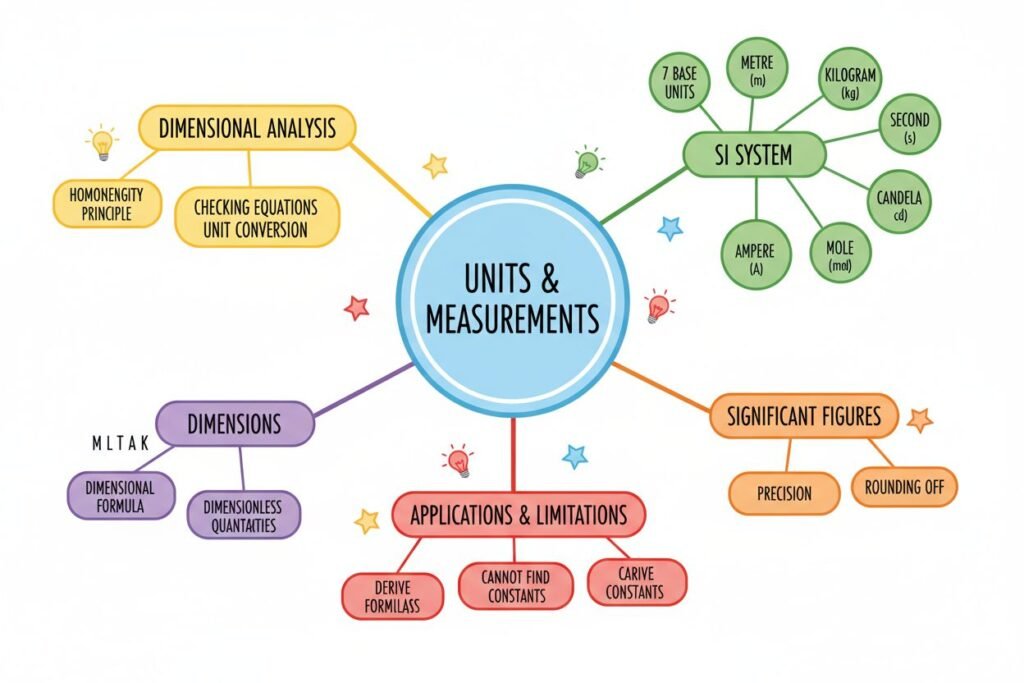
7 Base SI Units — The Foundation of Everything
| Physical Quantity | SI Unit | Symbol |
|---|---|---|
| Length | Metre | m |
| Mass | Kilogram | kg |
| Time | Second | s |
| Electric Current | Ampere | A |
| Temperature | Kelvin | K |
| Luminous Intensity | Candela | cd |
| Amount of Substance | Mole | mol |
2 Supplementary Units
| Physical Quantity | SI Unit | Symbol |
|---|---|---|
| Plane Angle | Radian | rad |
| Solid Angle | Steradian | sr |
Important Prefixes — Because Numbers Get Very Big or Very Small!
| Prefix | Symbol | Meaning |
|---|---|---|
| Giga | G | 10⁹ |
| Mega | M | 10⁶ |
| Kilo | k | 10³ |
| Centi | c | 10⁻² |
| Milli | m | 10⁻³ |
| Micro | μ | 10⁻⁶ |
| Nano | n | 10⁻⁹ |
Real life connect: Your phone storage is in Gigabytes (GB) — that’s 10⁹ bytes. Your medicine dose is in milligrams (mg) — that’s 10⁻³ grams. See? You already use SI prefixes every day!
Characteristics of a Good Unit:
- Well defined and universally accepted
- Easily reproducible
- Should not change with time, place, or physical conditions
- Should be of convenient size
🔢 3. Significant Figures
This is where students lose marks the most. Let’s fix that!
What are Significant Figures?
Significant figures are the meaningful digits in a measured quantity. They tell us how precise a measurement is.
Think of it this way — if you measure your height as 1.7 m, that’s different from 1.70 m. The second one says you measured more carefully!
Rules for Counting Significant Figures
Rule 1 — All non-zero digits are significant.
1234 → 4 significant figures 56.7 → 3 significant figures
Rule 2 — Zeros between non-zero digits are significant.
1007 → 4 significant figures 40.05 → 4 significant figures
Rule 3 — Leading zeros (before the first non-zero digit) are NOT significant.
0.0045 → 2 significant figures (4 and 5 only) 0.067 → 2 significant figures
Rule 4 — Trailing zeros after decimal point ARE significant.
1.500 → 4 significant figures 3.00 → 3 significant figures
Rule 5 — Trailing zeros in a whole number WITHOUT decimal point are NOT significant.
1500 → 2 significant figures 10000 → 1 significant figure
Rounding Off Rules:
- If digit to be dropped < 5 → leave the preceding digit unchanged
- If digit to be dropped > 5 → increase preceding digit by 1
- If digit to be dropped = 5 → if preceding digit is even, leave it; if odd, increase by 1
Operations with Significant Figures:
Addition/Subtraction → Answer should have same number of decimal places as the least precise measurement.
2.1 + 3.45 + 6.789 = 12.339 → 12.3 (1 decimal place)
Multiplication/Division → Answer should have same number of significant figures as the least precise measurement.
2.5 × 3.42 = 8.55 → 8.6 (2 significant figures)
📐 4. Dimensions of Physical Quantities
Now this is the really interesting part!
What are Dimensions?
Dimensions are the powers to which fundamental quantities must be raised to represent a physical quantity.
The 7 fundamental dimensions are represented as:
- Length → [L]
- Mass → [M]
- Time → [T]
- Electric Current → [A]
- Temperature → [K]
- Luminous Intensity → [cd]
- Amount of Substance → [mol]
Simple Example:
Speed = Distance/Time = Length/Time
So dimensions of Speed = [L T⁻¹] or [M⁰ L¹ T⁻¹]
More Examples:
| Physical Quantity | Formula | Dimensions |
|---|---|---|
| Speed | Length/Time | [M⁰ L¹ T⁻¹] |
| Acceleration | Speed/Time | [M⁰ L¹ T⁻²] |
| Force | Mass × Acceleration | [M¹ L¹ T⁻²] |
| Work/Energy | Force × Distance | [M¹ L² T⁻²] |
| Power | Work/Time | [M¹ L² T⁻³] |
| Pressure | Force/Area | [M¹ L⁻¹ T⁻²] |
| Density | Mass/Volume | [M¹ L⁻³ T⁰] |
Dimensionless Quantities:
Some quantities have no dimensions — [M⁰ L⁰ T⁰]
- Pure numbers (π, e)
- Angles (radian)
- Strain, refractive index, relative density
📋 5. Dimensional Formulae and Dimensional Equations
Dimensional Formula — Expression showing how and which fundamental quantities represent a physical quantity.
Example: Dimensional formula of Force = [M¹ L¹ T⁻²]
Dimensional Equation — Equation obtained by equating a physical quantity with its dimensional formula.
Example: Force = [M¹ L¹ T⁻²]
Important Dimensional Formulae to Remember:
| Quantity | Dimensional Formula |
|---|---|
| Velocity | [M⁰ L¹ T⁻¹] |
| Acceleration | [M⁰ L¹ T⁻²] |
| Force | [M¹ L¹ T⁻²] |
| Work/Energy | [M¹ L² T⁻²] |
| Power | [M¹ L² T⁻³] |
| Momentum | [M¹ L¹ T⁻¹] |
| Pressure | [M¹ L⁻¹ T⁻²] |
| Gravitational Constant (G) | [M⁻¹ L³ T⁻²] |
| Planck’s Constant (h) | [M¹ L² T⁻¹] |
| Coefficient of Viscosity | [M¹ L⁻¹ T⁻¹] |
| Surface Tension | [M¹ L⁰ T⁻²] |
| Angular Momentum | [M¹ L² T⁻¹] |
🔍 6. Dimensional Analysis and Its Applications
This is the most powerful tool in this chapter. Master this and you can solve problems you’ve never seen before!
What is Dimensional Analysis?
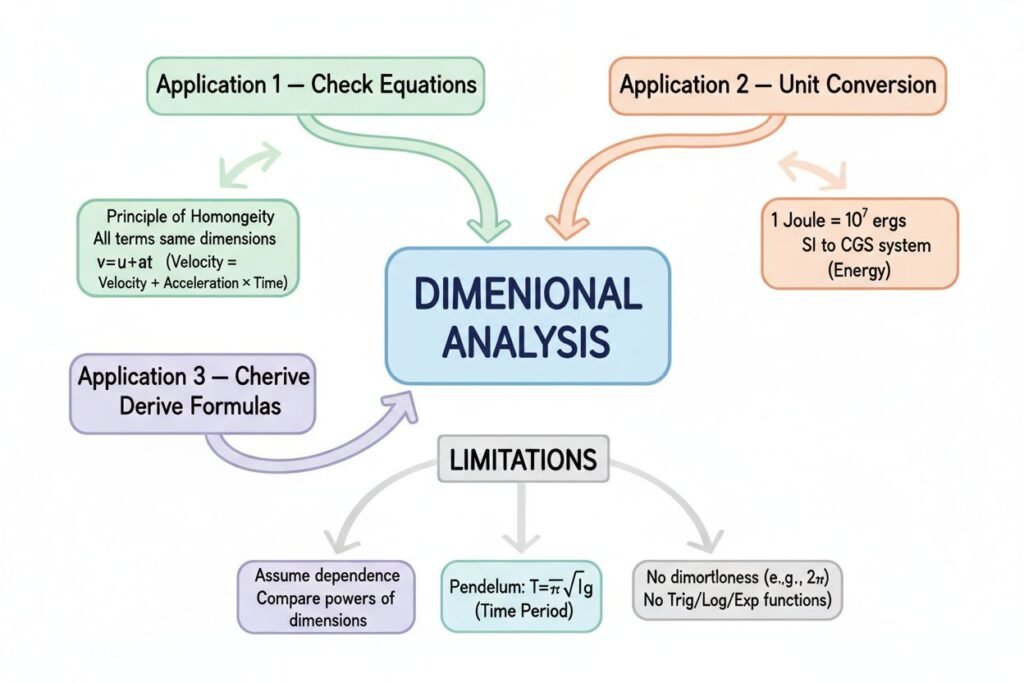
It is the method of using dimensions to check equations, convert units, and derive relationships between physical quantities.
Application 1 — Checking Dimensional Consistency of an Equation
Principle of Homogeneity: Every term in a correct physical equation must have the same dimensions.
Example: Check if v = u + at is dimensionally correct.
- LHS: v → [M⁰ L¹ T⁻¹]
- RHS: u → [M⁰ L¹ T⁻¹]
- RHS: at → [M⁰ L¹ T⁻²] × [T¹] = [M⁰ L¹ T⁻¹]
All terms have same dimensions ✅ → Equation is dimensionally correct!
Important Note: A dimensionally correct equation may not always be physically correct. But a dimensionally incorrect equation is always physically wrong.
Application 2 — Converting Units from One System to Another
Formula:
n₁u₁ = n₂u₂
Where n = numerical value, u = unit
Example: Convert 1 Newton into dynes (CGS unit)
Force = [M¹ L¹ T⁻²]
n₂ = n₁ × (M₁/M₂)¹ × (L₁/L₂)¹ × (T₁/T₂)⁻²
n₂ = 1 × (1 kg/1 g) × (1 m/1 cm) × (1 s/1 s)⁻²
n₂ = 1 × 1000 × 100 × 1 = 100000 = 10⁵ dynes
So 1 Newton = 10⁵ dynes ✅
Application 3 — Deriving Relationships Between Physical Quantities
This is the most exciting application! You can derive formulas just by using dimensions.
Example: Derive the formula for time period of a simple pendulum.
We know time period T depends on:
- Length of pendulum (l)
- Mass of bob (m)
- Acceleration due to gravity (g)
So: T = k × lᵃ × mᵇ × gᶜ (where k is dimensionless constant)
Writing dimensions: [M⁰ L⁰ T¹] = [Lᵃ] × [Mᵇ] × [L T⁻²]ᶜ
[M⁰ L⁰ T¹] = [Mᵇ Lᵃ⁺ᶜ T⁻²ᶜ]
Comparing powers:
- M: b = 0 → mass doesn’t matter!
- T: -2c = 1 → c = -1/2
- L: a + c = 0 → a = 1/2
So: T = k × l^(1/2) × g^(-1/2) = k√(l/g)
The actual formula is T = 2π√(l/g) — and we derived it just from dimensions! 🎉
Limitations of Dimensional Analysis
Nothing is perfect — and dimensional analysis has its limits too:
- Cannot determine dimensionless constants (like 2π in pendulum formula)
- Cannot be used when a quantity depends on more than 3 unknowns
- Cannot be applied to trigonometric, logarithmic, or exponential functions
- Cannot distinguish between quantities having same dimensions (e.g., Work and Torque both have [M¹ L² T⁻²])
🔘 MCQs — Quick Practice
Q1. Which of the following is NOT a fundamental unit in SI system? a) Kilogram b) Kelvin c) Newton ✅ d) Candela
Q2. How many significant figures are in 0.00450? a) 6 b) 5 c) 3 ✅ d) 2
Q3. Dimensional formula of pressure is: a) [M¹ L¹ T⁻²] b) [M¹ L⁻¹ T⁻²] ✅ c) [M¹ L² T⁻²] d) [M¹ L⁻² T⁻²]
Q4. Which principle is used in dimensional analysis? a) Principle of Superposition b) Principle of Homogeneity ✅ c) Principle of Conservation d) Principle of Relativity
Q5. Dimensional formula of Planck’s constant is: a) [M¹ L² T⁻²] b) [M¹ L¹ T⁻¹] c) [M¹ L² T⁻¹] ✅ d) [M⁰ L² T⁻¹]
Q6. 1 nanometre = ? a) 10⁻⁶ m b) 10⁻⁹ m ✅ c) 10⁻¹² m d) 10⁻³ m
Q7. Which quantity is dimensionless? a) Force b) Strain ✅ c) Pressure d) Momentum
Q8. Significant figures in 1500 are: a) 4 b) 3 c) 2 ✅ d) 1
📝 Important Long Questions
Q1. What is dimensional analysis? Explain its applications with examples.
Answer: Dimensional analysis is the method of studying physical quantities in terms of their fundamental dimensions. It is based on the Principle of Homogeneity which states that all terms in a physical equation must have the same dimensions.
Applications:
- Checking correctness of equations — if dimensions on both sides match, equation may be correct
- Unit conversion — using n₁u₁ = n₂u₂ to convert between unit systems
- Deriving formulas — by assuming dependence on physical quantities and solving for powers
Limitations: Cannot find dimensionless constants, cannot handle more than 3 unknowns, cannot apply to trigonometric or exponential functions.
Q2. State and explain the rules for significant figures with examples.
Answer: Significant figures represent the precision of a measurement. Key rules:
- All non-zero digits are significant (456 → 3 sig figs)
- Zeros between non-zero digits are significant (4006 → 4 sig figs)
- Leading zeros are NOT significant (0.0045 → 2 sig figs)
- Trailing zeros after decimal ARE significant (3.500 → 4 sig figs)
- Trailing zeros in whole numbers without decimal are NOT significant (1500 → 2 sig figs)
In calculations: for addition/subtraction use least decimal places; for multiplication/division use least significant figures.
Q3. What is the SI System of Units? Explain its base units and advantages over other systems.
Answer:
Have you ever wondered why scientists all over the world understand each other’s measurements perfectly? The answer is — the SI System.
The Système Internationale d’Unités (SI System) was established in 1960 by the General Conference on Weights and Measures. It is the most universally accepted system of measurement in the world today.
The 7 Base SI Units:
| Physical Quantity | Unit | Symbol |
|---|---|---|
| Length | Metre | m |
| Mass | Kilogram | kg |
| Time | Second | s |
| Electric Current | Ampere | A |
| Temperature | Kelvin | K |
| Luminous Intensity | Candela | cd |
| Amount of Substance | Mole | mol |
Advantages of SI System:
First — It is universal. Every country, every scientist, every laboratory uses the same units. No confusion, no conversion errors.
Second — It is coherent. All derived units are obtained by simply multiplying or dividing base units. No conversion factors needed within the system.
Third — It is decimal based. Prefixes like kilo, milli, micro make it very easy to express very large or very small quantities.
Fourth — It is well defined. Each unit is defined based on a physical constant or natural phenomenon that never changes. For example, 1 second is defined as 9,192,631,770 vibrations of a Cesium-133 atom.
Fifth — It is reproducible. Any laboratory in the world can reproduce these units independently.
Before SI, different countries used different systems — CGS (centimetre-gram-second), MKS (metre-kilogram-second), FPS (foot-pound-second). This caused confusion. SI solved all of that with one unified system.
Q4. What are Significant Figures? State all the rules for determining significant figures with examples.
Answer:
When you measure something, how do you know how precise your measurement is? That’s where significant figures come in.
Significant figures are the meaningful digits in a measured quantity that carry reliable information about its precision. More significant figures = more precise measurement.
For example — 1.7 m and 1.70 m look similar, but 1.70 m tells us the measurement was done more carefully, up to centimetre precision.
Rules for Significant Figures:
Rule 1 — All non-zero digits are always significant.
4567 → 4 significant figures 89.3 → 3 significant figures
Rule 2 — Zeros between two non-zero digits are significant.
4008 → 4 significant figures 30.05 → 4 significant figures
Rule 3 — Leading zeros (zeros before the first non-zero digit) are NOT significant.
0.0056 → 2 significant figures (5 and 6 only) 0.034 → 2 significant figures
Rule 4 — Trailing zeros after a decimal point ARE significant.
3.500 → 4 significant figures 12.00 → 4 significant figures
Rule 5 — Trailing zeros in a whole number WITHOUT a decimal point are NOT significant.
1500 → 2 significant figures 20000 → 1 significant figure
Rules for Calculations:
For Addition and Subtraction — the result should have the same number of decimal places as the measurement with the least decimal places.
2.5 + 3.45 + 1.234 = 7.184 → 7.2 (1 decimal place)
For Multiplication and Division — the result should have the same number of significant figures as the measurement with the least significant figures.
2.5 × 4.32 = 10.8 → 11 (2 significant figures)
Why do significant figures matter? Because in science, reporting a wrong precision is as bad as reporting a wrong value. A measurement of 5.0 m and 5.000 m are very different in terms of precision.
Q5. What are Dimensions of Physical Quantities? Explain with examples and write dimensional formulae of at least 8 physical quantities.
Answer:
Every physical quantity can be expressed in terms of fundamental quantities. The powers to which these fundamental quantities are raised are called dimensions.
The fundamental dimensions are:
- Mass → [M]
- Length → [L]
- Time → [T]
- Electric Current → [A]
- Temperature → [K]
How to find dimensions — Step by Step:
Take Force as an example.
Force = Mass × Acceleration
Acceleration = Velocity/Time = (Length/Time)/Time = Length/Time²
So Force = Mass × Length/Time²
Dimensions of Force = [M¹ L¹ T⁻²]
Simple, right? Let’s do more!
Dimensional Formulae of 8 Important Quantities:
| Physical Quantity | Derivation | Dimensional Formula |
|---|---|---|
| Velocity | Length/Time | [M⁰ L¹ T⁻¹] |
| Acceleration | Velocity/Time | [M⁰ L¹ T⁻²] |
| Force | Mass × Acceleration | [M¹ L¹ T⁻²] |
| Work/Energy | Force × Distance | [M¹ L² T⁻²] |
| Power | Work/Time | [M¹ L² T⁻³] |
| Momentum | Mass × Velocity | [M¹ L¹ T⁻¹] |
| Pressure | Force/Area | [M¹ L⁻¹ T⁻²] |
| Gravitational Constant G | From F = Gm₁m₂/r² | [M⁻¹ L³ T⁻²] |
Dimensionless Quantities — Some quantities have dimension [M⁰ L⁰ T⁰]:
- Pure numbers (1, 2, π)
- Angles (radian)
- Strain, relative density, refractive index
These are called dimensionless quantities.
Important: Two different physical quantities can have the same dimensional formula. For example, Work and Torque both have [M¹ L² T⁻²] — but they are completely different physical quantities!
Q6. What is Dimensional Analysis? Explain the Principle of Homogeneity and how it is used to check the correctness of a physical equation.
Answer:
Imagine you derived a formula after hours of calculation. How do you quickly check if it’s correct? Dimensional Analysis is your answer.
Dimensional Analysis is the method of analyzing physical quantities by studying their dimensions. It is one of the most powerful tools in physics.
Principle of Homogeneity of Dimensions:
“Every term in a correct physical equation must have the same dimensions.”
This is the foundation of dimensional analysis. If any term in an equation has different dimensions from the others — the equation is definitely wrong.
Example 1 — Check if v = u + at is correct:
- v (velocity) → [M⁰ L¹ T⁻¹]
- u (initial velocity) → [M⁰ L¹ T⁻¹]
- at (acceleration × time) → [M⁰ L¹ T⁻²] × [T¹] = [M⁰ L¹ T⁻¹]
All three terms have the same dimensions ✅ → Equation is dimensionally correct.
Example 2 — Check if s = ut + ½at² is correct:
- s (distance) → [M⁰ L¹ T⁰]
- ut → [M⁰ L¹ T⁻¹] × [T¹] = [M⁰ L¹ T⁰]
- at² → [M⁰ L¹ T⁻²] × [T²] = [M⁰ L¹ T⁰]
All terms match ✅ → Equation is dimensionally correct.
Example 3 — Check if v = u + at² (wrong equation):
- v → [M⁰ L¹ T⁻¹]
- at² → [M⁰ L¹ T⁻²] × [T²] = [M⁰ L¹ T⁰]
Dimensions don’t match ❌ → Equation is dimensionally WRONG.
Important Limitation: A dimensionally correct equation is not necessarily physically correct. For example, s = 2ut is dimensionally correct but physically wrong. Dimensional analysis can only reject wrong equations — it cannot confirm correct ones with 100% certainty.
Q7. Explain the applications of Dimensional Analysis. Also state its limitations clearly.
Answer:
Dimensional analysis is not just a checking tool — it’s a complete problem-solving technique. Let’s explore all its applications.
Application 1 — Checking Correctness of Equations
Using the Principle of Homogeneity, we can verify if a physical equation is dimensionally consistent. If dimensions on both sides match, the equation may be correct. If they don’t match, the equation is definitely wrong.
(Already explained in detail in Q4)
Application 2 — Converting Units from One System to Another
Formula used: n₁u₁ = n₂u₂
Where n = numerical value and u = unit in that system.
Example: Convert 1 Joule (SI) into ergs (CGS).
Energy has dimensions [M¹ L² T⁻²]
n₂ = n₁ × (M₁/M₂)¹ × (L₁/L₂)² × (T₁/T₂)⁻²
n₂ = 1 × (1 kg/1 g) × (1 m/1 cm)² × (1 s/1 s)⁻²
n₂ = 1 × 1000 × (100)² × 1
n₂ = 1 × 1000 × 10000 = 10⁷
So 1 Joule = 10⁷ ergs ✅
Application 3 — Deriving Relationships Between Physical Quantities
This is the most powerful application. We can derive formulas from scratch!
Example: Derive formula for time period of a simple pendulum.
Assume T depends on length (l), mass (m), and gravity (g):
T = k × lᵃ × mᵇ × gᶜ
[T¹] = [Lᵃ] [Mᵇ] [LT⁻²]ᶜ = [Mᵇ Lᵃ⁺ᶜ T⁻²ᶜ]
Comparing powers:
- M: b = 0 → mass has no effect on time period!
- T: −2c = 1 → c = −½
- L: a + c = 0 → a = ½
So: T = k√(l/g)
Actual formula: T = 2π√(l/g) — dimensional analysis gave us the correct form! 🎉
Limitations of Dimensional Analysis:
Limitation 1 — Cannot determine dimensionless constants. The value of k (like 2π in pendulum formula) cannot be found by dimensional analysis. Experiments are needed.
Limitation 2 — Cannot handle more than 3 unknowns. If a quantity depends on more than 3 physical quantities, we get more unknowns than equations — and the method fails.
Limitation 3 — Cannot apply to trigonometric and exponential functions. Equations like y = A sin(ωt) or x = e^(kt) cannot be verified or derived using dimensional analysis because sin and e are dimensionless functions.
Limitation 4 — Cannot distinguish between quantities with same dimensions. Work and Torque both have [M¹ L² T⁻²]. Dimensional analysis cannot tell them apart.
Limitation 5 — Cannot derive exact equations. It can only give the form of the equation, not the exact equation with all constants.
Despite these limitations, dimensional analysis remains one of the most elegant and powerful tools in physics — a true shortcut for smart students! 🎯
📌 Quick Revision Table
| Topic | Key Point |
|---|---|
| SI System | 7 base units, universally accepted |
| Significant Figures | Meaningful digits showing precision |
| Dimensions | Powers of fundamental quantities |
| Principle of Homogeneity | All terms in equation must have same dimensions |
| Dimensional Analysis | Check equations, convert units, derive formulas |
| Limitation | Cannot find dimensionless constants |
Motion in a Straight Line Class 11 Physics
The Living World Class 11 Biology Notes | NCERT Chapter 1 Summary