🔬 Discovery of Sub-atomic Particles
Pehle sochte the — atom indivisible hai. Phir experiments hue aur pata chala — atom ke andar bhi cheezein hain!
Yahi se sub-atomic particles ki story shuru hoti hai.
⚡ Discovery of Electron — Cathode Ray Experiment
— J.J. Thomson, 1897
Experiment:
- Ek sealed glass tube liya
- Dono ends par metal plates lagaye — cathode (−) aur anode (+)
- High voltage pass kiya
- Cathode se ek ray nikli — cathode ki taraf se anode ki taraf
Observations:
- Ray straight line mein chali
- Jab electric field apply kiya → ray positive plate ki taraf mudi → matlab rays negatively charged hain
- Kisi bhi material ka cathode use karo — rays same hain
Conclusion:
Cathode rays = negatively charged particles = ELECTRONS Electron har atom mein hota hai — universal particle hai
📊 Charge to Mass Ratio of Electron
— J.J. Thomson
Thomson ne electric aur magnetic fields use karke calculate kiya:
e/m = 1.758820 × 10¹¹ C/kg
Yeh ratio sabhi cathode materials ke liye same nikla — proof ki electron ek universal particle hai.
💧 Charge on the Electron
— R.A. Millikan, Oil Drop Experiment, 1909
Experiment:
- Oil ki tiny droplets spray ki
- X-rays se droplets ko charge kiya
- Electric field se droplets ko balance kiya
Result:
Charge on electron = −1.6 × 10⁻¹⁹ C
Mass of electron:
m = e/(e/m) = 1.6×10⁻¹⁹ / 1.758×10¹¹ = 9.1094 × 10⁻³¹ kg
🔴 Discovery of Protons and Neutrons
Proton:
- Goldstein (1886) ne canal rays discover ki
- Anode mein hole karke rays observe ki — ye positive thi
- Hydrogen gas use karne par — sabse hafli positive ray mili
- Yahi proton hai
- Charge = +1.6 × 10⁻¹⁹ C
- Mass = 1.6726 × 10⁻²⁷ kg
Neutron:
- James Chadwick, 1932
- Beryllium par alpha particles bombard kiye
- Ek neutral particle nikla — na electric field se deflect hua
- Yahi neutron hai
- Charge = 0
- Mass = 1.6749 × 10⁻²⁷ kg
🏛️ Atomic Models
1. 🍮 Thomson Model of Atom
“Plum Pudding Model”
Model:
- Atom ek positive sphere hai
- Usme electrons embedded hain — jaise plum pudding mein raisins
Limitations:
- Yeh explain nahi kar saka ki positive charge kahan concentrated hai
- Rutherford ke experiment ne ise completely disprove kar diya
2. ☢️ Rutherford’s Nuclear Model
— Gold Foil Experiment, 1911
Experiment:
- Thin gold foil par alpha particles (α) shoot kiye
- ZnS screen se detect kiya
Observations:
- Most particles seedha nikal gaye → atom zyaadatar empty space
- Kuch particles thoda mude → kuch positive charge hai beech mein
- Very few particles 180° wapas aaye → ek concentrated positive center hai
Conclusions — Nuclear Model:
- Atom ke center mein nucleus hota hai — bahut chhota, bahut dense
- Nucleus mein protons (+ charge) hote hain
- Electrons nucleus ke chaaron taraf orbit karte hain
- Atom zyaadatar empty space hai
🔢 Atomic Number and Mass Number
Atomic Number (Z) = Number of protons in nucleus e.g., Carbon Z = 6
Mass Number (A) = Protons + Neutrons A = Z + N
Number of neutrons (N) = A − Z
🔄 Isotopes and Isobars
Isotopes:
- Same atomic number (Z), different mass number (A)
- Same element, different neutrons
- e.g., ¹H, ²H (Deuterium), ³H (Tritium)
- e.g., ¹²C, ¹³C, ¹⁴C
Isobars:
- Different atomic number (Z), same mass number (A)
- Different elements, same total nucleons
- e.g., ⁴⁰Ar (Z=18) and ⁴⁰Ca (Z=20)
❌ Drawbacks of Rutherford’s Model
- Electron orbit problem: Classical physics kehta hai — charged particle jo accelerate kare, woh energy radiate karta hai. Toh electron spiral karke nucleus mein gir jaata — atom stable nahi rehta. But atoms stable hain!
- No explanation of atomic spectra: Atoms specific wavelengths ki light emit karte hain — Rutherford model yeh explain nahi kar saka.
🌊 Developments Leading to Bohr’s Model
Wave Nature of Electromagnetic Radiation
— Maxwell
Light ek electromagnetic wave hai jo electric aur magnetic fields ka oscillation hai.
Wave characteristics:
| Term | Symbol | Meaning |
|---|---|---|
| Wavelength | λ (lambda) | Distance between two crests |
| Frequency | ν (nu) | Waves per second |
| Velocity | c | Speed of light |
| Wavenumber | ν̄ | 1/λ |
Relationship:
c = ν × λ c = 3 × 10⁸ m/s
Electromagnetic Spectrum (increasing wavelength):
γ rays → X-rays → UV → Visible → IR → Microwaves → Radio waves
Visible light range = 400 nm (violet) to 750 nm (red)
🎯 Particle Nature — Planck’s Quantum Theory
— Max Planck, 1900
Problem: Classical theory couldn’t explain black body radiation — hot objects emit specific colors.
Planck’s Solution:
Energy is not continuous — it comes in discrete packets called QUANTA (singular: quantum)
E = hν
Jahan:
- E = energy of quantum
- h = Planck’s constant = 6.626 × 10⁻³⁴ J·s
- ν = frequency
Matlab — energy sirf certain fixed values mein hoti hai — quantized!
💡 Photoelectric Effect
— Albert Einstein, 1905
Observation:
- Jab light kisi metal surface par girti hai → electrons emit hote hain
- Lekin sirf tab jab frequency ek minimum value se zyada ho — threshold frequency (ν₀)
Classical theory fail kyu hui:
- Intensity badhao — electrons bahut der baad nikalenge (classical prediction)
- But actually — instantly nikalte hain!
Einstein ka explanation:
Light packets (photons) mein aati hai E = hν Ek photon ek electron ko eject karta hai — agar E ≥ threshold energy
Key points:
- Frequency badhao → electrons ki kinetic energy badhti hai
- Intensity badhao → zyada electrons nikalte hain, energy same
- KE = hν − hν₀ = h(ν − ν₀)
🌓 Dual Behaviour of Electromagnetic Radiation
Light ka dual nature hai:
- Wave nature — diffraction, interference mein dikhta hai
- Particle nature — photoelectric effect mein dikhta hai
Dono ek saath observe nahi ho sakte — situation par depend karta hai
📡 Atomic Spectra — Quantized Energy Levels
Emission Spectrum:
- Element ko heat karo ya excite karo → specific wavelengths ki light emit hoti hai
- Yeh bright lines form karta hai dark background par
- Har element ka spectrum unique hota hai — fingerprint of element
Absorption Spectrum:
- White light element ke through pass karo → specific wavelengths absorb ho jaati hain
- Dark lines on bright background
🌈 Line Spectrum of Hydrogen
Hydrogen ka spectrum series of lines dikhata hai:
| Series | Region | nᵢ | nf |
|---|---|---|---|
| Lyman | UV | 2,3,4… | 1 |
| Balmer | Visible | 3,4,5… | 2 |
| Paschen | IR | 4,5,6… | 3 |
| Brackett | IR | 5,6,7… | 4 |
| Pfund | Far IR | 6,7,8… | 5 |
Rydberg Formula:
1/λ = R_H (1/n₁² − 1/n₂²)
Jahan R_H = Rydberg constant = 1.097 × 10⁷ m⁻¹
🔵 Bohr’s Model for Hydrogen Atom
— Niels Bohr, 1913
Postulates:
1. Electrons fixed circular orbits mein revolve karte hain — stationary states — energy emit nahi karte
2. Sirf woh orbits allowed hain jisme angular momentum:
mvr = nh/2π (n = 1, 2, 3…)
3. Electron ek orbit se doosre mein jump karta hai energy absorb/emit karke:
ΔE = E₂ − E₁ = hν
Energy of nth orbit (Hydrogen):
Eₙ = −2.18 × 10⁻¹⁸ / n² J
Radius of nth orbit:
rₙ = 52.9 × n² pm (Bohr radius for n=1 = 52.9 pm)
📊 Explanation of Hydrogen Spectrum using Bohr’s Model
ΔE = hν = hc/λ 1/λ = R_H (1/n₁² − 1/n₂²)
- Electron lower orbit → higher orbit: energy absorbed
- Electron higher orbit → lower orbit: energy emitted as photon
Yahi explain karta hai hydrogen ke line spectrum ko! ✅
❌ Limitations of Bohr’s Model
- Multi-electron atoms explain nahi kar saka
- Zeeman effect (magnetic field mein spectrum splitting) explain nahi kiya
- Stark effect (electric field mein splitting) explain nahi kiya
- 3D orbital shapes explain nahi kiye
- De Broglie aur Heisenberg ki discoveries ke saath contradictory tha
🌀 Towards Quantum Mechanical Model
🌊 Dual Behaviour of Matter
— Louis de Broglie, 1924
Agar light wave bhi hai aur particle bhi — toh matter bhi wave bhi ho sakta hai!
de Broglie equation:
λ = h/mv = h/p
Jahan:
- λ = wavelength of particle
- h = Planck’s constant
- m = mass
- v = velocity
- p = momentum
Electrons ke liye yeh experimentally prove hua — electron diffraction!
Large objects (ball, car) ki wavelength itni chhoti hoti hai ki measure hi nahi hoti.
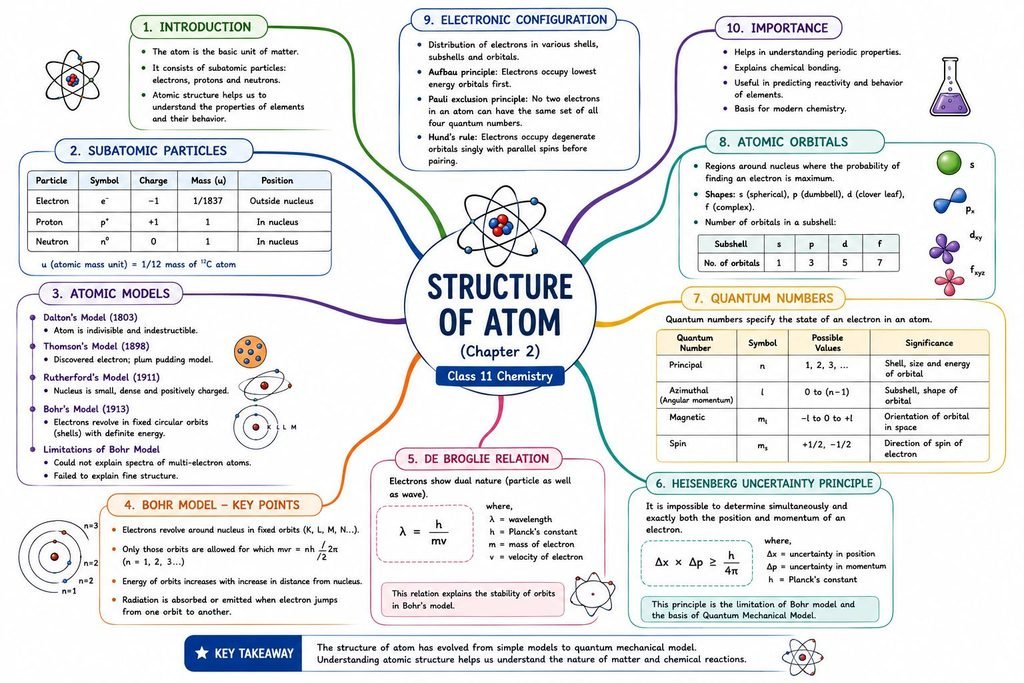
🌫️ Heisenberg’s Uncertainty Principle
— Werner Heisenberg, 1927
“It is impossible to simultaneously determine both the exact position AND exact momentum of a sub-atomic particle.”
Mathematical form:
Δx × Δp ≥ h/4π Δx × mΔv ≥ h/4π
Jahan:
- Δx = uncertainty in position
- Δp = uncertainty in momentum
Simple samjho:
- Jitna precisely position jaano → momentum aur uncertain ho jaata hai
- Jitna precisely momentum jaano → position aur uncertain ho jaata hai
💡 Significance of Uncertainty Principle
- Electron ki exact trajectory nahi de sakte — Bohr model galat!
- Orbits concept invalid — we can only talk about probability of finding electron
- Yahi quantum mechanics ka base hai
❌ Reasons for Failure of Bohr Model
- Bohr model mein electron ki exact position aur momentum dono define kiye gaye — Heisenberg principle violate!
- Electron wave nature consider nahi kiya — de Broglie ignore!
- Toh Bohr model fundamentally incomplete tha
🔮 Quantum Mechanical Model of Atom
— Erwin Schrödinger, 1926
Schrödinger Equation:
Ĥψ = Eψ
Jahan:
- Ĥ = Hamiltonian operator (total energy operator)
- ψ (psi) = wave function
- E = total energy
ψ² = Probability density — batata hai ki electron kahan milne ki kitni probability hai
🌐 Orbitals and Quantum Numbers
Orbital = 3D region in space where probability of finding electron is maximum (>90%)
Quantum numbers electron ko completely describe karte hain:
1. Principal Quantum Number (n)
- Shell number
- n = 1, 2, 3, 4… (K, L, M, N shells)
- Energy aur size determine karta hai
- Larger n → larger orbital → higher energy
2. Azimuthal Quantum Number (l)
- Subshell aur shape determine karta hai
- l = 0 to (n−1)
| l | Subshell | Shape |
|---|---|---|
| 0 | s | Spherical |
| 1 | p | Dumbbell |
| 2 | d | Double dumbbell / cloverleaf |
| 3 | f | Complex |
3. Magnetic Quantum Number (mₗ)
- Orbital orientation in space
- mₗ = −l to +l (including 0)
- Total values = (2l + 1)
| Subshell | l | mₗ values | Number of orbitals |
|---|---|---|---|
| s | 0 | 0 | 1 |
| p | 1 | −1, 0, +1 | 3 |
| d | 2 | −2,−1,0,+1,+2 | 5 |
| f | 3 | −3 to +3 | 7 |
4. Spin Quantum Number (mₛ)
- Electron ki spin
- mₛ = +½ (spin up ↑) or −½ (spin down ↓)
🔷 Shapes of Atomic Orbitals
s orbital:
- Spherical
- 1s < 2s < 3s (size badhta hai)
- 2s aur 3s mein nodes hote hain (nodes = zero probability region)
- Number of radial nodes = n − l − 1
p orbital:
- Dumbbell shape
- 3 orbitals: pₓ, pᵧ, p_z — perpendicular axes par
- 2 lobes separated by a nodal plane
d orbital:
- 5 orbitals
- dₓᵧ, dᵧ_z, d_xz, dₓ²₋ᵧ², d_z²
- Complex cloverleaf shapes
f orbital:
- 7 orbitals — very complex shapes
- Not required in detail for Class 11
⚡ Energies of Orbitals
For hydrogen (one electron):
Energy depends only on n 1s < 2s = 2p < 3s = 3p = 3d < 4s = 4p = 4d = 4f
For multi-electron atoms:
Energy depends on both n and l Lower (n+l) → lower energy Same (n+l) → lower n → lower energy
Order:
1s < 2s < 2p < 3s < 3p < 4s < 3d < 4p < 5s < 4d < 5p < 6s < 4f < 5d…
📥 Filling of Orbitals
1. 📈 Aufbau Principle
“Electrons fill orbitals in order of increasing energy”
Memory trick — diagonal rule:
1s
2s 2p
3s 3p 3d
4s 4p 4d 4f
5s 5p 5d 5f
Diagonally upar se neeche fill karo → 1s → 2s → 2p → 3s → 3p → 4s → 3d → 4p → 5s → 4d…
2. 🚫 Pauli Exclusion Principle
“No two electrons in an atom can have all four quantum numbers identical”
Simple matlab:
Ek orbital mein maximum 2 electrons — aur unki spin opposite honi chahiye (↑↓)
| Orbital capacity | |
|---|---|
| s subshell | 2 electrons |
| p subshell | 6 electrons |
| d subshell | 10 electrons |
| f subshell | 14 electrons |
3. 🎯 Hund’s Rule of Maximum Multiplicity
“Electrons fill degenerate orbitals (same energy) one by one first — all with same spin — before pairing begins”
e.g., Nitrogen (N) — 2p has 3 electrons:
↑ ↑ ↑ ← correct (one each, same spin) ↑↓ ↑ _ ← WRONG (pairing before all filled)
📋 Electronic Configuration of Atoms
Notation: nˡˣ (n = shell, l = subshell, x = electrons)
| Element | Z | Configuration |
|---|---|---|
| H | 1 | 1s¹ |
| He | 2 | 1s² |
| Li | 3 | 1s² 2s¹ |
| C | 6 | 1s² 2s² 2p² |
| N | 7 | 1s² 2s² 2p³ |
| O | 8 | 1s² 2s² 2p⁴ |
| Ne | 10 | 1s² 2s² 2p⁶ |
| Na | 11 | [Ne] 3s¹ |
| Cl | 17 | [Ne] 3s² 3p⁵ |
| Ar | 18 | [Ne] 3s² 3p⁶ |
| K | 19 | [Ar] 4s¹ |
| Ca | 20 | [Ar] 4s² |
| Cr | 24 | [Ar] 3d⁵ 4s¹ ⚠️ |
| Cu | 29 | [Ar] 3d¹⁰ 4s¹ ⚠️ |
⭐ Stability of Completely Filled and Half Filled Subshells
Cr aur Cu special kyun hain?
Expected:
- Cr = [Ar] 3d⁴ 4s²
- Cu = [Ar] 3d⁹ 4s²
Actual:
- Cr = [Ar] 3d⁵ 4s¹ ← half-filled d
- Cu = [Ar] 3d¹⁰ 4s¹ ← completely filled d
Kyun? — Two reasons:
1. Symmetry: Half-filled (d⁵) aur completely filled (d¹⁰) subshells symmetrical hote hain → extra stability
2. Exchange energy: Jab electrons ek jaisi spin ke saath zyada orbitals mein hote hain → exchange interactions zyada hoti hain → energy kam hoti hai → stability zyada
Basically nature prefer karta hai half-filled ya completely filled subshells — isliye ek electron 4s se 3d mein “jump” kar jaata hai!
📝 Summary Table
| Concept | Key Point |
|---|---|
| Electron | J.J. Thomson — e/m = 1.758 × 10¹¹ C/kg |
| Electron charge | Millikan — 1.6 × 10⁻¹⁹ C |
| Proton | Goldstein — canal rays |
| Neutron | Chadwick — 1932 |
| Thomson model | Plum pudding — electrons in positive sphere |
| Rutherford model | Nuclear model — nucleus + orbiting electrons |
| Planck’s theory | E = hν — energy quantized |
| Photoelectric effect | Einstein — photons, KE = h(ν−ν₀) |
| Bohr’s model | Fixed orbits, Eₙ = −2.18×10⁻¹⁸/n² J |
| de Broglie | λ = h/mv — matter has wave nature |
| Heisenberg | Δx·Δp ≥ h/4π — uncertainty principle |
| Quantum numbers | n, l, mₗ, mₛ |
| Aufbau | Fill lowest energy first |
| Pauli | Max 2 electrons per orbital, opposite spin |
| Hund’s rule | Half-fill before pairing |
| Cr, Cu | Extra stability of half/fully filled d |
💡 Exam Tips:
- ⭐ Bohr model energy formula yaad karo
- ⭐ Quantum numbers ke values aur rules
- ⭐ Electronic configuration of Cr aur Cu — tricky!
- ⭐ de Broglie equation numericals
- ⭐ Heisenberg principle — formula aur significance
NCERT Chemistry Chapter 2 — Solved Numericals
Structure of Atom | Q 2.1 to 2.13
✅ Q2.1
(i) Number of electrons that weigh 1 gram
Mass of 1 electron = 9.1094 × 10⁻³¹ kg = 9.1094 × 10⁻²⁸ g
Number of electrons = 1 g / 9.1094 × 10⁻²⁸ g
= 1.098 × 10²⁷ electrons ✅
(ii) Mass and Charge of 1 mole of electrons
Mass:
1 mole = 6.022 × 10²³ electrons Mass = 6.022 × 10²³ × 9.1094 × 10⁻³¹ kg = 5.486 × 10⁻⁴ kg = 5.486 × 10⁻¹ g ≈ 0.5486 g ✅
Charge:
Charge = 6.022 × 10²³ × 1.6 × 10⁻¹⁹ C = 9.65 × 10⁴ C = 96500 C = 1 Faraday ✅
✅ Q2.2
(i) Total electrons in 1 mole of Methane (CH₄)
Electrons in 1 molecule CH₄:
C = 6 electrons 4H = 4 × 1 = 4 electrons Total = 10 electrons per molecule
In 1 mole CH₄:
= 10 × 6.022 × 10²³ = 6.022 × 10²⁴ electrons ✅
(ii) Neutrons in 7 mg of ¹⁴C
¹⁴C: Z = 6 (protons), A = 14, Neutrons = 14 − 6 = 8 neutrons per atom
Step 1 — Moles of ¹⁴C:
Molar mass of ¹⁴C = 14 g/mol Moles = 7 × 10⁻³ / 14 = 5 × 10⁻⁴ mol
Step 2 — Number of atoms:
Atoms = 5 × 10⁻⁴ × 6.022 × 10²³ = 3.011 × 10²⁰ atoms
(a) Total number of neutrons:
= 3.011 × 10²⁰ × 8 = 2.408 × 10²¹ neutrons ✅
(b) Total mass of neutrons:
= 2.408 × 10²¹ × 1.675 × 10⁻²⁷ kg = 4.03 × 10⁻⁶ kg ✅
(iii) Protons in 34 mg of NH₃
NH₃: N = 7 protons, 3H = 3 × 1 = 3 protons
Total protons per molecule = 10 protons
Step 1 — Moles of NH₃:
Molar mass = 14 + 3 = 17 g/mol Moles = 34 × 10⁻³ / 17 = 2 × 10⁻³ mol
Step 2 — Number of molecules:
= 2 × 10⁻³ × 6.022 × 10²³ = 1.2044 × 10²¹ molecules
(a) Total number of protons:
= 1.2044 × 10²¹ × 10 = 1.2044 × 10²² protons ✅
(b) Total mass of protons:
Mass of proton = 1.6726 × 10⁻²⁷ kg = 1.2044 × 10²² × 1.6726 × 10⁻²⁷ = 2.014 × 10⁻⁵ kg ✅
Will answer change with T and P?
No — number of protons depends on number of molecules (moles), which depends only on mass and molar mass — not on temperature or pressure. ✅
✅ Q2.3 Protons and Neutrons in Nuclei
Formula: Protons = Z, Neutrons = A − Z
| Nucleus | Z (Protons) | A | Neutrons (A−Z) |
|---|---|---|---|
| ¹²₆C | 6 | 12 | 6 |
| ¹⁶₈O | 8 | 16 | 8 |
| ²⁴₁₂Mg | 12 | 24 | 12 |
| ⁵⁶₂₆Fe | 26 | 56 | 30 |
| ⁸⁸₃₈Sr | 38 | 88 | 50 |
✅
✅ Q2.4 Complete Symbol of Atom
Format: ᴬ_Z Symbol
(i) Z = 17, A = 35
Z = 17 → Chlorine (Cl) ³⁵₁₇Cl ✅
(ii) Z = 92, A = 233
Z = 92 → Uranium (U) ²³³₉₂U ✅
(iii) Z = 4, A = 9
Z = 4 → Beryllium (Be) ⁹₄Be ✅
✅ Q2.5 Frequency and Wavenumber of Yellow Light
Given:
- λ = 580 nm = 580 × 10⁻⁹ m = 5.80 × 10⁻⁷ m
- c = 3 × 10⁸ m/s
Frequency (ν):
ν = c/λ = (3 × 10⁸) / (5.80 × 10⁻⁷) ν = 5.17 × 10¹⁴ Hz ✅
Wavenumber (ν̄):
ν̄ = 1/λ = 1 / (5.80 × 10⁻⁷) ν̄ = 1.724 × 10⁶ m⁻¹ = 1.724 × 10⁴ cm⁻¹ ✅
✅ Q2.6 Energy of Photons
Formula: E = hν = hc/λ
h = 6.626 × 10⁻³⁴ J·s
(i) ν = 3 × 10¹⁵ Hz
E = hν = 6.626 × 10⁻³⁴ × 3 × 10¹⁵ E = 1.988 × 10⁻¹⁸ J ✅
(ii) λ = 0.50 Å = 0.50 × 10⁻¹⁰ m = 5 × 10⁻¹¹ m
E = hc/λ = (6.626 × 10⁻³⁴ × 3 × 10⁸) / (5 × 10⁻¹¹) = 19.878 × 10⁻²⁶ / 5 × 10⁻¹¹ E = 3.976 × 10⁻¹⁵ J ✅
✅ Q2.7 Wavelength, Frequency, Wavenumber (Period = 2.0 × 10⁻¹⁰ s)
Step 1 — Frequency:
ν = 1/T = 1 / (2.0 × 10⁻¹⁰) ν = 5.0 × 10⁹ Hz ✅
Step 2 — Wavelength:
λ = c/ν = (3 × 10⁸) / (5.0 × 10⁹) λ = 0.06 m = 6 × 10⁻² m ✅
Step 3 — Wavenumber:
ν̄ = 1/λ = 1 / (6 × 10⁻²) ν̄ = 16.67 m⁻¹ = 16.67 cm⁻¹ ✅
✅ Q2.8 Number of Photons providing 1 J of energy
Given:
- λ = 4000 pm = 4000 × 10⁻¹² m = 4 × 10⁻⁹ m
- Total energy = 1 J
Energy of 1 photon:
E = hc/λ = (6.626 × 10⁻³⁴ × 3 × 10⁸) / (4 × 10⁻⁹) = 19.878 × 10⁻²⁶ / 4 × 10⁻⁹ = 4.97 × 10⁻¹⁷ J
Number of photons:
n = Total energy / Energy per photon = 1 / 4.97 × 10⁻¹⁷ = 2.012 × 10¹⁶ photons ✅
✅ Q2.9 Photoelectric Effect — λ = 4 × 10⁻⁷ m, Work function = 2.13 eV
Given:
- λ = 4 × 10⁻⁷ m
- Work function W₀ = 2.13 eV
- 1 eV = 1.6020 × 10⁻¹⁹ J
(i) Energy of photon in eV
E = hc/λ = (6.626 × 10⁻³⁴ × 3 × 10⁸) / (4 × 10⁻⁷) = 4.969 × 10⁻¹⁹ J E in eV = 4.969 × 10⁻¹⁹ / 1.6020 × 10⁻¹⁹ E = 3.102 eV ✅
(ii) Kinetic Energy of emitted electron
KE = E − W₀ = 3.102 − 2.13 KE = 0.972 eV ✅ In Joules = 0.972 × 1.6020 × 10⁻¹⁹ = 1.558 × 10⁻¹⁹ J
(iii) Velocity of photoelectron
KE = ½mv² 1.558 × 10⁻¹⁹ = ½ × 9.1094 × 10⁻³¹ × v² v² = (2 × 1.558 × 10⁻¹⁹) / (9.1094 × 10⁻³¹) v² = 3.421 × 10¹¹ v = 5.848 × 10⁵ m/s ✅
✅ Q2.10 Ionisation Energy of Sodium
Given:
- λ = 242 nm = 242 × 10⁻⁹ m
- This is just sufficient → all energy = ionisation energy
Energy per photon:
E = hc/λ = (6.626 × 10⁻³⁴ × 3 × 10⁸) / (242 × 10⁻⁹) = 8.208 × 10⁻¹⁹ J
Ionisation energy per mole:
IE = E × Nₐ = 8.208 × 10⁻¹⁹ × 6.022 × 10²³ = 4.942 × 10⁵ J/mol = 494.2 kJ/mol ✅
✅ Q2.11 Rate of emission of quanta — 25W bulb, λ = 0.57 μm
Given:
- Power = 25 W = 25 J/s
- λ = 0.57 μm = 0.57 × 10⁻⁶ m
Energy per photon:
E = hc/λ = (6.626 × 10⁻³⁴ × 3 × 10⁸) / (0.57 × 10⁻⁶) = 3.487 × 10⁻¹⁹ J
Rate of emission:
n = Power / E per photon = 25 / 3.487 × 10⁻¹⁹ = 7.169 × 10¹⁹ quanta per second ✅
✅ Q2.12 Threshold Frequency and Work Function
Given:
- λ = 6800 Å = 6800 × 10⁻¹⁰ m = 6.8 × 10⁻⁷ m
- Electrons emitted with zero velocity → all energy = work function
Threshold frequency (ν₀):
ν₀ = c/λ = (3 × 10⁸) / (6.8 × 10⁻⁷) ν₀ = 4.41 × 10¹⁴ Hz ✅
Work function (W₀):
W₀ = hν₀ = 6.626 × 10⁻³⁴ × 4.41 × 10¹⁴ W₀ = 2.922 × 10⁻¹⁹ J ✅
✅ Q2.13 Wavelength of light — n = 4 to n = 2 (Hydrogen)
Formula:
1/λ = R_H (1/n₁² − 1/n₂²) R_H = 1.097 × 10⁷ m⁻¹
Given: n₁ = 2 (lower), n₂ = 4 (higher)
1/λ = 1.097 × 10⁷ × (1/2² − 1/4²) = 1.097 × 10⁷ × (1/4 − 1/16) = 1.097 × 10⁷ × (4/16 − 1/16) = 1.097 × 10⁷ × (3/16) = 1.097 × 10⁷ × 0.1875 = 2.057 × 10⁶ m⁻¹
λ = 1 / 2.057 × 10⁶ λ = 4.86 × 10⁻⁷ m = 486 nm ✅
🔵 This is the Hα line of Balmer Series — visible blue-green light!
✅ Q2.14 Energy to ionise H atom from n = 5
Formula:
Eₙ = −2.18 × 10⁻¹⁸ / n² J
Energy at n = 5:
E₅ = −2.18 × 10⁻¹⁸ / 25 = −8.72 × 10⁻²⁰ J
Ionisation energy from n = 5:
IE = 0 − (−8.72 × 10⁻²⁰) = +8.72 × 10⁻²⁰ J ✅
Ionisation energy from n = 1 (ground state):
IE = 0 − (−2.18 × 10⁻¹⁸) = +2.18 × 10⁻¹⁸ J
Comparison:
IE(n=1) / IE(n=5) = 2.18×10⁻¹⁸ / 8.72×10⁻²⁰ = 25 times
🔴 Ionisation from n=5 requires 25 times less energy than from n=1 ✅
✅ Q2.15 Maximum emission lines — n = 6 to ground state
Formula:
Number of spectral lines = n(n−1)/2
Here n = 6 (highest level) Lines = 6(6−1)/2 = 6×5/2 = 15 lines ✅
These transitions are:
6→5, 6→4, 6→3, 6→2, 6→1 5→4, 5→3, 5→2, 5→1 4→3, 4→2, 4→1 3→2, 3→1 2→1 Total = 5+4+3+2+1 = 15 ✅
✅ Q2.16
(i) Energy of 5th orbit
Given: E₁ = −2.18 × 10⁻¹⁸ J
Eₙ = E₁/n²
E₅ = −2.18 × 10⁻¹⁸ / 5² = −2.18 × 10⁻¹⁸ / 25 = −8.72 × 10⁻²⁰ J ✅
(ii) Radius of 5th Bohr orbit
Formula:
rₙ = n² × 52.9 pm (Bohr radius a₀ = 52.9 pm)
r₅ = 5² × 52.9 = 25 × 52.9 = 1322.5 pm = 13.225 Å ✅
✅ Q2.17 Longest wavelength in Balmer Series
Balmer series: n₁ = 2, transitions from higher levels
Longest wavelength = smallest energy gap = n₂ = 3 (closest to n=2)
Formula:
1/λ = R_H (1/n₁² − 1/n₂²) R_H = 1.097 × 10⁷ m⁻¹
1/λ = 1.097 × 10⁷ × (1/4 − 1/9) = 1.097 × 10⁷ × (9−4)/36 = 1.097 × 10⁷ × 5/36 = 1.097 × 10⁷ × 0.13889 = 1.5236 × 10⁶ m⁻¹
λ = 1/1.5236 × 10⁶ λ = 6.564 × 10⁻⁷ m = 656.4 nm
Wavenumber:
ν̄ = 1.5236 × 10⁶ m⁻¹ = 1.524 × 10⁴ cm⁻¹ ✅
🔴 This is the red line of hydrogen spectrum (Hα line)!
✅ Q2.18 Energy to shift electron n=1 to n=5, and wavelength of return
Given: E₁ = −2.18 × 10⁻¹¹ ergs = −2.18 × 10⁻¹⁸ J
Energy at n=1:
E₁ = −2.18 × 10⁻¹⁸ J
Energy at n=5:
E₅ = −2.18 × 10⁻¹⁸ / 25 = −8.72 × 10⁻²⁰ J
Energy required (absorption):
ΔE = E₅ − E₁ = (−8.72×10⁻²⁰) − (−2.18×10⁻¹⁸) = −8.72×10⁻²⁰ + 218×10⁻²⁰ = 2.093 × 10⁻¹⁸ J ✅
Wavelength of light emitted when electron returns (n=5 → n=1):
ΔE = hc/λ λ = hc/ΔE = (6.626×10⁻³⁴ × 3×10⁸) / 2.093×10⁻¹⁸ = 19.878×10⁻²⁶ / 2.093×10⁻¹⁸ = 9.498 × 10⁻⁸ m = 94.98 nm ✅
(UV region — Lyman series)
✅ Q2.19 Energy to remove electron from n=2, longest wavelength
Energy at n=2:
E₂ = −2.18 × 10⁻¹⁸ / 4 = −5.45 × 10⁻¹⁹ J
Energy required to remove (ionise from n=2):
IE = 0 − (−5.45×10⁻¹⁹) = 5.45 × 10⁻¹⁹ J ✅
Longest wavelength of light that can cause this:
λ = hc/ΔE = (6.626×10⁻³⁴ × 3×10⁸) / 5.45×10⁻¹⁹ = 19.878×10⁻²⁶ / 5.45×10⁻¹⁹ = 3.647 × 10⁻⁷ m = 3.647 × 10⁻⁵ cm ✅
✅ Q2.20 Wavelength of electron — v = 2.05 × 10⁷ m/s
de Broglie formula:
λ = h/mv
Given:
- h = 6.626 × 10⁻³⁴ J·s
- m = 9.1094 × 10⁻³¹ kg
- v = 2.05 × 10⁷ m/s
λ = 6.626×10⁻³⁴ / (9.1094×10⁻³¹ × 2.05×10⁷) = 6.626×10⁻³⁴ / 18.674×10⁻²⁴ = 6.626×10⁻³⁴ / 1.8674×10⁻²³ = 3.548 × 10⁻¹¹ m = 35.48 pm ✅
✅ Q2.21 Wavelength from KE — m = 9.1 × 10⁻³¹ kg, KE = 3.0 × 10⁻²⁵ J
Step 1 — Find velocity from KE:
KE = ½mv² v² = 2KE/m = (2 × 3.0×10⁻²⁵) / 9.1×10⁻³¹ = 6.0×10⁻²⁵ / 9.1×10⁻³¹ = 6.593 × 10⁵ v = 8.12 × 10² m/s = 812 m/s
Step 2 — de Broglie wavelength:
λ = h/mv = 6.626×10⁻³⁴ / (9.1×10⁻³¹ × 812) = 6.626×10⁻³⁴ / 7.389×10⁻²⁸ = 8.967 × 10⁻⁷ m ≈ 897 nm ✅
✅ Q2.22 Isoelectronic Species
Count electrons in each:
| Species | Electrons |
|---|---|
| Na⁺ | 11−1 = 10 |
| K⁺ | 19−1 = 18 |
| Mg²⁺ | 12−2 = 10 |
| Ca²⁺ | 20−2 = 18 |
| S²⁻ | 16+2 = 18 |
| Ar | 18 = 18 |
Isoelectronic groups:
🔵 10 electrons: Na⁺, Mg²⁺
🟢 18 electrons: K⁺, Ca²⁺, S²⁻, Ar ✅
✅ Q2.23
(i) Electronic Configurations of Ions
(a) H⁻ (H gains 1 electron, Z=1, electrons=2)
1s² ✅
(b) Na⁺ (Na loses 1 electron, Z=11, electrons=10)
1s² 2s² 2p⁶ ✅
(c) O²⁻ (O gains 2 electrons, Z=8, electrons=10)
1s² 2s² 2p⁶ ✅
(d) F⁻ (F gains 1 electron, Z=9, electrons=10)
1s² 2s² 2p⁶ ✅
Note: H⁻, Na⁺, O²⁻, F⁻ — sab isoelectronic hain (10 electrons)!
(ii) Atomic Numbers from outermost electron
(a) 3s¹
Configuration so far: 1s² 2s² 2p⁶ 3s¹ Total electrons = 2+2+6+1 = 11 Z = 11 → Sodium (Na) ✅
(b) 2p³
Configuration: 1s² 2s² 2p³ Total = 2+2+3 = 7 Z = 7 → Nitrogen (N) ✅
(c) 3p⁵
Configuration: 1s² 2s² 2p⁶ 3s² 3p⁵ Total = 2+2+6+2+5 = 17 Z = 17 → Chlorine (Cl) ✅
(iii) Atoms from configurations
(a) [He] 2s¹
He = 2 electrons, +1 = 3 electrons Z = 3 → Lithium (Li) ✅
(b) [Ne] 3s² 3p³
Ne = 10, +2+3 = 15 electrons Z = 15 → Phosphorus (P) ✅
(c) [Ar] 4s² 3d¹
Ar = 18, +2+1 = 21 electrons Z = 21 → Scandium (Sc) ✅
✅ Q2.24 Lowest n for g orbitals
For g orbital: l = 4
Rule: l ranges from 0 to (n−1)
For l = 4: n−1 ≥ 4 → n ≥ 5
Minimum n = 5 ✅
✅ Q2.25 Quantum numbers for 3d orbital electron
3d orbital:
| Quantum Number | Value |
|---|---|
| n | 3 |
| l | 2 (d orbital) |
| mₗ | −2, −1, 0, +1, +2 (any one of these 5) |
mₛ can be +½ or −½ (any one)
✅
✅ Q2.26 Element with 29 electrons and 35 neutrons
(i) Number of protons:
Atom is neutral → Protons = Electrons = 29 ✅ Z = 29 → Copper (Cu)
(ii) Electronic configuration:
Expected: [Ar] 3d⁹ 4s² Actual (exception): [Ar] 3d¹⁰ 4s¹ ✅
(Completely filled d subshell gives extra stability!)
✅ Q2.27 Electrons in H₂⁺, H₂, O₂⁺
| Species | Calculation | Electrons |
|---|---|---|
| H₂⁺ | 2(1) − 1 | 1 |
| H₂ | 2(1) | 2 |
| O₂⁺ | 2(8) − 1 | 15 |
✅
✅ Q2.28
(i) n = 3 → possible values of l and mₗ
l values: 0, 1, 2 (l = 0 to n−1)
| l | Subshell | mₗ values |
|---|---|---|
| 0 | 3s | 0 |
| 1 | 3p | −1, 0, +1 |
| 2 | 3d | −2, −1, 0, +1, +2 |
✅
(ii) Quantum numbers for 3d orbital
n = 3, l = 2 mₗ = −2, −1, 0, +1, +2 ✅
(iii) Which orbitals are possible?
| Orbital | n | l | Possible? | Reason |
|---|---|---|---|---|
| 1p | 1 | 1 | ❌ | l must be < n, so l max = 0 for n=1 |
| 2s | 2 | 0 | ✅ | Valid |
| 2p | 2 | 1 | ✅ | Valid |
| 3f | 3 | 3 | ❌ | l must be < n, so l max = 2 for n=3 |
Possible: 2s and 2p only ✅
✅ Q2.29 s, p, d, f notation from quantum numbers
| n | l | Orbital Name |
|---|---|---|
| 1 | 0 | 1s |
| 3 | 1 | 3p |
| 4 | 2 | 4d |
| 4 | 3 | 4fBa |
Baki Next Part me
Some Basic Concepts of Chemistry Class 11: Complete Notes
The Address by Marga Minco Class 11 Summary
[…] Structure of Atom Class 11: Complete Notes | NCERT Chemistry Chapter 2 […]