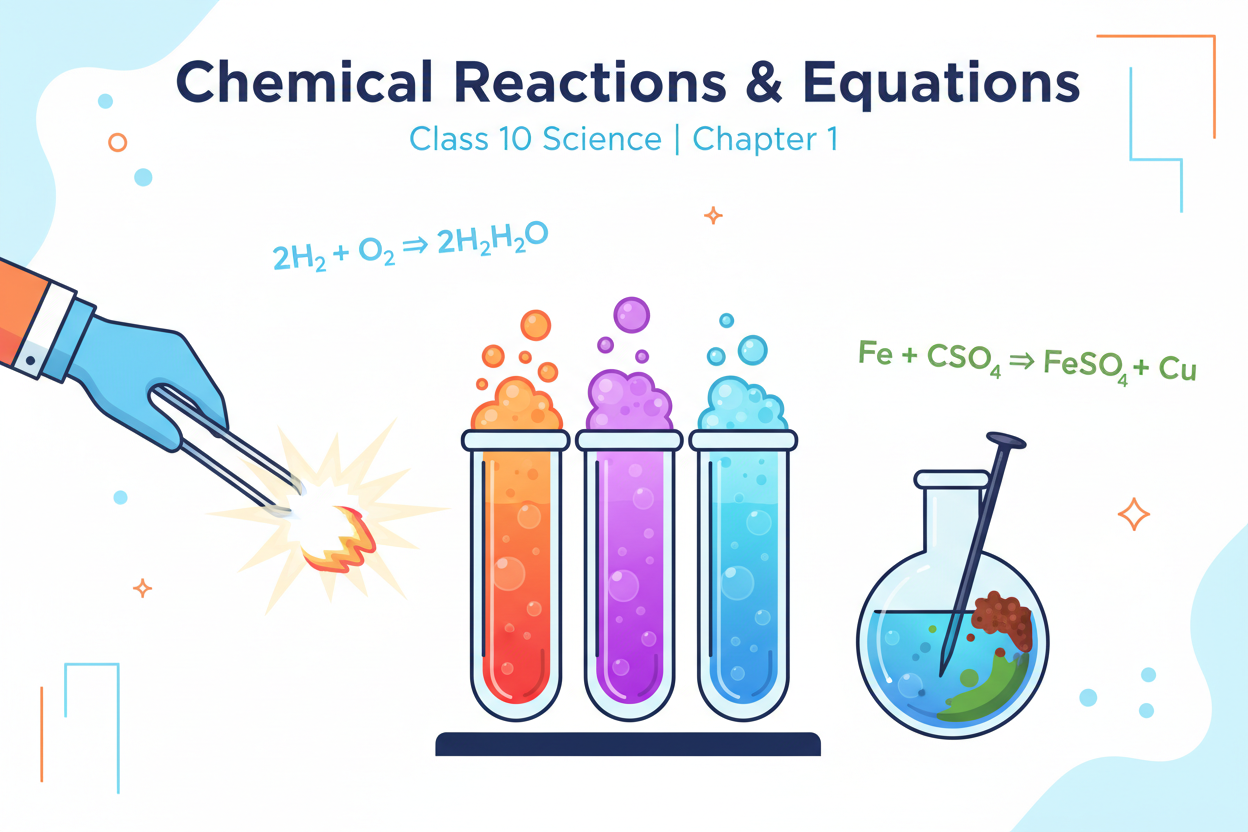
Class 10 Science — Chapter 1 | Study Notes
So, What Exactly is a Chemical Reaction?
Think about it. You leave an iron nail outside for a few days. What happens? It turns reddish-brown. Or you burn a piece of paper — ash is left behind. The original substance is gone. Something new has formed.
That’s a chemical reaction.
Simply put — when substances interact and form entirely new substances with different properties, we call it a chemical reaction.
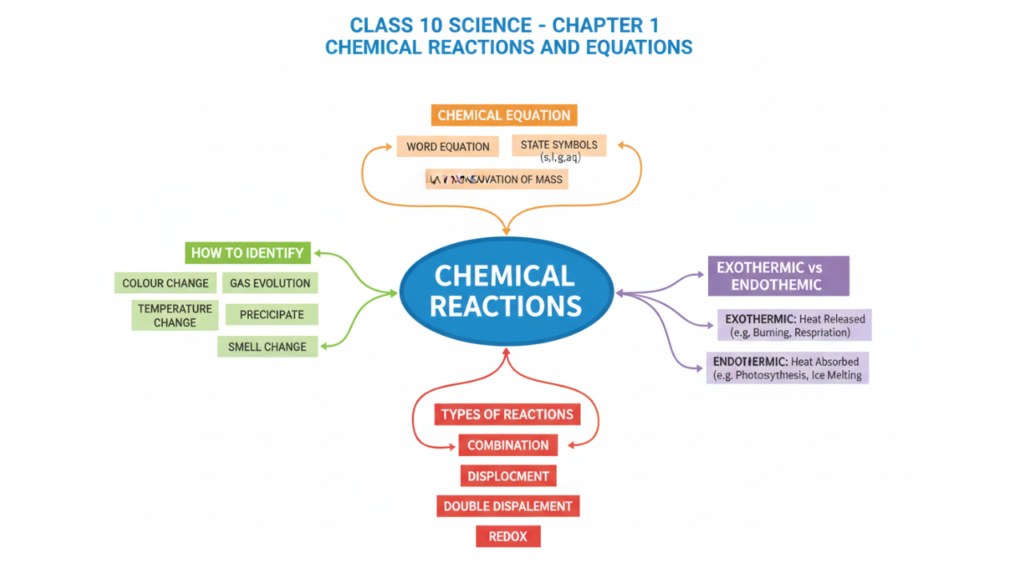
But how do you know a reaction has actually happened? Look for these signs:
- The colour changes — like iron turning rusty brown
- A gas is released — remember the fizz when you mix baking soda and vinegar?
- Temperature changes — some reactions make things hot, others make them cold
- A solid settles at the bottom — called a precipitate
- A new smell appears out of nowhere
If you notice any of these, a chemical reaction is happening right in front of you.
Writing Chemical Reactions — The Equation
Now, scientists don’t just describe reactions in words. They write them as chemical equations. It’s like a shorthand language.
Take magnesium burning in air. In words:
Magnesium + Oxygen → Magnesium Oxide
In chemical language:
2Mg + O₂ → 2MgO
See the difference? Much cleaner, right?
But here’s the important part — the equation must be balanced. Why? Because of a very fundamental law:
“Matter cannot be created or destroyed — only transformed.” — Law of Conservation of Mass (Antoine Lavoisier)
So the number of atoms on the left side must equal the number on the right. Always.
Physical States — Don’t Forget These!
| Symbol | What it means |
|---|---|
| (s) | Solid |
| (l) | Liquid |
| (g) | Gas |
| (aq) | Dissolved in water |
Types of Chemical Reactions — Let’s Break It Down
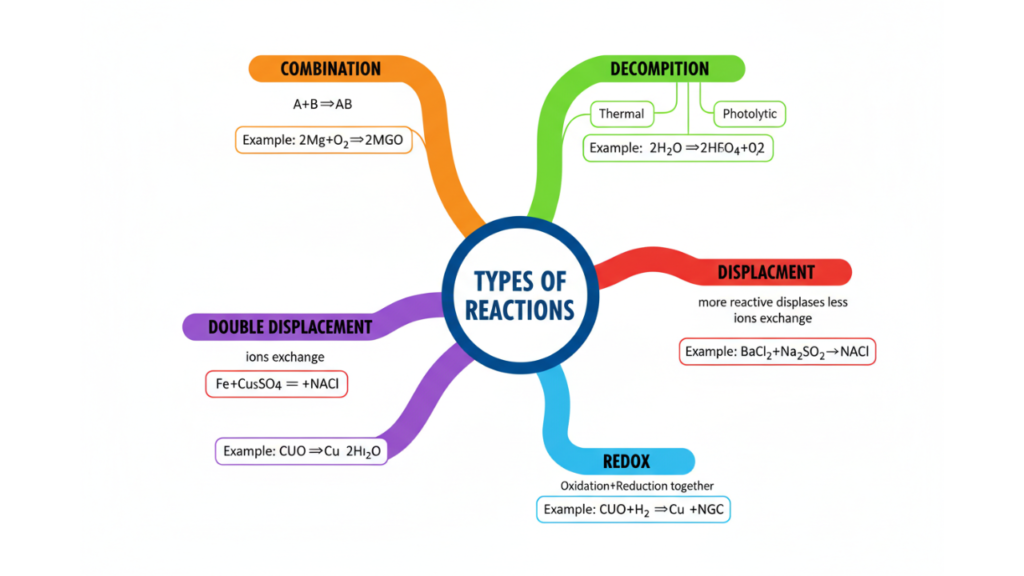
1. Combination Reaction
Two things come together. One new thing is formed. Simple.
A + B → AB
Real example — burning magnesium:
2Mg + O₂ → 2MgO
Ever seen quicklime react with water? It gets incredibly hot. That’s also combination:
CaO + H₂O → Ca(OH)₂ + Heat
2. Decomposition Reaction
Opposite of combination. One compound breaks apart into simpler substances.
AB → A + B
There are three ways this can happen:
- Heat breaks it → Thermal decomposition2FeSO₄ → Fe₂O₃ + SO₂ + SO₃
- Electricity breaks it → Electrolytic decomposition2H₂O → 2H₂ + O₂
- Light breaks it → Photolytic decomposition2AgCl → 2Ag + Cl₂ (used in photography!)
3. Displacement Reaction
Here’s where things get interesting. A more reactive element literally kicks out a less reactive one from its compound.
A + BC → AC + B
Drop an iron nail into blue copper sulphate solution. Watch what happens — the blue fades, turns green, and the nail gets a copper coating. Why?
Fe + CuSO₄ → FeSO₄ + Cu
Iron is more reactive than copper. So iron says — “Move aside, I’m taking over.” That’s displacement.
4. Double Displacement Reaction
Both compounds swap their partners. Like a dance exchange!
AB + CD → AD + CB
Example:
BaCl₂ + Na₂SO₄ → BaSO₄↓ + 2NaCl
Notice the ↓ symbol? That means a white solid (precipitate) has formed and settled down. This is also called a precipitation reaction.
5. Oxidation and Reduction (Redox)
This one’s a two-in-one deal. You can’t have one without the other.
- Oxidation = gaining oxygen (or losing hydrogen)
- Reduction = losing oxygen (or gaining hydrogen)
Look at this reaction:
CuO + H₂ → Cu + H₂O
- CuO loses oxygen → it’s reduced
- H₂ gains oxygen → it’s oxidised
Both happening at the same time. That’s why it’s called a Redox reaction.
The substance causing oxidation? Oxidising agent. The substance causing reduction? Reducing agent.
Oxidation in Real Life — It’s Everywhere
Corrosion — The Slow Destroyer
Ever wondered why old iron gates look so bad? That’s corrosion. Metals slowly react with moisture and oxygen in the air and get damaged.
- Iron → forms rust (reddish-brown Fe₂O₃·xH₂O)
- Copper → turns green (you’ve seen this on old statues!)
- Silver → turns black over time
How do we stop it?
- Paint it. Oil it. Coat it with zinc (galvanisation).
- Make alloys — stainless steel doesn’t rust because of chromium in it.
Rancidity — Why Food Goes Bad
Open a packet of chips that’s been lying around too long. That weird smell? That’s rancidity. Fats and oils in food get oxidised and start smelling awful.
How do we prevent it?
- Airtight containers
- Refrigeration
- Antioxidants added to food
- Nitrogen gas flushed into chips packets — that’s why they’re so puffy!
Quick Revision Table
| Reaction Type | What Happens | Example |
|---|---|---|
| Combination | A + B → AB | 2Mg + O₂ → 2MgO |
| Decomposition | AB → A + B | 2H₂O → 2H₂ + O₂ |
| Displacement | A kicks out B | Fe + CuSO₄ → FeSO₄ + Cu |
| Double Displacement | Both swap partners | BaCl₂ + Na₂SO₄ → BaSO₄↓ + 2NaCl |
| Redox | Oxidation + Reduction together | CuO + H₂ → Cu + H₂O |
Key Terms — Super Quick
- Reactants — what goes in (left of arrow)
- Products — what comes out (right of arrow)
- Catalyst — speeds up reaction, doesn’t get used up
- Exothermic — releases heat (burning, respiration)
- Endothermic — absorbs heat (photosynthesis, cooking)
- Precipitate — insoluble solid formed (shown by ↓)
Board Exam — Important Questions
Q1. Why is magnesium ribbon cleaned before burning?
Q2. What is the Law of Conservation of Mass? Who gave it?
Q3. Difference between combination and decomposition reactions — with examples.
Q4. What happens when iron is dipped in copper sulphate solution? Write the equation.
Q5. What is a redox reaction? Identify oxidising and reducing agents in: CuO + H₂ → Cu + H₂O
Q6. What is corrosion? How can it be prevented?
Q7. What is rancidity? Why are nitrogen gas packets used in chips?
Q8. Difference between exothermic and endothermic reactions — 2 examples each.
📚 Based on NCERT Class 10 Science Chapter 1. For complete preparation, solve all NCERT exercises too!
Class 10 Science — Chapter 1 | Q&A
NCERT Textbook Questions
Q1. Why should a magnesium ribbon be cleaned before burning in air?
Here’s the thing — magnesium doesn’t just sit there doing nothing. Even before you burn it, it slowly reacts with oxygen in the air and forms a thin layer of Magnesium Oxide (MgO) on its surface.
This layer acts like a shield. It stops the ribbon from burning properly.
So what do we do? We rub it with sandpaper. That removes the layer. Now the fresh magnesium underneath can burn brightly — the way it’s supposed to.
Q2. Write balanced equations for the following:
(i) Hydrogen + Chlorine → Hydrogen Chloride
H₂ + Cl₂ → 2HCl
(ii) Barium Chloride + Aluminium Sulphate → Barium Sulphate + Aluminium Chloride
3BaCl₂ + Al₂(SO₄)₃ → 3BaSO₄ + 2AlCl₃
(iii) Sodium + Water → Sodium Hydroxide + Hydrogen
2Na + 2H₂O → 2NaOH + H₂↑
Q3. Write balanced equations with state symbols for:
(i) Barium Chloride + Sodium Sulphate → Barium Sulphate + Sodium Chloride
BaCl₂(aq) + Na₂SO₄(aq) → BaSO₄(s)↓ + 2NaCl(aq)
The ↓ tells you that Barium Sulphate is insoluble — it settles as a white solid at the bottom.
(ii) Sodium Hydroxide + Hydrochloric Acid → Sodium Chloride + Water
NaOH(aq) + HCl(aq) → NaCl(aq) + H₂O(l)
Q4. A solution of substance ‘X’ is used for whitewashing. Name it, give its formula, and write its reaction with water.
The substance is Calcium Oxide (CaO) — commonly called Quicklime.
When you add water to it:
CaO(s) + H₂O(l) → Ca(OH)₂(aq) + Heat
Notice the “Heat” part? This reaction is exothermic — it releases so much heat that the water can actually start boiling. The product, Ca(OH)₂ (Slaked Lime), is what’s used for whitewashing walls.
Q5. In electrolysis of water, why is gas collected in one test tube double that of the other? Name that gas.
Water is H₂O. Look at the formula carefully — 2 hydrogen atoms, 1 oxygen atom.
When electricity passes through water:
2H₂O(l) → 2H₂(g) + O₂(g)
- Hydrogen collects at the cathode (negative electrode)
- Oxygen collects at the anode (positive electrode)
Since there are twice as many hydrogen atoms as oxygen atoms, hydrogen gas is collected in double the amount. That’s the gas — Hydrogen (H₂).
Q6. Why does the colour of copper sulphate solution change when an iron nail is dipped in it?
This one’s actually quite fascinating to watch in a lab.
Iron is more reactive than copper. So when an iron nail goes into the blue copper sulphate solution, iron pushes copper out:
Fe(s) + CuSO₄(aq) → FeSO₄(aq) + Cu(s)
What do you see?
- The blue colour fades and turns pale green (because FeSO₄ is green)
- A reddish-brown copper layer appears on the nail
This is a classic displacement reaction — the more reactive element always wins.
Q7. What is a precipitation reaction? Explain with an example.
Sometimes when you mix two clear solutions, a solid suddenly appears and settles at the bottom. That solid is called a precipitate, and the reaction is called a precipitation reaction.
Example:
Na₂SO₄(aq) + BaCl₂(aq) → BaSO₄(s)↓ + 2NaCl(aq)
The moment these two solutions meet, a white solid (Barium Sulphate) forms and drops to the bottom. The ↓ symbol tells you exactly that.
This is also a double displacement reaction — both compounds swap their partners.
Q8. Explain oxidation and reduction in terms of gain or loss of oxygen. Give two examples each.
(a) Oxidation — Gaining Oxygen
Think of oxidation as a substance “picking up” oxygen.
- 2Mg + O₂ → 2MgO (Magnesium picks up oxygen)
- C + O₂ → CO₂ (Carbon picks up oxygen)
(b) Reduction — Losing Oxygen
Reduction is the opposite — a substance “gives away” its oxygen.
- CuO + H₂ → Cu + H₂O (CuO gives away oxygen)
- Fe₂O₃ + 3CO → 2Fe + 3CO₂ (Iron oxide gives away oxygen)
Q9. In refining of silver, copper displaces silver from silver nitrate solution. Write the reaction.
Cu(s) + 2AgNO₃(aq) → Cu(NO₃)₂(aq) + 2Ag(s)
Copper is more reactive than silver — so it steps in and takes silver’s place. Pure silver is deposited. This is a displacement reaction.
Q10. What are exothermic and endothermic reactions? Give examples.
Exothermic — Energy Released
These reactions give out heat. You can actually feel the warmth.
- Burning of natural gas: CH₄ + 2O₂ → CO₂ + 2H₂O + Heat
- Respiration in our body: C₆H₁₂O₆ + 6O₂ → 6CO₂ + 6H₂O + Energy
Yes — your body is running on an exothermic reaction right now!
Endothermic — Energy Absorbed
These reactions need energy to happen. They take heat in.
- Photosynthesis: 6CO₂ + 6H₂O + Sunlight → C₆H₁₂O₆ + 6O₂
- Decomposition of limestone: CaCO₃ → CaO + CO₂ (needs strong heating)
Extra Important Questions
Q11. What is a redox reaction? Give one example.
A redox reaction is where oxidation and reduction happen at the same time — you can’t separate them.
CuO + H₂ → Cu + H₂O
- CuO loses oxygen → reduced → CuO is the oxidising agent
- H₂ gains oxygen → oxidised → H₂ is the reducing agent
One gains, one loses. Always together.
Q12. What is corrosion? How can it be prevented?
Corrosion is the slow destruction of metals when they react with moisture, oxygen, or acids around them. It’s basically nature taking back what it gave.
- Iron rusts: 4Fe + 3O₂ + xH₂O → 2Fe₂O₃·xH₂O
- Copper turns green
- Silver turns black
How do we fight it?
- Paint or oil the surface — cuts off contact with air
- Galvanisation — coat iron with zinc
- Make alloys — stainless steel resists rust because of chromium
- Electroplating — coat with a protective metal layer
Q13. What is rancidity? How can it be prevented?
Ever opened a biscuit packet that’s been lying around too long and got hit by that stale, unpleasant smell? That’s rancidity.
Fats and oils in food slowly get oxidised when exposed to air. The result — bad smell, bad taste, and food that’s no longer safe to eat.
How do we prevent it?
- Airtight containers — no air, no oxidation
- Refrigeration — cold slows down the reaction
- Antioxidants — added to packaged food (Vitamin C, Vitamin E)
- Nitrogen gas in chips packets — replaces oxygen so oxidation can’t happen
Q14. Difference between Combination and Decomposition Reactions
| Feature | Combination | Decomposition |
|---|---|---|
| What happens | Two substances join to form one | One substance breaks into many |
| General form | A + B → AB | AB → A + B |
| Energy | Usually releases heat | Usually needs energy |
| Example | 2Mg + O₂ → 2MgO | 2H₂O → 2H₂ + O₂ |
Q15. What happens when silver chloride is kept in sunlight?
2AgCl(s) → 2Ag(s) + Cl₂(g)
Sunlight provides the energy needed to break AgCl apart. The white silver chloride slowly turns grey as silver metal is deposited.
This is photolytic decomposition — and it’s the science behind black and white photography. Pretty cool, right?
One-Line Quick Revision
- Reactants → what reacts
- Products → what forms
- Catalyst → speeds up, not consumed
- Precipitate → insoluble solid (↓)
- Exothermic → releases heat
- Endothermic → absorbs heat
- Oxidation → gains O₂ / loses H₂
- Reduction → loses O₂ / gains H₂
- Corrosion → slow oxidation of metals
- Rancidity → oxidation of fats/oils
Forest and Wildlife Resources Class 10 Geography Chapter 2
Resource and Development Class 10 Geography Chapter 1
[…] Class 10 Science — Chapter 1 Chemical Reactions and Equations […]