About the Author
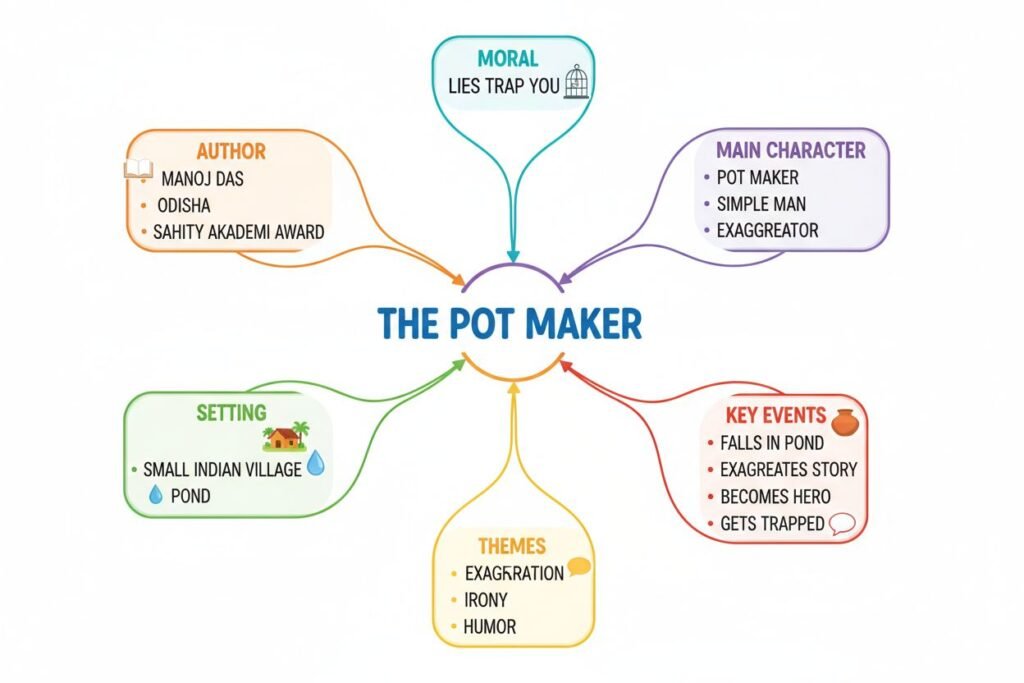
The story “The Pot Maker” is written by Manoj Das — one of India’s most celebrated English and Odia writers. Born in 1934 in Odisha, Manoj Das is known for his unique storytelling style that blends folklore, philosophy, humor, and deep human insight together.
He has won many prestigious awards including the Sahitya Akademi Award and the Padma Bhushan — one of India’s highest civilian honors. His stories often carry a subtle moral message wrapped inside a simple, everyday situation. He has a gift for making ordinary people and ordinary moments feel extraordinary.
“The Pot Maker” is a perfect example of his style — a simple village story on the surface, but with a deep, thought-provoking message underneath.
Theme — In English
The central theme of “The Pot Maker” is the power of imagination, storytelling, and the human tendency to exaggerate.
The story shows how a simple, harmless lie or exaggeration — told innocently — can snowball into something much bigger than anyone intended. It also explores how people blindly believe what they hear, especially when a story is told with confidence and detail.
At a deeper level, the story is about human gullibility — our tendency to accept things without questioning them. It gently mocks the way rumors spread in society, how one person’s imagination becomes another person’s “fact,” and how the truth gets buried under layers of storytelling.
There is also a theme of irony and humor — the pot maker himself becomes a victim of the very story he created. The story ends with a twist that makes you smile and think at the same time.
Theme — Hindi Mein
“The Pot Maker” की केंद्रीय थीम है — कल्पना की शक्ति, कहानियों का फैलना, और इंसान की बढ़ा-चढ़ाकर बोलने की आदत।
यह कहानी दिखाती है कि एक छोटी सी झूठ या exaggeration कैसे धीरे-धीरे इतनी बड़ी हो जाती है कि खुद कहानी बनाने वाला भी उसमें फँस जाता है। साथ ही यह भी दिखाता है कि लोग बिना सोचे-समझे किसी भी बात पर यकीन कर लेते हैं — खासकर जब कोई बात confidence से बोली जाए।
गहरी बात यह है कि यह कहानी इंसानी भोलेपन (gullibility) पर व्यंग्य करती है — कैसे एक इंसान की कल्पना दूसरे के लिए “सच” बन जाती है, और सच कहीं न कहीं खो जाता है।
कहानी में हास्य (humor) और विडंबना (irony) भी है — Pot Maker खुद अपनी ही बनाई कहानी का शिकार हो जाता है।
📌 एक पंक्ति में थीम — “झूठ और बढ़ा-चढ़ाकर बोलना इंसान को एक दिन उसी जाल में फँसा देता है जो उसने खुद बुना था।”
Summary — In English
The story is set in a small Indian village. The main character is a pot maker — a simple, ordinary man who makes clay pots for a living.
One day, while digging clay near a pond, the pot maker accidentally falls into the pond. He is not a good swimmer, and he struggles. Somehow, he manages to save himself and crawls out.
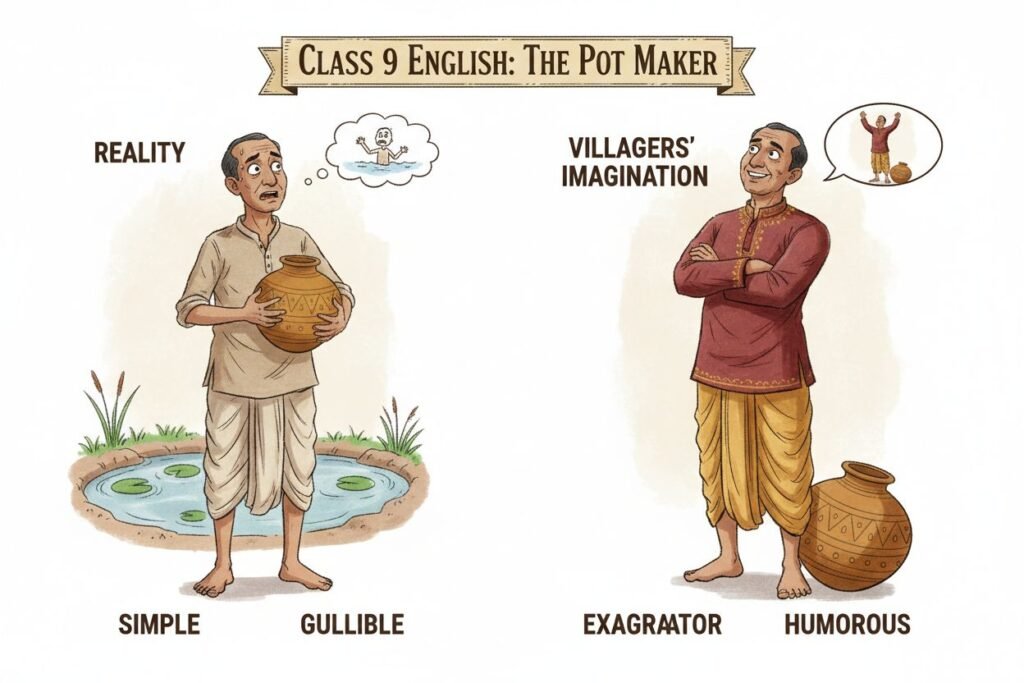
Now, when he goes back to the village, he tells people what happened — but instead of telling the simple truth, he exaggerates the story. He says the pond was very deep, the current was strong, and he barely survived a near-death experience.
People listen with wide eyes. They are impressed. They feel sorry for him. And they start retelling the story to others — but each time the story is retold, it gets bigger and more dramatic.
By the time the story travels through the village, the pond has become a raging river, the pot maker has become a heroic swimmer, and the incident has become a legendary near-death adventure.
The pot maker himself starts believing the exaggerated version. He begins to feel like a hero.
But then comes the twist — someone asks him to demonstrate his swimming skills. And the pot maker, who can barely swim, is now trapped by his own story. He has to face the consequences of the exaggeration he started.
The story ends with gentle humor and a clear moral — don’t exaggerate, because your own words can trap you.
Summary — Hindi Mein
यह कहानी एक छोटे से भारतीय गाँव में सेट है। मुख्य पात्र एक कुम्हार (Pot Maker) है — एक सादा, आम आदमी जो मिट्टी के बर्तन बनाता है।
एक दिन, तालाब के पास मिट्टी खोदने के दौरान, कुम्हार गलती से तालाब में गिर जाता है। वह अच्छा तैराक नहीं है, बहुत मुश्किल से बाहर निकलता है।
गाँव वापस आकर वह लोगों को बताता है — लेकिन सीधा सच नहीं बोलता। बढ़ा-चढ़ाकर कहता है कि तालाब बहुत गहरा था, बहुत मुश्किल से जान बची।
लोग हैरान हो जाते हैं। वे कहानी आगे सुनाते हैं — और हर बार कहानी और बड़ी हो जाती है। तालाब “नदी” बन जाता है, कुम्हार “बहादुर तैराक” बन जाता है, और एक छोटी सी घटना “legendary adventure” बन जाती है।
कुम्हार खुद भी यह सोचने लगता है कि वह हीरो है।
लेकिन फिर twist आता है — कोई उसे swimming demonstrate करने को कहता है। अब कुम्हार अपनी ही कहानी में फँस जाता है।
📌 कहानी का नैतिक (Moral) — झूठ या बढ़ा-चढ़ाकर बोलना मत करो, क्योंकि वह वापस तुम्हारे पास आता है।
MCQs — 15 Questions
1. Who is the author of “The Pot Maker”?
- a) Sudha Murthy
- b) Ruskin Bond
- c) Manoj Das ✅
- d) R.K. Narayan
2. What is the profession of the main character?
- a) Farmer
- b) Fisherman
- c) Pot Maker ✅
- d) Carpenter
3. Where does the pot maker fall accidentally?
- a) A well
- b) A river
- c) A pond ✅
- d) A ditch
4. Why did the pot maker exaggerate his story?
- a) To get money
- b) To impress people and gain attention ✅
- c) To scare others
- d) To get help
5. What happens to the story as it travels through the village?
- a) It stays the same
- b) It gets shorter
- c) It gets bigger and more dramatic ✅
- d) It gets forgotten
6. What does the pond become in the exaggerated version of the story?
- a) A lake
- b) A sea
- c) A raging river ✅
- d) A waterfall
7. What is the central theme of the story?
- a) Importance of swimming
- b) Village life in India
- c) Exaggeration and human gullibility ✅
- d) Friendship and loyalty
8. Manoj Das received which prestigious award?
- a) Booker Prize
- b) Sahitya Akademi Award ✅
- c) Nobel Prize
- d) Pulitzer Prize
9. What is the pot maker’s problem at the end of the story?
- a) He loses his pots
- b) He is asked to prove his swimming skills ✅
- c) He falls sick
- d) He leaves the village
10. The story is set in:
- a) A big city
- b) A small Indian village ✅
- c) A forest
- d) A school
11. What literary device is central to this story?
- a) Metaphor
- b) Irony and exaggeration ✅
- c) Alliteration
- d) Flashback
12. Manoj Das belongs to which state of India?
- a) West Bengal
- b) Kerala
- c) Odisha ✅
- d) Maharashtra
13. What moral does the story teach?
- a) Always learn to swim
- b) Never trust villagers
- c) Exaggeration can trap you in your own lies ✅
- d) Hard work always pays off
14. How does the pot maker feel after people start believing his story?
- a) Guilty and ashamed
- b) Like a hero ✅
- c) Scared and nervous
- d) Sad and lonely
15. The tone of the story is best described as:
- a) Tragic and emotional
- b) Humorous and ironic ✅
- c) Scary and suspenseful
- d) Romantic and dreamy
True / False Questions
- “The Pot Maker” is written by Sudha Murthy. — False (Manoj Das)
- The pot maker falls into a river. — False (a pond)
- The pot maker is a skilled swimmer. — False (he can barely swim)
- The story gets exaggerated as it spreads through the village. — True
- Manoj Das won the Sahitya Akademi Award. — True
- The pot maker feels ashamed after people believe his story. — False (he feels like a hero)
- The story has a humorous and ironic tone. — True
- The central theme is about the power of exaggeration and gullibility. — True
- The story is set in a big city. — False (a small village)
- The pot maker is asked to demonstrate his swimming at the end. — True
Fill in the Blanks
- “The Pot Maker” is written by Manoj Das.
- The pot maker accidentally falls into a pond.
- The story is set in a small Indian village.
- As the story spreads, the pond becomes a raging river in the exaggerated version.
- Manoj Das received the Sahitya Akademi Award for his literary work.
- The pot maker starts feeling like a hero after people believe his story.
- The central theme of the story is exaggeration and human gullibility.
- The tone of the story is humorous and ironic.
- At the end, the pot maker is asked to prove his swimming skills.
- Manoj Das was born in the state of Odisha.
Descriptive Type Questions & Answers
Q1. Give a brief character sketch of the pot maker.
The pot maker is a simple, ordinary village man who earns his living by making clay pots. He is not particularly brave or skilled — in fact, he can barely swim. However, he has a very human weakness — the desire to be admired and seen as important. When he accidentally falls into the pond and survives, instead of telling the plain truth, he exaggerates the incident to make himself look heroic. He enjoys the attention and admiration he receives from the villagers. He even starts believing his own exaggerated story. But his weakness for storytelling ultimately traps him when he is asked to prove his swimming skills. The pot maker represents every ordinary person who has ever stretched the truth a little — and paid the price for it.
Q2. How does the story spread and change as it travels through the village?
The story begins with the pot maker’s own exaggerated account of falling into the pond. He describes it as a near-death experience in deep, dangerous water. As the villagers retell the story to others, each person adds their own details and dramatizations. The pond becomes a raging river. The pot maker becomes a heroic, skilled swimmer. The incident transforms from a simple accident into a legendary adventure. This shows how rumors and stories change as they pass from person to person — each retelling adds something new, and the original truth gets completely buried. The story is a brilliant commentary on how gossip and exaggeration work in society.
Q3. What is the significance of the twist at the end of the story?
The twist at the end — where the pot maker is asked to demonstrate his swimming — is the most important moment in the story. It is the point where the pot maker’s exaggeration comes back to haunt him. He created a story to gain admiration, but now that very story puts him in an embarrassing and difficult situation. The twist serves two purposes: first, it provides the humor that makes the story entertaining; second, it delivers the moral — that lies and exaggerations always catch up with you. The ending is ironic because the pot maker becomes a victim of his own imagination. It makes the reader smile while also making them think.
Q4. What does the story say about human nature?
“The Pot Maker” reveals several truths about human nature. First, it shows our desire for attention and admiration — the pot maker exaggerates not out of malice, but simply because he wants to be seen as important. Second, it shows our tendency toward gullibility — the villagers believe the story without questioning it, simply because it is told with confidence and detail. Third, it shows how rumors spread — each person adds to the story, making it bigger and more dramatic. Finally, it shows the consequences of dishonesty — even small exaggerations can create big problems. The story holds up a mirror to society and makes us laugh at ourselves.
Q5. What is the moral of the story “The Pot Maker”?
The moral of the story is clear and timeless: do not exaggerate or lie, because your own words can trap you. The pot maker started with a small exaggeration to impress people. But as the story grew beyond his control, he found himself trapped in a situation he could not escape. The story also teaches us to think critically — not to blindly believe everything we hear. We should question stories before accepting them as truth. And most importantly, it teaches us that honesty is always the safest path — because the truth never needs to be remembered, but a lie always does.
Summary — Gifts of Grace: Honouring Our Vocations
Class 9 | Kaveri | Reading for Appreciation
First, Let’s Set the Mood
Think about your morning. You woke up, switched on the light — an electrician made that possible. You wore shoes — a shoemaker crafted them. You ate food — a cook prepared something like it. You walked on roads built by masons and carpenters.
We use the work of dozens of people every single day — and we almost never stop to say thank you.
This poem does exactly that. It stops. It looks around. And it says — “I see you. I hear you. Your work matters.”
What the Poem Is About
The poem opens with a beautiful line — “I hear Bharat celebrating, the varied vocations I hear.”
The poet is not talking about politicians or celebrities. They are talking about the real India — the India of craftspeople, artisans, carpenters, electricians, boatmen, shoemakers, cooks, designers, and masons. The people whose hands actually build this country, day after day, without fanfare or applause.
Each stanza of the poem celebrates a different worker:
- The craftsperson who weaves colors and hues into their work with pride
- The artisan with a lute — the musician, the artist — who celebrates emotions and dreams through their craft
- The carpenter who creates anything from wood with mathematical precision — not just skill, but science
- The electrician who hums while working, laying cables and wires to literally brighten our lives
- The boatman who gathers nets from the shore, sails, sings, and comes back with tales of the sea
- The shoemaker who affirms the quality of their work — for feet that walk, dance, run, jump, and return home
- The cook, designer, and mason — each celebrating what belongs uniquely to them
The Deeper Message
What makes this poem truly special is its philosophy — not just its description.
The last two lines say everything:
“The voice of their vocation is the voice of their identity. I hear Bharat celebrating, the varied voices I hear!”
This is profound. The poet is saying — your work is not just what you do. It is who you are. A carpenter is not just someone who cuts wood. A boatman is not just someone who rows a boat. Their craft is their identity, their pride, their voice.
And when all these voices come together — the carpenter, the electrician, the cook, the shoemaker — that collective sound is India celebrating itself.
Why This Poem Matters for Class 9 Students
In a world that often glorifies only doctors, engineers, and businesspeople, this poem is a gentle but powerful reminder — every vocation has grace and dignity. The person who fixes your electricity is as important as the person who designs your building. The cook who feeds you is as valuable as the person who earns the money to pay for the food.
This poem teaches respect for all kinds of work — and that is a lesson every student needs to carry through life.
One-Line Summary
“Gifts of Grace” is a celebration of India’s working people — craftspeople, artisans, electricians, boatmen, shoemakers, and cooks — reminding us that every vocation is an identity, and together, their voices are the true voice of Bharat.
How I Taught My Grandmother to Read Class 9 Summary & Theme | NCERT English
क्या लिखूँ Summary in Hindi — Class 9 Notes, MCQs & PYQs (पदुमलाल पुन्नालाल बख्शी)