2.1 Introduction
You’ve already met electric charges and the fields they create. But here’s a question nobody asks in textbooks — how much effort does it take to move a charge from one place to another?
Think about it. If you want to push a positive charge closer to another positive charge, you’re fighting against repulsion the whole way. That takes energy. And that energy doesn’t disappear — it gets stored in the system, ready to be released the moment you let go.
That stored energy per unit charge is what we call electric potential. And once you understand potential, everything else in this chapter clicks into place.
This chapter is really about two big ideas:
First — Electrostatic Potential. Instead of tracking forces (which are vectors and a headache to add), we track potential (which is a scalar — just plain numbers). It makes solving problems dramatically simpler. You’ll see how potential behaves around point charges, dipoles, and conductors — and why some surfaces in space are “equal height” zones where no work is needed to move a charge.
Second — Capacitors. These are devices built specifically to store electric energy. Your phone, your laptop, your camera flash, hospital defibrillators — all of them depend on capacitors. By the end of this chapter, you’ll understand exactly how they work, how to combine them, and how much energy they can hold.
There’s also a beautiful concept hiding in between — dielectrics. These are insulating materials that, when placed inside a capacitor, quietly boost its storage capacity without changing its size. Understanding why they work the way they do connects atomic-level physics to real engineering.
So whether it’s the spark from a camera flash or the pulse that restarts a heart — it all comes down to the physics you’re about to learn. Let’s get into it. ⚡
2.2 Electrostatic Potential
So here’s a question — if you had to move a positive charge closer to another positive charge, would it be easy or hard?
Hard, right? You’d have to push against the repulsion. That means you’re doing work against the electric force. And where does that work go? It gets stored as potential energy.
Electrostatic Potential (V) at a point is defined as the work done per unit positive charge in bringing a test charge from infinity to that point, without acceleration.
$$V = \frac{W}{q_0}$$
- SI Unit: Volt (V) = Joule/Coulomb
- It is a scalar quantity — no direction, just magnitude (with sign!)
- Potential due to a positive charge is positive
- Potential due to a negative charge is negative
Relation between Electric Field and Potential:
$$E = -\frac{dV}{dr}$$
The negative sign tells you something beautiful — the electric field always points from higher potential to lower potential. Just like water flows downhill, positive charges “flow” from high V to low V!
Think of it like altitude. Potential is like height — the higher you are, the more potential energy you have. Electric field is like the slope — it tells you which way is “downhill” for a charge.
2.3 Potential due to a Point Charge
For a point charge Q, the potential at distance r is:
$$V = \frac{kQ}{r} = \frac{Q}{4\pi\varepsilon_0 r}$$
Key observations:
- V decreases as r increases (inversely proportional to r — not r² like field!)
- For positive Q → V is positive everywhere
- For negative Q → V is negative everywhere
- At r = ∞ → V = 0 (reference point)
Notice: Electric field goes as 1/r², but potential goes as 1/r. Potential “reaches farther” than the field in terms of how slowly it drops off!
🔍 Example: A charge of +2μC is placed at origin. What is the potential at 0.5m away? V = (9×10⁹ × 2×10⁻⁶) / 0.5 = 36,000 V = 36 kV That’s a lot! This is why high-voltage equipment needs serious insulation.
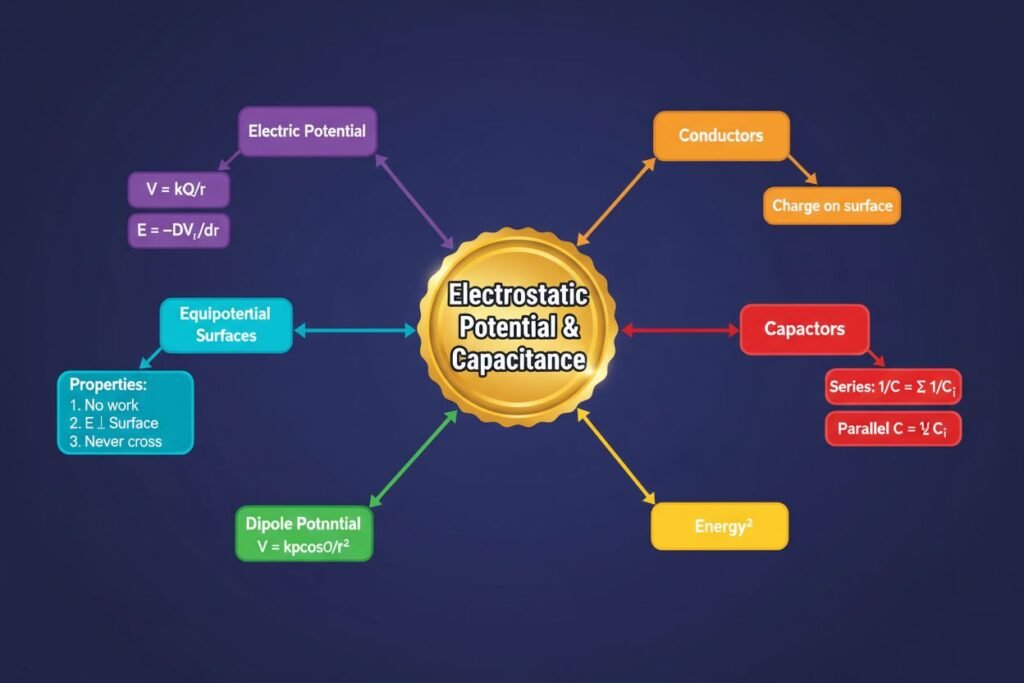
2.4 Potential due to an Electric Dipole
Remember our dipole from Chapter 1? (+q and −q separated by 2a)
At an axial point (distance r from centre, along axis):
$$V_{axial} = \frac{kp}{r^2 – a^2}$$
For r >> a: $$V_{axial} = \frac{kp}{r^2}$$
At an equatorial point (on perpendicular bisector):
$$V_{equatorial} = 0$$
Wait — zero?! Yes! At every point on the equatorial line, the potentials due to +q and −q are equal and opposite — they cancel perfectly.
At a general point (at distance r, angle θ from dipole axis):
$$V = \frac{kp\cos\theta}{r^2}$$
This single formula covers everything:
- θ = 0° → axial point → V = kp/r²
- θ = 90° → equatorial point → V = 0 ✅
🔍 Real-life connection: The potential pattern of a dipole is used in antenna design and in understanding how polar molecules like water interact with electric fields!
2.5 Potential due to a System of Charges
This is beautifully simple — because potential is a scalar, you just add them up algebraically (no vector addition needed!).
$$V = V1 + V_2 + V_3 + … = \sum{i} \frac{kq_i}{r_i}$$
Where r_i is the distance from each charge to the point where you want the potential.
🔍 Example: Three charges +1μC, −2μC, +3μC are at distances 1m, 2m, 3m from point P. V = k(1×10⁻⁶/1 + (−2×10⁻⁶)/2 + 3×10⁻⁶/3) V = 9×10⁹ × (10⁻⁶ − 10⁻⁶ + 10⁻⁶) V = 9000 V
This is the superpower of potential over electric field — no vector headaches!
2.6 Equipotential Surfaces
An equipotential surface is a surface where every point has the same electric potential.
Properties — very exam important!
- No work is done in moving a charge along an equipotential surface (Because W = q × ΔV = q × 0 = 0)
- Electric field is always perpendicular to equipotential surfaces
- Equipotential surfaces never intersect each other
- They are closer together where the field is stronger
- For a point charge → equipotential surfaces are concentric spheres
- For a uniform field → equipotential surfaces are parallel planes
- For a dipole → equipotential surfaces are complex 3D shapes
🔍 Analogy: Contour lines on a map are equipotential lines for gravitational potential. Walking along a contour line means you’re not going up or down — no work done against gravity. Same idea here!
🔍 Why is E perpendicular to equipotential surfaces? If E had a component along the surface, it would do work on a charge moving along it — but we said W = 0. Contradiction! So E must be purely perpendicular.
2.7 Potential Energy of a System of Charges
The potential energy of a system of charges is the total work done in assembling those charges from infinity.
For two charges q₁ and q₂:
$$U = \frac{kq1 q_2}{r{12}}$$
For three charges:
$$U = k\left[\frac{q1 q_2}{r{12}} + \frac{q2 q_3}{r{23}} + \frac{q1 q_3}{r{13}}\right]$$
You’re basically summing the potential energy of every unique pair.
Sign matters!
- Like charges → U is positive (you had to do work to push them together)
- Unlike charges → U is negative (they naturally attract — system released energy)
🔍 Think of it like this: Bringing two magnets together (unlike poles) releases energy — they snap together. That’s negative potential energy. Forcing two same poles together requires work — positive potential energy. Electric charges work the same way!
2.8 Potential Energy in an External Field
Potential energy of a single charge q in external field:
$$U = qV$$
Where V is the potential at the location of the charge due to the external field.
Potential energy of a dipole in an external field:
$$U = -\vec{p} \cdot \vec{E} = -pE\cos\theta$$
- θ = 0° → U = −pE (minimum, stable equilibrium)
- θ = 90° → U = 0
- θ = 180° → U = +pE (maximum, unstable equilibrium)
The dipole has minimum energy when aligned with the field — that’s its “happy place.” Disturb it, and it oscillates back — just like a pendulum at its lowest point!
2.9 Electrostatics of Conductors
This section has some of the most elegant results in all of electrostatics. Pay attention!
Six key properties of conductors in electrostatic equilibrium:
1. E = 0 inside a conductor Free electrons rearrange themselves until the internal field is completely cancelled. If E ≠ 0 inside, charges would keep moving — not equilibrium!
2. No charge inside — all charge resides on the surface Using Gauss’s Law: since E = 0 inside, flux through any internal Gaussian surface = 0, so enclosed charge = 0. All charge must be on the surface!
3. Electric field just outside = σ/ε₀, perpendicular to surface $$E = \frac{\sigma}{\varepsilon_0}$$ (Note: this is twice the field of an infinite sheet — because the conductor has charge only on one side!)
4. The entire conductor is at the same potential Since E = 0 inside, no work is done moving charges inside → same potential everywhere.
5. Potential is constant throughout the conductor and on its surface
6. Charge accumulates at sharp points (corners) This is why lightning rods are pointed — charge concentrates at the tip, creating a strong field that ionises air and provides a safe discharge path!
🔍 Faraday Cage revisited: A car, airplane, or metal box acts as a Faraday cage. During lightning, all charge stays on the outer surface. Inside? Perfectly safe. That’s pure conductor physics!
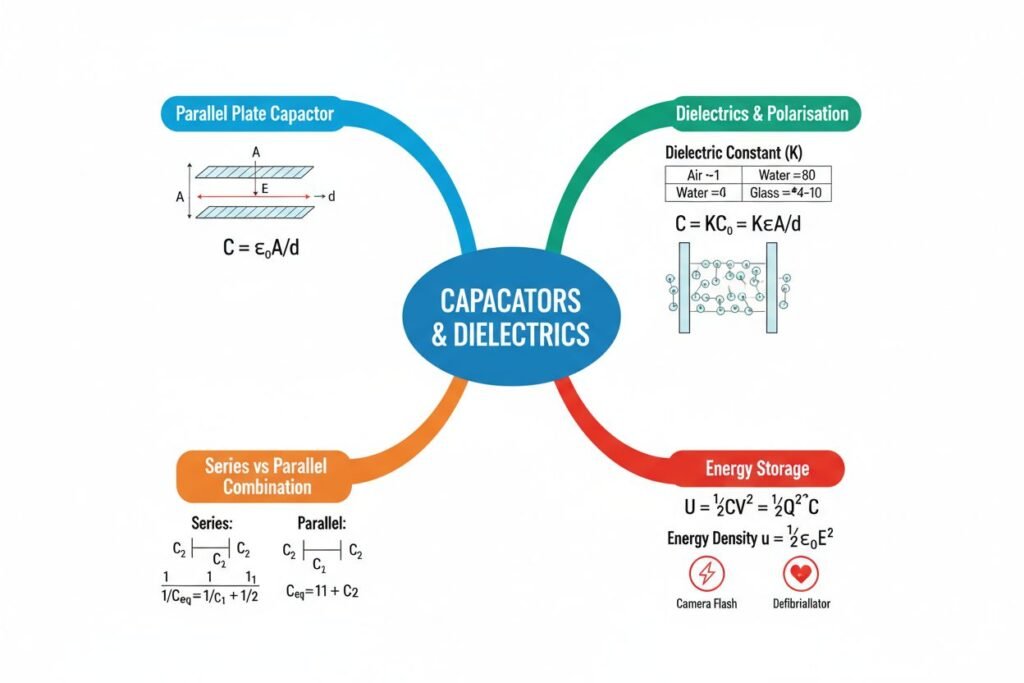
2.10 Dielectrics and Polarisation
So far we’ve talked about conductors. Now meet their opposite — dielectrics (insulators like glass, rubber, water).
In a dielectric, electrons are bound — they can’t move freely. But when you apply an external electric field, something interesting happens:
The positive and negative charges within each molecule shift slightly in opposite directions. Each molecule becomes a tiny induced dipole. This is called polarisation.
Polarisation (P) = dipole moment per unit volume
$$\vec{P} = \chi_e \varepsilon_0 \vec{E}$$
Where χₑ is the electric susceptibility of the material.
What polarisation does:
- Creates an internal electric field that opposes the external field
- The net field inside the dielectric is reduced
- This is why dielectrics are so useful in capacitors!
Two types of dielectrics:
- Non-polar dielectrics (like N₂, O₂): No permanent dipole. Dipoles are induced by external field.
- Polar dielectrics (like H₂O, HCl): Have permanent dipoles. External field aligns them.
🔍 Microwave oven example: Water molecules are polar dielectrics. Microwaves create an alternating electric field that makes water molecules rotate rapidly — generating heat. That’s how your food gets cooked! Physics in your kitchen. 🍕
2.11 Capacitors and Capacitance
A capacitor is a device that stores electric charge (and hence energy). It consists of two conductors (called plates) separated by an insulator (dielectric or air).
Capacitance (C) is the ability of a capacitor to store charge:
$$C = \frac{Q}{V}$$
- Q = charge stored on one plate
- V = potential difference between the plates
- SI Unit: Farad (F) = Coulomb/Volt
Practical units: μF (microfarad), nF (nanofarad), pF (picofarad) (1 Farad is enormous — most capacitors are in μF or pF range)
🔍 Analogy: Think of a capacitor like a water tank. Capacitance is the size of the tank — bigger tank, more water (charge) for the same pressure (voltage). A large capacitance means you can store more charge at the same voltage!
What affects capacitance?
- Size of the plates (larger area → more C)
- Distance between plates (closer → more C)
- Material between plates (dielectric → more C)
2.12 The Parallel Plate Capacitor
The most common and important type of capacitor!
Two large parallel conducting plates, each of area A, separated by distance d.
Electric field between the plates: $$E = \frac{\sigma}{\varepsilon_0} = \frac{Q}{\varepsilon_0 A}$$
Potential difference: $$V = Ed = \frac{Qd}{\varepsilon_0 A}$$
Capacitance: $$\boxed{C = \frac{\varepsilon_0 A}{d}}$$
What this tells you:
- Larger area A → larger C ✅
- Smaller separation d → larger C ✅
- ε₀ is fixed (for air/vacuum between plates)
🔍 Example: Two plates each of area 0.01 m² are separated by 1mm = 0.001m. C = (8.85×10⁻¹² × 0.01) / 0.001 = 88.5 pF That’s tiny! Real capacitors use dielectrics to boost this significantly.
2.13 Effect of Dielectric on Capacitance
When you insert a dielectric (insulating material) between the plates of a capacitor, the capacitance increases!
Why? The dielectric gets polarised, creating an opposing internal field. This reduces the net electric field, which reduces the voltage for the same charge — so C = Q/V increases!
New capacitance with dielectric:
$$\boxed{C = \frac{K\varepsilon_0 A}{d} = \frac{\varepsilon_r \varepsilon_0 A}{d}}$$
Where K = εᵣ is the dielectric constant (relative permittivity) of the material.
| Material | Dielectric Constant K |
|---|---|
| Vacuum/Air | 1 |
| Paper | 3.5 |
| Glass | 5–10 |
| Water | 80 |
| Barium Titanate | ~10,000 |
Two cases to remember:
Case 1: Battery connected (V = constant)
- V stays same, C increases → Q = CV increases
- E stays same (E = V/d)
- Energy stored increases (battery does extra work)
Case 2: Battery disconnected (Q = constant)
- Q stays same, C increases → V = Q/C decreases
- E decreases
- Energy stored decreases (energy goes into polarising the dielectric)
🔍 This is why capacitors in electronics always have a dielectric — it dramatically increases their storage capacity without making them physically larger!
2.14 Combination of Capacitors
Just like resistors, capacitors can be combined in series or parallel.
Capacitors in Series
Capacitors connected end-to-end. Same charge Q on each, but voltage divides.
$$\frac{1}{C_{eq}} = \frac{1}{C_1} + \frac{1}{C_2} + \frac{1}{C_3}$$
- Equivalent capacitance is less than the smallest individual capacitance
- Same charge on each capacitor
- Voltage adds up: V = V₁ + V₂ + V₃
🔍 Why does series reduce capacitance? It’s like increasing the distance between the plates — more separation, less capacitance!
Capacitors in Parallel
Capacitors connected side by side. Same voltage V across each, but charge divides.
$$C_{eq} = C_1 + C_2 + C_3$$
- Equivalent capacitance is the sum of all capacitances
- Same voltage across each capacitor
- Charge adds up: Q = Q₁ + Q₂ + Q₃
🔍 Why does parallel increase capacitance? It’s like increasing the plate area — more area, more capacitance!
🔍 Example: Three capacitors of 2μF, 3μF, 6μF in series: 1/C = 1/2 + 1/3 + 1/6 = 3/6 + 2/6 + 1/6 = 6/6 = 1 C_eq = 1μF
Same three in parallel: C_eq = 2 + 3 + 6 = 11μF
2.15 Energy Stored in a Capacitor
A charged capacitor stores energy in the electric field between its plates.
Energy stored:
$$\boxed{U = \frac{1}{2}CV^2 = \frac{Q^2}{2C} = \frac{QV}{2}}$$
All three forms are equivalent — use whichever is convenient based on what’s given!
Energy density (energy per unit volume) in the electric field:
$$u = \frac{1}{2}\varepsilon_0 E^2$$
This is a profound result — it tells us that energy is stored in the electric field itself, not just in the charges!
🔍 Example: A 100μF capacitor is charged to 12V. U = ½ × 100×10⁻⁶ × 12² = ½ × 100×10⁻⁶ × 144 = 0.0072 J = 7.2 mJ Small but enough to give you a nasty shock if you touch the terminals!
🔍 Real-life application: Camera flash units use large capacitors. They charge slowly from the battery, then discharge all that energy in a millisecond — creating a bright flash. That’s why you have to “wait for the flash to charge” between shots! 📸
🔍 Defibrillators (the heart-restart machines in hospitals) work the same way — charge a capacitor slowly, then dump all energy into the patient’s chest in one powerful pulse. Literally life-saving capacitor physics! ❤️
📋 Master Formula Sheet
| Concept | Formula |
|---|---|
| Electrostatic Potential | V = W/q₀ |
| Potential (point charge) | V = kQ/r |
| E and V relation | E = −dV/dr |
| Potential (dipole, general) | V = kp cosθ / r² |
| Potential (system of charges) | V = Σ kqᵢ/rᵢ |
| PE of two charges | U = kq₁q₂/r |
| PE of dipole in field | U = −pE cosθ |
| Field outside conductor | E = σ/ε₀ |
| Capacitance | C = Q/V |
| Parallel plate capacitor | C = ε₀A/d |
| With dielectric | C = Kε₀A/d |
| Series combination | 1/C = 1/C₁ + 1/C₂ + … |
| Parallel combination | C = C₁ + C₂ + … |
| Energy stored | U = ½CV² = Q²/2C |
| Energy density | u = ½ε₀E² |
🎯 Exam Tips
- Potential is scalar — biggest advantage over electric field (just add, no vectors!)
- Equipotential surface ⊥ field lines — always, no exceptions
- Inside conductor: E = 0, V = constant — two separate facts, both important
- Series capacitors: same Q, voltage divides. Parallel: same V, charge divides
- Energy = ½CV² — the ½ comes from the fact that charging is gradual, not all at once
- Dielectric always increases C — whether battery connected or not
- For battery connected problems: V is constant. For battery disconnected: Q is constant. This changes everything!
- Draw circuit diagrams for capacitor combination problems — saves you from silly mistakes
🧠 MCQs — Electrostatic Potential & Capacitance
(25 Questions | Board + JEE Level)
Q1. The SI unit of electric potential is:
- (a) Joule
- (b) Coulomb
- (c) Volt ✅
- (d) Farad
Q2. Electric potential is a:
- (a) Vector quantity
- (b) Scalar quantity ✅
- (c) Tensor quantity
- (d) Dimensionless quantity
Q3. The potential at a point due to a positive charge is:
- (a) Negative
- (b) Zero
- (c) Positive ✅
- (d) Depends on distance only
Q4. Work done in moving a charge along an equipotential surface is:
- (a) Maximum
- (b) Minimum
- (c) Infinite
- (d) Zero ✅
Q5. The relation between electric field E and potential V is:
- (a) E = dV/dr
- (b) E = −dV/dr ✅
- (c) E = V/r²
- (d) E = V × r
Q6. The potential at the equatorial point of an electric dipole is:
- (a) kp/r²
- (b) 2kp/r²
- (c) Zero ✅
- (d) −kp/r²
Q7. The capacitance of a parallel plate capacitor increases when:
- (a) Distance between plates increases
- (b) Area of plates decreases
- (c) A dielectric is inserted between plates ✅
- (d) Charge on plates decreases
Q8. Three capacitors of capacitance C each are connected in parallel. The equivalent capacitance is:
- (a) C/3
- (b) C
- (c) 2C
- (d) 3C ✅
Q9. Energy stored in a capacitor of capacitance C charged to voltage V is:
- (a) CV²
- (b) ½CV ✅ (½CV²)
- (c) CV
- (d) 2CV²
(Correct answer: ½CV²)
Q10. Inside a charged conductor, the electric field is:
- (a) Maximum
- (b) Equal to surface field
- (c) Zero ✅
- (d) Infinite
Q11. Equipotential surfaces for a uniform electric field are:
- (a) Concentric spheres
- (b) Concentric cylinders
- (c) Parallel planes ✅
- (d) Irregular surfaces
Q12. The dielectric constant of vacuum is:
- (a) 0
- (b) 1 ✅
- (c) Infinity
- (d) 8.85 × 10⁻¹²
Q13. When a dielectric slab is inserted in a capacitor with battery connected, which quantity increases?
- (a) Voltage
- (b) Electric field
- (c) Charge stored ✅
- (d) Distance between plates
Q14. For capacitors in series, which quantity remains the same?
- (a) Voltage
- (b) Charge ✅
- (c) Capacitance
- (d) Energy
Q15. The potential energy of a dipole in stable equilibrium in a uniform field is:
- (a) +pE
- (b) Zero
- (c) −pE ✅
- (d) 2pE
Q16. The unit of capacitance Farad is equal to:
- (a) Joule/Volt
- (b) Coulomb/Volt ✅
- (c) Volt/Coulomb
- (d) Newton/Coulomb
Q17. All points on an equipotential surface have the same:
- (a) Electric field
- (b) Charge density
- (c) Electric potential ✅
- (d) Distance from the source charge
Q18. The energy density in an electric field E is:
- (a) ε₀E
- (b) ε₀E²
- (c) ½ε₀E² ✅
- (d) 2ε₀E²
Q19. When battery is disconnected and a dielectric is inserted, the voltage across the capacitor:
- (a) Increases
- (b) Remains same
- (c) Decreases ✅
- (d) Becomes zero
Q20. The potential due to a system of charges at a point is:
- (a) Vector sum of individual potentials
- (b) Algebraic sum of individual potentials ✅
- (c) Product of individual potentials
- (d) Always zero
Q21. The capacitance of a parallel plate capacitor with plate area A and separation d is:
- (a) ε₀d/A
- (b) ε₀A/d ✅
- (c) ε₀Ad
- (d) A/ε₀d
Q22. Charge on a conductor always resides:
- (a) Inside the conductor
- (b) At the centre
- (c) On the outer surface ✅
- (d) Uniformly throughout
Q23. Two capacitors 4μF and 6μF are connected in series. Equivalent capacitance is:
- (a) 10μF
- (b) 2μF
- (c) 2.4μF ✅
- (d) 5μF
(1/C = 1/4 + 1/6 = 5/12 → C = 12/5 = 2.4μF)
Q24. The process by which a dielectric develops induced dipole moments in an external field is called:
- (a) Conduction
- (b) Polarisation ✅
- (c) Magnetisation
- (d) Ionisation
Q25. A camera flash works on the principle of:
- (a) Slow discharge of a resistor
- (b) Rapid discharge of a capacitor ✅
- (c) Continuous current from battery
- (d) Electromagnetic induction
📝 Important Questions — Board Exam Style
1 Mark Questions
Q1. Define electrostatic potential at a point.
Ans. Electrostatic potential at a point is the work done per unit positive test charge in bringing it from infinity to that point, without acceleration. $$V = \frac{W}{q_0}$$
Q2. What is an equipotential surface?
Ans. A surface on which every point has the same electric potential is called an equipotential surface. No work is done in moving a charge along it.
Q3. Why is the electric field always perpendicular to an equipotential surface?
Ans. If E had a component along the equipotential surface, it would do work on a moving charge — contradicting W = 0 on equipotential surfaces. Hence E must be perpendicular.
Q4. Define capacitance. Give its SI unit.
Ans. Capacitance is the ability of a conductor to store charge. C = Q/V. SI unit is Farad (F) = Coulomb/Volt.
Q5. What is the effect of inserting a dielectric on the capacitance of a capacitor?
Ans. Inserting a dielectric of dielectric constant K increases the capacitance by K times: C’ = KC.
2 Mark Questions
Q6. Derive the relation between electric field and electric potential.
Ans. Consider two equipotential surfaces with potentials V and V+dV, separated by distance dr.
Work done in moving charge q₀ from one to another: $$dW = q_0(V – (V + dV)) = -q_0 , dV$$
Also, work done by electric field: $$dW = q_0 E , dr$$
Equating: $$q_0 E , dr = -q_0 , dV$$ $$\boxed{E = -\frac{dV}{dr}}$$
The negative sign shows field points from high to low potential.
Q7. State two properties of equipotential surfaces.
Ans.
- No work is done in moving a charge along an equipotential surface (W = qΔV = 0).
- Electric field lines are always perpendicular to equipotential surfaces.
- Two equipotential surfaces never intersect each other.
- They are closer where the electric field is stronger.
(Any two with brief explanation)
Q8. Find the equivalent capacitance of 3μF and 6μF connected in (i) series (ii) parallel.
Ans.
(i) Series: $$\frac{1}{C} = \frac{1}{3} + \frac{1}{6} = \frac{2+1}{6} = \frac{3}{6} = \frac{1}{2}$$ $$C_{series} = 2\mu F$$
(ii) Parallel: $$C_{parallel} = 3 + 6 = 9\mu F$$
Q9. What is polarisation of a dielectric? How does it affect the electric field inside?
Ans. When a dielectric is placed in an external electric field, the bound charges in each molecule shift slightly — positive charges shift along the field, negative charges opposite. Each molecule becomes an induced dipole. This is polarisation.
The induced dipoles create an internal electric field that opposes the external field, reducing the net field inside the dielectric to E = E₀/K, where K is the dielectric constant.
Q10. Write the expression for potential energy of an electric dipole in a uniform electric field. When is it (i) minimum (ii) maximum?
Ans. $$U = -pE\cos\theta = -\vec{p}\cdot\vec{E}$$
- (i) Minimum: θ = 0° → U = −pE (stable equilibrium, dipole aligned with field)
- (ii) Maximum: θ = 180° → U = +pE (unstable equilibrium, dipole anti-aligned)
3 Mark Questions
Q11. Derive the expression for capacitance of a parallel plate capacitor.
Ans.
Consider two parallel plates, each of area A, separated by distance d, with surface charge density +σ and −σ.
Electric field between plates: $$E = \frac{\sigma}{\varepsilon_0} = \frac{Q}{\varepsilon_0 A}$$
(Field due to each plate = σ/2ε₀, both in same direction between plates, so they add up)
Potential difference: $$V = E \times d = \frac{Qd}{\varepsilon_0 A}$$
Capacitance: $$C = \frac{Q}{V} = \frac{Q}{\frac{Qd}{\varepsilon_0 A}}$$
$$\boxed{C = \frac{\varepsilon_0 A}{d}}$$
With dielectric of constant K: $C = \frac{K\varepsilon_0 A}{d}$
Q12. Derive the expression for energy stored in a capacitor. Hence find energy density.
Ans.
To charge a capacitor, we transfer charge in small increments dq. At any instant, charge on capacitor = q, potential = q/C.
Work done to transfer dq: $$dW = V , dq = \frac{q}{C} dq$$
Total work done (charging from 0 to Q): $$W = \int_0^Q \frac{q}{C} dq = \frac{1}{C} \cdot \frac{Q^2}{2}$$
$$\boxed{U = \frac{Q^2}{2C} = \frac{1}{2}CV^2 = \frac{1}{2}QV}$$
Energy density (energy per unit volume, volume = Ad): $$u = \frac{U}{Ad} = \frac{\frac{1}{2}\varepsilon_0 A E^2 d}{Ad}$$
$$\boxed{u = \frac{1}{2}\varepsilon_0 E^2}$$
Q13. State six properties of a conductor in electrostatic equilibrium.
Ans.
- E = 0 inside — free electrons rearrange to cancel internal field completely.
- All charge on outer surface — from Gauss’s Law, since E = 0 inside, enclosed charge = 0.
- E = σ/ε₀ just outside — perpendicular to the surface.
- Entire conductor at same potential — since E = 0, no work done moving charges inside.
- Equipotential surface — the surface of a conductor is always an equipotential.
- Charge concentrates at sharp points — leading to corona discharge; basis of lightning rods.
5 Mark Questions
Q14. (a) Derive expression for potential due to an electric dipole at a general point. (b) Find potential at axial and equatorial points as special cases.
Ans.
(a) General Point P at distance r, angle θ from dipole axis:
Let dipole have charges +q and −q separated by 2a. Centre at O.
Distance from +q to P ≈ r − a cosθ Distance from −q to P ≈ r + a cosθ (for r >> a)
Potential at P: $$V = kq\left[\frac{1}{r-a\cos\theta} – \frac{1}{r+a\cos\theta}\right]$$
$$V = kq\left[\frac{(r+a\cos\theta)-(r-a\cos\theta)}{r^2-a^2\cos^2\theta}\right]$$
$$V = kq\left[\frac{2a\cos\theta}{r^2-a^2\cos^2\theta}\right]$$
For r >> a, neglect a²cos²θ:
$$\boxed{V = \frac{kp\cos\theta}{r^2}}$$
(b) Special cases:
Axial point (θ = 0°): $$V_{axial} = \frac{kp\cos 0°}{r^2} = \frac{kp}{r^2}$$
Equatorial point (θ = 90°): $$V_{equatorial} = \frac{kp\cos 90°}{r^2} = 0$$
The equatorial potential is always zero — the contributions from +q and −q cancel exactly!
Q15. (a) What is a dielectric? Explain polarisation. (b) Show that capacitance becomes KC when dielectric of constant K is inserted. (c) Compare the two cases: battery connected vs battery disconnected.
Ans.
(a) Dielectric & Polarisation: A dielectric is an insulating material where charges are bound. In an external field E₀, bound charges shift slightly — each molecule becomes an induced dipole. This is polarisation. The induced dipoles create an opposing field Ep, reducing net field to E = E₀/K.
(b) Capacitance with dielectric:
Without dielectric: $C_0 = \frac{\varepsilon_0 A}{d}$, field = E₀ = σ/ε₀
With dielectric: Net field = E₀/K, so: $$V’ = \frac{E_0}{K} \cdot d = \frac{V_0}{K}$$
$$C’ = \frac{Q}{V’} = \frac{Q}{V_0/K} = K \cdot \frac{Q}{V_0} = KC_0$$
$$\boxed{C’ = KC_0}$$
(c) Comparison:
| Quantity | Battery Connected (V = const) | Battery Disconnected (Q = const) |
|---|---|---|
| Capacitance | Increases (KC₀) | Increases (KC₀) |
| Charge | Increases (KQ₀) | Remains same (Q₀) |
| Voltage | Remains same (V₀) | Decreases (V₀/K) |
| Electric Field | Remains same | Decreases (E₀/K) |
| Energy | Increases (KU₀) | Decreases (U₀/K) |
📋 Quick Revision Card
| Topic | Key Point |
|---|---|
| Potential | Scalar — just add, no vectors! |
| Equipotential | W = 0, E ⊥ surface |
| Dipole potential | V = kpcosθ/r², zero at equatorial |
| Conductor | E = 0 inside, V = constant |
| Capacitance | C = Q/V = ε₀A/d |
| Dielectric | C becomes KC |
| Series | Same Q, 1/C = 1/C₁ + 1/C₂ |
| Parallel | Same V, C = C₁ + C₂ |
| Energy | U = ½CV² |
| Battery ON + dielectric | Q increases, V same |
| Battery OFF + dielectric | V decreases, Q same |