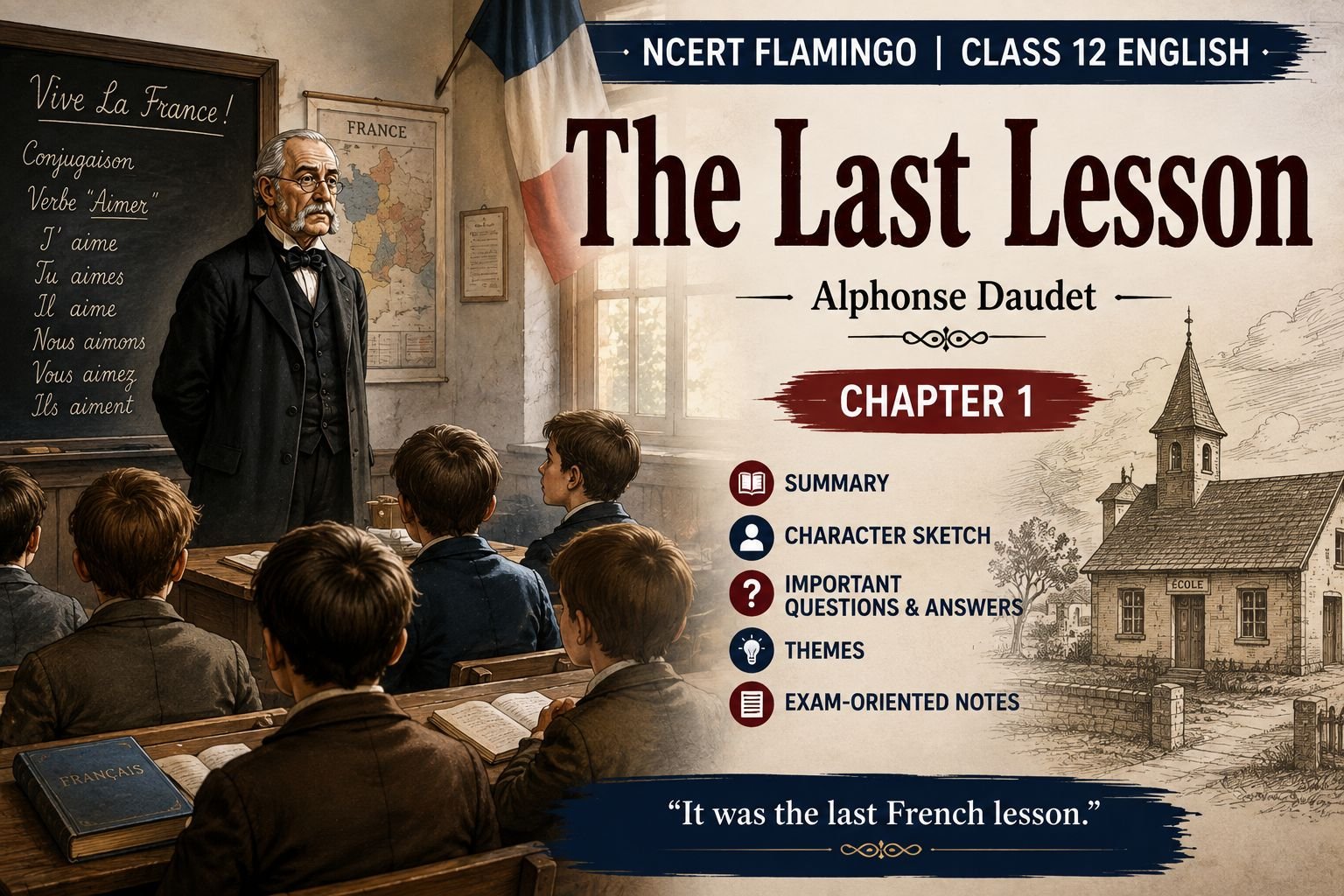
About the Author — Alphonse Daudet
Alphonse Daudet… honestly when I first read about him, I thought — here’s a man who turned personal pain into timeless literature.
He was born on May 13, 1840, in Nîmes, a small town in southern France. His family wasn’t wealthy — in fact, his childhood was marked by financial struggle. His father’s silk business collapsed when Alphonse was just a young boy, forcing the family to move to Lyon. These early hardships? They never left him. You can feel them in every story he wrote.
At just 17 years old, he became a teacher’s assistant — not because he wanted to, but because the family needed money. He himself admitted it was a miserable experience. The classroom felt like a prison. But here’s the irony — that very experience of feeling trapped, of longing for something more, became the emotional backbone of his writing.
He moved to Paris when he was around 18. And Paris changed everything. He began writing poetry, short stories, and eventually novels. His early work caught the attention of the Duke of Morny, who became his patron. That support gave him the freedom to write seriously.
Now, what made Daudet truly special was his style. He wasn’t a grand philosophical writer like Victor Hugo. He was intimate. Personal. He wrote about ordinary people — farmers, teachers, children, small-town folk — with such warmth and honesty that readers felt he was writing about them specifically.
His most famous works include “Tartarin de Tarascon” — a humorous novel about a bumbling adventurer that became hugely popular. Then there’s “Lettres de mon moulin” (Letters from My Windmill) — a collection of short stories full of warmth, humor, and deep feeling. And of course “Les Contes du lundi” (Monday Tales) — the collection that contains “La Dernière Classe,” which we know as “The Last Lesson.”
“The Last Lesson” was written in 1873, just after France lost the Franco-Prussian War. Germany had taken over the regions of Alsace and Lorraine — and one of the first things the new German rulers did was ban French from being taught in schools. They would now teach only German.
Daudet wasn’t from Alsace — but he felt the wound deeply. The story he wrote wasn’t just about a classroom. It was about identity, language, and what it means to lose something you never truly valued until it was gone.
He wrote it in first person — through the eyes of a little boy named Franz — which makes it even more powerful. Because Franz is all of us. Lazy, careless, taking things for granted… until suddenly, it’s too late.
Daudet passed away on December 16, 1897, in Paris. He was 57. But “The Last Lesson” — that small, quiet story — has outlived him by more than a century. And honestly? It deserves to.
📖 Chapter Summary — The Last Lesson By Alphonse Daudet
(Bilingual — English heading first, then Hindi)
🔹 1. Franz’s Lazy Morning
Franz is running late for school. He’s worried because M. Hamel had announced a test on participles — and Franz hasn’t prepared at all. He thinks about skipping school and spending the day outdoors instead. The weather is warm, birds are chirping, and the fields look inviting.
But something stops him — and he rushes to school.
🔹 १. फ्रांज़ की आलसी सुबह
फ्रांज़ को स्कूल के लिए देर हो रही है। M. हेमल ने participles पर test लेने की बात कही थी — और फ्रांज़ ने कुछ पढ़ा नहीं था। उसका मन था कि वो स्कूल छोड़कर बाहर खेलने चला जाए।
पर कुछ सोचकर वो रुका — और भागते हुए स्कूल पहुँचा।
🔹 2. Strange Silence at School
When Franz reaches school, he notices something odd. Usually there’s noise — students shouting, desks banging. But today? Complete silence. He slips in through the back — and is shocked. M. Hamel is standing quietly. And the back benches — usually empty — are filled with village elders: the ex-mayor, the postman, old Hauser with his spelling book.
Something is different today. Very different.
🔹 २. स्कूल में अजीब शांति
जब फ्रांज़ स्कूल पहुँचा, सब कुछ अजीब लगा। आमतौर पर शोर होता था — पर आज पूरी खामोशी थी। वो चुपके से अंदर घुसा — और हैरान रह गया।
M. हेमल शांत खड़े थे। और पीछे की बेंचें — जो हमेशा खाली रहती थीं — आज गाँव के बुज़ुर्गों से भरी थीं: पूर्व मेयर, डाकिया, बूढ़े हॉज़र अपनी spelling book लेकर।
आज कुछ अलग था। बहुत अलग।
🔹 3. The Announcement — The Last French Lesson
M. Hamel speaks. His voice is calm but heavy. He announces that an order has come from Berlin — from this day, only German will be taught in the schools of Alsace and Lorraine. Today is the last French lesson.
Franz is stunned. Suddenly everything feels different — the classroom, the teacher, even the old grammar book in his hands feels precious.
🔹 ३. घोषणा — आखिरी फ्रेंच पाठ
M. हेमल बोलते हैं। आवाज़ शांत पर भारी है। वो बताते हैं कि बर्लिन से आदेश आया है — आज से Alsace और Lorraine के स्कूलों में सिर्फ जर्मन पढ़ाई जाएगी। आज आखिरी फ्रेंच पाठ है।
फ्रांज़ सन्न रह गया। अचानक सब कुछ अलग लगने लगा — classroom, teacher, यहाँ तक कि हाथ में पकड़ी पुरानी grammar book भी कीमती लगने लगी।
🔹 4. Franz’s Regret
Franz feels a deep pang of regret. He thinks about all the times he skipped lessons, wasted time, made excuses. He had always thought — “I’ll learn it later.” But now there is no “later.”
He looks at M. Hamel differently now. This man had given 40 years to this school — and today is his last day too.
🔹 ४. फ्रांज़ का पछतावा
फ्रांज़ के मन में गहरा पछतावा उठता है। उसे याद आते हैं वो सारे दिन जब उसने पाठ छोड़े, समय बर्बाद किया, बहाने बनाए। उसने हमेशा सोचा था — “बाद में सीख लूँगा।” पर अब “बाद में” जैसा कुछ नहीं था।
वो M. हेमल को अलग नज़रों से देखता है। इस इंसान ने 40 साल इस स्कूल को दिए थे — और आज उनका भी आखिरी दिन था।
🔹 5. M. Hamel’s Last Teaching
M. Hamel teaches with a patience and dedication Franz had never seen before. He speaks about the French language — calling it the most beautiful language in the world, the clearest, the most logical.
He says — “When a people are enslaved, as long as they hold fast to their language, it is as if they had the key to their prison.”
This line — honestly — hits differently every time you read it.
🔹 ५. M. हेमल का आखिरी पाठ
M. हेमल ने उस दिन जितने धैर्य और समर्पण से पढ़ाया, फ्रांज़ ने पहले कभी नहीं देखा था। वो फ्रेंच भाषा के बारे में बात करते हैं — उसे दुनिया की सबसे सुंदर, सबसे स्पष्ट, सबसे तार्किक भाषा बताते हैं।
वो कहते हैं — “जब कोई कौम गुलाम हो जाती है, जब तक वो अपनी भाषा को थामे रहती है — मानो उसके पास अपनी जेल की चाबी है।”
यह वाक्य… हर बार पढ़ो, हर बार चुभता है।
🔹 6. The Village Elders — Their Regret
The old villagers sitting at the back are also filled with regret. They too had neglected the French language — sent their children to fields instead of schools, never valued what they had.
They are here today as an act of silent apology — to M. Hamel, to their language, to themselves.
🔹 ६. गाँव के बुज़ुर्ग — उनका पछतावा
पीछे बैठे बुज़ुर्ग भी पछतावे से भरे हैं। उन्होंने भी फ्रेंच भाषा को नज़रअंदाज़ किया था — बच्चों को स्कूल की जगह खेतों में भेजा, कभी उसकी कदर नहीं की।
आज वो यहाँ हैं — एक मौन माफी के रूप में — M. हेमल के लिए, अपनी भाषा के लिए, खुद के लिए।
🔹 7. The Final Moment — “Vive La France!”
The church clock strikes noon. Then the Prussian trumpets sound outside. M. Hamel stands up. He tries to speak — but emotion chokes his voice. He cannot say anything.
He turns to the blackboard and writes in his largest, clearest letters:
“Vive La France!” (Long Live France!)
Then — he gestures to the students that school is dismissed. And just like that… it’s over.
🔹 ७. आखिरी पल — “Vive La France!”
चर्च की घड़ी में दोपहर के बारह बजते हैं। फिर बाहर Prussian trumpets की आवाज़ आती है। M. हेमल खड़े होते हैं। बोलने की कोशिश करते हैं — पर भावनाएँ गला रोक लेती हैं। वो कुछ नहीं कह पाते।
वो blackboard की तरफ मुड़ते हैं और अपने सबसे बड़े, सबसे साफ अक्षरों में लिखते हैं:
“Vive La France!” (फ्रांस जिंदाबाद!)
फिर — हाथ के इशारे से बच्चों को जाने देते हैं। और बस… सब खत्म।
📝 Important Point Exam के लिए
Central Theme — Language as identity. Jab koi cheez chhinti hai tab uski value samajh aati hai.
Franz — Represents common people who take their culture for granted. His transformation in one day is the heart of the story.
M. Hamel — Not just a teacher. A symbol of a dying culture fighting to survive with dignity.
The Coat — M. Hamel wore his special Sunday coat that day. It symbolizes respect — for the occasion, for the language, for the end.
Key Quote to remember — “Always put off learning till tomorrow” — this is what Franz and the villagers had done. And suddenly tomorrow never came.
Irony of the story — The things we ignore the most become the most precious when we’re about to lose them.
Exam tip — The last scene with “Vive La France!” is the most important — it shows patriotism, emotion, and silent resistance all at once.
Bilkul! Dono ready karta hoon! 📚
🎭 The Last Lesson — Themes & Character Sketches
NCERT Flamingo | Class 12 | Chapter 1
🌟 THEMES / मुख्य विषय
🔹 Theme 1: Language as Identity
🔹 विषय १: भाषा ही पहचान है
English:
This is the soul of the story. Honestly, jab tak Maine yeh nahi socha tab tak samjha nahi — language isn’t just a tool for communication. It is who you are.
When the Prussians banned French, they didn’t just change a subject in school. They tried to erase an entire people’s identity. M. Hamel understood this. That’s why he called French “the most beautiful language in the world” — not because it literally is, but because it was theirs.
The key quote that says it all — “When a people are enslaved, as long as they hold fast to their language, it is as if they had the key to their prison.”
Language = freedom. Language = resistance. Language = self.
Hindi (Devanagari):
यही इस कहानी की आत्मा है। भाषा सिर्फ बात करने का ज़रिया नहीं — भाषा आपकी पहचान है।
जब Prussians ने फ्रेंच पर प्रतिबंध लगाया, तो उन्होंने सिर्फ एक विषय नहीं हटाया — उन्होंने पूरी एक कौम की पहचान मिटाने की कोशिश की। M. हेमल यह समझते थे। इसीलिए उन्होंने फ्रेंच को “दुनिया की सबसे सुंदर भाषा” कहा — क्योंकि वो उनकी अपनी थी।
सबसे ज़रूरी पंक्ति — “जब कोई कौम गुलाम हो जाती है, जब तक वो अपनी भाषा थामे रहती है — मानो उसके पास अपनी जेल की चाबी है।”
भाषा = आज़ादी। भाषा = प्रतिरोध। भाषा = अस्तित्व।
🔹 Theme 2: Procrastination and Regret
🔹 विषय २: टालमटोल और पछतावा
English:
Franz had always thought — “I’ll learn French properly someday.” The villagers had always thought — “We’ll send our kids to school when the time is right.” M. Hamel himself admitted he had sometimes sent students to water his garden instead of teaching.
Everyone was guilty of putting things off. And then — one morning — it was too late.
This theme is deeply personal. Matlab sochte hain — hum bhi toh yahi karte hain. We ignore what matters until it slips away. The story is a quiet warning dressed in a beautiful narrative.
Hindi (Devanagari):
फ्रांज़ हमेशा सोचता था — “कभी ठीक से फ्रेंच सीखूँगा।” गाँव वाले सोचते थे — “सही वक्त पर बच्चों को स्कूल भेजेंगे।” खुद M. हेमल ने माना कि कभी-कभी वो बच्चों को पढ़ाने की जगह बगीचे में काम करवाते थे।
सब दोषी थे — टालते रहने के।
और फिर एक सुबह — बहुत देर हो गई।
यह विषय बहुत गहरा है। हम भी तो यही करते हैं — जो चीज़ ज़रूरी है उसे नज़रअंदाज़ करते हैं जब तक वो हाथ से न निकल जाए। यह कहानी एक शांत चेतावनी है।
🔹 Theme 3: Patriotism and Silent Resistance
🔹 विषय ३: देशभक्ति और मौन प्रतिरोध
English:
No guns. No protests. No speeches. Just a teacher writing “Vive La France!” on a blackboard with trembling hands.
That’s what makes this story so powerful. The patriotism here isn’t loud — it’s quiet, dignified, heartbreaking. M. Hamel doesn’t fight the Prussians with weapons. He fights them by teaching French with full love and dedication on the very last day.
The village elders sitting in the back — that too is patriotism. Showing up when it’s already too late, just to say — “We were here. We cared. Even if we showed it too late.”
Hindi (Devanagari):
कोई बंदूक नहीं। कोई विरोध नहीं। कोई भाषण नहीं। बस एक teacher जो काँपते हाथों से blackboard पर लिखता है — “Vive La France!”
यही इस कहानी की ताकत है। यहाँ देशभक्ति शोरगुल वाली नहीं — शांत, गरिमामय, दिल तोड़ने वाली है।
M. हेमल Prussians से हथियारों से नहीं लड़ते। वो लड़ते हैं — आखिरी दिन भी पूरे प्रेम और समर्पण से फ्रेंच पढ़ाकर।
पीछे बैठे गाँव के बुज़ुर्ग — यह भी देशभक्ति है। तब आना जब बहुत देर हो चुकी हो — बस यह कहने के लिए — “हम यहाँ थे। हमें परवाह थी। भले ही देर से।”
🔹 Theme 4: The Value of What We Ignore
🔹 विषय ४: जिसे हम नज़रअंदाज़ करते हैं उसी की असली कीमत
English:
Franz never cared about French grammar. The villagers never prioritized French education. Even M. Hamel — by his own admission — wasn’t always the most dedicated teacher.
But the moment it was taken away — everything changed. The grammar book felt precious. The classroom felt sacred. The teacher felt like a hero.
This is one of the most universal human truths Daudet captured — we only truly value things when we are about to lose them.
Hindi (Devanagari):
फ्रांज़ को कभी French grammar की परवाह नहीं थी। गाँव वालों ने कभी इसे priority नहीं दी। खुद M. हेमल हमेशा पूरी तरह dedicated नहीं थे।
पर जैसे ही यह छिनने वाली थी — सब बदल गया। Grammar book अनमोल लगी। Classroom पवित्र लगा। Teacher हीरो लगे।
यह वो सच है जो Daudet ने पकड़ा — हम चीज़ों की असली कदर तभी करते हैं जब वो छिनने वाली हों।
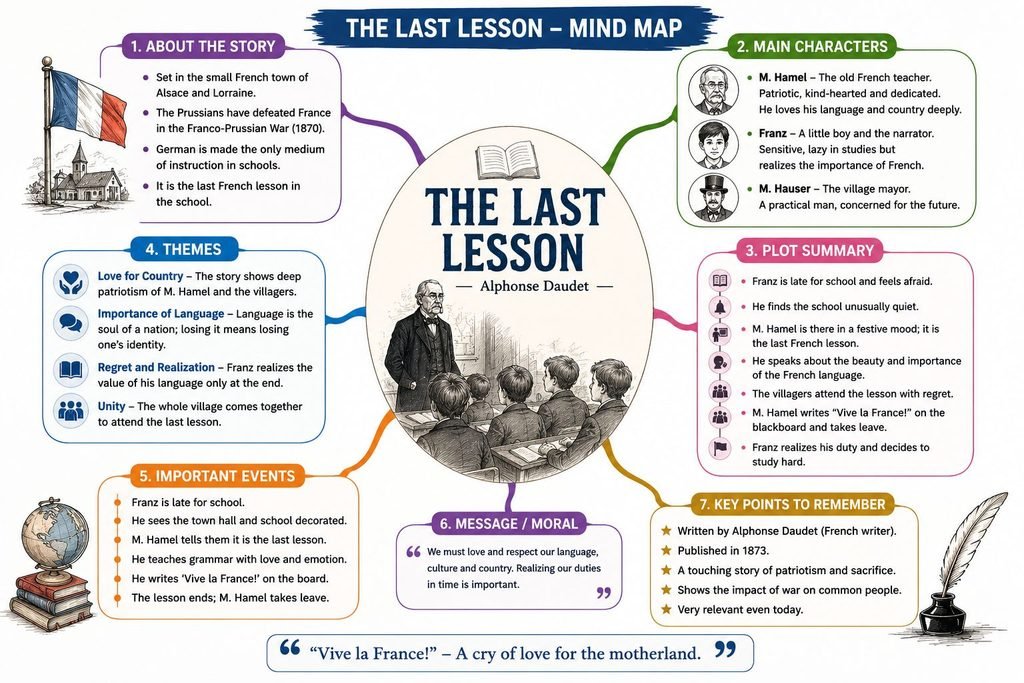
👤 CHARACTER SKETCHES / चरित्र चित्रण
🔸 1. Franz (फ्रांज़)
English:
Franz is the narrator — and honestly, the most relatable character in the story. He’s a young boy who would rather watch birds or play outdoors than sit in a French class. He hasn’t prepared for his test. He thinks about skipping school. He’s lazy, carefree, and a little irresponsible.
Sounds familiar? That’s the point.
But here’s what makes Franz special — he changes. In a single day.
When M. Hamel announces that this is the last French lesson, something shifts inside Franz. Suddenly the language he ignored feels beautiful. The teacher he feared feels noble. The grammar book he hated feels like a treasure.
His transformation represents the awakening of every person who takes their culture, language, and freedom for granted — until it’s gone.
Key traits:
- Carefree and lazy at the start
- Sensitive and observant underneath
- Capable of deep regret and emotion
- Represents the common person’s relationship with identity
Hindi (Devanagari):
फ्रांज़ कहानी का narrator है — और सबसे relatable किरदार भी। वो एक ऐसा लड़का है जिसे French class से ज़्यादा बाहर खेलना पसंद है। Test की तैयारी नहीं की। स्कूल छोड़ने का मन था। आलसी, लापरवाह, थोड़ा गैरज़िम्मेदार।
जानी-पहचानी बात है ना? यही तो Daudet चाहते थे।
पर फ्रांज़ की खासियत यह है — वो बदलता है। एक ही दिन में।
जब M. हेमल ने बताया कि यह आखिरी फ्रेंच पाठ है — फ्रांज़ के अंदर कुछ बदल गया। जो भाषा उसने नज़रअंदाज़ की थी, वो अचानक सुंदर लगी। जिस teacher से वो डरता था, वो महान लगे। जिस grammar book से नफरत थी, वो अनमोल लगी।
फ्रांज़ का बदलाव हर उस इंसान का जागना है जो अपनी संस्कृति, भाषा और आज़ादी को तब तक नज़रअंदाज़ करता है जब तक वो छिन न जाए।
मुख्य विशेषताएँ:
- शुरुआत में लापरवाह और आलसी
- अंदर से संवेदनशील और समझदार
- गहरे पछतावे और भावनाओं में सक्षम
- आम इंसान का प्रतिनिधित्व करता है
🔸 2. M. Hamel (M. हेमल)
English:
M. Hamel is not a perfect teacher. Let’s be honest about that first. He has sometimes sent students away to do his errands. He hasn’t always been the most dedicated educator.
But on this last day — he becomes something extraordinary.
He wears his special Sunday coat — the one he kept for inspections and prize-giving days. That coat says everything. He knew this day deserved dignity.
He teaches with a patience, a tenderness, and a depth that Franz had never seen before. He speaks about the French language with love — as if saying goodbye to an old friend. He doesn’t blame the students or the villagers. He blames everyone — including himself.
And at the very end — when emotion overwhelms him — he doesn’t cry out. He doesn’t make a speech. He simply writes “Vive La France!” and gestures them away.
That silence is more powerful than any words.
Key traits:
- Dedicated to his language and culture
- Humble — admits his own failures
- Emotionally restrained but deeply feeling
- Symbol of quiet patriotism and dignified resistance
Hindi (Devanagari):
M. हेमल एक perfect teacher नहीं हैं। यह पहले मान लेते हैं। उन्होंने कभी-कभी बच्चों को अपने काम पर भेजा। वो हमेशा पूरी तरह dedicated नहीं रहे।
पर इस आखिरी दिन — वो कुछ असाधारण बन जाते हैं।
उन्होंने अपना special Sunday coat पहना — वो जो inspections और prize-giving के लिए रखते थे। वो coat सब कुछ कह देती है। उन्हें पता था — इस दिन को गरिमा चाहिए।
उन्होंने उस दिन जितने धैर्य, कोमलता और गहराई से पढ़ाया — फ्रांज़ ने पहले कभी नहीं देखा था। फ्रेंच के बारे में ऐसे बोले जैसे किसी पुराने दोस्त से विदाई ले रहे हों। बच्चों को या गाँव वालों को दोष नहीं दिया — खुद को भी दोषी माना।
और अंत में — जब भावनाएँ गला भर आईं — वो चीखे नहीं। भाषण नहीं दिया। बस “Vive La France!” लिखा और हाथ के इशारे से विदा किया।
वो खामोशी किसी भी शब्द से ज़्यादा powerful थी।
मुख्य विशेषताएँ:
- अपनी भाषा और संस्कृति के प्रति समर्पित
- विनम्र — खुद की कमियाँ स्वीकार कीं
- भावनाओं पर नियंत्रण, पर अंदर से गहरी संवेदना
- मौन देशभक्ति और गरिमामय प्रतिरोध का प्रतीक
🔸 3. The Village Elders (गाँव के बुज़ुर्ग)
English:
They sit quietly at the back. Old Hauser with his spelling book. The ex-mayor. The postman. Men who had spent their whole lives in Alsace — and yet never truly mastered their own language.
They are there as witnesses. As mourners. As silent apologizers.
Their presence is heartbreaking because it represents an entire community’s neglect — and their last-minute awakening. They couldn’t change the past. But they could show up for the last chapter.
Key traits:
- Represent collective guilt and regret
- Silent but emotionally powerful presence
- Symbol of a community that woke up too late
Hindi (Devanagari):
वो चुपचाप पीछे बैठे हैं। बूढ़े हॉज़र अपनी spelling book लेकर। पूर्व मेयर। डाकिया। वो लोग जिन्होंने पूरी ज़िंदगी Alsace में बिताई — पर कभी अपनी भाषा ठीक से नहीं सीखी।
वो वहाँ गवाह बनने आए हैं। शोक मनाने। मौन माफी माँगने।
उनकी उपस्थिति दिल तोड़ती है — क्योंकि वो पूरे समाज की लापरवाही का प्रतीक हैं। और उनका देर से जागना भी।
मुख्य विशेषताएँ:
- सामूहिक अपराधबोध और पछतावे का प्रतिनिधित्व
- शांत पर भावनात्मक रूप से शक्तिशाली उपस्थिति
- उस समाज का प्रतीक जो बहुत देर से जागा
📝 Quick Exam Tips
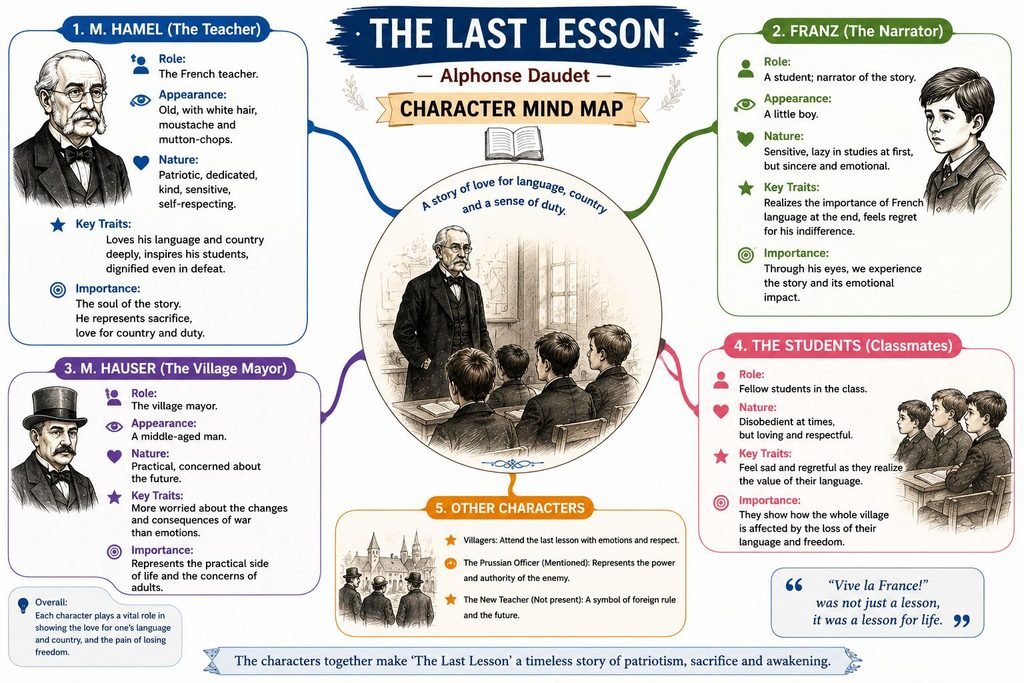
- Franz = common man who ignores culture → then regrets
- M. Hamel = silent patriot → dignity in defeat
- Sunday coat = respect for language and occasion
- “Vive La France!” = most important moment → patriotism without words
- Village elders = collective guilt of society
- Core message = Value what you have — before it’s taken away
🌟 The Last Lesson — Theme Summary
Theme: Language, Identity & The Cost of Neglect
Honestly, jab pehli baar yeh kahani padhi toh laga — yeh sirf ek French class ki kahani hai. Ek teacher, ek student, ek announcement. Simple si baat.
Par jab socha… toh samajh aaya. Yeh kahani itni badi hai.
Alphonse Daudet ne “The Last Lesson” mein ek aisi sach dikhai hai jo aaj bhi utni hi relevant hai. Bhasha sirf bolne ka zariya nahi hoti — bhasha aapki pehchaan hoti hai. Jab Prussians ne Alsace aur Lorraine pe kaabiz hokar French padhana band karwa diya, toh unhone sirf ek subject nahi hataya. Unhone ek poori qaum ki rooh par haath daala.
Kahani ka sabse bada theme hai — “jo hamare paas hai, uski hum tab tak kadar nahi karte jab tak woh chhin na jaaye.”
Franz puri zindagi French class se bhaagta raha. Participles yaad nahi kiye. Grammar boring lagi. Socha — “baad mein seekh lunga.” Gaon ke buzurg bhi aise hi the — bachhon ko kheton mein bheja, school ko secondary rakha. Khud M. Hamel ne maana ki kabhi kabhi woh bhi classes seriously nahi lete the.
Sabne kal pe taala diya. Aur ek din — kal aaya hi nahi.
Yahi toh dard hai is kahani ka. Woh grammar book jo Franz ne kabhi kholi nahi thi — aakhri din ussi ko seedhne se lagayi. Woh teacher jisse woh darta tha — aakhri din ussi mein usse ek hero dikha. Woh language jise usne kabhi value nahi diya — aakhri din ussi ki khubsurti samajh aayi.
Aur M. Hamel ka woh ek sentence — “When a people are enslaved, as long as they hold fast to their language, it is as if they had the key to their prison” — yeh sirf ek line nahi hai. Yeh poori kahani ka saar hai.
Bhasha = Azaadi. Bhasha = Pehchaan. Bhasha = Pratirodh.
Jab tum apni bhasha bachate ho — tum apne aap ko bachate ho. Chahe duniya badal jaaye, chahe hukumat badal jaaye — agar bhasha zinda hai, toh qaum zinda hai.
Aur is sabke beech — M. Hamel ka woh aakhri pal. Koi bhashan nahi. Koi rona nahi. Sirf ek blackboard par likha — “Vive La France!”
Woh khamoshi… woh do shabd… us din ke saare dard ko, saari ummeed ko, saari takleef ko — sab kuch ek saath keh dete hain.
Daudet ne yeh kahani 1873 mein likhi thi — France haara tha abhi abhi. Par is kahani ka sandesh 2026 mein bhi utna hi taza hai. Kyunki har generation mein ek Franz hota hai. Aur har generation mein ek aakhri ghanta aata hai — jab pata chalta hai ki bahut der ho gayi.
Moral yeh nahi ki “apni bhasha seekho.” Moral yeh hai — “jo tumhara hai, usse aaj sambhalo. Kal ka intezaar mat karo.”
The Last Lesson — Textbook Questions
Understanding the Text & Talking about the Text
🔍 UNDERSTANDING THE TEXT
Q1. The people suddenly realise how precious their language is. What shows you this? Why does this happen?
Pehle toh main yeh sochta raha — “ek din mein itna bada change kaise?” Par phir samajh aaya…
What shows us this realisation:
Sabse pehle — Franz khud. Woh ladka jo roz school se bhaagta tha, jo French grammar se nafrat karta tha — aaj woh chahta hai ki woh sab kuch yaad ho jaaye. Uske haath mein grammar book hai aur woh soch raha hai — “kaash maine pehle itna dhyan diya hota.” Woh M. Hamel ko naye nazariyye se dekhta hai — ab teacher nahi, ek hero lagta hai.
Phir — gaon ke buzurg. Old Hauser apni spelling book lekar aaye. Puraane mayor, daakiya — sab woh log jo zindagi bhar French nahi seekhi — aaj aakhri baar classroom mein baithe hain. Khamoshi se. Aankhon mein shayad aansu. Yeh unki mook maafi thi.
Aur M. Hamel khud — jo aakhri din apna special Sunday coat pehne aaye. Puri dedication se padhaya. Jab bolne ki koshish ki — awaaz nahi nikalti. Sirf “Vive La France!” likh diya blackboard par.
Why does this happen:
Simple sa psychological sach hai yeh — hum kisi cheez ki kadar tab karte hain jab woh chhinne wali hoti hai.
Jab tak French thi — woh thi. Boring thi. Kal seekhenge. Par jab pata chala ki aaj aakhri baar hai — achanak woh bhasha sundar ho gayi, anmol ho gayi.
Yahi insaani fitrat hai. Aur Daudet ne ise bahut honestly pakda hai.
Q2. Franz thinks — “Will they make them sing in German, even the pigeons?” What could this mean?
Yeh line chhoti si hai — par ismein kai meanings hain. Sochte hain ek ek karke…
Meaning 1 — Language is natural, it cannot be forced:
Pigeons apni awaaz mein bolte hain — woh kisi ke kehne pe nahi bolte. Franz soch raha hai — kya Prussians pigeons ko bhi German mein bolne par majboor kar denge? Matlab — kuch cheezein naturally hoti hain. Language bhi aise hi hai. Tum use ban kar sakte ho, par replace nahi kar sakte.
Meaning 2 — The absurdity of cultural imposition:
Yeh ek tarah ka sarcasm bhi hai. Agar Prussians itna control chahte hain — toh kya prakriti ko bhi control karenge? Pigeons, birds — sab? Cultural takeover ki hadd kahan hai? Franz ka yeh sawaal asal mein ek protest hai — childlike, par bahut gehri.
Meaning 3 — Alsace ki pehchaan:
Pigeons Alsace ke the. French bol-bolke bade hue the woh log. Woh birds bhi us zameen ka hissa the. Agar bhasha badal di — toh kya poori zameen badal jaayegi? Kya jo cheez naturally iss jagah ki hai — woh bhi chhin jaayegi?
Meaning 4 — Innocence meeting harsh reality:
Ek bacche ka dimaag realistically nahi sochta. Franz apni duniya mein pigeons ko bhi apne saath judge karta hai. Yeh line bachpan ki pureness dikhati hai — jo ek bade dard ko bahut seedha keh deti hai.
💬 TALKING ABOUT THE TEXT
Q1. “When a people are enslaved, as long as they hold fast to their language it is as if they had the key to their prison.” — Historical examples?
Yeh quote padha toh honestly andar tak baith gaya. History mein kai baar yahi hua hai…
Example 1 — India under British Rule:
Angrezon ne English ko impose kiya. Macaulay’s Minute of 1835 — iska seedha goal tha ek aisi class banana jo Indian ho dekhne mein par English soche. Sanskrit, Persian, local languages ko secondary kar diya. Schools mein English mandatory. Bhasha ke zariye identity badalne ki koshish.
Par… Hindi, Bengali, Tamil — sab zinda rahi. Aur inhi bhaashon mein likha gaya — swatantrata andolan ka sahitya. Premchand, Tagore, Subramania Bharati — sab ne apni bhasha mein likha. Bhasha hi resistance bani.
Example 2 — Ireland (Irish Language):
British rule mein Irish language ko systematically dabaaya gaya. English schools forced. Irish bolne par punishment. Kai generations tak Irish almost khatam ho gayi.
Par 20th century mein — Irish revival movement shuru hua. Aaj Ireland mein Irish official language hai. Yeh ek qaum ka apni chabi dhundhna tha — aur milna.
Example 3 — Native Americans (USA):
American government ne Native American bachhon ko forcibly boarding schools mein daala — jahaan unhe apni language bolne par punish kiya jaata tha. “Kill the Indian, save the man” — yeh actual policy thi.
Kai languages hamesha ke liye khatam ho gayi. Jo bachi — unhe bachane ki koshish aaj bhi ho rahi hai. Bhasha chhin gayi toh pehchaan toot gayi.
Example 4 — Kurdish People:
Turkey, Iran, Iraq, Syria — in sab deshon mein Kurds ki apni bhasha thi. Kai jagah Kurdish language par ban lagaya gaya — schools mein, media mein, public life mein.
Phir bhi — Kurdish zinda rahi. Ghar mein, gaanon mein, kahaniyon mein. Kyunki jab tak bhasha hai — qaum hai.
Q2. Linguistic minorities in a state — how do they keep their language alive?
Punjabis in Bangalore / Tamilians in Mumbai / Kannadigas in Delhi / Gujaratis in Kolkata
Yeh sawaal bahut practical hai. Aur honestly — yeh hum sab ke aas-paas hota hai.
Kya hota hai linguistic minority ke saath:
- School mein local language dominant hoti hai
- Bacche dheere dheere apni mother tongue bhoolne lagte hain
- Parents pressure mein aate hain — “local language seekho, settle ho jao”
- Pehli generation bolti hai — doosri generation samajhti hai — teesri generation… sirf yaad karti hai
Kaise zinda rakhein apni bhasha:
Ghar mein — pehle ghar se shuru karo Sabse zyada effective yahi hai. Agar ghar mein Punjabi boli jaati hai — baccha Punjabi seekhega. TV dekhte waqt Punjabi show, gaane, films. Bhasha ghar se milti hai — school se nahi.
Community gatherings: Bangalore ke Punjabi log — gurpurab, lohri, baisakhi — milke manate hain. Aise events mein bhasha naturally use hoti hai. Community center, religious spaces — yeh sab bhasha ko zinda rakhte hain.
Language classes / weekend schools: Kai cities mein communities ne apne liye weekend classes shuru ki hain. Gujarati samaj, Tamil sangam — yeh organizations actively apni bhasha sikhati hain naye generation ko.
Digital age ka fayda uthao: YouTube pe Kannada channels, Gujarati podcasts, Tamil memes — yeh sab bhasha ko cool aur relevant banate hain. Jab bhasha modern lagti hai — naye log use karte hain.
Intermarriage aur mixed households: Dono bhaashein sikhao. “Aap Punjabi bolein, main Kannada seekhunga” — yeh attitude bhasha ko survive karwata hai.
Key insight: Bhasha tab marti hai jab hum use sharmindagi se dekhne lagte hain. Jab hum proud hote hain — tab woh zinda rehti hai.
Q3. Can pride in one’s language go too far? What is ‘linguistic chauvinism’?
Ab yeh interesting sawaal hai. Aur thoda sensitive bhi.
Haan — pride bahut zyada bhi ho sakti hai.
Linguistic Chauvinism kya hai:
Jab koi apni bhasha ko na sirf superior maane — balki doosri bhaashon ko inferior, galat, ya dushman maane — tab woh pride chauvinism ban jaati hai.
Chauvinism = extreme, aggressive, irrational pride jo doosron ko hurt kare.
Examples from India:
- “Hindi hamari rashtrabhasha hai — sabko Hindi bolni chahiye” — aur phir South Indian states mein protests. Hindi imposition ka sawaal aaj bhi sensitive hai.
- Maharashtra mein kabhi “outsiders” ke against movements — jahan Marathi ko defend karne ke naam par North Indians ko target kiya gaya.
- Extreme Tamil pride movements — jahan kisi bhi “non-Tamil” influence ko reject kiya jaata tha.
Kahan hai line — pride aur chauvinism ke beech:
| Healthy Pride | Linguistic Chauvinism |
|---|---|
| Apni bhasha se pyaar | Doosri bhasha se nafrat |
| Apni bhasha padhao | Doosri bhasha ban karo |
| “Meri bhasha sundar hai” | “Teri bhasha bekaar hai” |
| Culture preserve karo | Doosron ka culture destroy karo |
M. Hamel ki story se connection:
M. Hamel ne French ko “most beautiful language” kaha — par unhone German ko galat nahi kaha. Unka dard apni bhasha kho dene ka tha — doosri bhasha se nafrat ka nahi.
Woh hai healthy pride.
Jab pride defensive ban jaaye — “main apna bachana chahta hoon” — toh woh noble hai. Jab pride aggressive ban jaaye — “main doosre ko destroy karna chahta hoon” — toh woh chauvinism hai.
Aakhri baat:
Har bhasha ek duniya hai. Ek soch hai. Ek tarika hai duniya dekhne ka. Jab ek bhasha marti hai — ek duniya marti hai.
Isliye apni bhasha se pyaar karo — par doosron ki bhasha ko bhi jeene do. Bahulaata mein hi asli taakat hai.
Lost Spring By Anees Jung | Class 12 English
सिल्वर वैडिंग : मनोहर श्याम जोशी | Class 12 Hindi Vitan Chapter 1
[…] आत्मपरिचय Class 12 Summary, Explanation & Question AnswersThe Last Lesson By Alphonse Daudet | Class 12 English Flamingo Chapter 1: Summary, Questions & A… […]