🚀 1. Introduction
Ever watched a train moving on a straight track? Or a ball dropped from a building falling straight down?
That’s exactly what this chapter is about — motion along a straight line, also called rectilinear motion or linear motion.
What is Motion?
An object is said to be in motion if it changes its position with time with respect to a reference point.
Key Terms to Know First:
Frame of Reference — A coordinate system with respect to which we describe the position of an object. Without a frame of reference, motion has no meaning.
Position — Location of an object with respect to the origin at any given time. It can be positive or negative depending on direction.
Path Length (Distance) — Total length of the actual path travelled by an object. It is always positive and a scalar quantity.
Displacement — Shortest distance between initial and final position. It can be positive, negative, or zero and is a vector quantity.
Distance vs Displacement — Don’t Confuse These!
| Property | Distance | Displacement |
|---|---|---|
| Type | Scalar | Vector |
| Value | Always positive | Can be +, −, or 0 |
| Path | Actual path | Shortest path |
| Example | Odometer reading | Straight line from A to B |
Real life example: If you walk 4 km East and then 3 km West — your distance = 7 km but displacement = 1 km East. See the difference?
Types of Motion:
Uniform Motion — Equal distances covered in equal intervals of time. Speed is constant.
Non-Uniform Motion — Unequal distances covered in equal intervals of time. Speed keeps changing.
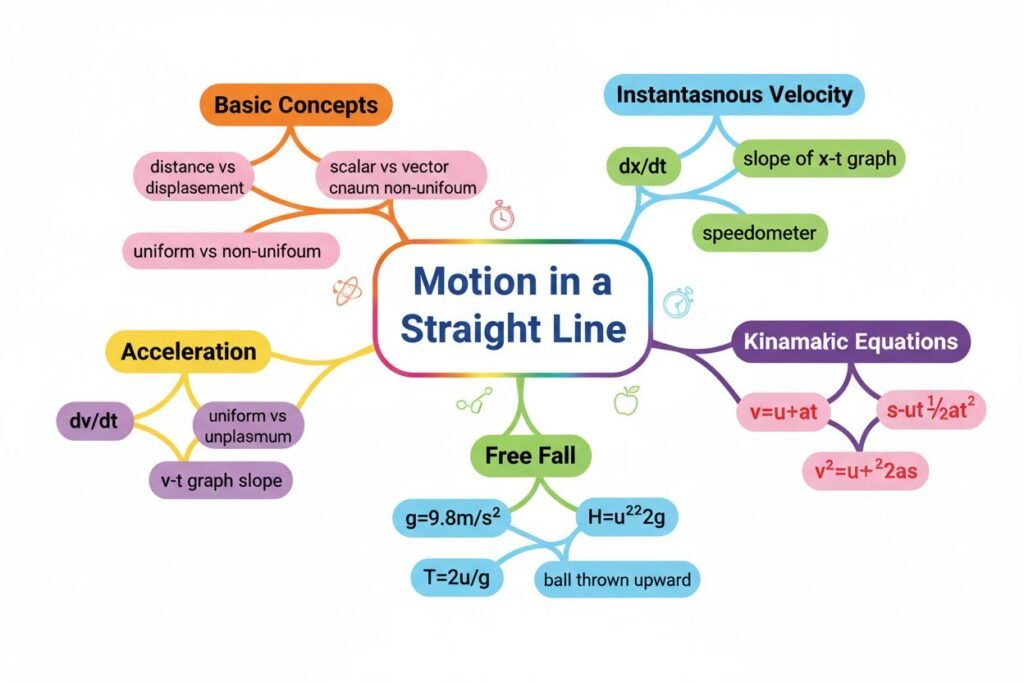
⚡ 2. Instantaneous Velocity and Speed
Average Velocity vs Instantaneous Velocity
Average Velocity is the total displacement divided by total time taken.
v_avg = Δx/Δt = (x₂ – x₁)/(t₂ – t₁)
But here’s the problem — average velocity tells you nothing about what happened in between. A car could have stopped, reversed, and sped up — and the average velocity would still look the same!
That’s why we need Instantaneous Velocity.
Instantaneous Velocity is the velocity of an object at a particular instant of time. It is the limiting value of average velocity as the time interval approaches zero.
v = lim(Δt→0) Δx/Δt = dx/dt
In simple words — it’s the derivative of position with respect to time.
This is exactly what your speedometer shows! It doesn’t show your average speed for the whole journey — it shows your speed at that exact moment.
Instantaneous Speed
Instantaneous speed is the magnitude of instantaneous velocity. It is always positive.
Speed = |v| = |dx/dt|
Important distinction:
- Average speed ≠ magnitude of average velocity (in general)
- Instantaneous speed = magnitude of instantaneous velocity (always)
Position-Time Graph and Velocity
On a position-time (x-t) graph:
- Slope of the curve at any point = instantaneous velocity
- Steeper slope = higher velocity
- Horizontal line = object at rest (zero velocity)
- Negative slope = object moving in negative direction
Key points about x-t graph:
- Straight line → uniform velocity
- Curved line → non-uniform velocity (acceleration present)
- Slope of tangent at any point = instantaneous velocity
📈 3. Acceleration
What is Acceleration?
When velocity changes — either in magnitude or direction — we say the object is accelerating.
Average Acceleration = Change in velocity / Time taken
a_avg = Δv/Δt = (v₂ – v₁)/(t₂ – t₁)
Instantaneous Acceleration = Rate of change of velocity at a particular instant
a = lim(Δt→0) Δv/Δt = dv/dt = d²x/dt²
Acceleration is the second derivative of position with respect to time.
Important Points About Acceleration:
Acceleration is a vector quantity — it has both magnitude and direction.
Positive acceleration — velocity is increasing (in positive direction)
Negative acceleration (Retardation/Deceleration) — velocity is decreasing
Zero acceleration — uniform motion (velocity constant)
Can acceleration be non-zero when velocity is zero?
YES! This confuses many students.
Example — A ball thrown upward. At the highest point, velocity = 0. But acceleration = g = 9.8 m/s² downward. The ball is momentarily at rest but still accelerating!
Velocity-Time Graph and Acceleration
On a velocity-time (v-t) graph:
- Slope at any point = instantaneous acceleration
- Area under the curve = displacement
- Straight line → uniform acceleration
- Horizontal line → zero acceleration (uniform velocity)
- Curved line → non-uniform acceleration
| v-t Graph Shape | Meaning |
|---|---|
| Straight line with positive slope | Uniform acceleration |
| Straight line with negative slope | Uniform deceleration |
| Horizontal line | Zero acceleration |
| Curved line | Non-uniform acceleration |
Uniform vs Non-Uniform Acceleration:
Uniform Acceleration — acceleration remains constant throughout the motion. Example: free fall under gravity.
Non-Uniform Acceleration — acceleration changes with time. Example: a car in city traffic.
📊 4. Kinematic Equations for Uniformly Accelerated Motion
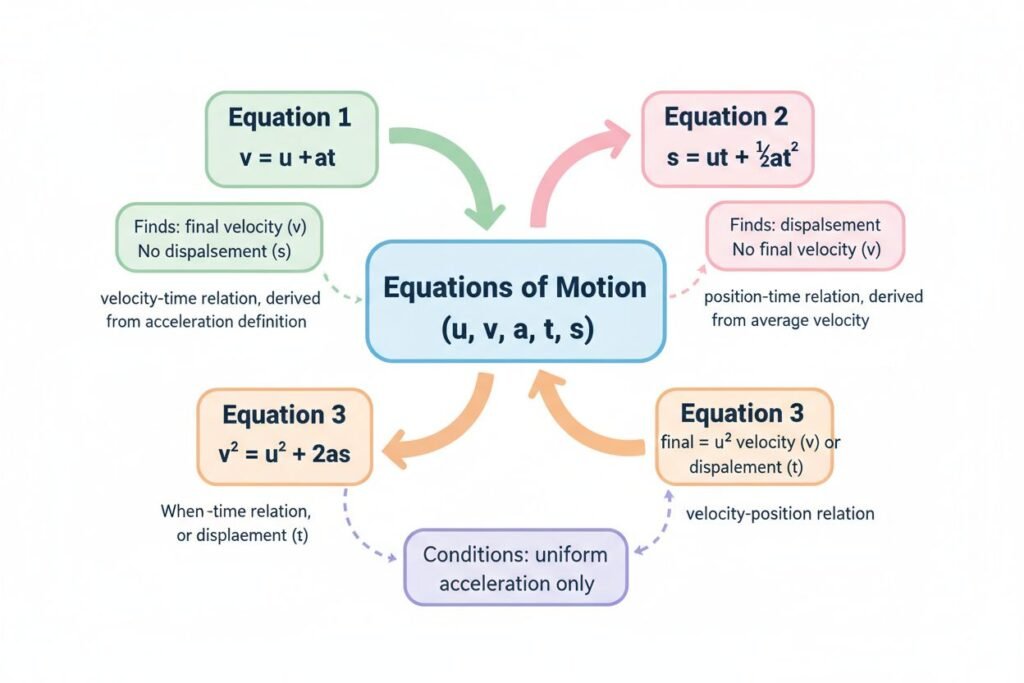
This is the most important section for exams! These 3 equations can solve almost any problem in this chapter.
The 3 Golden Equations of Motion
These equations are valid only when acceleration is constant (uniform).
Equation 1 — Velocity-Time Relation:
v = u + at
Equation 2 — Position-Time Relation:
s = ut + ½at²
Equation 3 — Velocity-Position Relation:
v² = u² + 2as
Where:
- u = initial velocity
- v = final velocity
- a = acceleration (constant)
- t = time
- s = displacement
Derivation of Equation 1 — v = u + at
From definition of acceleration: a = (v – u)/t
Rearranging: v = u + at ✅
Derivation of Equation 2 — s = ut + ½at²
Displacement = Average velocity × time
s = [(u + v)/2] × t
Substituting v = u + at:
s = [(u + u + at)/2] × t = [(2u + at)/2] × t
s = ut + ½at² ✅
Derivation of Equation 3 — v² = u² + 2as
From Equation 1: t = (v – u)/a
Substituting in Equation 2:
s = u[(v-u)/a] + ½a[(v-u)/a]²
2as = 2u(v-u) + (v-u)²
2as = 2uv – 2u² + v² – 2uv + u²
v² = u² + 2as ✅
Special Case — Displacement in nth Second
sₙ = u + a(2n-1)/2
This gives displacement in the nth second specifically — very useful in problems!
🌍 5. Motion Under Gravity (Free Fall)
A very important special case of uniformly accelerated motion!
When an object falls freely under gravity (ignoring air resistance):
- Acceleration = g = 9.8 m/s² ≈ 10 m/s² (downward)
- All kinematic equations apply with a = g
Sign Convention (very important!):
- Take downward as positive → g = +10 m/s²
- Take upward as positive → g = −10 m/s²
Be consistent with your sign convention throughout a problem!
Equations for Free Fall (taking downward as positive):
| Equation | Free Fall Form |
|---|---|
| v = u + at | v = u + gt |
| s = ut + ½at² | h = ut + ½gt² |
| v² = u² + 2as | v² = u² + 2gh |
Ball Thrown Upward — Key Points:
- At highest point: v = 0
- Time to reach highest point: t = u/g
- Maximum height: H = u²/2g
- Time to come back to same level: T = 2u/g (double the time to go up)
- Speed when it returns to starting point = u (same as initial speed)
🔘 MCQs — Quick Practice
Q1. Displacement of an object can be: a) Only positive b) Only negative c) Zero d) Positive, negative, or zero ✅
Q2. Instantaneous velocity is defined as: a) Total displacement/Total time b) lim(Δt→0) Δx/Δt ✅ c) Total distance/Total time d) Change in speed/Time
Q3. Area under velocity-time graph gives: a) Acceleration b) Speed c) Displacement ✅ d) Distance
Q4. Slope of position-time graph gives: a) Acceleration b) Velocity ✅ c) Displacement d) Speed
Q5. Which equation gives velocity-position relation? a) v = u + at b) s = ut + ½at² c) v² = u² + 2as ✅ d) sₙ = u + a(2n-1)/2
Q6. At the highest point of a vertically thrown ball: a) Both velocity and acceleration are zero b) Velocity is zero, acceleration is g downward ✅ c) Both are non-zero d) Acceleration is zero, velocity is non-zero
Q7. A body has zero velocity but non-zero acceleration. This is: a) Impossible b) Possible ✅ c) Only possible in circular motion d) Only possible in free fall
Q8. Kinematic equations are valid only for: a) Non-uniform acceleration b) Uniform acceleration ✅ c) Zero velocity d) Circular motion
📝 5 Long Answer Questions
Q1. Distinguish between distance and displacement. Explain with examples why displacement can be zero even when distance is not zero.
Answer:
This is one of the most fundamental distinctions in kinematics — and one that students often confuse.
Distance is the total length of the actual path travelled by an object, regardless of direction. It is a scalar quantity — only magnitude, no direction. It is always positive and can never decrease.
Displacement is the shortest straight-line distance between the initial and final positions of an object, along with direction. It is a vector quantity — has both magnitude and direction. It can be positive, negative, or zero.
Example 1: A person walks 5 km East, then 5 km West and returns to the starting point.
- Distance = 5 + 5 = 10 km
- Displacement = 0 (back to starting point)
Example 2: A person walks 3 km East and then 4 km North.
- Distance = 3 + 4 = 7 km
- Displacement = √(3² + 4²) = 5 km (Northeast direction)
Why can displacement be zero when distance is not?
Displacement depends only on the starting and ending positions. If an object returns to its starting point — no matter how long the journey — displacement is zero. But distance keeps adding up throughout the journey.
This is why athletes running a 400m race on a circular track have zero displacement at the finish line — but they’ve covered 400m distance!
Key differences:
| Property | Distance | Displacement |
|---|---|---|
| Type | Scalar | Vector |
| Value | Always ≥ 0 | Can be +, −, 0 |
| Path | Actual path | Shortest path |
| Can decrease? | No | Yes |
Q2. What is instantaneous velocity? How is it different from average velocity? Explain with the help of a position-time graph.
Answer:
Imagine you’re driving from Delhi to Agra. Your average velocity for the whole trip might be 80 km/h. But at different moments — you might be doing 120 km/h on the highway or 20 km/h in traffic. The velocity at each specific moment is the instantaneous velocity.
Average Velocity:
v_avg = Total Displacement / Total Time = Δx/Δt
Average velocity gives an overall picture of the motion but hides all the details of what happened in between.
Instantaneous Velocity:
v = lim(Δt→0) Δx/Δt = dx/dt
It is the velocity at a specific instant of time. Mathematically, it is the derivative of position with respect to time.
Key differences:
| Property | Average Velocity | Instantaneous Velocity |
|---|---|---|
| Time interval | Finite (Δt) | Infinitesimally small (dt) |
| Information | Overall motion | Motion at one instant |
| Formula | Δx/Δt | dx/dt |
| Speedometer | No | Yes |
From Position-Time Graph:
On an x-t graph, average velocity between two points = slope of the chord joining those two points.
As we bring the two points closer and closer together, the chord becomes a tangent at that point.
Therefore: Instantaneous velocity = slope of tangent to x-t graph at that point.
- Steep tangent → high instantaneous velocity
- Gentle tangent → low instantaneous velocity
- Horizontal tangent → zero instantaneous velocity (object momentarily at rest)
- Negative slope tangent → object moving in negative direction
Q3. Define acceleration. Explain uniform and non-uniform acceleration with examples. Can a body have zero velocity and non-zero acceleration simultaneously?
Answer:
Acceleration is defined as the rate of change of velocity with respect to time.
a = Δv/Δt (average) or a = dv/dt (instantaneous)
It is a vector quantity with SI unit m/s².
Uniform Acceleration:
When the velocity of an object changes by equal amounts in equal intervals of time, the acceleration is said to be uniform.
- Acceleration remains constant throughout the motion
- v-t graph is a straight line
- Example: A ball falling freely under gravity (a = g = 9.8 m/s² throughout)
Non-Uniform Acceleration:
When the velocity changes by unequal amounts in equal intervals of time, the acceleration is non-uniform.
- Acceleration keeps changing with time
- v-t graph is a curved line
- Example: A car accelerating in city traffic — sometimes speeding up fast, sometimes slowly
Can velocity be zero and acceleration be non-zero?
YES — absolutely! This is a very important concept.
Example 1 — Ball thrown upward: At the highest point, the ball momentarily stops — velocity = 0. But gravity is still acting on it — acceleration = g = 9.8 m/s² downward. The ball is at rest for just an instant but immediately starts falling back.
Example 2 — A car braking to a stop: Just as the car stops, velocity = 0. But if the brakes are still applied, there is still a retarding acceleration acting on it.
Conclusion: Velocity and acceleration are completely independent quantities. One can be zero while the other is non-zero.
Q4. Derive the three equations of motion for uniformly accelerated motion from first principles.
Answer:
The three equations of motion are the backbone of kinematics. Let’s derive all three from scratch.
Given:
- u = initial velocity
- v = final velocity
- a = uniform acceleration
- t = time elapsed
- s = displacement
Derivation of Equation 1: v = u + at
From the definition of uniform acceleration:
a = (v – u) / t
Multiplying both sides by t:
at = v – u
Rearranging:
v = u + at ✅
Derivation of Equation 2: s = ut + ½at²
For uniform acceleration, average velocity = (u + v)/2
Displacement = Average velocity × time
s = [(u + v)/2] × t
Substituting v = u + at:
s = [(u + u + at)/2] × t
s = [(2u + at)/2] × t
s = [u + at/2] × t
s = ut + ½at² ✅
Derivation of Equation 3: v² = u² + 2as
From Equation 1: t = (v – u)/a
Substituting in Equation 2:
s = u × [(v-u)/a] + ½a × [(v-u)/a]²
s = u(v-u)/a + ½(v-u)²/a
Multiplying throughout by 2a:
2as = 2u(v-u) + (v-u)²
2as = 2uv – 2u² + v² – 2uv + u²
2as = v² – u²
v² = u² + 2as ✅
These three equations can solve any problem involving uniform acceleration — provided you identify u, v, a, t, and s correctly!
Q5. Explain the motion of a body thrown vertically upward. Derive expressions for maximum height and time of flight.
Answer:
This is one of the most beautiful applications of kinematic equations — and a favourite in exams!
Setup:
A ball is thrown vertically upward with initial velocity u.
Taking upward as positive:
- Initial velocity = +u
- Acceleration = −g (gravity acts downward)
- g = 9.8 m/s² ≈ 10 m/s²
Phase 1 — Going Up:
The ball decelerates due to gravity. Velocity decreases from u to 0.
At the highest point: v = 0
Using v = u + at: 0 = u + (−g)t
Time to reach highest point: t = u/g
Maximum Height:
Using v² = u² + 2as: 0 = u² + 2(−g)H
2gH = u²
H = u²/2g ✅
Phase 2 — Coming Down:
After reaching the highest point, the ball falls back under gravity.
Time to fall from highest point back to starting level = u/g (same as time to go up — by symmetry)
Total Time of Flight:
T = time up + time down = u/g + u/g
T = 2u/g ✅
Speed on return:
Using v² = u² + 2as with s = 0 (returns to same level): v² = u² v = u
The ball returns with the same speed as it was thrown — but in the opposite direction.
Key Summary:
| Quantity | Expression |
|---|---|
| Time to highest point | t = u/g |
| Maximum height | H = u²/2g |
| Total time of flight | T = 2u/g |
| Speed on return | v = u |
| Velocity at highest point | 0 |
| Acceleration throughout | g downward |
Important: Throughout the entire motion — going up AND coming down — acceleration is always g downward. It never becomes zero, not even at the highest point!
📌 Quick Revision Table
| Concept | Key Formula/Point |
|---|---|
| Instantaneous velocity | v = dx/dt |
| Instantaneous acceleration | a = dv/dt = d²x/dt² |
| Equation 1 | v = u + at |
| Equation 2 | s = ut + ½at² |
| Equation 3 | v² = u² + 2as |
| nth second displacement | sₙ = u + a(2n-1)/2 |
| Max height (thrown up) | H = u²/2g |
| Time of flight | T = 2u/g |
| Slope of x-t graph | Velocity |
| Slope of v-t graph | Acceleration |
| Area under v-t graph | Displacement |
Structure of Atom Class 11: Complete Notes
Some Basic Concepts of Chemistry Class 11
[…] Motion in a Straight Line Class 11 Physics Notes, Complete Chapter 2 Summary […]
[…] Motion in a Straight Line Class 11 Physics Notes, Complete Chapter 2 SummaryBiological Classification Class 11 Notes | NCERT Chapter 2 Summary […]
[…] Motion in a Straight Line Class 11 Physics Notes, Complete Chapter 2 Summary […]