Class 9 English Notes | Theme, Summary & Key Points
About the Author
This story is written by Sudha Murthy — one of India’s most respected authors and philanthropists. She is the Chairperson of the Infosys Foundation and has written many books in Kannada and English. Her writing is simple, warm, and always carries a strong message. This story is autobiographical — meaning it actually happened in her life.
Before You Read — Setting the Context
Have you ever seen an elder in your family struggle with something that you find easy? Maybe using a smartphone, or reading a menu? Now imagine — what if that elder wanted to learn, but felt too embarrassed to ask for help?
That’s exactly what this story is about. And it will make you think about respect, determination, and the power of education in a whole new way.
Summary of the Story
The story is set in a village in Karnataka during the narrator’s childhood. The narrator (young Sudha Murthy) used to visit her grandparents every summer vacation. Her grandmother was a strong, respected woman in the village — but she had never been to school and could not read Kannada.
At that time, a Kannada novel called “Kashi Yatre” by Triveni was being serialized in a weekly magazine called Karmaveera. The story of “Kashi Yatre” was about an old woman who had a lifelong dream of visiting Kashi (Varanasi) — a holy city. But she kept postponing the trip because of family responsibilities.
The grandmother became deeply attached to this story. Why? Because she saw herself in that old woman. She too had a dream — to visit Kashi — and she too had kept delaying it for the sake of her family.
Every week, when the magazine arrived, the grandmother would wait eagerly for someone to read it to her. Usually, the narrator (young Sudha) would read it aloud. But one week, Sudha had to go to a relative’s house and couldn’t read the magazine to her grandmother. When she returned, she found her grandmother in tears.
The grandmother had missed the latest episode of the story. She felt helpless — she couldn’t read it herself. And that helplessness hit her hard.
That moment was a turning point.
The grandmother told Sudha: “I felt so very dependent. I could not read the story myself. I want to learn to read Kannada. Will you teach me?”
Sudha was surprised — and moved. She agreed immediately.
And so began their daily lessons. Every morning, Sudha would teach her grandmother the Kannada alphabet. The grandmother was a sincere and hardworking student — she never missed a class, never made excuses, and always did her homework. Within just a few months, she could read simple Kannada text on her own.
On the day of Dussehra (a festival that symbolizes the victory of good over evil and is also considered auspicious for starting new learning), the grandmother sat down and read the entire episode of “Kashi Yatre” — by herself, without any help.
She then touched Sudha’s feet — a traditional Indian gesture of deep respect — and gave her a gift: a Kanjeevaram silk saree, which is a very precious and expensive saree in South India.
Sudha was overwhelmed. She said she didn’t deserve such a big gift just for teaching the alphabet. But the grandmother replied with something beautiful:
“You are my teacher. In our culture, a teacher is always respected and given a gift on Vijayadashami. You deserve it.”
And that moment stayed with Sudha Murthy — and with every reader — forever.
Themes of the Story
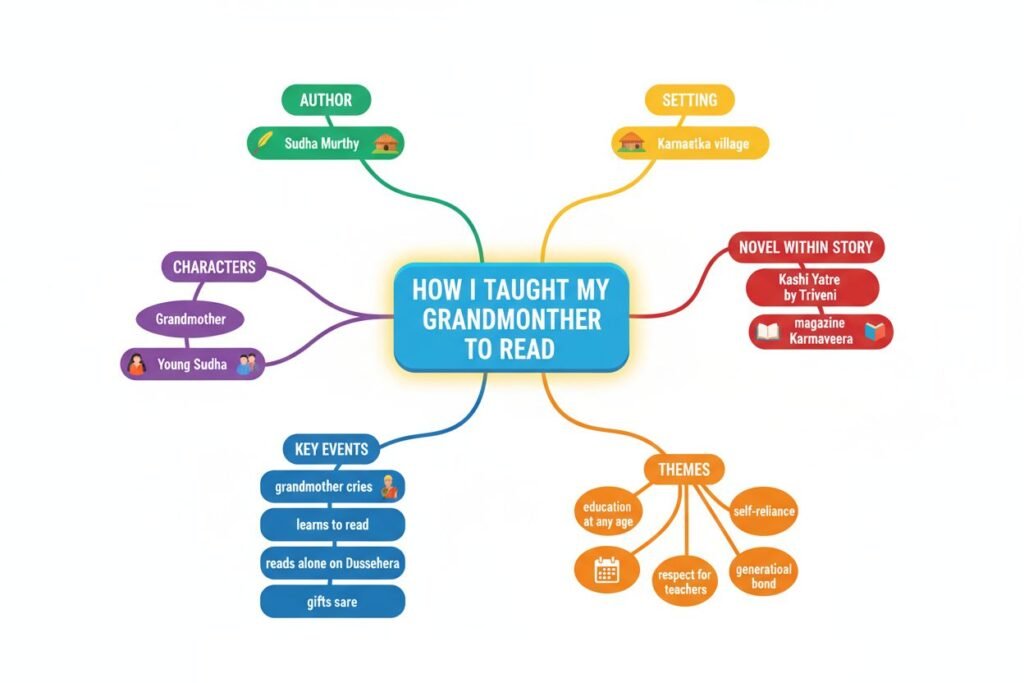
1. 🎓 The Importance of Education at Any Age
The most powerful message of this story is that learning has no age limit. The grandmother was old, but she didn’t let age stop her. She felt the need to be independent and literate, and she worked hard for it. This is a reminder for all of us — it’s never too late to learn something new.
2. 💪 Self-Reliance and Independence
The grandmother cried not because she missed a story — she cried because she felt dependent on others. That feeling of helplessness pushed her to take action. True self-respect comes from being able to do things on your own.
3. 🙏 Respect for Teachers
In Indian culture, teachers hold a very high place. The grandmother’s gesture of touching Sudha’s feet and giving her a saree shows how deeply she valued the role of a teacher — even if that teacher was her own granddaughter. Age doesn’t matter when it comes to respect for knowledge.
4. ❤️ Love Between Generations
This story beautifully shows the bond between a grandmother and her granddaughter. There’s no ego, no embarrassment — just love, trust, and mutual respect. The grandmother was not ashamed to learn from someone younger, and Sudha was not dismissive of her grandmother’s desire to learn.
5. 📖 Literature as a Mirror
The novel “Kashi Yatre” worked as a mirror for the grandmother — she saw her own life in the story’s character. This shows how literature connects us to our own emotions and experiences. A good story doesn’t just entertain — it makes you reflect.
Character Sketch
The Grandmother
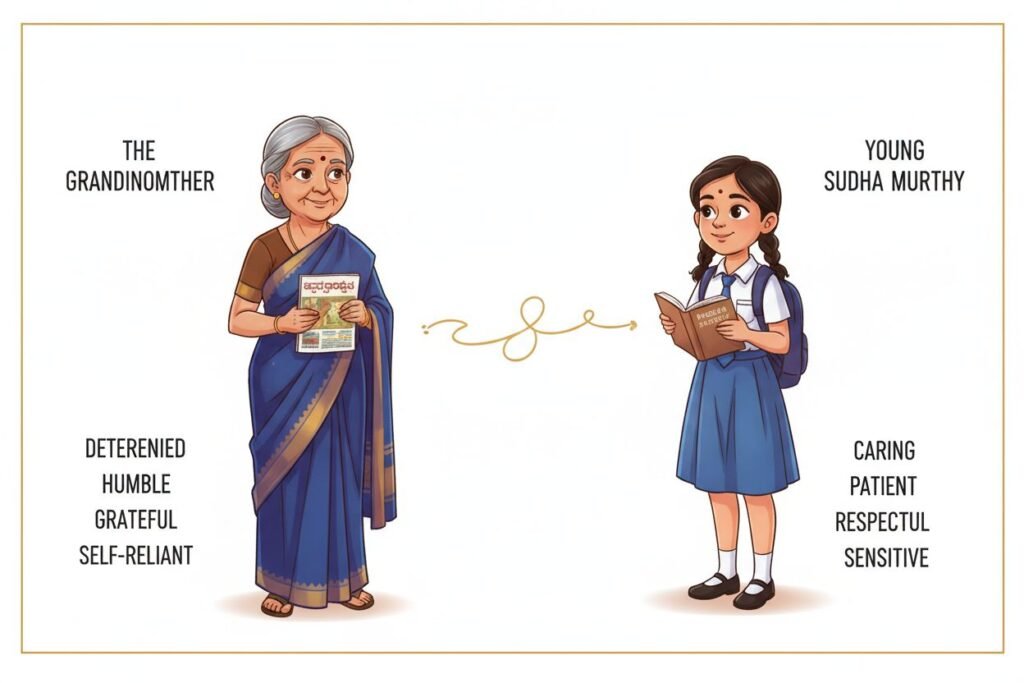
- Strong, dignified, and respected in the village
- Illiterate, but not ignorant — she was wise and emotionally intelligent
- Deeply moved by the story of “Kashi Yatre” because she related to it personally
- Humble enough to ask her granddaughter to teach her
- Hardworking and sincere as a student — never missed a lesson
- Grateful and generous — gave a precious saree as a guru dakshina (gift to teacher)
The Narrator (Young Sudha Murthy)
- Loving and respectful towards her grandmother
- Sensitive — she understood her grandmother’s pain without being told
- Patient teacher — taught her grandmother without making her feel small
- Surprised but deeply touched by her grandmother’s gesture at the end
Important Vocabulary
| Word | Meaning |
|---|---|
| Serialized | Published in parts, one after another |
| Determined | Having a strong will to do something |
| Autobiography | A story written by the person about their own life |
| Vijayadashami | Festival of Dussehra — auspicious for starting new things |
| Guru Dakshina | A gift given by a student to their teacher |
| Kanjeevaram | A type of expensive silk saree from South India |
| Illiterate | Unable to read or write |
Important Questions & Answers
Q1. Why did the grandmother cry when Sudha returned from her relative’s house? She had missed the latest episode of “Kashi Yatre” because no one was there to read it to her. She felt helpless and dependent, which made her emotional.
Q2. Why did the grandmother relate so strongly to the story “Kashi Yatre”? The story was about an old woman who kept postponing her dream of visiting Kashi due to family duties — just like the grandmother herself. She saw her own life in that character.
Q3. What did the grandmother do on Vijayadashami? She read the full episode of “Kashi Yatre” on her own for the first time, touched Sudha’s feet as a mark of respect, and gifted her a Kanjeevaram silk saree as guru dakshina.
Q4. What is the central message of the story? That education and self-reliance are important at every age. It’s never too late to learn, and teachers — regardless of age — deserve deep respect.
Q5. How did Sudha feel when her grandmother touched her feet? She was overwhelmed and felt that she didn’t deserve such respect just for teaching the alphabet. But her grandmother’s words made her realize the true value of being a teacher.
One-Line Summary (for quick revision)
An old grandmother, inspired by a serialized novel, decides to learn to read at an advanced age — and her journey teaches us that determination, humility, and respect for knowledge have no age limit.
What Makes This Story Special?
Most stories about education show a young student learning from an old teacher. But here, it’s reversed — and that’s what makes it so memorable. The grandmother’s courage to say “I don’t know, please teach me” is something even adults struggle with. She didn’t let ego or embarrassment stop her.
And Sudha Murthy — even as a child — handled it with such grace and sensitivity. She didn’t laugh, didn’t make it awkward. She just said yes and showed up every day.
That’s the real lesson here. Learning is beautiful. Teaching is sacred. And humility is strength.
MCQs — How I Taught My Grandmother to Read
Class 9 | Kaveri | With Answers
1. Who is the author of “How I Taught My Grandmother to Read”?
- a) Rabindranath Tagore
- b) Sudha Murthy ✅
- c) Triveni
- d) R.K. Narayan
2. The story is set in which state of India?
- a) Maharashtra
- b) Tamil Nadu
- c) Karnataka ✅
- d) Andhra Pradesh
3. What was the name of the Kannada novel that the grandmother loved?
- a) Malgudi Days
- b) Kashi Yatre ✅
- c) Savitri
- d) Nirmala
4. In which magazine was “Kashi Yatre” being serialized?
- a) Chandamama
- b) Sudha
- c) Karmaveera ✅
- d) Prajavani
5. Who wrote the novel “Kashi Yatre”?
- a) Sudha Murthy
- b) Anupama Niranjana
- c) Triveni ✅
- d) Girish Karnad
6. Why did the grandmother relate to the character in “Kashi Yatre”?
- a) Both were teachers
- b) Both had a dream of visiting Kashi but kept postponing it ✅
- c) Both lived in the same village
- d) Both were illiterate
7. Why was the grandmother in tears when the narrator returned?
- a) She had fallen ill
- b) She had a fight with someone
- c) She had missed the latest episode and couldn’t read it herself ✅
- d) She lost her magazine
8. What did the grandmother ask the narrator to do?
- a) Read the full novel to her
- b) Buy her a new magazine
- c) Teach her to read Kannada ✅
- d) Take her to Kashi
9. How did the narrator respond to her grandmother’s request?
- a) She refused politely
- b) She agreed immediately ✅
- c) She asked her mother first
- d) She laughed at the idea
10. How long did it take the grandmother to learn to read?
- a) One week
- b) One year
- c) A few months ✅
- d) Two years
11. On which festival did the grandmother read the episode on her own for the first time?
- a) Diwali
- b) Holi
- c) Vijayadashami / Dussehra ✅
- d) Ugadi
12. What did the grandmother do after reading the episode on her own?
- a) She called all the villagers
- b) She touched the narrator’s feet and gave her a saree ✅
- c) She wrote a letter to the author
- d) She started teaching others
13. What gift did the grandmother give to the narrator?
- a) Gold bangles
- b) A Mysore silk saree
- c) A Kanjeevaram silk saree ✅
- d) A silver necklace
14. What is “Guru Dakshina”?
- a) A type of festival
- b) A gift given by a student to their teacher ✅
- c) A Kannada word for grandmother
- d) A prayer offered to God
15. Why did the grandmother consider Vijayadashami the right day to read for the first time?
- a) It was her birthday
- b) It is considered auspicious for beginning new learning ✅
- c) The magazine arrived that day
- d) The narrator was free that day
16. What does the story “Kashi Yatre” symbolize in this lesson?
- a) The importance of travel
- b) How literature can reflect one’s own life and emotions ✅
- c) The history of Karnataka
- d) Religious beliefs of old people
17. What is the main theme of the story?
- a) Importance of festivals
- b) Village life in Karnataka
- c) It is never too late to learn ✅
- d) Relationship between authors and readers
18. The story is best described as:
- a) Fictional
- b) Autobiographical ✅
- c) Mythological
- d) Historical
19. What quality of the grandmother is most highlighted in the story?
- a) Her cooking skills
- b) Her wealth
- c) Her determination and humility ✅
- d) Her religious devotion
20. What lesson does the narrator learn from her grandmother?
- a) How to read Kannada
- b) How to cook traditional food
- c) That a teacher deserves deep respect regardless of age ✅
- d) That old people should not study
Bonus Q21. The grandmother’s tears were a symbol of:
- a) Physical pain
- b) Loneliness
- c) Helplessness due to illiteracy ✅
- d) Missing her granddaughter
Bonus Q22. Which value is NOT shown by the grandmother in this story?
- a) Humility
- b) Determination
- c) Arrogance ✅
- d) Gratitude
Theme of the Poem — “Bharat Our Land”
By Subramania Bharati | Class 9 | Kaveri
What Is This Poem About?
Have you ever felt a sudden rush of pride when someone praises your home? That feeling — that warm, swelling emotion in your chest — is exactly what Subramania Bharati captures in this poem.
This is not just a poem. It’s a love letter to India.
Bharati wrote this poem with deep patriotic feeling, and every single line drips with pride, reverence, and devotion for the motherland. He doesn’t just describe India — he celebrates it. He holds it up like a trophy and says to the world: “Look at what we have. There is nothing like this anywhere.”
The Central Theme — Patriotism and National Pride
The core theme of this poem is love for the motherland — India (Bharat).
Bharati talks about India’s greatest treasures one by one:
- The Himavant (Himalayas) — mighty, unmatched, peerless
- The Ganga — generous, graceful, sacred
- The Upanishads — ancient scriptures of wisdom that no other text can equal
- The warriors and sages who walked this land and made it holy
- The divine music that has echoed through its valleys
- The Brahma-knowledge (spiritual wisdom) that took root here
- The Buddha who preached his Dhamma on this very soil
Each of these is not just a fact — it’s a point of pride. Bharati is essentially saying: “Every great thing the world values — wisdom, courage, spirituality, music, nature — India has it all.”
The Theme of Spiritual Greatness
What makes this poem deeper than just geography is its spiritual dimension.
Bharati doesn’t just praise India’s rivers and mountains. He praises its soul — the knowledge, the philosophy, the saints and sages who meditated here, the scriptures that were written here, the enlightenment that was born here.
When he says “Here Brahma-knowledge has taken root, and the Buddha preached his Dhamma here” — he is reminding us that India is not just a piece of land. It is a civilization. A living, breathing, ancient civilization that gave the world some of its deepest spiritual truths.
The Theme of Timeless Glory
The phrase “Of hoary antiquity is Bharat” is key. Hoary antiquity means very, very old. Bharati is saying — India is ancient. And that age is not a weakness. It is glory.
India has survived thousands of years. Empires rose and fell. Invaders came and went. But India — its culture, its rivers, its wisdom, its spirit — remained. That resilience, that timelessness, is what Bharati is celebrating.
The Refrain — “She’s Peerless, Let’s Praise Her!”
The poem ends with a call to action — “Let’s praise her!”
This is not arrogance. This is gratitude. Bharati is asking every Indian to pause, look around, and feel grateful for the land they were born in. To not take it for granted. To celebrate it. To protect it.
In One Line
The poem’s theme is a passionate celebration of India’s unmatched natural beauty, spiritual heritage, ancient wisdom, and timeless glory — a call to every Indian to feel proud and grateful for their extraordinary motherland.
दो बैलों की कथा Summary in Hindi — Class 9 Notes, MCQs & PYQs (मुंशी प्रेमचंद)
How I Taught My Grandmother to Read Class 9 Summary
[…] How I Taught My Grandmother to Read Class 9 Summary & Theme | NCERT English […]