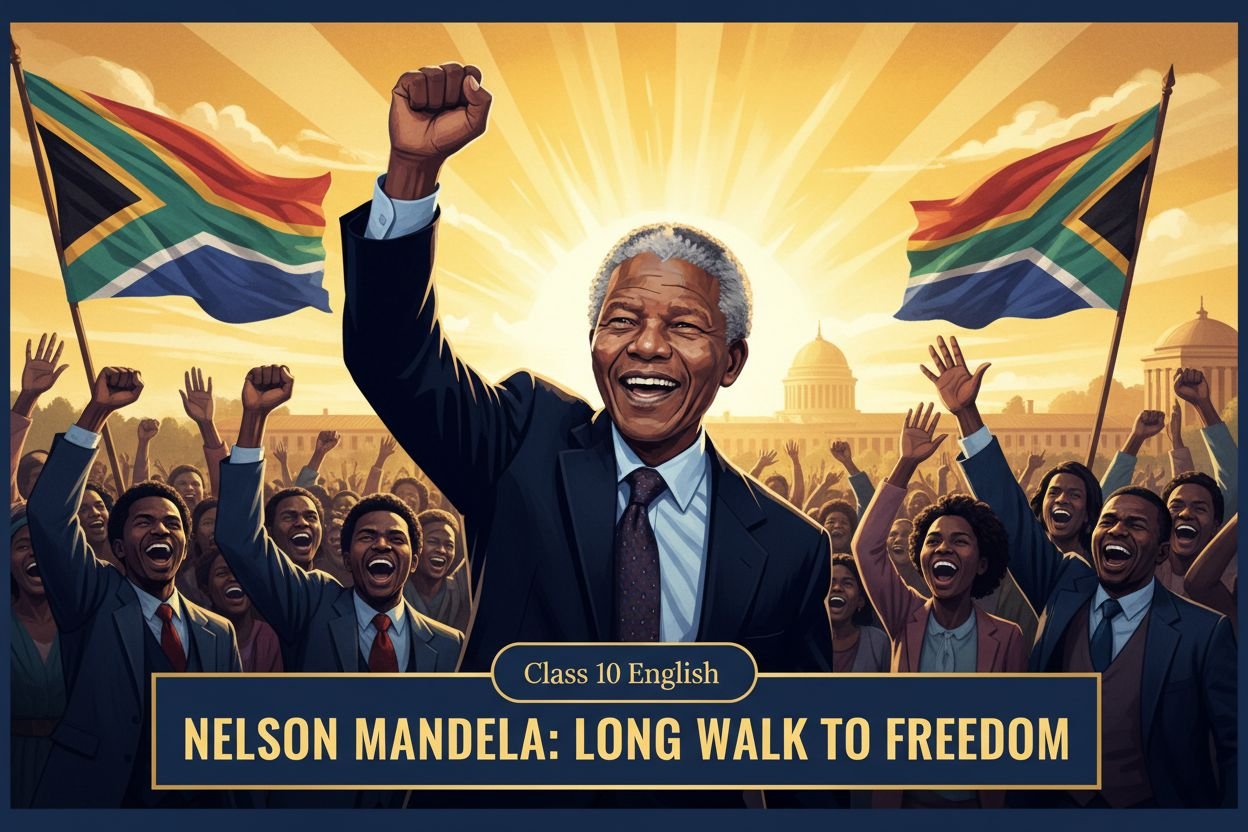
✍️ About the Author
Nelson Rolihlahla Mandela (1918–2013) was not just a writer — he was a legend. South Africa’s first Black President, Nobel Peace Prize winner (1993), and one of the greatest freedom fighters the world has ever seen.
He spent 27 years in prison for fighting against apartheid — a brutal system of racial segregation in South Africa. His autobiography “Long Walk to Freedom” tells the story of his life, his struggle, and his vision for a free, equal South Africa.
This chapter is an excerpt from that autobiography — describing the inauguration ceremony on May 10, 1994, when Mandela became South Africa’s first democratically elected President.
📖 SUMMARY (English)
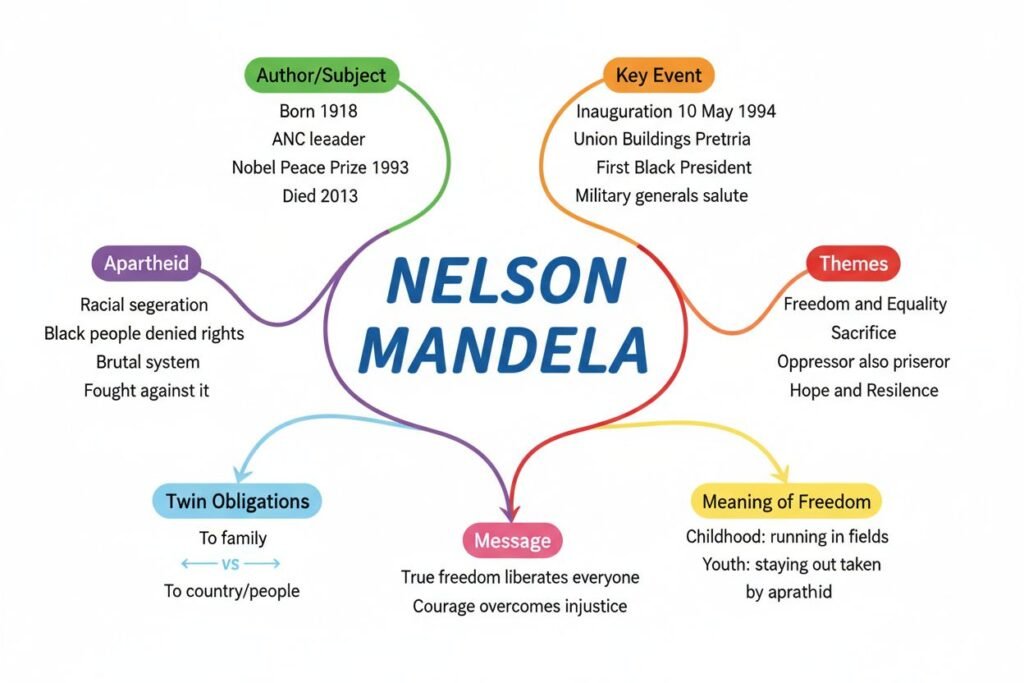
The chapter begins with the description of the inauguration ceremony held in the Union Buildings amphitheatre in Pretoria on 10th May 1994. It was a historic day — for the first time in South Africa’s history, a Black man was being sworn in as President.
Mandela describes the dignitaries, military generals, and leaders from around the world who attended. He notes the irony — the same military generals who had once enforced apartheid now saluted him.
He reflects on the long struggle against apartheid — a system where Black people were denied basic rights, forced to live separately, and treated as inferior. He remembers his comrades who sacrificed their lives — Oliver Tambo, Walter Sisulu, Chris Hani, Yusuf Dadoo, Bram Fischer, Robert Sobukwe — many of whom did not live to see this day.
Mandela then talks about the two obligations every man has — one to his family, and one to his people and country. Under apartheid, fulfilling both was impossible. He had to choose — and he chose the struggle.
He describes twin obligations — as a son, husband, father on one hand, and as a citizen fighting for freedom on the other. Apartheid made it impossible to fulfill both.
He then reflects on the meaning of freedom — as a child, freedom meant running freely in the fields. As a young man, it meant freedom to stay out at night. But gradually he realized that his freedom was taken away — and so was the freedom of every Black South African.
He concludes with a powerful message — that the oppressor is also a prisoner of hatred. Both the oppressed and the oppressor need to be liberated. True freedom means liberating everyone.
📖 सारांश (हिंदी)
यह अध्याय नेल्सन मंडेला की आत्मकथा “लॉन्ग वॉक टू फ्रीडम” का एक अंश है।
10 मई 1994 को प्रिटोरिया के यूनियन बिल्डिंग्स में दक्षिण अफ्रीका के पहले लोकतांत्रिक राष्ट्रपति के रूप में मंडेला का शपथ ग्रहण हुआ। यह ऐतिहासिक दिन था — पहली बार एक अश्वेत व्यक्ति राष्ट्रपति बन रहा था।
मंडेला उस विडंबना का वर्णन करते हैं — जिन सैन्य अधिकारियों ने कभी रंगभेद लागू किया था, वे अब उन्हें सलामी दे रहे थे।
वे रंगभेद (Apartheid) की क्रूरता का वर्णन करते हैं — जहाँ अश्वेत लोगों को बुनियादी अधिकारों से वंचित किया जाता था। वे अपने उन साथियों को याद करते हैं जिन्होंने इस दिन को देखने से पहले ही अपनी जान दे दी।
मंडेला दो दायित्वों की बात करते हैं — परिवार के प्रति और देश के प्रति। रंगभेद के दौर में दोनों एक साथ निभाना असंभव था।
फिर वे स्वतंत्रता के अर्थ पर विचार करते हैं — बचपन में स्वतंत्रता का मतलब था खेतों में दौड़ना। धीरे-धीरे उन्हें एहसास हुआ कि उनकी और हर अश्वेत की स्वतंत्रता छीन ली गई है।
अंत में वे कहते हैं — उत्पीड़क भी घृणा का कैदी है। सच्ची आज़ादी तभी आएगी जब सभी — उत्पीड़ित और उत्पीड़क दोनों — मुक्त होंगे।
🎯 THEMES (English)
1. Freedom and Equality The central theme. Mandela fought his entire life for the freedom and equal rights of Black South Africans. True freedom means freedom for all — not just one group.
2. Sacrifice and Courage Mandela and his comrades sacrificed everything — family, comfort, freedom — for the larger cause. The story honors those who gave their lives.
3. Apartheid and Racial Discrimination The chapter exposes the brutal reality of apartheid — a system that denied basic human rights based on skin color.
4. Dual Obligation Every person has two duties — to family and to society. Mandela chose his people over personal comfort, showing the highest form of civic responsibility.
5. Liberation of Both Oppressed and Oppressor Mandela’s most powerful idea — the oppressor is also imprisoned by hatred and prejudice. True freedom liberates everyone.
6. Hope and Resilience Despite 27 years in prison, Mandela never gave up hope. The inauguration represents the triumph of hope over despair.
🎯 विषय-वस्तु / थीम (हिंदी)
1. स्वतंत्रता और समानता मंडेला का पूरा जीवन अश्वेत लोगों की स्वतंत्रता और समान अधिकारों के लिए समर्पित था।
2. बलिदान और साहस मंडेला और उनके साथियों ने परिवार, सुख-सुविधा, स्वतंत्रता — सब कुछ त्याग दिया।
3. रंगभेद और नस्लीय भेदभाव अध्याय रंगभेद की क्रूर वास्तविकता को उजागर करता है।
4. दोहरा दायित्व परिवार और समाज — दोनों के प्रति कर्तव्य। मंडेला ने देश को चुना।
5. उत्पीड़क और उत्पीड़ित दोनों की मुक्ति मंडेला का सबसे शक्तिशाली विचार — घृणा उत्पीड़क को भी कैदी बनाती है।
6. आशा और दृढ़ता 27 साल जेल के बाद भी मंडेला ने उम्मीद नहीं छोड़ी।
👥 CHARACTERS (English)
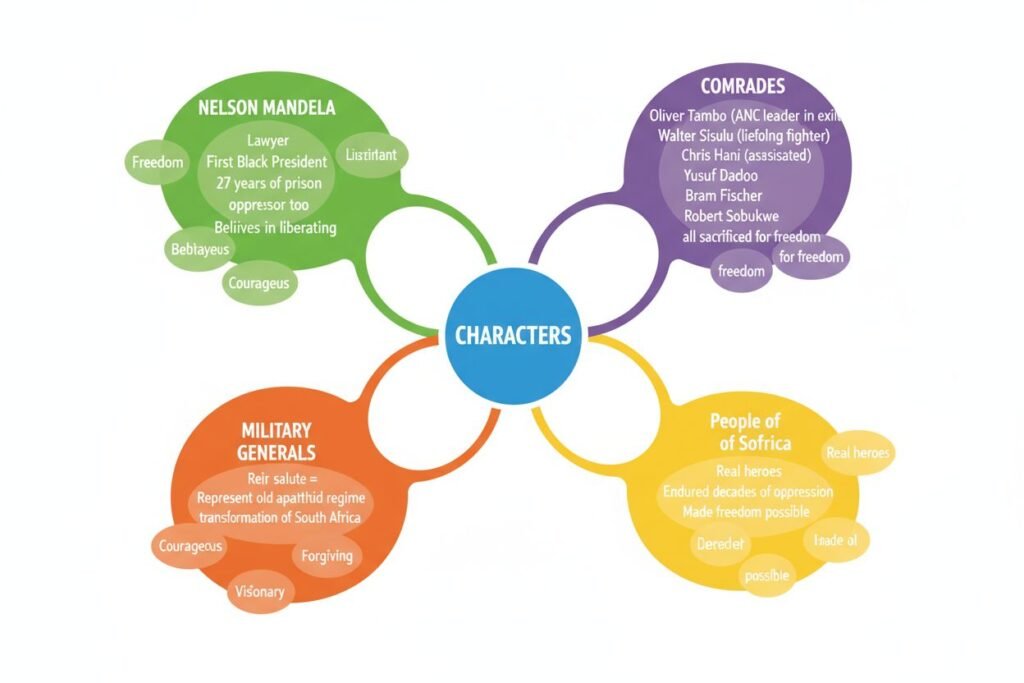
1. Nelson Mandela
- Freedom fighter, lawyer, and South Africa’s first Black President
- Spent 27 years in prison for fighting apartheid
- Deeply committed to equality and justice
- Believes in liberating both the oppressed and the oppressor
- Humble, visionary, and courageous
- Represents the triumph of the human spirit
2. Walter Sisulu
- One of Mandela’s closest comrades
- Lifelong freedom fighter
- Sacrificed his life for the cause
3. Oliver Tambo
- Another key comrade of Mandela
- Led the ANC (African National Congress) in exile
4. Chris Hani
- Brave freedom fighter
- Assassinated before seeing freedom
5. The Military Generals
- Represent the old apartheid regime
- Their salute to Mandela symbolizes the complete transformation of South Africa
6. The People of South Africa
- The real heroes — they endured decades of oppression
- Their patience and resilience made freedom possible
👥 पात्र-परिचय (हिंदी)
1. नेल्सन मंडेला
- स्वतंत्रता सेनानी, वकील, दक्षिण अफ्रीका के पहले अश्वेत राष्ट्रपति
- 27 साल जेल में रहे
- समानता और न्याय के प्रति पूर्णतः समर्पित
- विनम्र, दूरदर्शी, साहसी
2. वॉल्टर सिसुलु
- मंडेला के करीबी साथी
- आजीवन स्वतंत्रता सेनानी
3. ओलिवर टैम्बो
- ANC के प्रमुख नेता
- निर्वासन में संघर्ष जारी रखा
4. क्रिस हानी
- साहसी स्वतंत्रता सेनानी
- आज़ादी देखने से पहले ही शहीद हो गए
5. सैन्य अधिकारी
- पुराने रंगभेद शासन के प्रतीक
- मंडेला को सलामी — दक्षिण अफ्रीका के परिवर्तन का प्रतीक
6. दक्षिण अफ्रीका की जनता
- असली नायक — दशकों के उत्पीड़न को सहा
- उनकी दृढ़ता ने आज़ादी संभव बनाई
✅ QUESTION ANSWERS (English)
Q1. Where did the inauguration take place and what was its significance? The inauguration took place at the Union Buildings amphitheatre in Pretoria on 10th May 1994. It was historically significant because it was the first time a democratically elected government was being installed in South Africa — and for the first time, a Black man was becoming President.
Q2. What did Mandela feel when the military generals saluted him? Mandela felt a deep sense of irony and triumph. The same generals who had once enforced apartheid and oppressed Black people were now saluting him — a Black President. It symbolized the complete transformation of South Africa.
Q3. Who were Mandela’s comrades and what happened to them? Mandela’s comrades included Oliver Tambo, Walter Sisulu, Chris Hani, Yusuf Dadoo, Bram Fischer, and Robert Sobukwe. Many of them sacrificed their lives for the freedom struggle and did not live to see the day of liberation.
Q4. What were the twin obligations Mandela talked about? Mandela said every man has two obligations — one to his family (as son, husband, father) and one to his people and country (as a citizen). Under apartheid, it was impossible to fulfill both. He had to choose the struggle for his people.
Q5. How did Mandela’s understanding of freedom change as he grew up? As a child, freedom meant running freely in the fields, swimming in streams, and roasting corn. As a young man, it meant staying out at night and reading what he wanted. But gradually he realized that his freedom — and that of every Black South African — had been taken away by apartheid.
Q6. What does Mandela mean when he says the oppressor is also a prisoner? Mandela means that a person who hates and oppresses others is also imprisoned — by his own hatred, prejudice, and narrow-mindedness. True freedom means liberating everyone — both the oppressed and the oppressor — from hatred and fear.
Q7. What is the “policy of apartheid”? Apartheid was a system of racial segregation in South Africa where Black people were denied basic rights — they couldn’t vote, couldn’t live in certain areas, couldn’t use the same facilities as white people. It was a brutal system of discrimination based on skin color.
Q8. What did the inauguration mean to Mandela personally? For Mandela, the inauguration was the culmination of a lifelong struggle. It was the moment when the dream of a free, equal South Africa became reality. It was also a tribute to all his comrades who had sacrificed their lives for this day.
Q9. What is the message of the chapter? The chapter conveys that freedom is the birthright of every human being. No system of oppression can last forever. Courage, sacrifice, and resilience can overcome even the most brutal injustice. And true freedom means liberating everyone — not just one group.
Q10. Why is the chapter titled “Long Walk to Freedom”? Because freedom did not come easily or quickly. It took decades of struggle, sacrifice, imprisonment, and suffering. The “long walk” represents the entire journey — from oppression to liberation — that Mandela and millions of South Africans undertook.
✅ प्रश्न-उत्तर (हिंदी)
प्र.1. शपथ ग्रहण समारोह कहाँ हुआ और इसका क्या महत्व था? शपथ ग्रहण 10 मई 1994 को प्रिटोरिया के यूनियन बिल्डिंग्स में हुआ। यह ऐतिहासिक था क्योंकि पहली बार दक्षिण अफ्रीका में लोकतांत्रिक सरकार बन रही थी और पहली बार एक अश्वेत व्यक्ति राष्ट्रपति बन रहा था।
प्र.2. सैन्य अधिकारियों की सलामी पर मंडेला ने क्या महसूस किया? मंडेला ने गहरी विडंबना और विजय का अनुभव किया। जिन अधिकारियों ने कभी रंगभेद लागू किया था, वे अब उन्हें सलामी दे रहे थे — यह दक्षिण अफ्रीका के पूर्ण परिवर्तन का प्रतीक था।
प्र.3. मंडेला के साथी कौन थे और उनका क्या हुआ? ओलिवर टैम्बो, वॉल्टर सिसुलु, क्रिस हानी, यूसुफ दादू, ब्राम फिशर, रॉबर्ट सोबुकवे — इनमें से कई ने आज़ादी देखने से पहले ही अपनी जान दे दी।
प्र.4. मंडेला ने किन दो दायित्वों की बात की? पहला — परिवार के प्रति (पुत्र, पति, पिता के रूप में)। दूसरा — देश और जनता के प्रति (नागरिक के रूप में)। रंगभेद के दौर में दोनों एक साथ निभाना असंभव था।
प्र.5. मंडेला की स्वतंत्रता की समझ कैसे बदली? बचपन में स्वतंत्रता का मतलब था खेतों में दौड़ना, नदी में तैरना। युवावस्था में रात को बाहर रहना, मनचाही किताब पढ़ना। धीरे-धीरे उन्हें एहसास हुआ कि उनकी और हर अश्वेत की स्वतंत्रता छीन ली गई है।
प्र.6. मंडेला का “उत्पीड़क भी कैदी है” से क्या तात्पर्य है? जो व्यक्ति दूसरों से घृणा करता है और उन्हें सताता है, वह भी अपनी घृणा और संकीर्णता का कैदी है। सच्ची आज़ादी तभी आएगी जब सभी — उत्पीड़ित और उत्पीड़क दोनों — घृणा और भय से मुक्त होंगे।
प्र.7. रंगभेद नीति क्या थी? रंगभेद दक्षिण अफ्रीका में नस्लीय भेदभाव की एक क्रूर व्यवस्था थी जिसमें अश्वेत लोगों को मतदान, आवास, शिक्षा जैसे बुनियादी अधिकारों से वंचित किया जाता था।
प्र.8. शपथ ग्रहण का मंडेला के लिए व्यक्तिगत महत्व क्या था? यह उनके जीवनभर के संघर्ष की परिणति थी। यह उन सभी साथियों को श्रद्धांजलि थी जिन्होंने इस दिन के लिए अपनी जान दी।
प्र.9. इस अध्याय का संदेश क्या है? स्वतंत्रता हर इंसान का जन्मसिद्ध अधिकार है। साहस, बलिदान और दृढ़ता से बड़े से बड़े अन्याय को भी हराया जा सकता है। और सच्ची आज़ादी सबके लिए होती है।
प्र.10. अध्याय का शीर्षक “लॉन्ग वॉक टू फ्रीडम” क्यों है? क्योंकि आज़ादी आसानी से नहीं मिली। दशकों का संघर्ष, बलिदान, कारावास — यह “लंबी यात्रा” उत्पीड़न से मुक्ति तक की पूरी यात्रा का प्रतीक है।
🔘 MCQs — Nelson Mandela: Long Walk to Freedom
1. When did Nelson Mandela’s inauguration take place?
- a) 10th April 1994
- b) ✅ 10th May 1994
- c) 10th June 1994
- d) 27th April 1994
2. Where was the inauguration ceremony held?
- a) Cape Town
- b) Johannesburg
- c) ✅ Union Buildings, Pretoria
- d) Durban
3. How many years did Mandela spend in prison?
- a) 17 years
- b) 20 years
- c) ✅ 27 years
- d) 30 years
4. What was “apartheid”?
- a) A political party
- b) ✅ A system of racial segregation in South Africa
- c) A freedom movement
- d) A type of election
5. Who was NOT one of Mandela’s comrades mentioned in the chapter?
- a) Oliver Tambo
- b) Walter Sisulu
- c) Chris Hani
- d) ✅ Mahatma Gandhi
6. What did Mandela say about the oppressor?
- a) The oppressor is always right
- b) The oppressor should be punished
- c) ✅ The oppressor is also a prisoner of hatred
- d) The oppressor can never change
7. What were Mandela’s “twin obligations”?
- a) To God and to country
- b) ✅ To family and to his people/country
- c) To ANC and to the world
- d) To himself and to God
8. What did freedom mean to Mandela as a child?
- a) Voting rights
- b) Equal education
- c) ✅ Running freely in fields, swimming in streams
- d) Reading any book
9. What is the full title of Mandela’s autobiography?
- a) Walk to Freedom
- b) Freedom at Last
- c) ✅ Long Walk to Freedom
- d) The Road to Freedom
10. What did the military generals’ salute to Mandela symbolize?
- a) Military power
- b) ✅ Complete transformation of South Africa
- c) Respect for old age
- d) Political formality
11. Mandela won the Nobel Peace Prize in which year?
- a) 1990
- b) 1992
- c) ✅ 1993
- d) 1994
12. What is the central message of the chapter?
- a) Violence is necessary for freedom
- b) Only one race deserves freedom
- c) ✅ Freedom is the birthright of all and true freedom liberates everyone
- d) Politics is the only way to change
13. Which organization did Mandela lead?
- a) INC
- b) ✅ ANC (African National Congress)
- c) NAACP
- d) UN
14. What does “Long Walk” in the title refer to?
- a) A physical journey
- b) ✅ Decades of struggle and sacrifice for freedom
- c) Mandela’s time in prison
- d) The inauguration ceremony
15. Mandela was born in which year?
- a) 1910
- b) 1915
- c) ✅ 1918
- d) 1920
✍️ WRITING SECTION
1. Character Sketch — Nelson Mandela (English)
Nelson Mandela is one of the most inspiring figures in human history. Born in 1918 in South Africa, he grew up witnessing the brutal injustice of apartheid. Rather than accepting it, he chose to fight — and paid the price with 27 years of imprisonment.
What makes Mandela extraordinary is not just his courage, but his wisdom. He never preached hatred. Even after decades of oppression, he believed that the oppressor too needed to be liberated — from hatred and prejudice. This remarkable capacity for forgiveness and vision set him apart from ordinary leaders.
His inauguration as South Africa’s first Black President was not just a personal triumph — it was the triumph of the human spirit over injustice. Mandela represents the highest ideals of courage, sacrifice, forgiveness, and hope.
2. पात्र-चित्रण — नेल्सन मंडेला (हिंदी)
नेल्सन मंडेला मानव इतिहास के सबसे प्रेरणादायक व्यक्तित्वों में से एक हैं। 1918 में जन्मे मंडेला ने रंगभेद की क्रूरता को देखा और उसके विरुद्ध लड़ने का निर्णय किया — 27 साल की कैद की कीमत पर।
मंडेला की महानता उनके साहस में ही नहीं, उनकी दूरदर्शिता में भी है। उन्होंने कभी घृणा नहीं फैलाई। दशकों के उत्पीड़न के बाद भी उनका मानना था कि उत्पीड़क को भी मुक्त होना है — घृणा और पूर्वाग्रह से।
यह क्षमाशीलता और दृष्टि उन्हें साधारण नेताओं से अलग करती है। मंडेला साहस, बलिदान, क्षमा और आशा के सर्वोच्च आदर्शों का प्रतीक हैं।
3. The Importance of Freedom (English)
Freedom is not just a political concept — it is the foundation of human dignity. Nelson Mandela’s life teaches us that freedom is the birthright of every human being, regardless of race, color, or religion.
Mandela spent 27 years in prison, yet he never gave up. His story shows that the human spirit cannot be imprisoned — even when the body is. True freedom, as Mandela understood it, is not just the absence of chains — it is the presence of opportunity, equality, and dignity for all.
His most powerful insight was that the oppressor too needs to be freed — from hatred and prejudice. This vision of universal freedom is what makes Mandela’s message timeless and universal.
4. स्वतंत्रता का महत्व (हिंदी)
स्वतंत्रता केवल एक राजनीतिक अवधारणा नहीं — यह मानवीय गरिमा की नींव है। मंडेला का जीवन हमें सिखाता है कि स्वतंत्रता हर इंसान का जन्मसिद्ध अधिकार है।
27 साल की कैद के बाद भी मंडेला ने उम्मीद नहीं छोड़ी। उनकी कहानी बताती है कि मानवीय आत्मा को कैद नहीं किया जा सकता।
उनका सबसे शक्तिशाली विचार — उत्पीड़क को भी घृणा से मुक्त होना है। यही सार्वभौमिक स्वतंत्रता की दृष्टि मंडेला के संदेश को कालजयी बनाती है।
A Letter to God — Summary, Explanation & Question Answers | Class 10 First Flight Chapter 1
तुलसीदास — सम्पूर्ण अध्ययन सामग्री | राम-लक्ष्मण-परशुराम संवाद
[…] तुलसीदास — सम्पूर्ण अध्ययन सामग्री | राम-लक्ष्मण-परशुराम संवाद | Class 10 KshitijNelson Mandela: Long Walk to Freedom – Summary & Question Answers | Class 10 First Flight … […]