Biological Classification
Toh basically… yeh chapter Chapter 1 ka continuation hai.
Wahan humne jaana ki classification kyun zaroori hai. Yahan jaanenge — kaise classify karte hain aur kaun se kingdoms hain.
Pehle sirf do kingdoms the — Plantae aur Animalia. Linnaeus ne yahi diya tha. Simple tha — jo hila nahi woh plant, jo hila woh animal.
But phir problems aane lagi. Fungi — plant jaisi dikhti hai, but photosynthesis nahi karti. Bacteria — plant bhi nahi, animal bhi nahi. Euglena — light mein photosynthesis karta hai, dark mein animal ki tarah khata hai. Kahan daalo inhe?
Isliye classification evolve hoti rahi:
- Two Kingdom → Linnaeus
- Three Kingdom → Haeckel (Protista add kiya)
- Four Kingdom → Copeland
- Five Kingdom → R.H. Whittaker (1969) ← yeh NCERT mein follow hota hai
Whittaker ne classify kiya based on:
- Cell structure (prokaryotic/eukaryotic)
- Body organization
- Mode of nutrition
- Reproduction
- Phylogenetic relationships
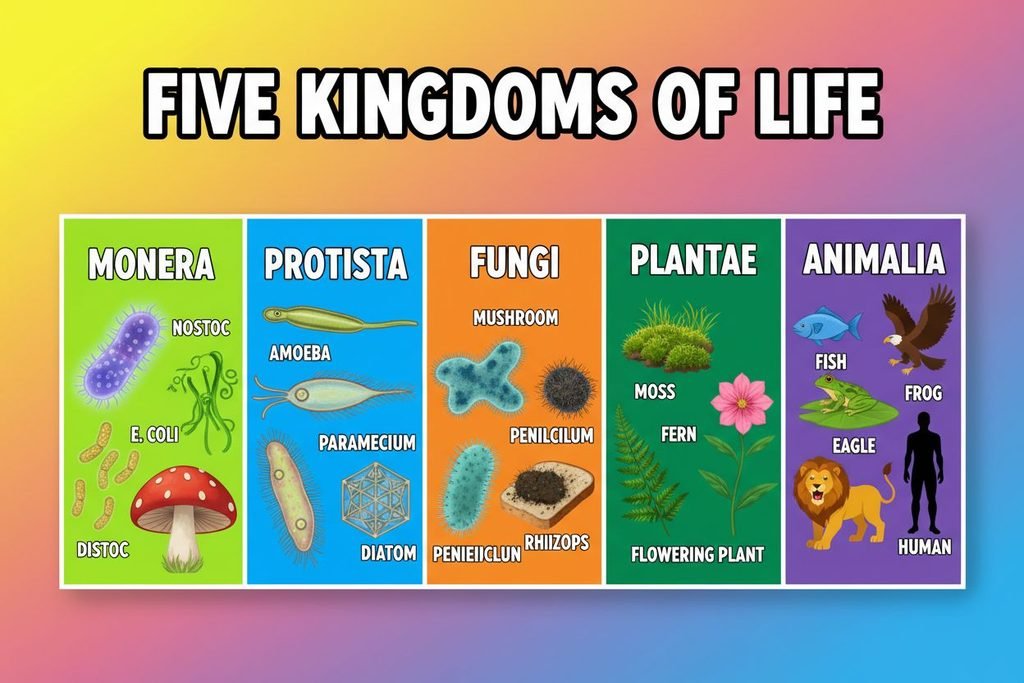
Kingdom Monera
Sabse primitive. Sabse simple. Aur sabse zyada abundant.
Key features:
- Prokaryotic — nucleus nahi hota, membrane-bound organelles nahi
- Unicellular
- Cell wall mostly present (but composition vary karti hai)
- Nutrition — autotrophic ya heterotrophic dono ho sakte hain
- Reproduction — mainly binary fission
Monera mein do major groups hain:
Archaebacteria
Yeh ancient bacteria hain — literally “archae” = ancient.
Sabse harsh environments mein milte hain jahan koi aur survive nahi kar sakta:
- Halophiles — extreme salt mein (Dead Sea jaisi jagah)
- Thermoacidophiles — hot springs mein, high temperature + high acid
- Methanogens — marsh areas mein, methane gas produce karte hain. Cow ke gut mein bhi hote hain — isliye cows methane release karti hain!
Special feature — inki cell wall ki chemical composition doosre bacteria se alag hoti hai. Isliye yeh extreme conditions mein survive kar lete hain.
Jab maine padha ki yeh 100°C se zyada temperature pe survive karte hain — honestly amazing laga. Hum 40°C fever mein toot jaate hain. 😄
Eubacteria
Yeh “true bacteria” hain — woh jo hum normally bacteria kehte hain.
Shape ke basis pe:
- Coccus — spherical (Streptococcus)
- Bacillus — rod-shaped (E. coli)
- Vibrium — comma-shaped (Vibrio cholerae)
- Spirillum — spiral (Treponema)
Nutrition ke basis pe:
- Autotrophic — khud food banate hain
- Photosynthetic — Cyanobacteria (Blue-green algae) — chlorophyll hota hai, O₂ release karte hain
- Chemosynthetic — inorganic chemicals oxidize karke energy lete hain
- Heterotrophic — doosron pe depend karte hain
- Saprophytic — dead matter se
- Parasitic — living organisms se
Cyanobacteria — bahut important hain:
- Nitrogen fixation karte hain — Nostoc, Anabaena
- Paddy fields mein natural fertilizer ka kaam karte hain
- Oldest photosynthetic organisms — Earth pe oxygen inhi ki wajah se aayi
Mycoplasma — special mention:
- Cell wall nahi hoti — isliye antibiotics (jo cell wall attack karte hain) inpe kaam nahi karte
- Sabse chhote living organisms
- Pleomorphic — koi fixed shape nahi
Kingdom Protista
Yeh ek “dustbin kingdom” jaisa hai — jo Monera mein fit nahi, Fungi/Plantae/Animalia mein bhi nahi — woh Protista mein.
Key features:
- Eukaryotic — proper nucleus hota hai
- Mostly unicellular
- Aquatic mostly
- Sexual reproduction — cell fusion aur zygote formation se
Protista mein 5 groups hain:
Chrysophytes
“Chryso” = golden. Isliye golden algae bhi kehte hain.
- Diatoms aur golden algae
- Diatoms — most important:
- Cell wall silica se bani hoti hai — glass jaisi
- Indestructible — fossilize ho jaati hain
- Diatomaceous earth — inke fossils se bani soil — toothpaste, fire-proofing materials mein use hoti hai
- Chief producers of ocean — ocean ki food chain inhi se shuru hoti hai
Dinoflagellates
“Dino” = whirling. Yeh spin karte hain move karte waqt.
- Mostly marine
- Two flagella — ek longitudinal, ek transverse (groove mein)
- Cell wall — cellulose plates se bani — armour jaisi
- Red tide — jab yeh bahut zyada multiply ho jaate hain toh ocean red/orange dikhta hai. Toxins release karte hain jo fish kill kar dete hain
- Example — Gonyaulax — bioluminescent hai — raat ko ocean glow karta hai inki wajah se. Honestly magical lagta hai.
Euglenoids
Yeh sabse confusing group hai — plant bhi, animal bhi.
- Freshwater mostly
- No cell wall — protein-rich layer hoti hai jise pellicle kehte hain
- Two flagella — ek short, ek long
- Light mein — photosynthesis karte hain (plant jaisa)
- Dark mein — heterotrophic ho jaate hain (animal jaisa)
- Eyespot hota hai — light detect karne ke liye
- Example — Euglena
Jab maine padha ki Euglena plant bhi hai aur animal bhi — toh samajh aaya ki nature ko boxes mein fit karna mushkil kyun hota hai.
Slime Moulds
Yeh aur bhi weird hain.
- Saprophytic — dead organic matter pe
- Normal conditions mein — individual amoeba-like cells
- Unfavorable conditions mein — sab aggregate ho jaate hain ek plasmodium banate hain — ek bada mass
- Plasmodium move kar sakta hai — aur fruiting bodies banata hai spores ke liye
- Spores — extremely resistant — harsh conditions mein survive karte hain
Matlab yeh akele bhi reh sakte hain, saath bhi aa sakte hain. Survival strategy ekdum unique hai.
Protozoans
Yeh animal-like protists hain.
- Heterotrophic
- Mostly parasitic ya free-living
- 4 types:
| Type | Movement | Example | Disease |
|---|---|---|---|
| Amoeboid | Pseudopodia | Amoeba | Amoebic dysentery |
| Flagellated | Flagella | Trypanosoma | Sleeping sickness |
| Ciliated | Cilia | Paramecium | — |
| Sporozoans | None | Plasmodium | Malaria |
Plasmodium — malaria ka causative agent. Anopheles mosquito se spread hota hai. NEET mein bahut important hai.
Kingdom Fungi
Fungi — na plant, na animal. Apni alag duniya.
Key features:
- Eukaryotic
- Heterotrophic — photosynthesis nahi karte
- Saprophytic mostly — dead matter decompose karte hain (nature ke garbage collectors)
- Cell wall — chitin se bani (plants mein cellulose hoti hai)
- Body — hyphae (singular: hypha) se bana — thread-like structures
- Hyphae ka network — mycelium
- Coenocytic hyphae — septa nahi hote, nuclei freely distributed
Fungi 4 classes mein divide hain:
Phycomycetes
“Phyco” = algae-like fungi.
- Aquatic ya decaying wood pe
- Coenocytic hyphae — septa nahi
- Asexual — zoospores ya aplanospores
- Sexual — zygospore formation
- Examples — Mucor, Rhizopus (bread mould), Albugo (white rust of mustard)
Ascomycetes
“Sac fungi” — kyunki spores ascus (sac) mein hote hain.
- Saprophytic, parasitic, ya coprophilous (dung pe)
- Septate hyphae — septa hote hain
- Asexual — conidia (conidiophores pe)
- Sexual — ascospores (ascus mein, 8 spores)
- Examples:
- Aspergillus — food spoilage, aflatoxin
- Penicillium — penicillin antibiotic yahan se aata hai!
- Saccharomyces — yeast — bread, beer, wine
- Neurospora — genetics research mein use
- Morels aur Truffles — edible, expensive delicacies
Basidiomycetes
“Club fungi” — spores basidium (club-shaped) pe hote hain.
- Septate hyphae
- Asexual spores — rare
- Sexual — basidiospores (basidium pe, usually 4)
- Examples:
- Agaricus — mushroom (edible)
- Ustilago — smut disease (wheat)
- Puccinia — rust disease (wheat) — black rust of wheat
- Bracket fungi — trees pe
Mushrooms yahan se aate hain. Aur wheat ke sabse dangerous diseases bhi yahan se. Interesting contrast.
Deuteromycetes
“Imperfect fungi” — kyunki inki sexual reproduction known nahi hai.
- Sirf asexual reproduction — conidia se
- Isliye “Fungi Imperfecti” bhi kehte hain
- Mostly decomposers
- Examples:
- Alternaria — leaf blight
- Colletotrichum — anthracnose
- Trichoderma — biological control agent
Jab sexual stage discover ho jaati hai — toh inhe doosre groups mein shift kar dete hain. Yeh group basically “unidentified” fungi ka waiting room hai.
Kingdom Plantae
Yeh relatively simple hai is chapter mein — detailed study aage ke chapters mein hogi.
Key features:
- Eukaryotic
- Autotrophic — chlorophyll se photosynthesis
- Cell wall — cellulose
- Multicellular (mostly)
- Alternation of generations — sporophyte aur gametophyte
Kuch plants partially heterotrophic bhi hote hain:
- Insectivorous — Nepenthes (pitcher plant), Drosera (sundew) — insects khate hain nitrogen ke liye
- Parasitic — Cuscuta (amarbel) — doosre plants pe depend karti hai
Kingdom Animalia
Yeh bhi brief hai is chapter mein.
Key features:
- Eukaryotic
- Heterotrophic — holozoic nutrition (food ingest karte hain)
- No cell wall
- Multicellular
- Sexual reproduction mostly
- Locomotion — move kar sakte hain
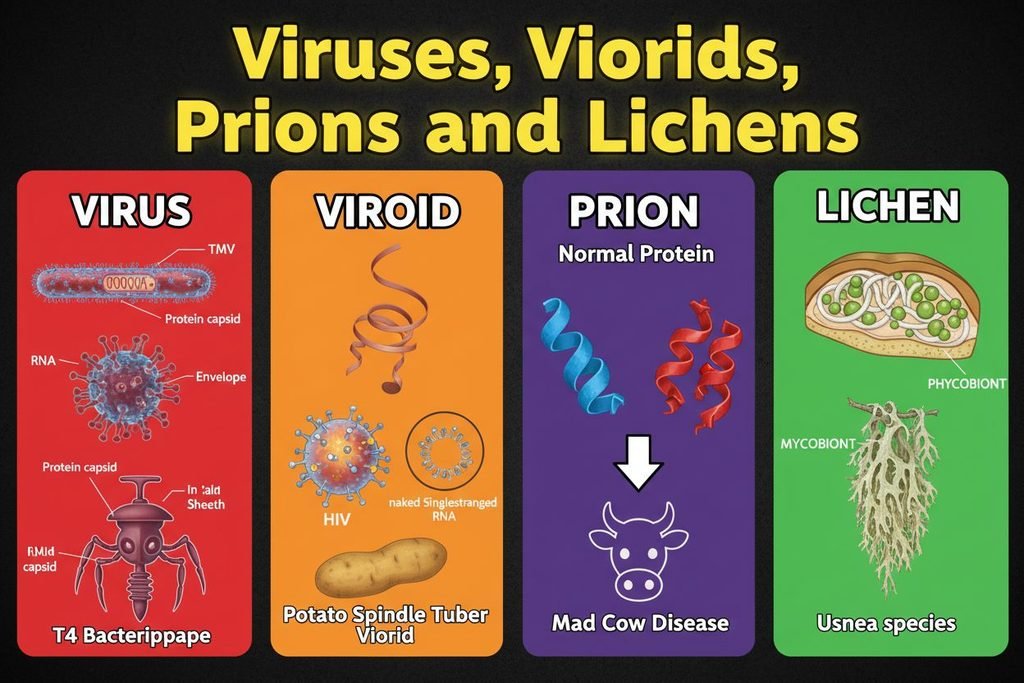
Viruses, Viroids, Prions and Lichens
Yeh sab kisi bhi kingdom mein fit nahi hote. Isliye alag section mein hain.
Viruses
Living ya non-living? — yeh debate abhi bhi hai.
- Outside host — completely inert, crystallize ho sakte hain — non-living
- Inside host — reproduce karte hain, evolve karte hain — living jaisa behavior
Structure:
- Nucleic acid (DNA ya RNA — dono nahi, sirf ek) + Protein coat (capsid)
- Kuch mein envelope bhi hoti hai (lipid layer)
Types:
- Plant viruses — mostly ssRNA
- Animal viruses — DNA ya RNA
- Bacteriophages — bacteria ko infect karte hain — mostly dsDNA
Discovery — D.J. Ivanowsky (1892) — tobacco mosaic disease study karte waqt. W.M. Stanley ne crystalize kiya.
Diseases:
- Mumps, Smallpox, Herpes, Influenza, HIV/AIDS — animal viruses
- Tobacco Mosaic Virus (TMV), Cauliflower Mosaic Virus — plant viruses
Viroids
- T.O. Diener ne discover kiya (1971)
- Sirf naked RNA — protein coat bhi nahi
- Viruses se bhi chhote
- Plant diseases cause karte hain — Potato Spindle Tuber Viroid
Matlab virus se bhi simple — sirf ek RNA strand. Aur phir bhi disease cause kar sakta hai. Honestly surprising.
Prions
- Stanley Prusiner ne discover kiya — Nobel Prize mila
- Sirf misfolded proteins — koi nucleic acid nahi
- Mad Cow Disease (Bovine Spongiform Encephalopathy) aur Creutzfeldt-Jakob disease in humans
- Normal proteins ko misfolded karte hain — chain reaction
Yeh sabse weird hai — koi DNA/RNA nahi, phir bhi “infectious.” Science ki boundaries yahan blur hoti hain.
Lichens
- Fungi + Algae ka symbiotic association
- Fungi — shelter aur water provide karta hai
- Algae — photosynthesis karke food provide karti hai
- Dono ek doosre ke bina survive nahi kar sakte (mostly)
- Pollution indicators — clean air mein milte hain, polluted areas mein nahi
- Pioneer species — bare rocks pe sabse pehle uge hain — soil banate hain
Lichen ek relationship hai — ek organism nahi. Yeh concept bahut important hai.
Summary
Is chapter ka core:
Five Kingdoms — Monera (prokaryotic), Protista (unicellular eukaryotic), Fungi (chitin cell wall, heterotrophic), Plantae (autotrophic), Animalia (heterotrophic, no cell wall).
Aur jo fit nahi hote — Viruses (nucleic acid + protein), Viroids (naked RNA), Prions (misfolded protein), Lichens (fungi + algae symbiosis).
Quick Revision
- Five Kingdom → R.H. Whittaker (1969)
- Archaebacteria → extreme environments, ancient
- Cyanobacteria → nitrogen fixation, O₂ producers
- Mycoplasma → no cell wall, smallest living
- Diatoms → silica cell wall, diatomaceous earth
- Euglena → plant + animal both
- Fungi cell wall → chitin
- Penicillin → Penicillium (Ascomycetes)
- Mushroom → Agaricus (Basidiomycetes)
- Virus discovery → Ivanowsky
- Viroid discovery → T.O. Diener
- Prion discovery → Stanley Prusiner
- Lichens → fungi + algae, pollution indicators ⚠️
NCERT Exercise — Complete Answers
Q1. Discuss how classification systems have undergone several changes over a period of time?
Yeh ek evolution ki kahani hai — organisms ki nahi, classification ki.
Two Kingdom System — Linnaeus (18th century) Sirf do kingdoms — Plantae aur Animalia.
- Plants = jo move nahi karte, photosynthesis karte hain
- Animals = jo move karte hain, food ingest karte hain
Problem — Fungi kahan? Bacteria kahan? Euglena kahan? Yeh system bahut simple tha.
Three Kingdom System — Ernst Haeckel (1866) Protista add kiya — unicellular organisms ke liye. But bacteria aur fungi abhi bhi misfit the.
Four Kingdom System — Copeland (1956) Monera add kiya — prokaryotes ke liye alag kingdom.
Five Kingdom System — R.H. Whittaker (1969) Fungi ko alag kingdom diya. Yeh system NCERT mein follow hota hai.
Classification criteria:
- Cell structure (prokaryotic/eukaryotic)
- Body organization (unicellular/multicellular)
- Mode of nutrition
- Reproduction
- Phylogenetic relationships
Six Kingdom / Three Domain System — Carl Woese (1990) rRNA sequencing se pata chala ki Archaebacteria fundamentally alag hain. Isliye:
- Domain Bacteria
- Domain Archaea
- Domain Eukarya
Aaj bhi classification change ho rahi hai — DNA sequencing, molecular phylogeny se naye relationships discover ho rahe hain. Science kabhi final nahi hoti.
Q2. State two economically important uses of: (a) Heterotrophic bacteria (b) Archaebacteria
(a) Heterotrophic Bacteria:
- Food industry — Lactobacillus milk ko curd mein convert karta hai. Cheese, vinegar, alcohol production mein bacteria use hote hain. Bread banaane mein bhi.
- Medicine/Agriculture — Streptomyces se streptomycin antibiotic milta hai. Decomposer bacteria dead matter decompose karke soil fertile banate hain — natural recyclers hain. Sewage treatment mein bhi use hote hain.
(b) Archaebacteria:
- Biogas production — Methanogens (Methanobacterium) organic waste se methane gas produce karte hain. Biogas plants mein use hote hain — clean energy source. Cow dung se biogas yahi bacteria banate hain.
- Industrial enzymes — Thermoacidophiles extreme temperature pe stable enzymes produce karte hain. Yeh enzymes industrial processes mein use hote hain jahan high temperature chahiye — detergents, food processing, PCR (DNA amplification) mein Taq polymerase ek thermophilic bacteria se aata hai.
Q3. What is the nature of cell-walls in diatoms?
Diatoms ki cell wall silica (silicon dioxide — SiO₂) se bani hoti hai.
Yeh cell wall do overlapping halves mein hoti hai — jaise ek soap box — ek half doosre ke upar fit hota hai. Inhe frustules kehte hain.
Key points:
- Silica wall — extremely hard aur indestructible
- Fossilize ho jaati hai — millions of years tak preserved rehti hai
- Inke fossils se diatomaceous earth banti hai
- Diatomaceous earth use hoti hai — toothpaste, metal polish, fire-proofing materials, filtration mein
Jab maine socha ki toothpaste mein diatoms ke fossils hain — thoda weird laga. But true hai. 😄
Q4. Find out what do the terms ‘Algal Bloom’ and ‘Red Tides’ signify.
Algal Bloom:
Jab kisi water body mein algae ya cyanobacteria ki population suddenly bahut zyada badh jaati hai — isse algal bloom kehte hain.
Causes — excess nutrients (nitrogen, phosphorus) from fertilizers, sewage — isse eutrophication kehte hain.
Effects:
- Water green/blue-green ho jaata hai
- Oxygen depleted ho jaati hai — fish mar jaati hain
- Toxins release hote hain — drinking water contaminate hoti hai
- Sunlight neeche nahi pahunchti — aquatic plants mar jaati hain
Red Tides:
Yeh dinoflagellates ki wajah se hota hai — especially Gonyaulax jaisi species.
Jab dinoflagellates bahut zyada multiply hote hain — ocean red/orange dikhta hai (inke pigments ki wajah se).
Effects:
- Toxins release hote hain — shellfish inhe accumulate karte hain
- Jo humans yeh shellfish khate hain — paralytic shellfish poisoning ho sakti hai
- Fish mass mortality
- Marine ecosystem disturb hota hai
Dono phenomena pollution aur climate change se badh rahe hain globally.
Q5. How are viroids different from viruses?
| Feature | Virus | Viroid |
|---|---|---|
| Discovery | Ivanowsky (1892) | T.O. Diener (1971) |
| Composition | Nucleic acid + Protein coat (capsid) | Only naked RNA — no protein |
| Size | Larger (20–300 nm) | Smaller (246–375 nucleotides) |
| Genetic material | DNA or RNA | Only ssRNA (single stranded) |
| Protein coat | Present (capsid) | Absent |
| Envelope | Sometimes present | Absent |
| Host | Plants, animals, bacteria | Only plants |
| Example | TMV, HIV, Influenza | Potato Spindle Tuber Viroid |
Simple summary: Virus = nucleic acid + protein coat. Viroid = sirf naked RNA, kuch nahi.
Viroid virus se bhi simple hai — aur phir bhi disease cause karta hai. Yeh biology ka ek amazing fact hai.
Q6. Describe briefly the four major groups of Protozoa.
Protozoans — animal-like protists. Heterotrophic, mostly unicellular.
1. Amoeboid Protozoans
- Movement — pseudopodia (false feet) se
- Aquatic ya soil mein
- Kuch parasitic — Entamoeba histolytica — amoebic dysentery cause karta hai
- Example — Amoeba, Entamoeba
2. Flagellated Protozoans
- Movement — flagella se
- Free-living ya parasitic
- Trypanosoma — sleeping sickness cause karta hai (tsetse fly se spread)
- Leishmania — kala-azar cause karta hai (sandfly se spread)
- Example — Euglena (though debated), Trypanosoma, Leishmania
3. Ciliated Protozoans
- Movement — cilia se (thousands of tiny hair-like structures)
- Aquatic, free-living mostly
- Gullet hota hai — food ingestion ke liye
- Example — Paramecium, Vorticella
4. Sporozoans
- No locomotory organs — koi cilia, flagella, pseudopodia nahi
- Parasitic — intracellular parasites
- Spore-like stage hoti hai life cycle mein
- Most important — Plasmodium — malaria cause karta hai
- P. vivax — benign tertian malaria
- P. falciparum — malignant malaria (most dangerous)
- P. malariae — quartan malaria
- Example — Plasmodium, Monocystis
Q7. Plants are autotrophic. Can you think of some plants that are partially heterotrophic?
Haan! Kuch plants partially heterotrophic hote hain — matlab sirf photosynthesis pe depend nahi karte.
Insectivorous Plants (Partially Heterotrophic):
Yeh plants nitrogen-deficient soil mein rehte hain — isliye insects pakad ke nitrogen lete hain. Photosynthesis bhi karte hain — isliye “partially” heterotrophic.
- Nepenthes — Pitcher Plant — insects pitcher mein gir jaate hain, digest ho jaate hain
- Drosera — Sundew — sticky tentacles se insects pakadta hai
- Utricularia — Bladderwort — aquatic, small organisms trap karta hai
- Dionaea — Venus Flytrap — leaves snap shut karke insects pakadta hai
Parasitic Plants:
- Cuscuta (Amarbel) — doosre plants pe completely depend karti hai nutrients ke liye. Photosynthesis nahi karti — isliye yeh total parasite hai, partially nahi.
- Viscum (Mistletoe) — partial parasite — photosynthesis karta hai but water aur minerals host se leta hai
Interesting na — plants jo “peaceful” lagte hain, woh bhi insects kha sakte hain. 😄
Q8. What do the terms phycobiont and mycobiont signify?
Yeh terms Lichens se related hain.
Lichens = Fungi + Algae ka symbiotic association.
- Phycobiont — “Phyco” = algae. Lichen mein jo algal component hota hai use phycobiont kehte hain. Yeh photosynthesis karta hai aur food provide karta hai.
- Mycobiont — “Myco” = fungi. Lichen mein jo fungal component hota hai use mycobiont kehte hain. Yeh shelter, water, aur minerals provide karta hai.
Dono ek doosre ke bina survive nahi kar sakte (mostly) — yeh mutualistic symbiosis hai.
Phycobiont mostly — Trebouxia (green alga) ya Cyanobacteria (Nostoc). Mycobiont mostly — Ascomycetes fungi.
Q9. Comparative account of classes of Kingdom Fungi:
(i) Mode of Nutrition:
| Class | Mode of Nutrition |
|---|---|
| Phycomycetes | Saprophytic (dead organic matter) or parasitic (on plants/animals) or coprophilous (on dung) |
| Ascomycetes | Saprophytic, parasitic, or coprophilous |
| Basidiomycetes | Saprophytic (decomposers of wood/litter) or parasitic (plant pathogens) |
| Deuteromycetes | Saprophytic or parasitic |
Sab mostly heterotrophic hain — photosynthesis koi nahi karta.
(ii) Mode of Reproduction:
| Class | Asexual Reproduction | Sexual Reproduction |
|---|---|---|
| Phycomycetes | Zoospores (motile) or Aplanospores (non-motile) | Zygospore formation |
| Ascomycetes | Conidia (on conidiophores) | Ascospores (in ascus — 8 spores) |
| Basidiomycetes | Rare — conidia sometimes | Basidiospores (on basidium — 4 spores) |
| Deuteromycetes | Conidia only | Unknown / absent |
Key differences yaad rakhne ke liye:
- Phycomycetes → Zoospores + Zygospore ⚡
- Ascomycetes → Conidia + Ascospores (sac mein) 🎒
- Basidiomycetes → Basidiospores (club pe) 🍄
- Deuteromycetes → Sirf Conidia, sexual = ❌
Q10. What are the characteristic features of Euglenoids?
Euglena — sabse famous euglenoid.
Characteristics:
- Mostly freshwater — stagnant water mein milte hain
- No cell wall — instead pellicle hoti hai — flexible protein-rich layer. Isliye shape change kar sakte hain
- Two flagella — ek short (barely visible), ek long (locomotion ke liye)
- Photosynthetic — chloroplasts hote hain, light mein food banate hain
- Heterotrophic in dark — jab light nahi hoti, heterotrophic ho jaate hain — animal jaisa behavior
- Eyespot (stigma) — light-sensitive spot — light detect karne ke liye, phototaxis mein help karta hai
- Reservoir — flagella ke base pe ek cavity hoti hai
- Stored food — paramylon (carbohydrate) — starch nahi
Why important: Euglenoids prove karte hain ki plant-animal boundary rigid nahi hai. Yeh “connecting link” hain plants aur animals ke beech — isliye classification mein inhe Protista mein rakha gaya.
Q11. Give a brief account of viruses with respect to their structure and nature of genetic material. Also name four common viral diseases.
Discovery:
- D.J. Ivanowsky (1892) — tobacco mosaic disease study karte waqt pata chala ki causative agent bacteria se chhota hai aur filter se pass ho jaata hai
- M.W. Beijerinck — “contagium vivum fluidum” kaha — living infectious fluid
- W.M. Stanley (1935) — TMV ko crystallize kiya — Nobel Prize
Structure:
Viruses mein hota hai:
- Genetic material — DNA ya RNA (dono kabhi nahi, sirf ek)
- Protein coat — Capsid — capsomeres se bana
- Envelope — kuch animal viruses mein lipid layer hoti hai bahar se
Nature of Genetic Material:
| Type | Genetic Material | Example |
|---|---|---|
| Plant viruses | Mostly ssRNA | TMV, Cauliflower Mosaic Virus |
| Animal viruses | DNA or RNA | HIV (ssRNA), Herpes (dsDNA), Influenza (ssRNA) |
| Bacteriophages | Mostly dsDNA | T4 phage |
- ssRNA = single stranded RNA
- dsRNA = double stranded RNA
- ssDNA = single stranded DNA
- dsDNA = double stranded DNA
Four Common Viral Diseases:
- Influenza — flu — Influenza virus (RNA virus)
- AIDS — HIV — Human Immunodeficiency Virus (retrovirus, ssRNA)
- Dengue — Dengue virus (ssRNA, Flavivirus)
- Smallpox — Variola virus (dsDNA) — now eradicated
Plant diseases — TMV (Tobacco Mosaic Virus), Yellow Vein Mosaic of Bhindi.
Q12. Are Viruses Living or Non-living? — Discussion Points
Yeh ek open-ended question hai — dono sides ke arguments hain.
Arguments for NON-LIVING:
- Outside host — completely inert
- Crystallize ho sakte hain — jaise chemicals
- No metabolism of their own
- No cellular organization
- No response to stimuli outside host
- Cannot grow independently
Arguments for LIVING:
- Inside host — reproduce karte hain
- Genetic material (DNA/RNA) hota hai
- Mutations hoti hain — evolve karte hain
- Host cell machinery use karte hain — but result living jaisa hai
- Species-specific hote hain — specific hosts ko infect karte hain
Conclusion: Viruses “living chemicals” hain — yeh living aur non-living ke beech ki boundary pe hain. Inhe obligate intracellular parasites kehte hain — sirf living cells ke andar “alive” hote hain.
Yahi reason hai ki viruses ko kisi bhi kingdom mein nahi rakha gaya. Yeh classification se bahar hain.
Honestly yeh question biology ka sabse interesting philosophical debate hai — life ki definition kya hai? Viruses us definition ko challenge karte hain.
🔵 MCQs — Practice Set
Q1. Five Kingdom classification was proposed by: (a) Linnaeus (b) Ernst Haeckel (c) R.H. Whittaker (d) Carl Woese
✅ Answer: (c) R.H. Whittaker 1969 mein. Criteria — cell structure, nutrition, reproduction, phylogeny.
Q2. Which kingdom includes prokaryotic organisms? (a) Protista (b) Fungi (c) Monera (d) Plantae
✅ Answer: (c) Monera Sirf Monera mein prokaryotes hain — no membrane-bound nucleus, no organelles.
Q3. Cell wall of fungi is made up of: (a) Cellulose (b) Chitin (c) Peptidoglycan (d) Silica
✅ Answer: (b) Chitin Plants = cellulose. Fungi = chitin. Bacteria = peptidoglycan. Diatoms = silica. Yeh chart yaad rakho! ⚠️
Q4. Mycorrhiza is an example of: (a) Parasitism (b) Commensalism (c) Mutualism (d) Amensalism
✅ Answer: (c) Mutualism Fungi + plant roots — fungi water/minerals deta hai, plant sugars deta hai. Dono ko benefit.
Q5. Which of the following is correctly matched? (a) Penicillium — Basidiomycetes (b) Agaricus — Ascomycetes (c) Aspergillus — Ascomycetes (d) Puccinia — Phycomycetes
✅ Answer: (c) Aspergillus — Ascomycetes
- Penicillium → Ascomycetes ✅
- Agaricus → Basidiomycetes ✅
- Puccinia → Basidiomycetes ✅ Common exam trap — sab yaad rakho!
Q6. Diatomaceous earth is used in: (a) Making glass (b) Filtration, toothpaste, fire-proofing (c) Making rubber (d) Biogas production
✅ Answer: (b) Filtration, toothpaste, fire-proofing Diatoms ki silica cell wall indestructible hoti hai — fossilize ho ke diatomaceous earth banati hai.
Q7. Which protozoan causes sleeping sickness? (a) Plasmodium (b) Entamoeba (c) Trypanosoma (d) Leishmania
✅ Answer: (c) Trypanosoma Trypanosoma = sleeping sickness (tsetse fly se). Leishmania = kala-azar (sandfly se). Plasmodium = malaria (Anopheles mosquito se).
Q8. Viroids differ from viruses in having: (a) No protein coat (b) No nucleic acid (c) DNA instead of RNA (d) Double stranded RNA
✅ Answer: (a) No protein coat Viroid = sirf naked RNA. Virus = nucleic acid + protein coat (capsid). Yeh difference most important hai.
Q9. Lichens are good pollution indicators because: (a) They grow only in polluted areas (b) They are sensitive to SO₂ and cannot grow in polluted air (c) They absorb pollutants and grow faster (d) They produce toxins in clean air
✅ Answer: (b) They are sensitive to SO₂ and cannot grow in polluted air Lichens clean air mein milte hain. Polluted areas mein SO₂ inhe kill kar deta hai. Isliye pollution indicators hain.
Q10. Cyanobacteria are placed in Kingdom: (a) Protista (b) Plantae (c) Monera (d) Fungi
✅ Answer: (c) Monera Cyanobacteria = prokaryotic = Monera. Inhe blue-green algae bhi kehte hain but yeh algae nahi hain — bacteria hain. Common confusion! ⚠️
Q11. Which of the following has no cell wall? (a) Cyanobacteria (b) Mycoplasma (c) Diatoms (d) Fungi
✅ Answer: (b) Mycoplasma Mycoplasma — sabse chhote living organisms, no cell wall, pleomorphic. Isliye antibiotics (jo cell wall attack karte hain) inpe kaam nahi karte.
Q12. Methanogens belong to: (a) Eubacteria (b) Archaebacteria (c) Protista (d) Fungi
✅ Answer: (b) Archaebacteria Methanogens = marsh areas mein, cow gut mein, methane produce karte hain. Archaebacteria group mein hain.
Q13. Sexual reproduction in Ascomycetes results in formation of: (a) Zoospores (b) Zygospores (c) Ascospores (d) Basidiospores
✅ Answer: (c) Ascospores Ascomycetes → Ascospores (ascus/sac mein, 8 spores). Basidiomycetes → Basidiospores (basidium/club pe, 4 spores). Phycomycetes → Zygospores.
Q14. Euglena is placed in Protista because: (a) It is unicellular and eukaryotic (b) It has chloroplasts (c) It moves with flagella (d) It has a cell wall
✅ Answer: (a) It is unicellular and eukaryotic Euglena unicellular + eukaryotic = Protista. Yeh plant bhi nahi (no cell wall) aur animal bhi nahi (has chloroplasts). Protista mein fit hota hai.
Q15. Red tide is caused by rapid multiplication of: (a) Diatoms (b) Euglenoids (c) Dinoflagellates (d) Slime moulds
✅ Answer: (c) Dinoflagellates Gonyaulax jaisi dinoflagellates — ocean red/orange kar deti hain. Toxins release karte hain — fish kill, shellfish poisoning.
🔴 NEET PYQs — Biological Classification
Q1. [NEET 2023] Which of the following statements is incorrect about Mycoplasma? (a) They are the smallest living cells known (b) They can survive without oxygen (c) They have a cell wall made of chitin (d) They are pathogenic in plants and animals
✅ Answer: (c) They have a cell wall made of chitin Mycoplasma mein cell wall hoti hi nahi — chitin toh door ki baat. Yahi inki defining feature hai.
Q2. [NEET 2022] Archaebacteria differ from eubacteria in: (a) Cell membrane structure (b) Mode of nutrition (c) Presence of nucleus (d) Reproduction
✅ Answer: (a) Cell membrane structure Archaebacteria ki cell membrane mein branched chain lipids hote hain — ether linkage se. Eubacteria mein straight chain fatty acids — ester linkage se. Yahi inhe extreme conditions mein survive karne deta hai.
Q3. [NEET 2021] Which of the following is a slime mould? (a) Physarum (b) Thiobacillus (c) Anabaena (d) Rhizopus
✅ Answer: (a) Physarum Physarum — slime mould. Thiobacillus — chemosynthetic bacteria. Anabaena — cyanobacteria. Rhizopus — Phycomycetes fungi.
Q4. [NEET 2020] Viruses that infect bacteria, multiply and cause their lysis are called: (a) Lysogenic (b) Lytic (c) Bacteriophages (d) Both (b) and (c)
✅ Answer: (d) Both (b) and (c) Bacteriophages jo lytic cycle follow karte hain — bacteria ko infect karte hain, multiply karte hain, lyse (burst) kar dete hain. Yeh lytic bacteriophages hain.
Q5. [NEET 2019] Which of the following is used as a bio-fertilizer? (a) Rhizobium (b) Aspergillus (c) Penicillium (d) Saccharomyces
✅ Answer: (a) Rhizobium Rhizobium — leguminous plants ki roots mein nitrogen fixation karta hai. Natural bio-fertilizer. Anabaena, Nostoc (cyanobacteria) bhi nitrogen fixers hain.
Q6. [NEET 2018] Which of the following statements is wrong for viroids? (a) They are smaller than viruses (b) They cause infections (c) Their RNA is of high molecular weight (d) They lack protein coat
✅ Answer: (c) Their RNA is of high molecular weight Viroids mein low molecular weight RNA hota hai — sirf 246–375 nucleotides. High molecular weight nahi. Baaki sab statements correct hain.
Q7. [NEET 2017] Chrysophytes, Euglenoids, Dinoflagellates and Slime moulds are included in Kingdom: (a) Monera (b) Protista (c) Fungi (d) Animalia
✅ Answer: (b) Protista Yeh sab Protista ke groups hain — eukaryotic, mostly unicellular, aquatic. Direct question — seedha answer.
Q8. [NEET 2016] Which one of the following is a correct statement? (a) Bacterial cell wall is made up of cellulose (b) Puccinia is an Ascomycetes (c) Yeast is used in making bread and beer (d) Viroids have protein coat but no nucleic acid
✅ Answer: (c) Yeast is used in making bread and beer
- Bacterial cell wall → peptidoglycan (cellulose nahi) ❌
- Puccinia → Basidiomycetes (Ascomycetes nahi) ❌
- Yeast (Saccharomyces) → bread, beer, wine ✅
- Viroids → no protein coat (nucleic acid hota hai) ❌
Q9. [NEET 2015] Identify the wrong statement with reference to the gene ‘I’ that controls ABO blood groups: (This was a genetics question — not Chapter 2)
Replacing with important Chapter 2 NEET question:
[NEET 2015] Which of the following is not a characteristic of Kingdom Fungi? (a) They are heterotrophic (b) They have chitin in cell wall (c) They are autotrophic (d) They reproduce by spores
✅ Answer: (c) They are autotrophic Fungi kabhi autotrophic nahi hote — no chlorophyll, no photosynthesis. Yeh strictly heterotrophic hain — saprophytic ya parasitic.
Q10. [NEET 2014] Tobacco mosaic virus is a: (a) ds DNA virus (b) ss RNA virus (c) ds RNA virus (d) ss DNA virus
✅ Answer: (b) ss RNA virus TMV = single stranded RNA virus. Plant viruses mostly ssRNA hote hain. TMV pehla virus tha jo discover hua (Ivanowsky, 1892) aur pehla jo crystallize hua (Stanley, 1935).
⚡ NEET ke liye Most Important Points
Discoverers — must know:
- Five Kingdom → Whittaker (1969)
- Virus → Ivanowsky (1892)
- TMV crystallized → W.M. Stanley
- Viroid → T.O. Diener (1971)
- Prion → Stanley Prusiner (Nobel Prize)
Cell walls — must know:
- Bacteria → Peptidoglycan ⚠️
- Fungi → Chitin ⚠️
- Plants → Cellulose ⚠️
- Diatoms → Silica ⚠️
- Mycoplasma → None ⚠️
Common traps:
- Cyanobacteria = Monera (Protista nahi) ⚠️
- Puccinia = Basidiomycetes (Ascomycetes nahi) ⚠️
- Viroid = no protein coat ⚠️
- Lichen = fungi + algae (not one organism) ⚠️
- Euglena = Protista (plant ya animal nahi) ⚠️