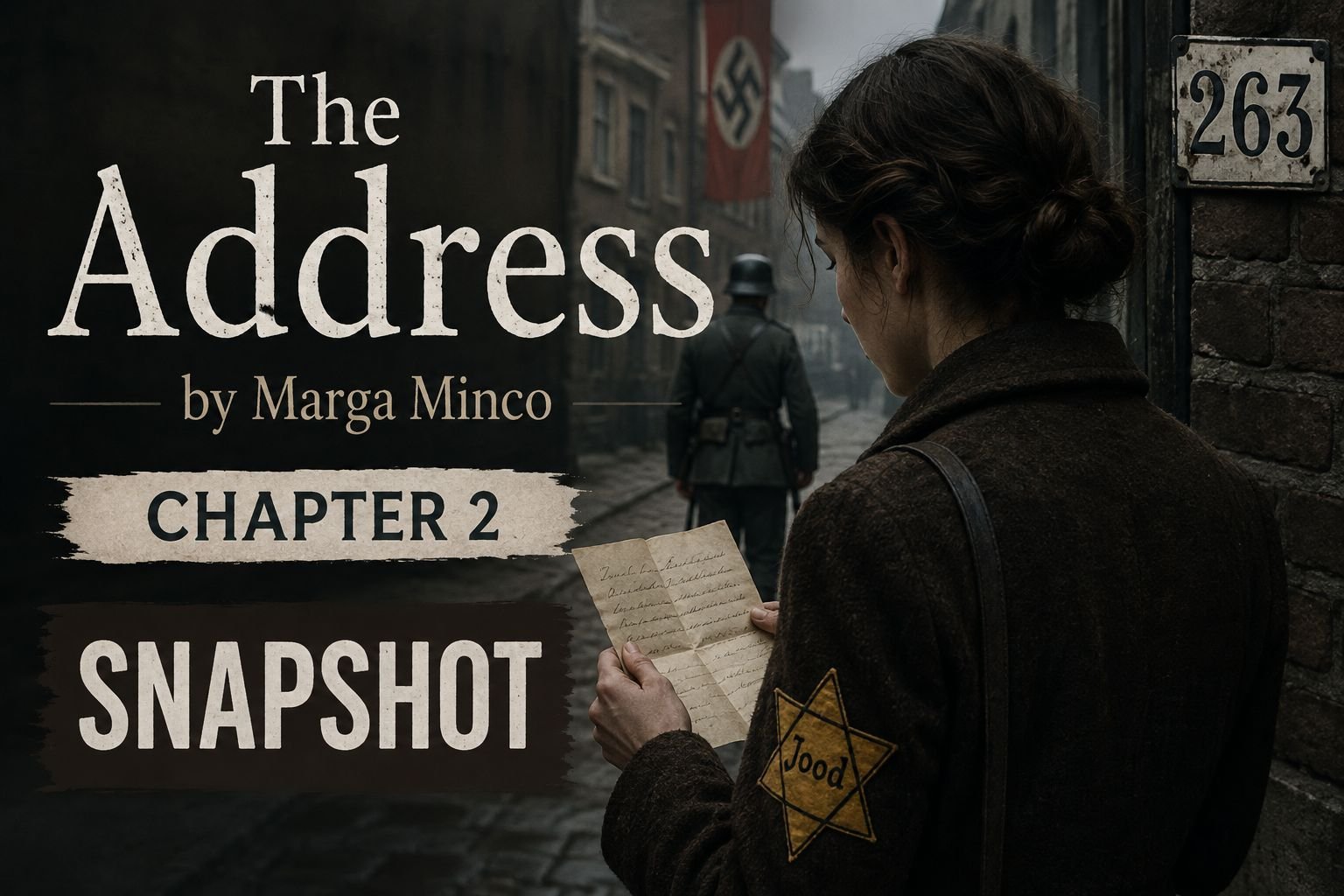
About the Writer: Marga Minco
Marga Minco is the pen name of Sara Menco, born on 31 March 1920 in Ginneken, Netherlands. She is one of the most celebrated Dutch Jewish writers of the twentieth century. Her real name was Sara Menco, but she adopted the pen name Marga Minco when she began her literary career.
Marga Minco came from a Jewish family, and her life was deeply shaped by the horrors of World War II and the Nazi occupation of the Netherlands. During the war, she managed to survive by going into hiding, but she lost almost her entire family — her parents, her brother, and her sister — to the Nazi Holocaust. This personal tragedy became the central theme of her writing.
She began her career as a journalist, which gave her writing a sharp, observational quality. Her style is known for being restrained, minimalist, and emotionally controlled — she never over-dramatizes pain, but that very understatement makes her writing deeply moving.
Her most famous work is “Het Bittere Kruid” (Bitter Herbs), published in 1957, which is a semi-autobiographical account of her experiences during the German occupation. It was translated into many languages and brought her international recognition.
“The Address” is one of her celebrated short stories, also rooted in her post-war experiences. It explores themes of memory, loss, displacement, and the inability to reclaim the past. The story reflects how war does not just destroy lives — it destroys the very sense of home, belonging, and identity.
What makes Marga Minco’s writing so powerful is her ability to say so much with so little. Her prose is clean and precise, yet it carries enormous emotional weight beneath the surface. She does not tell you how to feel — she shows you a situation, and the emotions hit you quietly, like a slow wave.
Minco received numerous literary awards throughout her career, including the Constantijn Huygens Prize in 1990, one of the most prestigious literary honors in the Netherlands. She continued writing well into her later years.
Her works are important not just as literature, but as historical testimony — a voice that refuses to let the world forget what happened to Jewish families during the Holocaust. Through her quiet, dignified writing, she memorialized those who could no longer speak for themselves.
In the context of Class 11 NCERT (Hornbill), “The Address” is taught as a story that helps students understand how war and loss affect human psychology — specifically, how we relate to objects, memories, and places that once defined our lives.
Summary The Address Marga Minco
1. The Girl Returns After the War
English: After World War II ends, a young girl travels to a town to visit a woman named Mrs. Dorling. During the war, her mother had given Mrs. Dorling their valuable household belongings for safekeeping. The girl remembers the address — Number 46, Marconi Street — an address her mother had repeated so often that it stayed in her memory. She knocks on the door, hoping to reconnect with the past and perhaps retrieve her mother’s things.
Hindi (Devanagari): द्वितीय विश्व युद्ध समाप्त होने के बाद, एक युवा लड़की एक महिला से मिलने एक शहर जाती है जिसका नाम श्रीमती डॉर्लिंग है। युद्ध के दौरान, उसकी माँ ने अपना कीमती सामान सुरक्षित रखने के लिए श्रीमती डॉर्लिंग को दे दिया था। लड़की को वह पता याद है — मार्कोनी स्ट्रीट, नंबर 46 — जिसे उसकी माँ ने इतनी बार दोहराया था कि वह उसके मन में बस गया था। वह दरवाज़ा खटखटाती है, अतीत से जुड़ने और शायद अपनी माँ की चीज़ें वापस पाने की उम्मीद में।
2. The Cold Reception
English: When the door opens, Mrs. Dorling herself stands there. She looks at the girl with no warmth or recognition — almost as if she does not want to acknowledge her. She is cold and unwelcoming. She tells the girl that her daughter is not home and closes the door without inviting her in. The girl is left standing outside, confused and hurt. She notices that Mrs. Dorling is wearing her mother’s green cardigan — a detail that is small but deeply painful.
Hindi (Devanagari): जब दरवाज़ा खुलता है, तो स्वयं श्रीमती डॉर्लिंग सामने खड़ी होती है। वह लड़की को बिना किसी गर्मजोशी या पहचान के देखती है — जैसे वह उसे स्वीकार ही नहीं करना चाहती। वह ठंडी और अनाड़ी है। वह लड़की को बताती है कि उसकी बेटी घर पर नहीं है और बिना अंदर बुलाए दरवाज़ा बंद कर देती है। लड़की बाहर खड़ी रह जाती है, भ्रमित और आहत। वह नोटिस करती है कि श्रीमती डॉर्लिंग उसकी माँ का हरा कार्डिगन पहने हुए है — एक छोटी-सी बात, लेकिन बेहद दर्दनाक।
3. The Second Visit — Entering the House
English: The girl visits again, and this time she is let in by Mrs. Dorling’s daughter. Inside the house, she is overwhelmed. Every corner of the house is filled with her mother’s belongings — the furniture, the cutlery, the tablecloth, the candlesticks. Everything is familiar, yet everything feels wrong. The objects are there, but they are out of place — used carelessly, crammed into an unfamiliar setting. What was once a warm home now feels cold and alien.
Hindi (Devanagari): लड़की दोबारा जाती है, और इस बार उसे श्रीमती डॉर्लिंग की बेटी अंदर आने देती है। घर के अंदर जाकर वह अभिभूत हो जाती है। घर का हर कोना उसकी माँ की चीज़ों से भरा हुआ है — फर्नीचर, कटलरी, मेज़पोश, दीपदान। सब कुछ जाना-पहचाना है, फिर भी सब कुछ गलत लगता है। चीज़ें वहाँ हैं, लेकिन वे बेतरतीब हैं — एक अपरिचित माहौल में लापरवाही से इस्तेमाल की जा रही हैं। जो कभी एक गर्म घर था, वह अब ठंडा और अजनबी लगता है।
4. The Pain of Familiar Objects
English: The girl tries to feel connected to the objects, but she cannot. She picks up a sugar bowl that she remembers from her childhood home, but it feels meaningless in this context. The things that once carried love, warmth, and memory now seem stripped of all emotion. The objects have survived the war, but the people, the relationships, and the feelings they represented — all are gone. She realizes that objects alone cannot recreate the past.
Hindi (Devanagari): लड़की चीज़ों से जुड़ने की कोशिश करती है, लेकिन वह जुड़ नहीं पाती। वह एक चीनी के डिब्बे को उठाती है जिसे वह अपने बचपन के घर से याद करती है, लेकिन इस संदर्भ में वह बेमानी लगती है। जो चीज़ें कभी प्यार, गर्मजोशी और यादें लेकर चलती थीं, वे अब भावनाओं से खाली लगती हैं। चीज़ें युद्ध से बच गई हैं, लेकिन जिन लोगों, रिश्तों और भावनाओं का वे प्रतिनिधित्व करती थीं — वे सब जा चुके हैं। वह समझती है कि सिर्फ चीज़ें अतीत को वापस नहीं ला सकतीं।
5. The Decision to Let Go
English: The girl makes a quiet but powerful decision — she will not take the things back. She does not want them anymore. Carrying those objects back would mean carrying the unbearable weight of grief, a grief that has no resolution. She chooses to forget the address. By erasing Number 46, Marconi Street from her memory, she tries to free herself from a past she can no longer live in. The story ends on this note of painful but necessary detachment.
Hindi (Devanagari): लड़की एक शांत लेकिन शक्तिशाली निर्णय लेती है — वह चीज़ें वापस नहीं लेगी। उसे अब उनकी ज़रूरत नहीं है। उन चीज़ों को वापस ले जाने का मतलब होगा दुःख का वह असहनीय बोझ उठाना, जिसका कोई समाधान नहीं है। वह उस पते को भूलने का फैसला करती है। मार्कोनी स्ट्रीट, नंबर 46 को अपनी स्मृति से मिटाकर, वह खुद को उस अतीत से मुक्त करने की कोशिश करती है जिसमें वह अब नहीं रह सकती। कहानी इसी दर्दनाक लेकिन ज़रूरी अलगाव के भाव पर समाप्त होती है।
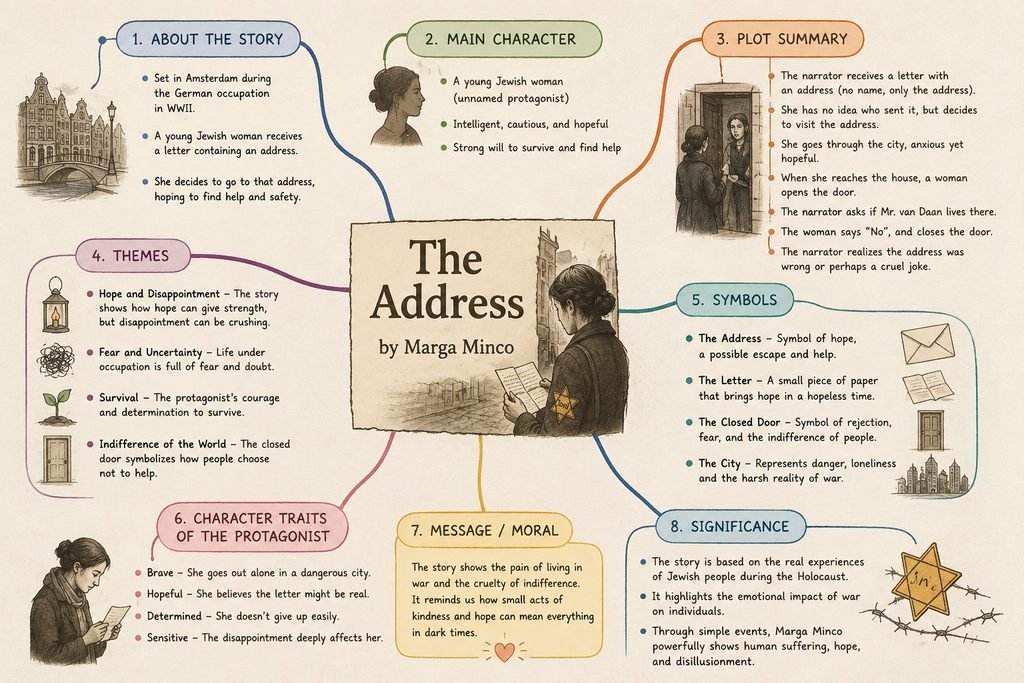
Character Sketches — The Address by Marga Minco
1. 👧 The Narrator (The Girl)
The narrator is the central character of the story — a young Jewish woman who has survived World War II but lost her entire family to the Holocaust.
Emotionally Strong, Yet Deeply Wounded: Woh ek aisi ladki hai jo bahar se composed dikhti hai, lekin andar se toot chuki hai. Usne apni maata, apna ghar, apni puri zindagi kho di hai — phir bhi woh wapas jaane ki himmat karti hai. Yeh uski strength ka proof hai.
Brave and Determined: Woh Mrs. Dorling ke ghar do baar jaati hai — pehli baar thodi hesitation ke saath, doosri baar thodi aur himmat ke saath. Woh apna haq maangne jaati hai, kisi ki daya nahi.
Thoughtful and Self-Aware: Jab woh andar jaati hai aur apni maata ki cheezein bekardar padi dekhti hai, woh ruk jaati hai. Woh emotionally react nahi karti — woh sochti hai, mehsoos karti hai, aur phir decide karti hai. Yahi uski sabse badi khasiyat hai.
Lets Go with Dignity: Sabse important — woh cheezein wapas nahi leti. Yeh weakness nahi, balki ek mature aur painful realization hai ki past ko pakde rehna sirf aur sirf dard deta hai. Woh address bhoolne ka faisla karti hai — apni azadi ke liye.
“She is not a victim — she is a survivor who chooses healing over bitterness.”
2. 🧥 Mrs. Dorling
Mrs. Dorling ek secondary but very significant character hai — woh story mein villain nahi hai, lekin woh morally gray zaroor hai.
Opportunistic and Self-Serving: Usne narrator ki maata ka saamaan “safekeeping” ke naam par rakha tha, lekin war ke baad usne woh sab apna bana liya. Woh jaanti thi ki shayad koi wapas na aaye — aur usne iska fayda uthaya. Yeh human greed aur opportunism ka dark portrayal hai.
Cold and Guilt-Ridden: Jab narrator pehli baar aati hai, Mrs. Dorling na uss se pyaar se milti hai, na seedha mana karti hai. Woh avoid karti hai — yeh uski guilt ki nishani hai. Koi jo genuinely innocent hota, woh itna defensive nahi hota.
A Mirror of War’s Effect on Humanity: Mrs. Dorling ek buri aurat nahi hai necessarily — woh uss insaan ka symbol hai jo war mein morally compromise kar leta hai. Jab sab kuch uncertain ho, log selfish ho jaate hain. Yeh human nature ki ek uncomfortable sach hai.
Absent yet Present: Woh story mein zyada nahi aati, lekin uski presence har jagah feel hoti hai — narrator ki maata ke kapdon mein, ghar ki cheezoon mein, uski beti ke behavior mein.
“Mrs. Dorling is not pure evil — she is the uncomfortable truth of what ordinary people do in extraordinary times.”
3. 👩 Mrs. Dorling’s Daughter
Woh ek minor character hai, lekin uska role symbolic hai.
Innocent and Unknowing: Woh apni maata ke past se anjaan lagti hai. Woh narrator ko andar aane deti hai bina kisi hesitation ke — innocence ka symbol hai woh.
Contrast to Her Mother: Jahan Mrs. Dorling cold aur guarded hai, wahan uski beti open aur welcoming hai. Yeh contrast generations ke beech moral difference ko dikhata hai.
4. 💛 The Narrator’s Mother (Mentioned, Not Present)
Woh story mein physically absent hai — lekin emotionally woh har jagah hai.
Caring and Foresighted: Usne war se pehle hi apna saamaan Mrs. Dorling ko diya — woh jaanti thi ki kuch bura hone wala hai. Yeh uski wisdom aur apne parivaar ke liye soch dikhata hai.
Symbol of Home and Love: Uski cheezein — cardigan, sugar bowl, tablecloth — woh sirf objects nahi hain. Woh uski maujoodgi ka ehsaas hain. Narrator unhe dekh kar maata ko yaad karti hai.
The Heart of the Story: Poori kahani basically uski maata ke loss ko process karne ki kahani hai. Woh hai nahi, phir bhi woh story ki soul hai.
“She lives in every object, every memory, and every tear that the narrator holds back.”
💡 Summary of Characters:
- Narrator — Survivor, strong, chooses healing
- Mrs. Dorling — Opportunistic, guilty, morally complex
- Mrs. Dorling’s Daughter — Innocent, contrasting
- Narrator’s Mother — Absent but the emotional core
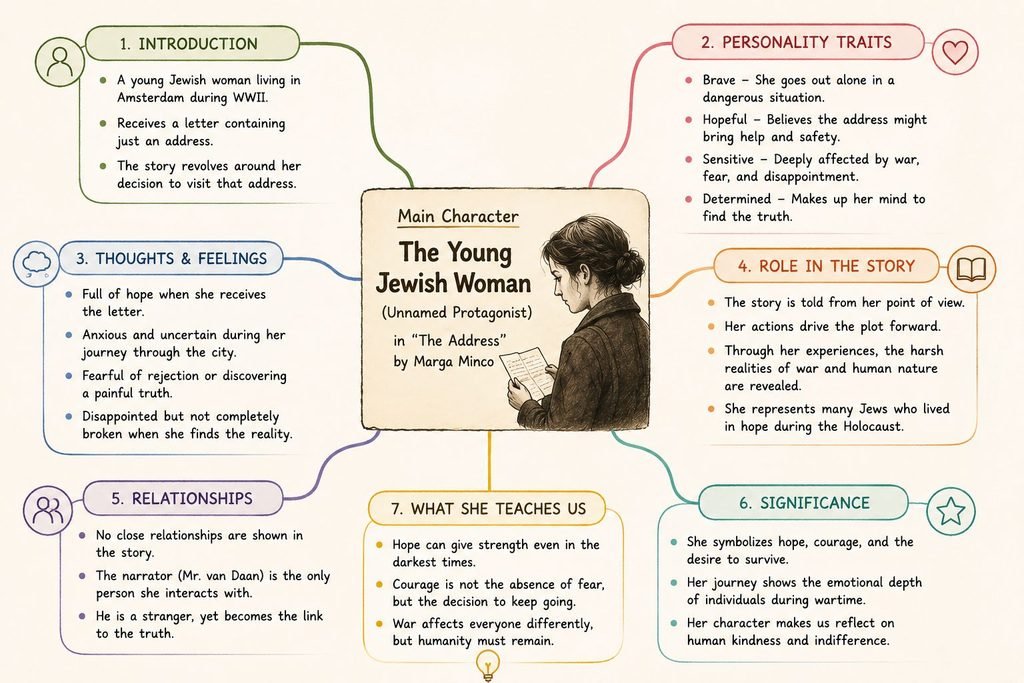
Q&A -The Address by Marga Minco
Q1. ‘Have you come back?’ said the woman. ‘I thought that no one had come back.’ Does this statement give some clue about the story? If yes, what is it?
Yes, this statement gives a very important clue about the story.
Jab Mrs. Dorling yeh kehti hai — “I thought that no one had come back” — toh yeh ek simple line nahi hai. Ismein poori kahani ka dard chhupa hua hai.
Yeh line clearly suggest karti hai ki war mein bahut se log mare — itne zyada ki wapas aana ek ajeeb baat lagti thi. Mrs. Dorling ko genuinely surprise hua ki koi bach gaya aur wapas aa gaya. Yeh baat Jewish Holocaust ki taraf ishara karti hai, jisme poore ke poore parivaar tabah ho gaye the.
Saath hi, yeh line Mrs. Dorling ki guilty conscience ko bhi reveal karti hai. Shayad usne socha tha ki koi wapas aayega hi nahi, isliye woh saamaan rakh sakti hai bina kisi dar ke. Jab ladki aati hai, toh woh uncomfortable ho jaati hai.
Toh yeh ek line hume batati hai:
- War ne kitna bhaari tabahi macha di thi
- Ladki ne apna poora parivaar khoya
- Mrs. Dorling ne unka saamaan apna samajh liya tha
- Kahani loss, survival, aur betrayal ki hai
Q2. The story is divided into pre-War and post-War times. What hardships do you think the girl underwent during these times?
🔴 Pre-War Hardships:
War shuru hone se pehle bhi halaat theek nahi the. Jewish families par restrictions lagne lage the. Darr ka mahool tha. Ladki ki mother ne apna keemat saamaan Mrs. Dorling ko de diya — yeh isi baat ka proof hai ki unhe pata tha ki kuch bura hone wala hai. Ghar chhodne ka, apni cheezein kisi aur ko saunpne ka dard — yeh bhi ek bada hardship tha.
🔵 During War Hardships:
- Ladki ko apna ghar, apni family, apni pehchaan — sab kuch chhodna pada
- Poora parivaar Holocaust mein kho gaya — parents, bhai-behen, sab
- Survival ke liye shayad chhup kar rehna pada, bhaagna pada
- Har din jeena ek struggle tha — na safe jagah, na khaana, na apne log
🟢 Post-War Hardships:
- War khatam hua, lekin ghar wapas nahi mila
- Jab woh Mrs. Dorling ke paas gayi, toh thanda swagat mila
- Apni hi maata ki cheezein kisi aur ke ghar mein bekardar padi dekhi
- Realize kiya ki cheezein hain, log nahi — aur cheezein bina logo ke kuch nahi hoti
- Aur sabse bada dard — past ko chhodna pada, kyunki woh past ab exist hi nahi karta
Yeh ladki ka dard sirf physical nahi tha — yeh emotional aur psychological dard tha jo shayad kabhi puri tarah theek na ho.
Q3. Why did the narrator of the story want to forget the address?
Yeh question story ka sabse important emotional moment hai.
Narrator — yeh ladki — Mrs. Dorling ke ghar jaati hai apni maata ki cheezein wapas lene. Lekin jab woh andar jaati hai aur sab kuch dekhti hai, toh kuch ajeeb hota hai uske andar.
Woh cheezein pehchaanti hai — sugar bowl, candlesticks, tablecloth, cutlery — sab kuch. Lekin woh unhe chhoo nahi sakti usi pyaar se jaise pehle hota tha. Woh objects ab sirf objects hain. Unke saath jo yaadein thi, jo log the, jo ghar tha — woh sab khatam ho chuka hai.
Agar woh yeh cheezein wapas le jaati, toh kya hota?
- Har cheez dekhkar maata ki yaad aati — aur dard taza hota
- Woh cheezein ek broken past ka bojh ban jaati
- Jeena mushkil ho jaata kyunki past aur present ke beech woh phans jaati
Isliye usne decide kiya — “Mujhe yeh address bhool jaana chahiye.”
Address bhoolna = past ko chhodna = apne grief se azad hone ki koshish karna.
Yeh weakness nahi hai — balki yeh ek bahut brave aur painful decision hai. Woh samajhti hai ki zindagi aage badhti hai. Kuch cheezein hamesha ke liye kho jaati hain, aur unhe pakde rehna sirf aur sirf takleef deta hai.
Q4. ‘The Address’ is a story of human predicament that follows war. Comment.
“Predicament” matlab hota hai — ek aisi situation jisme koi rasta nahi suhjhta, jo painful aur confusing hoti hai.
Yeh story perfectly yahi dikhati hai.
🔸 Loss of Home and Belonging:
War ke baad, ladki ke paas na ghar hai, na parivaar. Woh ek aisi duniya mein wapas aati hai jo physically toh waisi hi hai, lekin emotionally bilkul badal chuki hai. Yeh displacement — ghar hone ke baad bhi ghar na hona — war ka sabse bada human tragedy hai.
🔸 Objects vs. Memories:
Story yeh bataati hai ki hum cheezein isliye nahi chahte kyunki woh valuable hain — hum unhe isliye chahte hain kyunki woh hamare kisi apne se judi hain. Jab woh “apna” nahi raha, toh cheez bhi begaani ho jaati hai. Yahi war ka cruel sach hai.
🔸 Betrayal by Someone Trusted:
Mrs. Dorling ne ek trusted neighbor ki tarah saamaan rakha tha, lekin woh khud hi uski malik ban gayi. War ke baad jo log bache, unhe dobara insaano par trust karne mein takleef hoti hai. Yeh bhi ek human predicament hai.
🔸 The Impossibility of Going Back:
Kahani ka sabse bada message yahi hai — tum past mein wapas nahi ja sakte. Cheezein wapas mil sakti hain, ghar wapas ja sakte ho, lekin jo rishte, jo log, jo feelings the — woh dobara nahi aate. Yahi war ki asli tragedy hai.
🔸 The Painful Choice — Remember or Forget:
Narrator ke paas do hi options hain — ya toh dard ke saath jeena, ya sab kuch bhool jaana. Dono mushkil hain. Koi bhi option easy nahi hai — aur yahi human predicament ki definition hai.
💡 Conclusion: “The Address” sirf ek story nahi hai — yeh un lakho logo ki kahani hai jo war ke baad wapas aaye, lekin wapas aane layak kuch bacha hi nahi tha. Marga Minco ne apna personal dard universal bana diya — aur isliye yeh story aaj bhi dil ko chu jaati hai.
MCQs- The Address by Marga Minco
(Class 11 NCERT Hornbill)
Q1. Who is the author of the story “The Address”?
- A) Anne Frank
- B) Marga Minco ✅
- C) Isak Dinesen
- D) Virginia Woolf
Q2. What is the address mentioned in the story?
- A) Number 7, Marconi Street
- B) Number 46, Marconi Street ✅
- C) Number 12, Holland Avenue
- D) Number 46, Amsterdam Road
Q3. Why had the narrator’s mother given her belongings to Mrs. Dorling?
- A) She was moving to another city
- B) She wanted to sell them
- C) For safekeeping during the war ✅
- D) Mrs. Dorling had bought them
Q4. What was Mrs. Dorling wearing when the narrator first saw her?
- A) Her mother’s blue coat
- B) Her mother’s green cardigan ✅
- C) Her mother’s yellow dress
- D) Her own coat
Q5. How did Mrs. Dorling react when the narrator came to her door the first time?
- A) She welcomed her warmly
- B) She invited her inside
- C) She was cold and unwelcoming ✅
- D) She pretended not to know her
Q6. Who let the narrator inside the house on her second visit?
- A) Mrs. Dorling herself
- B) A neighbor
- C) Mrs. Dorling’s daughter ✅
- D) A servant
Q7. What did the narrator feel when she saw her mother’s belongings in Mrs. Dorling’s house?
- A) Happy and relieved
- B) Disconnected and disturbed ✅
- C) Angry and loud
- D) Excited to take them back
Q8. Why did the narrator decide NOT to take her mother’s belongings back?
- A) They were damaged
- B) Mrs. Dorling refused to give them
- C) The objects brought unbearable grief with no comfort ✅
- D) She had no place to keep them
Q9. What does the narrator’s decision to forget the address symbolize?
- A) She forgave Mrs. Dorling
- B) She wanted to move on from her painful past ✅
- C) She lost her memory due to trauma
- D) She planned to come back later
Q10. What is the central theme of “The Address”?
- A) Adventure and courage
- B) Love and romance
- C) Loss, memory, and the impossibility of reclaiming the past ✅
- D) Friendship and loyalty
Q11. The line “I thought that no one had come back” suggests:
- A) Mrs. Dorling was happy to see her
- B) The narrator was expected
- C) Most Jewish families were wiped out in the war ✅
- D) The town was deserted after war
Q12. What object does the narrator pick up and feel disconnected from?
- A) A photograph
- B) A candlestick
- C) A sugar bowl ✅
- D) A tablecloth
Q13. The story is set against the backdrop of:
- A) World War I
- B) The Cold War
- C) World War II ✅
- D) The Indian Independence Movement
Q14. Marga Minco’s writing style is best described as:
- A) Loud and dramatic
- B) Minimalist and emotionally restrained ✅
- C) Humorous and light
- D) Complex and philosophical
Q15. What is the nationality of Marga Minco?
- A) German
- B) French
- C) Dutch ✅
- D) Polish